 By
Quick answer: How do I find a good startup idea?
- Best recipe: what your team is especially good at; unfair advantage.
- Also: what you wish existed; recent changes; broken industries.
- Use with care: passion projects; 'X for Y' variants; crowdsourced ideas.
- Avoid: waiting for a brilliant idea; jumping on the first one; starting from a solution.
- Then: test the problem with people before building.
Key takeaways
- You don't need a brilliant idea; you need a good starting point and execution.
- Founder/market fit makes an idea far more likely to work.
- Ideas morph: Airbnb began as air beds.
- 'Uber for X' ideas are often solutions in search of problems.
- Spend a couple of weeks choosing; you may spend years building.
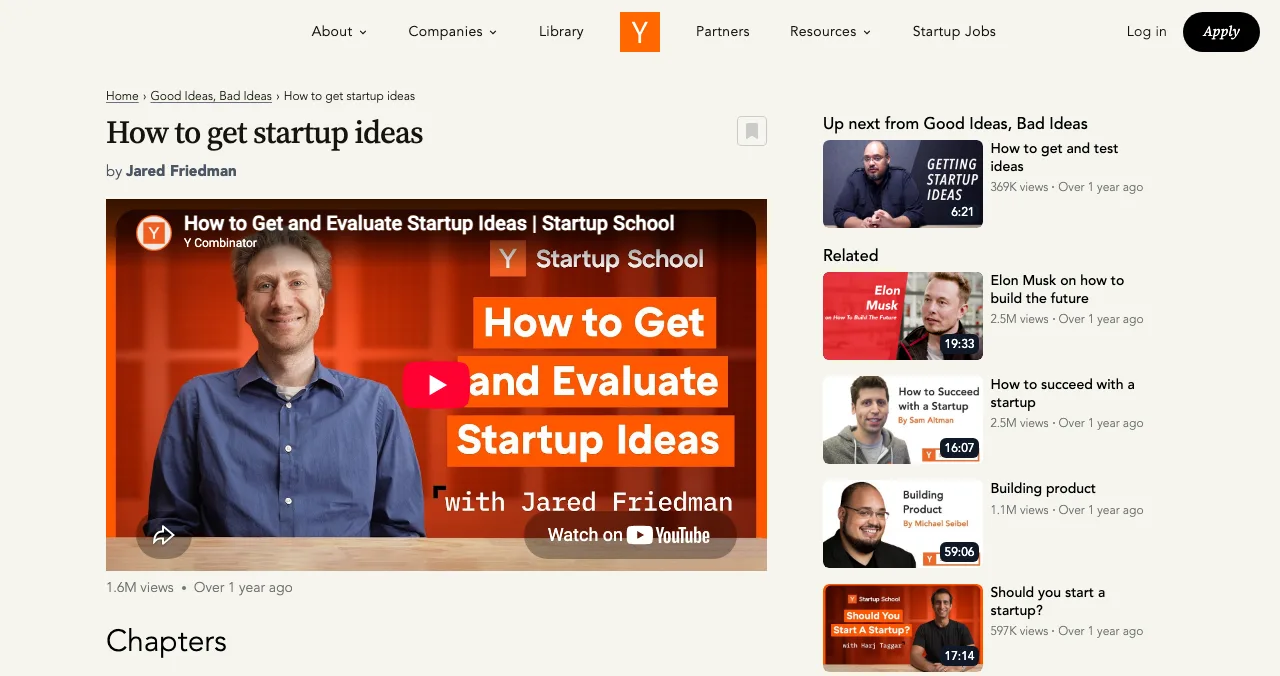
Most people waiting for a startup idea are waiting for the wrong thing: a flash of brilliance. YC's Jared Friedman, who has watched thousands of startups try thousands of ideas, argues the opposite. Google was around the 20th search engine; what mattered was a good-enough idea and great execution. His Startup School talk lays out the mistakes to avoid and seven recipes for generating ideas, ranked from best to worst. This guide summarises them, with how to test an idea once you have one. Jump to the mistakes, the seven recipes or testing.
Three mistakes
| Mistake | Why it hurts |
|---|---|
| Waiting for a brilliant idea | Successful ideas only look brilliant in hindsight |
| Jumping on the first idea | You may spend years on it; spend weeks choosing |
| Starting with a solution | "Uber for plumbers" solves which problem? |
Table: Common startup idea mistakes (Jared Friedman, YC Startup Library)
Seven recipes, best first
| # | Recipe | Example from the talk |
|---|---|---|
| 1 | What your team is especially good at (unfair advantage) | SnapDocs, Lattice, Mixpanel |
| 2 | Things you wish someone would build for you | DoorDash |
| 3 | What you'd work on for 10 years even if it failed (use with care) | Boom |
| 4 | Recent changes: new tech, platforms, regulation | — |
| 5 | Variants of recent successes (be sceptical) | Standard Cognition |
| 6 | Crowdsource problems from people, especially founders | — |
| 7 | Industries that seem broken | LendUp |
Table: Seven recipes for startup ideas (Jared Friedman, YC Startup Library)
Friedman says about half of YC's most successful companies can be traced roughly to the first recipe, because ideas found that way come with founder/market fit.
Recipe one, in practice

- List every place you've worked — internships count.
- What did you learn there that others don't know?
- What seemed broken or clumsy?
- What did your company build in-house that others might need?
Test it before you build

- Talk to ten people with the problem — about past behaviour, not your idea
- Look for workarounds and spending — signs the problem is real
- Write a one-liner — if you can't, the idea isn't clear yet
- Build the smallest MVP — weeks, not months
More in how to validate a startup idea.
Ready to start?
How we know
Mistakes, recipes and examples come from Jared Friedman's "How to get startup ideas" in YC's Startup Library (recorded for Startup School 2020), read on 17 November 2026. The testing checklist is our addition.
Key terms, defined
- Founder/market fit: a team's unfair advantage in a market.
- Recipe: a repeatable way to generate ideas.
- Solution in search of a problem: an idea that starts from a product, not a need.
- Pivot: changing the idea based on what you learn.
- MVP: the smallest product that can deliver value.
Frequently asked questions
How do I find a good startup idea?
Start with what you're unusually good at or have seen up close at work, and look for problems there. Also consider what you wish existed, what recent changes make newly possible, and industries that seem broken.
Do I need a brilliant idea to start a startup?
No. YC's Jared Friedman points out Google was around the 20th search engine and Facebook around the 20th social network; a good-enough idea with great execution is what mattered.
What's the most common mistake with startup ideas?
Friedman lists believing you need an amazing idea, jumping on the first idea without thinking it through, and starting with a solution instead of a problem.
What is founder/market fit?
When the team has an unfair advantage in the market, such as years in the industry or having built the tool in-house before. Friedman says about half of YC's most successful companies came from this kind of idea.
Are 'Uber for X' ideas good?
Be sceptical. Friedman says ideas built as variants of successful companies are often solutions in search of problems.
How do I test a startup idea quickly?
Talk to people who'd have the problem about their past behaviour, look for workarounds and spending, and build the smallest possible MVP. See our idea-validation guide.
Sources
- Y Combinator Startup Library — How to get startup ideas (Jared Friedman)
- Y Combinator Startup Library — How to plan an MVP (Michael Seibel)
- Rob Fitzpatrick — The Mom Test (book site)
- Science of Apps — Launchpad: launch your product free
- Checked November 17, 2026. Figures that change — fees, salaries, prices — are reviewed every six months; if something is out of date, tell us.
Where to go from here
- Validate a startup idea — test it next
- Customer interview script — what to ask
- How to launch an MVP — build small
- Science of Apps - LaunchpadThe Product Hunt launch mistakes that kill your ranking, or your launch, and how to avoid each oneThe Product Hunt launch mistakes that hurt ranking or get launches removed: asking for upvotes, new-account votes, vague taglines, broken flows and more.
- Science of Apps - LaunchpadHow to validate a startup idea in 7 days: a day-by-day plan to find out whether people will use and pay for itHow to validate a startup idea in 7 days: define the problem, find people who have it, run 10+ interviews, test demand with a page and a price, then decide.
- Science of Apps - LaunchpadHow to get backlinks for a new startup for free, and which link tactics Google treats as spamHow a new startup can earn backlinks for free in 2027: launch sites, reviewed directories, data, free tools, partners and press, plus the link tactics to avoid.
- Science of Apps - LaunchpadHow to use Indie Hackers to launch and grow: what the community rewards, what to post, and how it fits with Product Hunt and Show HNHow to use Indie Hackers to launch: what the founder community rewards, posts that work, mistakes that get ignored, and where it fits with other launches.
- Science of Apps - LaunchpadHow to get your first 100 users without paid ads: a channel-by-channel plan founders can start todayHow to get your first 100 users without paid ads in 2027: your network, communities, launch sites, directories, content and one-to-one outreach, step by step.
- Science of Apps - LaunchpadHow to write a startup one-liner: the formula, the test Product Hunt uses, before-and-after examples, and why the same line everywhere helps search and AI enginesHow to write a startup one-liner: a simple formula, Product Hunt's tagline test, before-and-after examples, and why one consistent line helps AI search.
Get the ideas, not the noise.
Sign up with Google and we’ll send you short UX psychology tips by email — why people tap, stall and leave, and what to do about it. Unsubscribe anytime. Prefer something to keep? Get the free Laws of UX guide as a PDF.
Launch day ends. Your listing shouldn't.
Found your idea? Start a free Launchpad draft while you build, and once live get a permanent profile ranked by relevance, never payment, plus a product test.