 By
Quick answer: How do I launch an MVP?
- What: the simplest thing that can deliver value to your first users.
- How fast: weeks, not months.
- How small: extremely limited functionality; a landing page and spreadsheet can count.
- Launch to: people with the problem first; then launch sites.
- Then: get feedback, iterate; don't fall in love with the MVP.
Key takeaways
- An MVP tests whether you can deliver value, not whether you can build features.
- Speed matters more than polish at this stage.
- Launches aren't special: you can launch again as the product improves.
- Feedback from real use beats opinions about a demo.
- Iterate on the problem, not on finding new problems for your solution.
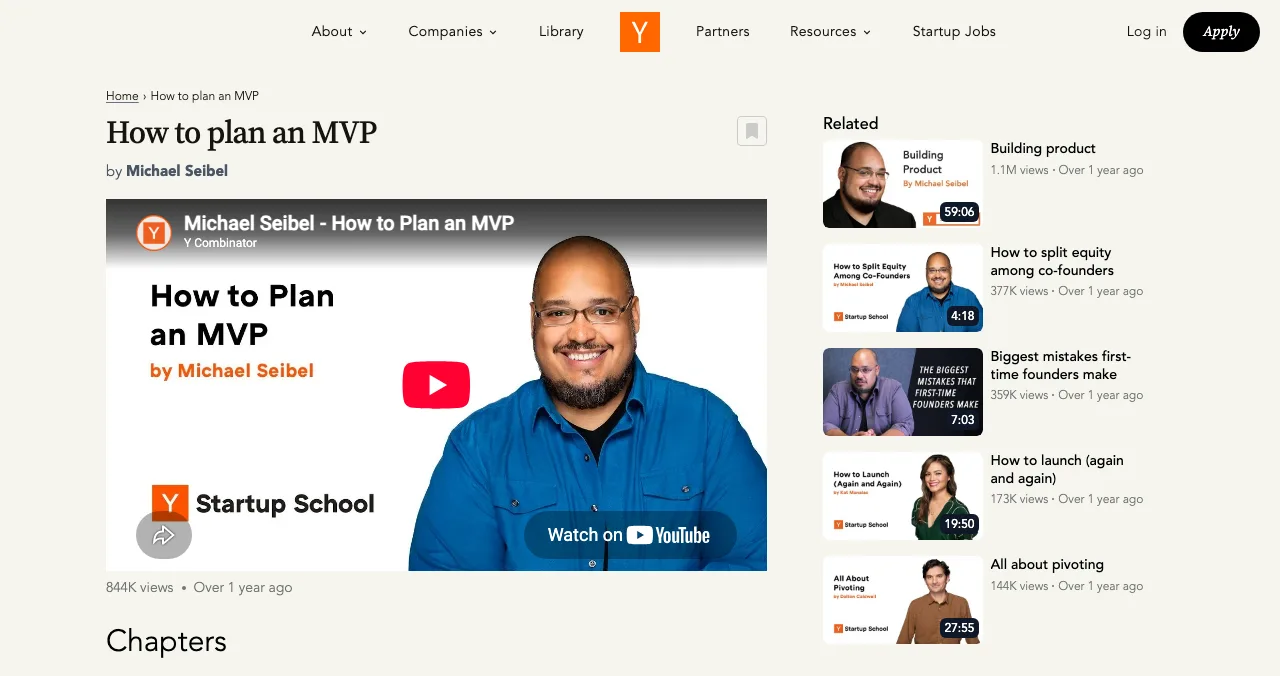
Most MVPs launch too late. The founder keeps adding "just one more feature" because the product feels embarrassing, and months pass without a single real user. Y Combinator's advice is the opposite, and it's blunt: in Michael Seibel's words, "launch something bad, quickly". This guide turns that into a plan: what to build, how fast, where to launch it and what to do next, drawing on YC's Startup School talk and launch-site rules as read on 17 November 2026. Jump to scoping, launching or after launch.
Scope it small
| Principle | What it means |
|---|---|
| Ridiculously simple | The first thing that can deliver value to your first users |
| Weeks, not months | Most MVPs should be fast to build |
| Extremely limited functionality | Only what your initial users need |
| Any medium | Software, or a landing page and a spreadsheet |
| Don't fall in love | If it doesn't solve the problem, change it |
Table: MVP principles (YC Startup Library, "How to plan an MVP")
Launch it

- Talk to users first — know who the MVP is for.
- Give it to them directly — personally onboard the first few.
- List it — a permanent profile and a launch site that accepts usable early products.
- Show HN — if people can try it now.
- Product Hunt — once anyone can sign up; it says closed betas usually aren't a fit.
After launch

- Talk to every user — what did they try, where did they stop?
- Fix the biggest blocker first
- Measure one thing — do people come back?
- Launch again — Seibel's point: launches aren't special
- Iterate on the problem — not new problems for your solution
Mistakes

- Months of building before a user sees it
- Feature lists instead of one core job
- Launching to "everyone"
- Treating launch day as the finish line
- Falling in love with the solution
Ready to launch?
How we know
MVP principles come from Michael Seibel's "How to plan an MVP" in YC's Startup Library; launch-site rules from Product Hunt's help centre and the Show HN guidelines, read on 17 November 2026. The steps are our adaptation.
Key terms, defined
- MVP: minimum viable product.
- Iterate: improve in small cycles based on feedback.
- Pivot: change the problem or customer you target.
- Core value: the main result the product delivers.
- Blocker: a problem that stops users reaching value.
Frequently asked questions
What is an MVP?
A minimum viable product: the first, ridiculously simple thing you can give your target users to see if you can deliver any value at all, as YC's Michael Seibel describes it.
How long should an MVP take to build?
Weeks, not months, in most cases. Seibel notes some startups simply start with a landing page and a spreadsheet.
Where should I launch an MVP?
First to people who have the problem, directly. Then on launch sites that accept usable early products: Peerlist, Show HN if it's try-able, Product Hunt once anyone can sign up, and a permanent profile.
What features should an MVP have?
Only the few things your first users need to get the core value. Everything else waits until real use tells you what matters.
What do I do after launching an MVP?
Talk to every user, watch where they get stuck, fix the biggest blocker, and repeat. Launch again when the product is meaningfully better.
Is it bad to launch an unfinished product?
Not at the MVP stage, as long as it delivers some real value and you're honest about what's unfinished. Waiting for polish delays the learning.
Sources
- Y Combinator Startup Library — How to plan an MVP (Michael Seibel)
- Y Combinator Startup Library — How to talk to users (Gustaf Alströmer)
- Product Hunt Help Center — What kind of products get featured (checked 17 Nov 2026)
- Hacker News — Show HN guidelines (checked 17 Nov 2026)
- Science of Apps — Launchpad: launch your product free
- Checked November 17, 2026. Figures that change — fees, salaries, prices — are reviewed every six months; if something is out of date, tell us.
Where to go from here
- Validate a startup idea — before the MVP
- Soft launch vs hard launch — launching in stages
- How to launch a startup — the full plan
- Science of Apps - LaunchpadProduct launch strategy for 2027: how to plan, run and follow up a launch that brings users, not just a spikeA product launch strategy for 2027: set goals, size the launch, build a permanent page, sequence launch days, run launch week and follow up, step by step.
- Science of Apps - LaunchpadPre-launch marketing for startups: a six-week plan from waitlist to launch day, with the channels, assets and rules that matterPre-launch marketing for startups: a 6-week plan with a waitlist, building in public, early adopters, launch assets and a scheduled launch date.
- Science of Apps - LaunchpadWhat to do after a Product Hunt launch: a 30-day plan to turn one day of attention into users, reviews and a better productWhat to do after a Product Hunt launch: keep replying, follow up, measure, ship feedback, collect reviews, launch elsewhere and plan your relaunch.
- Science of Apps - LaunchpadHow to launch a SaaS product in 2027: from private beta to public launch to the first paying customersHow to launch a SaaS in 2027, step by step: private beta, pricing, onboarding that activates, a permanent page, launch days, and turning trials into customers.
- Science of Apps - LaunchpadHow to launch an AI product: prove the outputs, describe the task not the model, pick free and paid launch sites, and make sure AI search can find youHow to launch an AI product in 2027: show real outputs, describe the task, launch on Product Hunt and AI directories, and get found by AI search engines.
- Science of Apps - LaunchpadProduct Hunt pre-launch: the pre-launch dashboard, building your audience weeks ahead, and the waitlists and listings that work alongside itProduct Hunt pre-launch, explained: the pre-launch dashboard, building an audience weeks ahead, a waitlist, BetaList and a draft listing while you build.
Get the ideas, not the noise.
Sign up with Google and we’ll send you short UX psychology tips by email — why people tap, stall and leave, and what to do about it. Unsubscribe anytime. Prefer something to keep? Get the free Laws of UX guide as a PDF.
Launch day ends. Your listing shouldn't.
Launch your MVP free on the Launchpad: a permanent profile ranked by relevance, never payment, plus an end-to-end test showing what first users will hit.