 By
Quick answer: Is Product Hunt worth it for a startup in 2027?
- It's free: submitting, commenting and reaching Product of the Day cost nothing.
- It's curated: the homepage is an editorial decision; unfeatured launches go live but get far less attention.
- It's short: the launch page covers one day; your Product Page stays.
- Worth it for: polished SaaS, AI and consumer tools, with a founder who can reply all day.
- Less worth it for: closed betas, local businesses and content (blog posts, lists).
- Do it alongside: a permanent page, a second launch site and your own channels.
Key takeaways
- Product Hunt costs nothing to launch on; its real cost is preparation time and one full day of your attention.
- Featuring is editorial, so even a well-prepared launch may not reach the homepage; plan for that outcome.
- Product Hunt itself says many launches hit their goals without finishing first: feedback, users and connections count.
- Upvotes from established members count far more than new accounts, so a crowd of fresh sign-ups won't help.
- Pair it with a permanent page and a second launch site, so the attention has somewhere to go after the day.
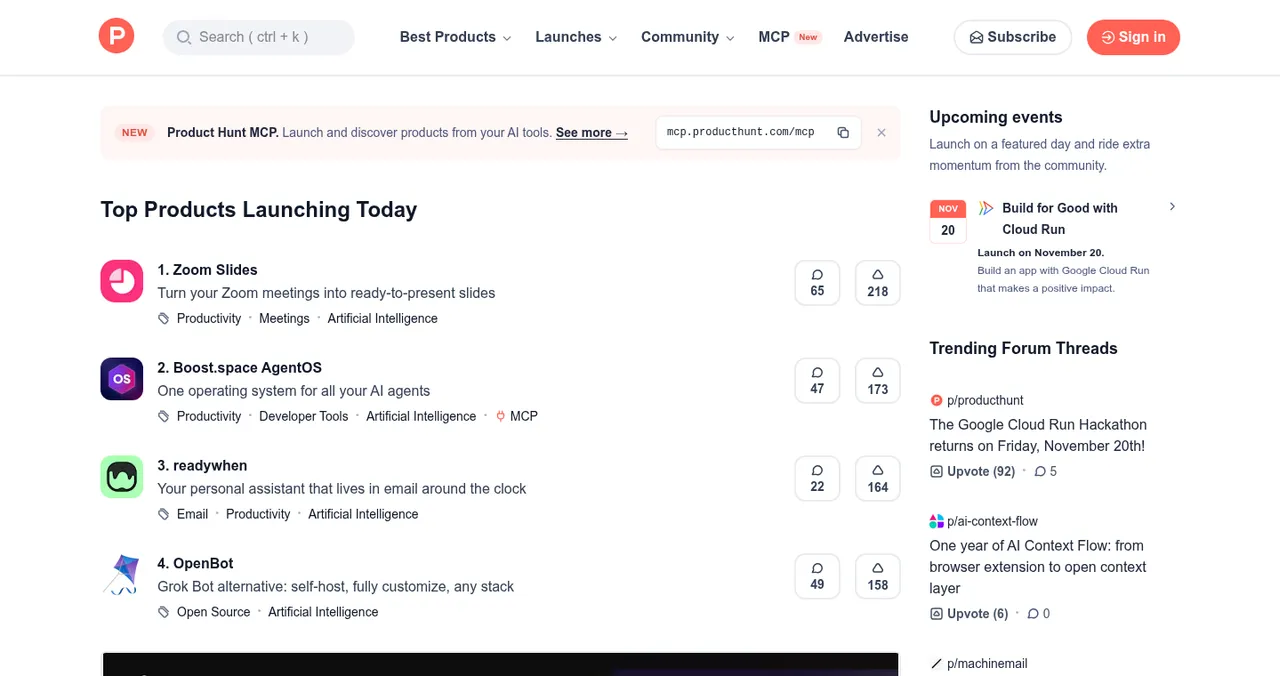
Every few months someone declares Product Hunt dead, and every day thousands of makers still launch there. Both are a little right. Product Hunt is free and can still deliver a strong day, but its homepage is curated, the competition (especially among AI tools) is intense, and the spotlight lasts about 24 hours. Whether it's worth it depends less on Product Hunt than on you: what you built, who it's for and whether you can show up all day. This answer uses Product Hunt's own help centre, read on 17 November 2026, rather than anecdotes. Jump to who it's worth it for, what it costs or what to do alongside it.
The short answer
| Product Hunt is worth it if… | It's probably not worth it if… |
|---|---|
| Your product is live and people can try it today | It's a closed beta nobody can join |
| You have a clear edge over the obvious alternative | You can't say why someone would pick you |
| Your audience is global and tech-savvy | You're a local business or service |
| You can reply to comments all day, in real time | You can't be online on launch day |
| You've prepared for weeks: audience, page, posts | You're launching tomorrow on a whim |
| You'll pair it with a permanent page and other launches | It's your only plan for getting users |
Table: When a Product Hunt launch is worth it, based on Product Hunt's own featuring guidance (checked 17 Nov 2026)
What Product Hunt gives you
- A free launch day. Submitting, commenting and reaching Product of the Day are all free, and Product Hunt says never to pay for upvotes.
- Concentrated attention. If your launch is featured, it sits on a homepage leaderboard that people check daily.
- Feedback from builders. Comments from makers and early adopters, often blunt, often useful.
- A permanent Product Page. It collects all your launches, reviews, awards and followers.
- Awards and badges. Product of the Day, Week and Month, with badges for your site.
- Relaunches. Every major update can be launched again (a relaunch request is needed within two months of the last).
What it can't give you
- A guaranteed homepage spot. Product Hunt reviews thousands of launches a day and says featuring "is an editorial decision, not a checklist".
- Lasting traffic on its own. The launch page covers one day; people keep finding it for a few days, then attention moves on.
- Shortcuts. Upvotes from established members count far more than from new accounts, and asking for or buying upvotes can get you removed.
- Product-market fit. A great day tells you people are curious, not that they'll stay or pay.
What it really costs
Money: nothing. Time: more than most founders expect.
| Cost | What it involves |
|---|---|
| Preparation | Weeks of being active in the community, building an audience and preparing posts and emails |
| Your launch page | Name, tagline, description, logo, gallery, video or demo, maker comment |
| Launch day | Replying to every comment in near real time, ideally with someone online around the clock |
| After the day | Follow-ups, reviews, turning feedback into updates |
Table: The real cost of a Product Hunt launch (from Product Hunt's Launch Guide)
Our Product Hunt launch checklist lists every item.
Who it's worth it for
Strong fit: polished SaaS and productivity tools, AI products with a clear use case and a demo, developer tools with a broad audience, consumer apps and browser extensions aimed at early adopters, and major updates to existing products.
Weak fit: products nobody can try yet; content such as blog posts, lists and plain documents (Product Hunt says these don't belong on the leaderboard); local services; and products the community already uses, with no major update.
What to do alongside Product Hunt
Treat Product Hunt as your biggest day, not your whole strategy.

- Publish a permanent page first. Every launch needs one canonical place to send people; a free Science of Apps Launchpad listing ranks for the problem you solve and keeps working after the day.
- Add a second launch that suits your product. Show HN or DevHunt for developer tools, Peerlist or Uneed for side projects, AI directories for AI tools. See Uneed vs Product Hunt vs Microlaunch.
- Bring your own people. Your email list, your community and your users matter more than Product Hunt's algorithm.
- Fix what launch day reveals. Every comment is free research; ship the best ideas and tell the community.

Signs your Product Hunt launch worked

- You hit the goals you set before the day — sign-ups, feedback or conversations, not just rank
- People asked specific questions — a sign they tried it
- Comments turned into fixes or features — that you shipped within weeks
- Visitors kept arriving after the day — through your Product Page, reviews and your permanent page
- You know what you'd do differently — written down for the relaunch
Ready to launch?
How we know
This answer is based on Product Hunt's own Launch Guide (what gets featured, how to promote, what to do during and after, and the FAQ and myths), read on 17 November 2026. We don't quote launch results, because Product Hunt doesn't publish typical outcomes and individual stories vary too much to generalise. Science of Apps runs the Launchpad mentioned above and has no relationship with Product Hunt.
Key terms, defined
- Featured: a launch Product Hunt's team selects for the homepage leaderboard.
- Product of the Day: the top-ranked featured launch of the day; there are also Week and Month awards.
- Launch page vs Product Page: the launch page covers one day; the Product Page is the permanent home for all launches and reviews.
- Relaunch: launching again after a major update.
- Maker comment: the first, pinned comment on a launch, written by the maker.
Frequently asked questions
Is Product Hunt still relevant in 2027?
Yes, for the right products. It's still free, its community still reviews thousands of launches a day, and a featured launch can bring a burst of users, feedback and a permanent Product Page. What's changed is the competition: many launches, especially AI tools, compete for a hand-picked homepage, so preparation and a clear edge matter more than ever.
Does Product Hunt actually bring users?
It can, but results vary widely and Product Hunt doesn't guarantee traffic. A featured launch with a clear tagline, a working product and a founder replying all day tends to bring sign-ups and feedback; an unfeatured one brings much less. Measure with a UTM link and judge against goals you set before the day.
Is it bad if my Product Hunt launch isn't featured?
It's disappointing but common: Product Hunt says only some of the thousands of daily launches are featured, and that featuring is an editorial decision, not a checklist. An unfeatured launch still goes live and can be found through your link and the 'See all of today's products' button. Use your own channels to bring people to it.
Do I need to finish #1 for Product Hunt to be worth it?
No. Product Hunt calls that a myth: many launches hit their goals without topping the leaderboard. Feedback, early users, partners and the permanent Product Page and reviews all count.
Who shouldn't launch on Product Hunt?
Products people can't try yet (closed betas), content such as blog posts and lists, products most of the community already uses with no major update, and founders who can't be present on launch day. Local service businesses also tend to get little from a global tech audience.
What should I do instead of, or as well as, Product Hunt?
Publish a permanent page first, such as a free Science of Apps Launchpad listing, then add a second launch site that suits your product: Show HN or DevHunt for developer tools, Peerlist or Uneed for side projects. Keep your own email list and communities at the centre of every launch.
Sources
- Product Hunt Help Center — Launch FAQ and myths (checked 17 Nov 2026)
- Product Hunt Help Center — What kind of products get featured (checked 17 Nov 2026)
- Product Hunt Help Center — What to do during and after your launch (checked 17 Nov 2026)
- Product Hunt Help Center — How to promote your launch (and what to avoid) (checked 17 Nov 2026)
- Science of Apps — Launchpad: launch your product free
- Checked November 17, 2026. Figures that change — fees, salaries, prices — are reviewed every six months; if something is out of date, tell us.
Where to go from here
- Product Hunt launch checklist — every field and rule, in order
- 14 Product Hunt alternatives — if it isn't right for you
- Uneed vs Product Hunt vs Microlaunch — three shapes of launch compared
- Science of Apps - LaunchpadProduct Hunt vs BetaList: cost, selection, audience and timing compared, and which suits your startup's stageProduct Hunt vs BetaList: Product Hunt is free with editorial featuring; BetaList is paid with a refund if not selected. Which suits your startup's stage.
- Science of Apps - LaunchpadDo you need a hunter for your Product Hunt launch? No: here's what a hunter is, why self-hunting is recommended, and how featuring really worksYou don't need a hunter on Product Hunt: it says to hunt your own product and that who posts doesn't affect ranking. Here's what actually gets you featured.
- Science of Apps - LaunchpadHow does Product Hunt work? Featuring, the daily leaderboard, upvote weighting and Product of the Day, from Product Hunt's own rulesHow Product Hunt works: launches go live at 12:01 AM PT, editors pick what's featured, and the leaderboard weighs upvotes, comments, time and more.
- Science of Apps - LaunchpadHow much does a Product Hunt launch cost? Nothing to launch, but here's what founders actually spend time and money onA Product Hunt launch costs nothing to submit. What founders really spend on: time, a demo video, a launch offer, optional ads, and the services to avoid.
- Science of Apps - LaunchpadWhat is Product Hunt? How launches, the leaderboard, featuring, makers and Product of the Day actually workWhat Product Hunt is and how it works in 2027: daily launches, the leaderboard, featuring, makers and hunters, Product of the Day and the rules, explained.
- Science of Apps - LaunchpadWhat to do after a Product Hunt launch: a 30-day plan to turn one day of attention into users, reviews and a better productWhat to do after a Product Hunt launch: keep replying, follow up, measure, ship feedback, collect reviews, launch elsewhere and plan your relaunch.
Get the ideas, not the noise.
Sign up with Google and we’ll send you short UX psychology tips by email — why people tap, stall and leave, and what to do about it. Unsubscribe anytime. Prefer something to keep? Get the free Laws of UX guide as a PDF.
Launch day ends. Your listing shouldn't.
Product Hunt gives you a day. A free Launchpad listing gives you a permanent page that keeps ranking, plus your product tested end to end with a detailed report on what to fix.