 By
Quick answer: Where do I publish an MCP server?
- First: the official MCP Registry, which clients can read.
- Then: Glama (122k+ servers) and MCP.so (open submissions).
- Note: Smithery is now part of Arcade; check its current flow.
- Make it installable: a clear README, config example, tools list.
- Product page: a listing for the service behind the server.
Key takeaways
- The official registry is the source clients and other directories can build on.
- Community directories bring search traffic and browsing developers.
- The registry is in preview; expect changes.
- Installs follow clear docs, not just listings.
- Your MCP server sells the product only if people can find the product too.
You've built an MCP server that lets Claude, ChatGPT or Cursor talk to your product. Now nobody can find it. Model Context Protocol servers are spread across an official registry, several community directories with tens of thousands of entries each, and GitHub. Getting listed is quick; getting installed takes a README that answers the right questions. This list covers where to publish, what each directory is, and how to make the listing turn into installs, from each site as checked on 17 November 2026. Jump to the directories, how to publish or getting installs.
- Servers listed on Glama (17 Nov 2026)
- 122,370
- Official registry, in preview
- 1
- Official registry launched in preview
- Sep 2025
- Directories compared, plus a product listing
- 4
MCP server directories compared
| Directory | What it is | How you get listed | Best for |
|---|---|---|---|
| Official MCP Registry | Community-driven registry clients can read | Publish via its documented process | Being the canonical source |
| Glama | Large directory of open-source servers with quality grades | "Add Server" | Search traffic, quality signals |
| MCP.so | Community directory with categories and rankings | "Submit" | Browsing developers |
| Smithery | MCP hub, now part of Arcade | Check current docs | Existing Arcade users |
| Science of Apps Launchpad | Launch listing for the product behind the server | Free listing | Being found by the problem you solve |
Table: MCP server directories compared (each site, checked 17 Nov 2026)
The directories
1. Official MCP Registry: the canonical source
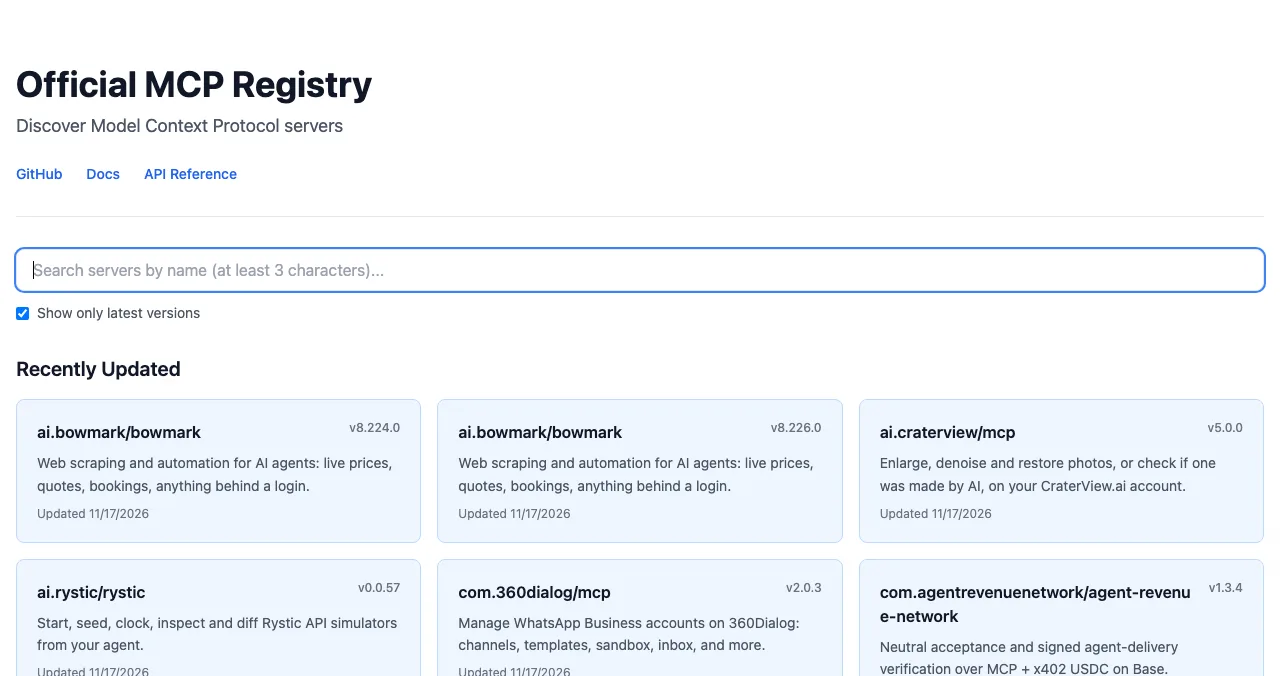
The registry's README describes it as providing MCP clients with a list of MCP servers, "like an app store for MCP servers". It launched in preview in September 2025; its v0.1 API entered an API freeze in October 2025 while work continues toward general availability. Because it's a preview, the README warns that breaking changes or data resets may occur. Its README links a "Publish my MCP server" guide.
Best for: every public server; other tools can build on the registry's data.
2. Glama: the largest browsable list
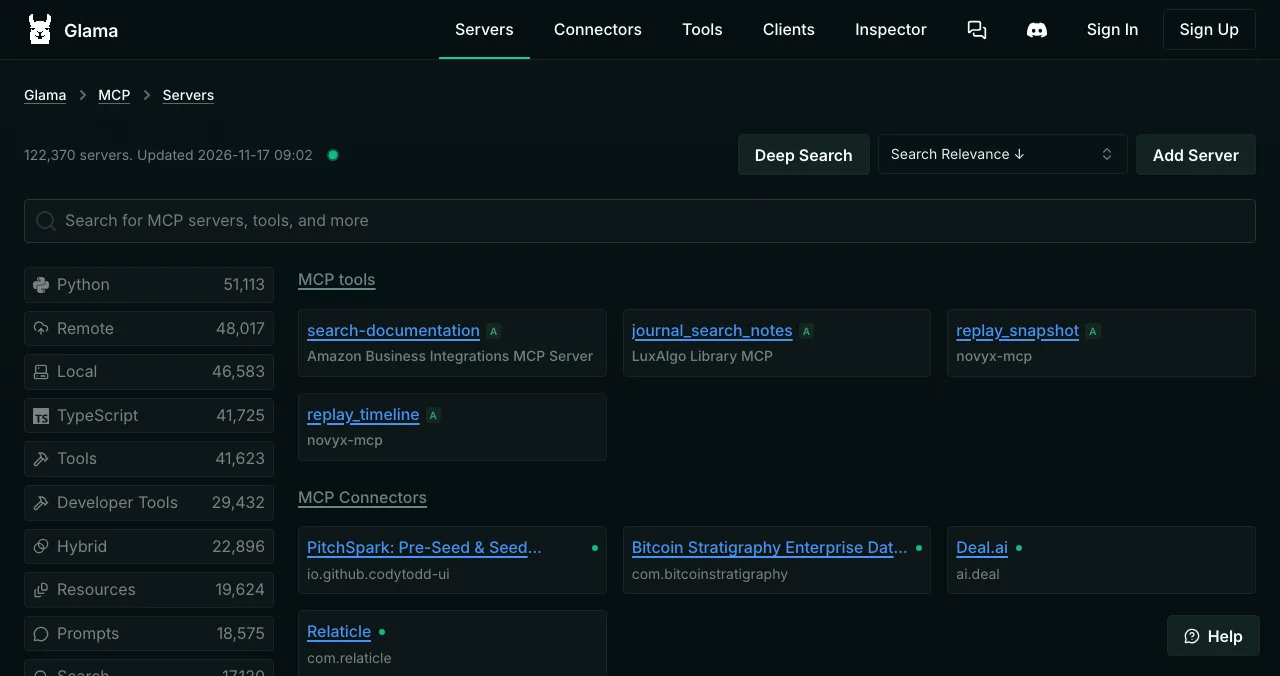
Glama listed 122,370 servers on 17 November 2026, each with grades for licence, quality and maintenance, categories and an API for the directory itself. Use Add Server to submit. Best for: being found in a big, filterable list.
3. MCP.so: community directory
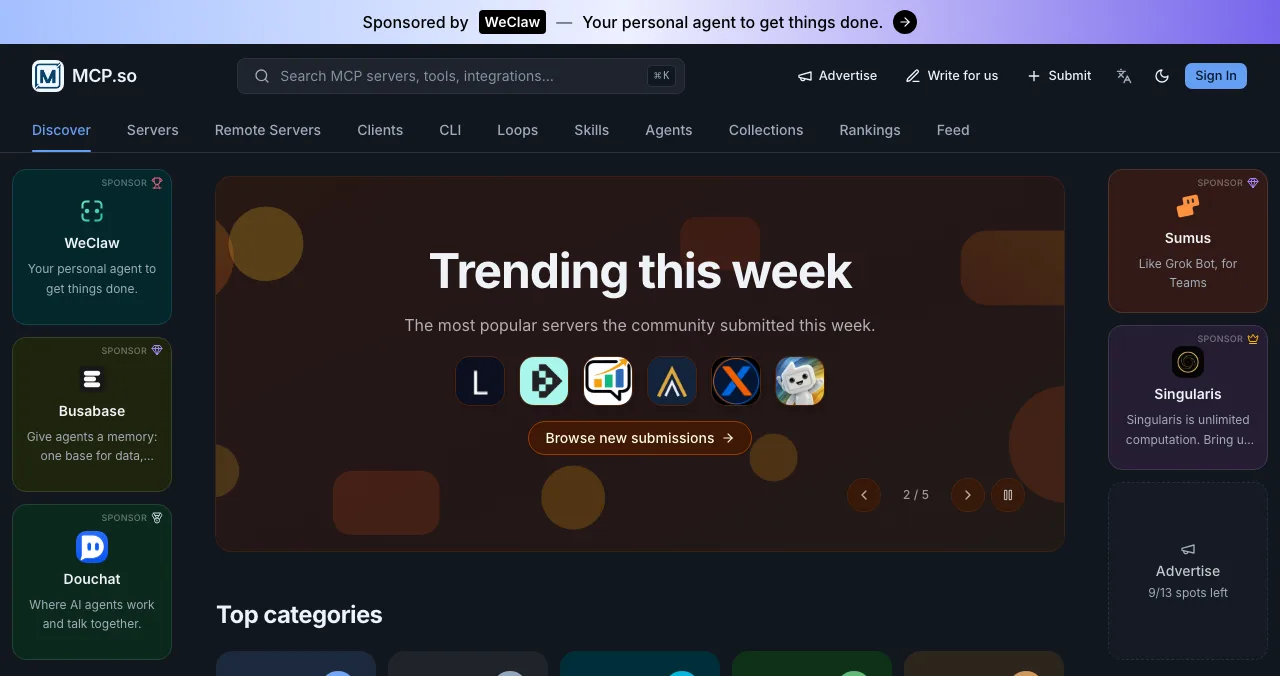
MCP.so organises servers by category, with remote servers, clients, rankings and a feed, plus sponsored placements. Use Submit in the header. Best for: developers browsing by category.
4. Smithery: now part of Arcade
Smithery's site says it is now part of Arcade and that its MCP proxy and managed identity shut down on 31 October. It still links to browsing MCPs. Check its current documentation before planning around it.
5. Science of Apps Launchpad: the product behind the server
A free, permanent profile for the service your server connects to, found by the problem it solves. Best for: turning MCP users into product users.
How to publish an MCP server

- Publish the package — npm, PyPI or a container image, with a clear name.
- Publish to the official registry — follow its "Publish my MCP server" guide.
- Add it to Glama and MCP.so — same name, description and links.
- Write the README — what it does, the tools it exposes, config for common clients.
- List the product — a launch page and directories for the service itself.
- Announce it — Show HN, developer communities, your changelog.
From listing to installs

- One-line purpose — "Lets your AI assistant create and search invoices in Acme"
- Tools listed — every tool with a sentence on what it does
- Copy-paste config — for the clients your users actually use
- Auth explained — what credentials it needs and the scopes
- A short demo — a GIF or video of a real prompt and result
- Maintained — recent releases; directories show update dates
Mistakes

- Different names in each directory — one name everywhere
- No security note — say what data the server can read and change
- Abandoned versions — stale servers get low maintenance grades
- Listing the server but not the product — users need somewhere to go next
Ready to list the product too?
How we know
Registry details come from the official MCP Registry and its GitHub README; directory counts and features from Glama, MCP.so and Smithery; all read on 17 November 2026. MCP is a fast-moving ecosystem, so check each directory's submission page before publishing.
Key terms, defined
- MCP (Model Context Protocol): an open standard for connecting AI assistants to tools and data.
- MCP server: a program that exposes tools or data to AI assistants over MCP.
- MCP client: an app, like an AI assistant or IDE, that connects to MCP servers.
- Registry: a canonical list other tools can read.
- Remote server: an MCP server hosted online rather than run locally.
Frequently asked questions
Where do I publish an MCP server?
Start with the official MCP Registry at registry.modelcontextprotocol.io, which provides MCP clients with a list of servers 'like an app store'. Then list it on community directories such as Glama and MCP.so, and publish the package itself to its package registry (npm, PyPI or a container registry).
What is the official MCP Registry?
A community-driven registry service for Model Context Protocol servers, built in the open by MCP contributors. It launched in preview in September 2025 and its v0.1 API entered an API freeze in October 2025, per its GitHub README.
How many MCP servers are there?
Glama's directory listed 122,370 open-source MCP servers on 17 November 2026. Counts vary by directory, and many servers are small or experimental.
Is Smithery still an MCP directory?
Smithery's site says it is now part of Arcade, and that its MCP proxy and managed identity shut down on 31 October. It still has a 'Browse MCPs' link; check its current docs before relying on it.
How do I get people to install my MCP server?
Make the README answer three things fast: what it does, which tools it exposes, and a copy-paste config for common clients. Add a demo, keep versions current, and link it from your product's page.
Do MCP directories help SEO?
A directory page can rank for your server's name and send developers to your repo or site. Link policies vary by directory, so treat any backlink as a bonus.
Sources
- Official MCP Registry (checked 17 Nov 2026)
- GitHub — modelcontextprotocol/registry README (checked 17 Nov 2026)
- Glama — MCP servers (checked 17 Nov 2026)
- MCP.so (checked 17 Nov 2026)
- Smithery (checked 17 Nov 2026)
- Checked November 17, 2026. Figures that change — fees, salaries, prices — are reviewed every six months; if something is out of date, tell us.
Where to go from here
- Launch a developer tool — the wider plan
- Places to launch a startup — for the product
- Backlinks for startups — links from listings
- Science of Apps - LaunchpadWhere to list an AI agent: AI agent directories (AI Agents List, AI Agents Directory, There's An AI For That), MCP registries, the ChatGPT plugin directory and a permanent product pageWhere to list an AI agent: AI agent directories, There's An AI For That, MCP registries, ChatGPT's plugin directory and a permanent product page.
- Science of Apps - LaunchpadCan you still submit to Futurepedia? What we found in November 2026, and six alternatives for listing an AI tool, free and paidCan you still submit an AI tool to Futurepedia? What we found in Nov 2026, plus 6 alternatives: Future Tools, TAAFT, TopAI, Toolify, AIxploria, Launchpad.
- Science of Apps - LaunchpadSaaSHub vs AlternativeTo: how each lists software, what each accepts and rejects, and how to get listed on bothSaaSHub vs AlternativeTo compared: who each accepts, how submission and approval work, what gets rejected, and how to list your software on both.
- Science of Apps - LaunchpadAIxploria review: the $79, $279 and $399 options, how long listing takes, and how it compares with other AI tools directoriesAIxploria review for 2027: $79 fast listing, $279 verified, $399 featured ads, timing and manual review, compared with Toolify, TAAFT, TopAI and free options.
- Science of Apps - LaunchpadNo-code tools directory guide: where to submit a tool built for no-code makers (NoCodeList, NoCode.Tech, Product Hunt, AlternativeTo, SaaSHub) and what each costsNo-code tools directories for a tool built for makers: NoCodeList (submit, or sponsor from $150/week), NoCode.Tech, Product Hunt and AlternativeTo.
- Science of Apps - LaunchpadFree startup directories in 2027: 16 checked sites to submit your startup to, grouped by what you want (investors, customers, a launch, India) with each one's rules16 free startup directories checked for 2027, grouped by goal: investors, customers, launch day and India, with each site's rules and the ones to skip.





Get the ideas, not the noise.
Sign up with Google and we’ll send you short UX psychology tips by email — why people tap, stall and leave, and what to do about it. Unsubscribe anytime. Prefer something to keep? Get the free Laws of UX guide as a PDF.
Launch day ends. Your listing shouldn't.
MCP directories list your server for developers; a free, permanent Launchpad profile is the page for the product behind it, found by the problem it solves and ranked by relevance, never payment.