 By
Quick answer: What's the best prompt engineering course?
- Free — DeepLearning.AI short courses, vendor guides.
- Structured — Vanderbilt on Coursera, Google Prompting Essentials.
- Official docs — Anthropic and OpenAI prompt guides.
- Certification — free SOA Prompt Engineering Certification.
- Proof — a portfolio of prompts with before/after results.
Key takeaways
- Prompt engineering is a practical skill; the best courses are hands-on.
- Free resources from Anthropic, OpenAI and DeepLearning.AI are excellent and up to date.
- Paid certificate programs (Coursera, Google) add structure and a shareable credential.
- Science of Apps offers a free, verifiable Prompt Engineering certification.
- Pair prompting with domain skills (marketing, data, product); that's where it's most valuable.
Best prompt engineering courses

| Course / resource | Cost | Certificate | Best for |
|---|---|---|---|
| DeepLearning.AI short courses | Free to learn | No formal certificate | Developers & beginners1 |
| Prompt Engineering for ChatGPT (Vanderbilt, Coursera) | Paid / financial aid | Coursera certificate | Structured learners |
| Google Prompting Essentials / AI Essentials | Paid | Google certificate | Business users |
| Anthropic & OpenAI prompt guides | Free | None | Up-to-date techniques23 |
| SOA Prompt Engineering Certification | Free | Verifiable certificate | Proving the skill4 |
What a good prompt engineering course teaches
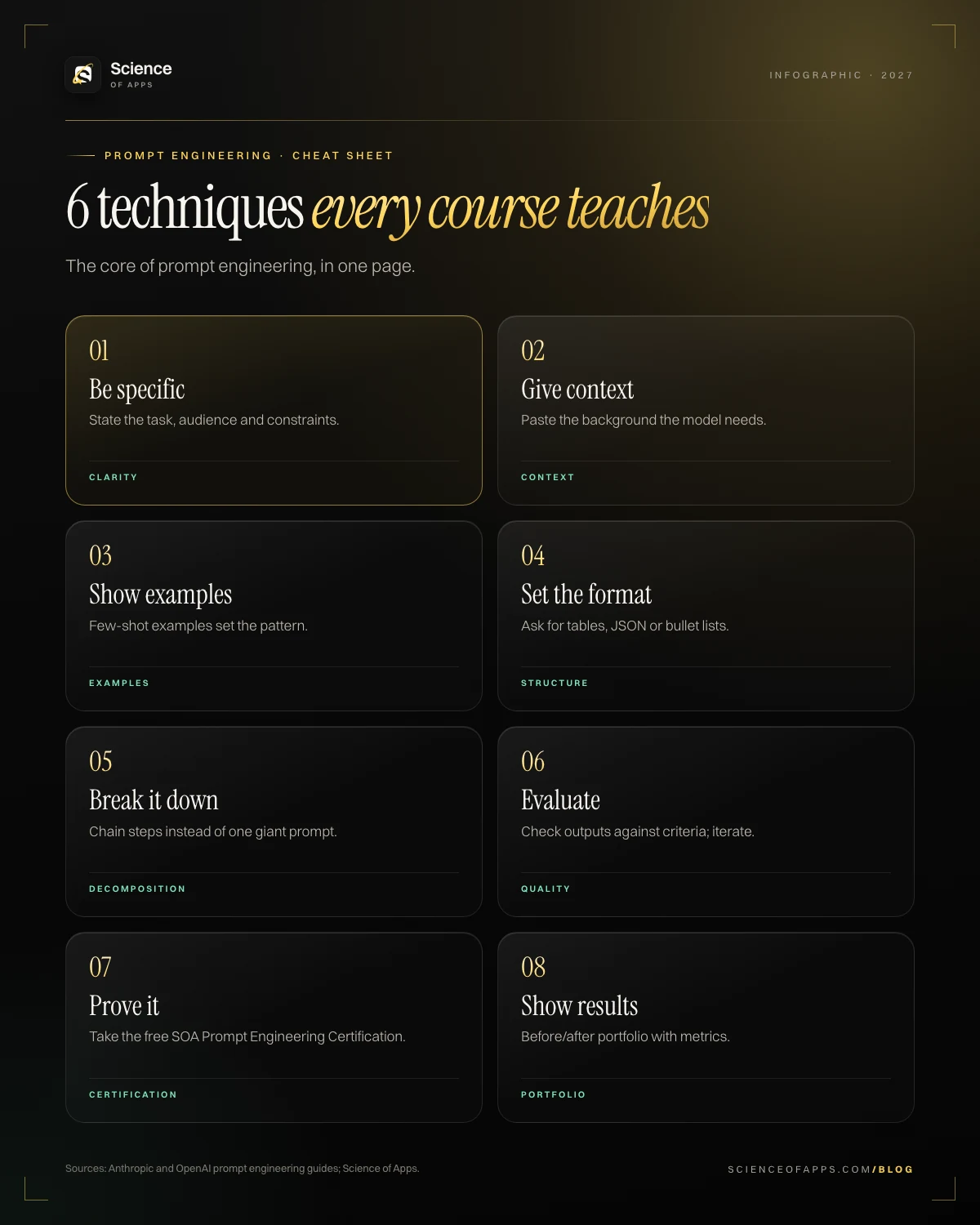
- Clear instructions, roles and context.
- Examples (few-shot) and output formats.
- Breaking tasks into steps and chaining prompts.
- Evaluating outputs and reducing hallucinations.
- Working with documents, data and tools.
Prompt engineering course free with certificate
Most free courses don't include a certificate. Free options that do: the Science of Apps Prompt Engineering Certification (scenario-based, verifiable) and some vendor learning paths. Google's prompting courses are paid, with financial aid on Coursera.
Is prompt engineering a real career?
Standalone "prompt engineer" roles are relatively rare; prompting is more often a core skill inside product, marketing, data, support and engineering jobs. Certify it, then show how it improves your work.
Build a prompt portfolio
Document 3–5 tasks: the problem, your prompt iterations, the final output and the measurable result (time saved, quality improved). This is the strongest evidence of skill.
Google's prompt engineering courses
Google offers AI Essentials and Prompting Essentials certificate programs (paid, with financial aid on Coursera). They target everyday business use: writing, research, data analysis and building simple AI workflows.
Prove it free: the tests that match this guide
Prove your prompting skills with SOA's free prompt engineering certifications. (Disclosure: Science of Apps publishes these tests.)
Microsoft and other vendor courses
Microsoft Learn includes free modules on prompt engineering for Copilot and Azure OpenAI. Vendor documentation from Anthropic and OpenAI is free, practical and updated as models change.
Generative AI certifications beyond prompting
To go further, learn retrieval-augmented generation (RAG), evaluation and agents. AWS Generative AI Developer – Professional and Microsoft AI-102 cover building generative AI applications.
How to evaluate a prompt engineering course
- Does it use current models and tools?
- Does it include hands-on exercises with feedback?
- Does it teach evaluation, not just tricks?
- Does it end with a verifiable assessment?
Who benefits most
Marketers, analysts, product managers, support teams, developers and educators gain the most, because prompting multiplies skills they already have.
Frequently asked questions
What is the best prompt engineering course?
DeepLearning.AI's free short courses and Vanderbilt's Prompt Engineering for ChatGPT on Coursera are popular; official Anthropic and OpenAI guides are the most current.
Is there a free prompt engineering course with a certificate?
Yes: the Science of Apps Prompt Engineering Certification is free and verifiable.
Is Google's prompt engineering course free?
Google's prompting certificate programs are paid (financial aid is available on Coursera); some Google AI learning is free on Grow with Google.
Is prompt engineering a good career?
It's most valuable as a skill inside other roles rather than as a standalone job title.
Is there a free prompt engineering course with a certificate?
Most free courses don't include a certificate. Free options that do: the Science of Apps Prompt Engineering Certification (scenario-based, verifiable) and some vendor learning paths. Google's prompting courses are paid, with financial aid on Coursera.
Sources
- DeepLearning.AI courses
- Anthropic: prompt engineering overview
- OpenAI: prompt engineering guide
- Science of Apps: free online certifications
- Coursera: Prompt Engineering for ChatGPT
- Checked November 11, 2026. Figures that change — fees, salaries, prices — are reviewed every six months; if something is out of date, tell us.
Where to go from here
- The best AI certifications — the best AI and machine learning certifications for 2027, from Google, Microsoft
- Digital marketing certifications — compare the top digital marketing certifications from Google, HubSpot and Meta
- The best data science certifications — the best data science certifications for 2027, from free options to university programs
- CertificationsData analytics & SQL certificationsThe best data analytics and SQL certifications, including Google Data Analytics and Microsoft, ranked by cost, time and job value.
- Career guides by Science of Apps for 2027The best prompt engineering certifications of 2027: six worth your time, ranked honestlyThe 6 best prompt engineering certifications and courses for 2027: Google Prompting Essentials, Anthropic, OpenAI, DeepLearning.AI and Azure AI-102, with costs.
- CertificationsThe best data science certificationsThe best data science certifications for 2027, from free options to university programs, ranked by cost, depth and job outcomes.
- Career guides by Science of Apps for 2027Top 10 generative AI courses online in 2027: from your first prompt to shipping an LLM appThe top 10 generative AI courses online for 2027, from beginner to builder: DeepLearning.AI, Google, Anthropic, OpenAI, NVIDIA, Microsoft and Databricks.
- CertificationsThe best AI certificationsThe best AI and machine learning certifications for 2027, from Google, Microsoft, AWS and more, ranked for beginners and pros.
- Career guides by Science of Apps for 2027The best AI certifications of 2027: ten ranked by what they do for your career, from first exam to AI engineerThe 10 best AI certifications of 2027, ranked by career impact: AWS AI Practitioner, Azure AI-102, Google's AI exams and more, with costs and enrol links.





Get the ideas, not the noise.
Sign up with Google and we’ll send you short UX psychology tips by email — why people tap, stall and leave, and what to do about it. Unsubscribe anytime. Prefer something to keep? Get the free Laws of UX guide as a PDF.
Prove the skill before you pay for the exam.
1,200+ free, test-based certifications graded on our server. Pass and get a founder-signed certificate with a credential ID employers can verify.