 By
Quick answer: How do I get my product featured in a newsletter?
- Product Hunt: 1.5M+ readers; features notable launches.
- TLDR: 8M+ readers, 14 newsletters; paid native ads.
- Ben's Bites: 118,000+ subscribers; AI, editorial.
- Launching Next, Tiny Startups: newsletters tied to their launches.
- Order: launch, get results, then pitch or pay.
Key takeaways
- Launch-site newsletters are the easiest way in.
- Big newsletters are mostly paid placements; treat them as ads.
- Editorial newsletters want a story, not an announcement.
- Match the newsletter's audience to your buyers.
- Track clicks with UTM links before paying again.
A mention in the right newsletter can send more interested visitors in a morning than a month of social posts. Founders usually aim straight for the biggest tech newsletters and find they're paid placements with media kits. The easier route runs through launch sites whose newsletters feature what launched there, and through editorial newsletters that want a story. This list covers five, with audience figures from each newsletter's own page as checked on 17 November 2026. Jump to the list, how to pitch or paid vs editorial.
- Product Hunt newsletter readers
- 1.5M+
- TLDR readers across 14 newsletters
- 8M+
- Ben's Bites subscribers
- 118,000+
- Tiny Startups newsletter subscribers
- 25k+
Newsletters compared
| Newsletter | Audience (own figure) | How products get in | Best for |
|---|---|---|---|
| Product Hunt | 1.5M+ readers | Notable launches on Product Hunt | Tech products with a strong launch |
| TLDR | 8M+ across 14 newsletters | Paid native ads | Developer, AI and B2B tools with budget |
| Ben's Bites | 118,000+ subscribers | Editorial | AI products |
| Launching Next | 5,000+ founders | Startups it publishes | Early products |
| Tiny Startups | 25k+ subscribers | Its launches and featured spots | Small and indie startups |
Table: Startup newsletters that feature new products (each newsletter's own page, checked 17 Nov 2026)
The list
1. Product Hunt's newsletter
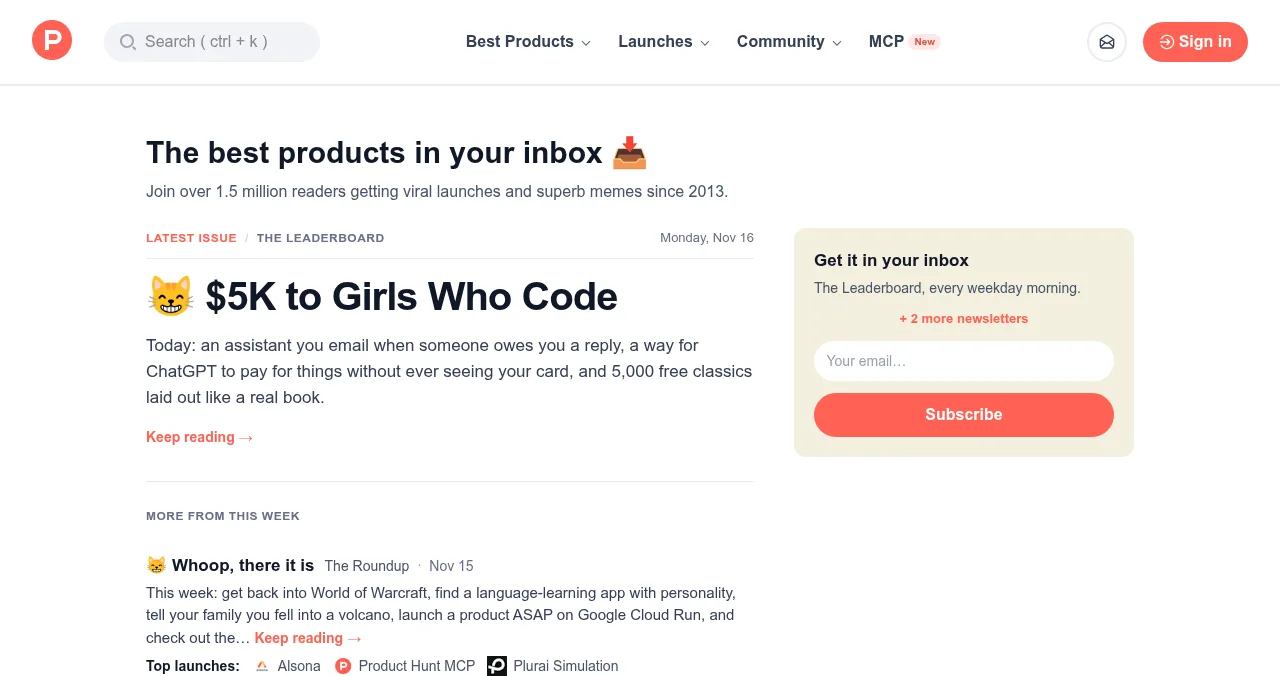
Product Hunt says over 1.5 million readers get its newsletters, which list top launches. The way in is a strong launch (launch guide).
2. TLDR
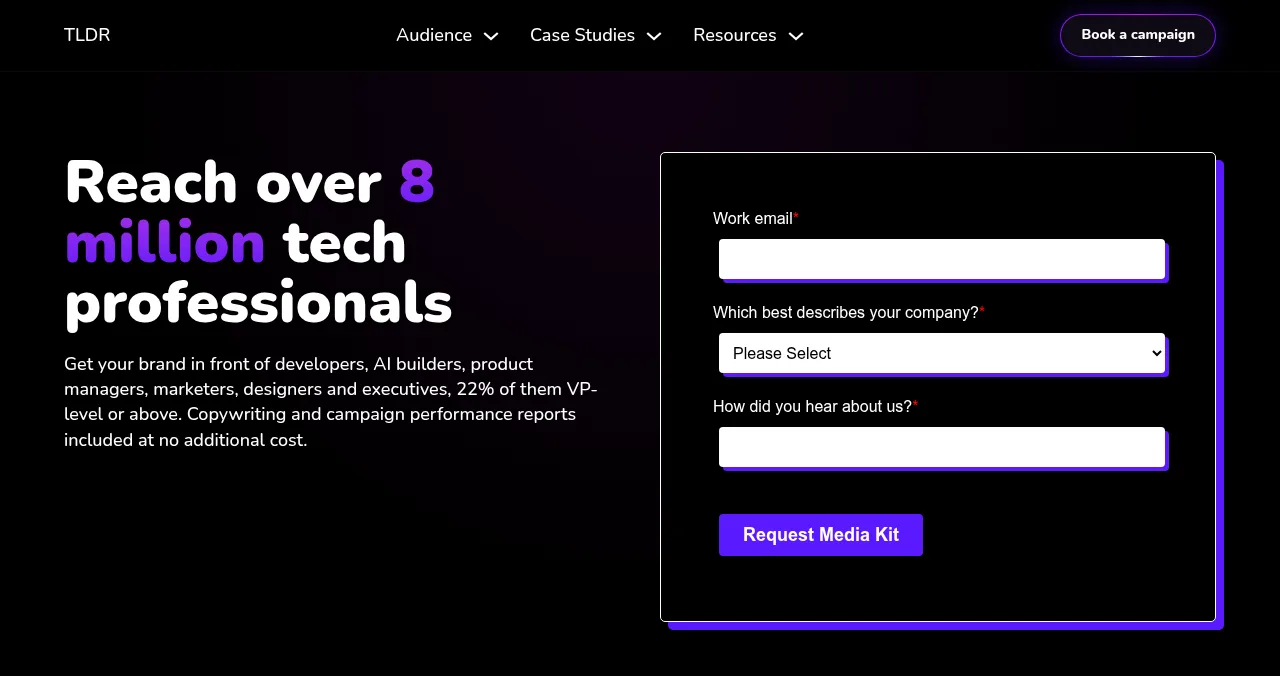
TLDR runs 14 interest-based newsletters (TLDR Tech 1.6 million subscribers, TLDR AI 1.15 million, by its figures) and sells native ads with copywriting and reports included. Prices come with a media kit. Best for: funded B2B, developer and AI tools.
3. Ben's Bites
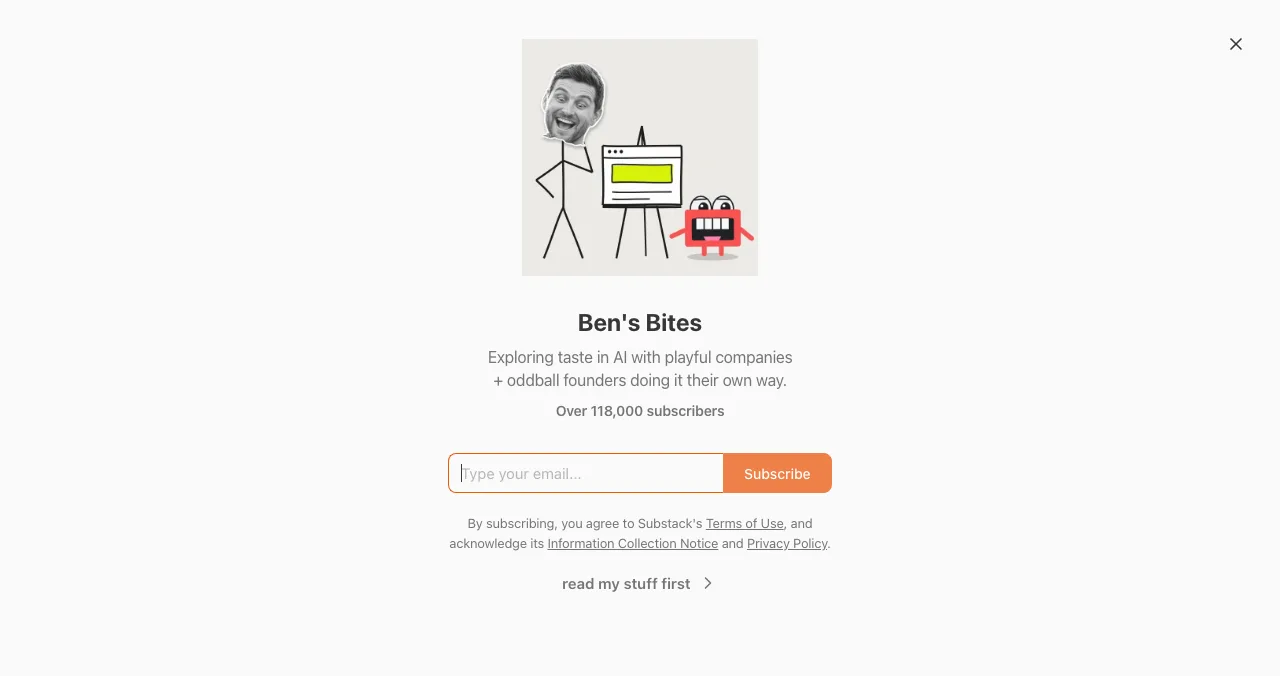
An AI newsletter "exploring taste in AI with playful companies and oddball founders", with over 118,000 subscribers. Editorial: read it, then pitch a story that fits.
4. Launching Next
Free to submit; startups it publishes reach a weekly newsletter for 5,000+ founders, by its count (review).
5. Tiny Startups
A curated launch platform with a 25k+ subscriber newsletter, by its count; featured spots are sold by bidding (review).
How to pitch an editorial newsletter

- Read three issues — what do they actually feature?
- Find the angle — a result, a surprising use, a story.
- Write three sentences — what, for whom, one concrete result.
- Link a live page — your product and a permanent listing.
- Follow up once — after a week, briefly.
Paid vs editorial

Paid placement
- Guaranteed, on your schedule
- Copy you control
- Large audiences
Editorial feature
- Free, but not guaranteed
- More trusted by readers
- Needs a real story
Mistakes

- Pitching before launching — editors feature what exists
- Buying the biggest newsletter first — test a smaller, closer audience
- No tracked link — you won't know what worked
- Generic pitches — show you read the newsletter
Ready to launch?
How we know
Audience figures come from each newsletter's own page, read on 17 November 2026, and are their own claims. TLDR's prices aren't published on its advertising page. The pitching steps are our editorial guidance.
Key terms, defined
- Native ad: a paid placement written to match a newsletter's style.
- Media kit: a document of audience data and ad prices.
- Editorial feature: coverage chosen by the newsletter's editors.
- UTM link: a tagged link that shows where visits came from.
- Pitch: a short message proposing a story to an editor.
Frequently asked questions
How do I get my product featured in a newsletter?
Launch somewhere first (Product Hunt, Launching Next, Tiny Startups), since their newsletters feature launches. For editorial newsletters, send a short pitch with a story and a result. For big newsletters like TLDR, buy a native ad.
Does Product Hunt's newsletter feature launches?
Product Hunt's newsletters page says over 1.5 million readers get 'viral launches and superb memes' and lists top launches in issues. A strong launch is the way in.
How much does it cost to advertise in TLDR?
TLDR doesn't publish prices on its advertising page; it offers a media kit and campaign booking. It says it reaches 8M+ tech professionals across 14 newsletters, with copywriting and performance reports included.
Which newsletters cover AI products?
Ben's Bites (118,000+ subscribers) covers AI products and founders, TLDR AI has 1.15 million subscribers (sold as ad space), and There's An AI For That sells newsletter placements with its listings.
Is a paid newsletter placement worth it?
Only if the audience matches your buyers and you can measure results. Test one placement with a tracked link and an offer, and judge it by users who stay.
How do I pitch an editorial newsletter?
Read a few issues, then send two or three sentences: what you built, for whom, one concrete result and why it fits their readers. Link to a live page.
Sources
- Product Hunt — Newsletters (checked 17 Nov 2026)
- TLDR — Advertise (checked 17 Nov 2026)
- Ben's Bites (checked 17 Nov 2026)
- Launching Next — Submit Your Project (checked 17 Nov 2026)
- Tiny Startups (checked 17 Nov 2026)
- Checked November 17, 2026. Figures that change — fees, salaries, prices — are reviewed every six months; if something is out of date, tell us.
Where to go from here
- Launching Next and Tiny Startups — reviewed
- Product Hunt launch — the way into its newsletter
- Startup press release — pitching media
- Science of Apps - LaunchpadLaunching Next, Startup Stash and Tiny Startups reviewed: what each is, what it costs (free, $99 fast-track, paid plans, bid-for-rank spots) and who should submitLaunching Next, Startup Stash and Tiny Startups reviewed: free submission vs $99 fast-track, paid listings and bid-for-rank featured spots.
- Science of Apps - LaunchpadBetaList review for 2027: how it works now that every submission is paid, who it suits, and the free alternativesA 2027 BetaList review: how submissions work now that all are paid, the refund rule, what it features, who it suits and the free alternatives.
- Science of Apps - LaunchpadProduct Hunt badges: how to get one, how to add it to your website, what each badge means, and other earned launch badgesHow to get and add a Product Hunt badge: launch badges from your dashboard, award badges by email, review badges, and other earned startup badges.
- Science of Apps - LaunchpadHow to get your first users for a new app: the store listing, launch sites, communities, direct outreach and a web page that keeps bringing people inHow to get users for a new app, free: fix the store listing, launch on Product Hunt and Peerlist, reach people directly, and add a permanent web page.
- Science of Apps - LaunchpadHow to launch an AI product: prove the outputs, describe the task not the model, pick free and paid launch sites, and make sure AI search can find youHow to launch an AI product in 2027: show real outputs, describe the task, launch on Product Hunt and AI directories, and get found by AI search engines.
- Science of Apps - LaunchpadHow to promote my website for free: 15 ways that work for a new startup or small business site, grouped by where visitors actually come fromHow to promote your website for free: 15 ways grouped by where visitors come from (search, listings, communities and people), with what each costs in time.
Get the ideas, not the noise.
Sign up with Google and we’ll send you short UX psychology tips by email — why people tap, stall and leave, and what to do about it. Unsubscribe anytime. Prefer something to keep? Get the free Laws of UX guide as a PDF.
Launch day ends. Your listing shouldn't.
Newsletters pick up products that have launched somewhere; a free, permanent Launchpad listing gives editors a page to link to, ranked by relevance, never payment.