 By
Quick answer: Which TEFL certificate do I need?
- Minimum — 120-hour TEFL from an accredited provider.
- Most respected — Cambridge CELTA.
- Teaching practice — observed practice strengthens it.
- Free TEFL — useful taster; rarely accepted alone.
- Online — fully online 120-hour courses are widely accepted.
Key takeaways
- There's no single TEFL authority; quality depends on the provider's external accreditation.
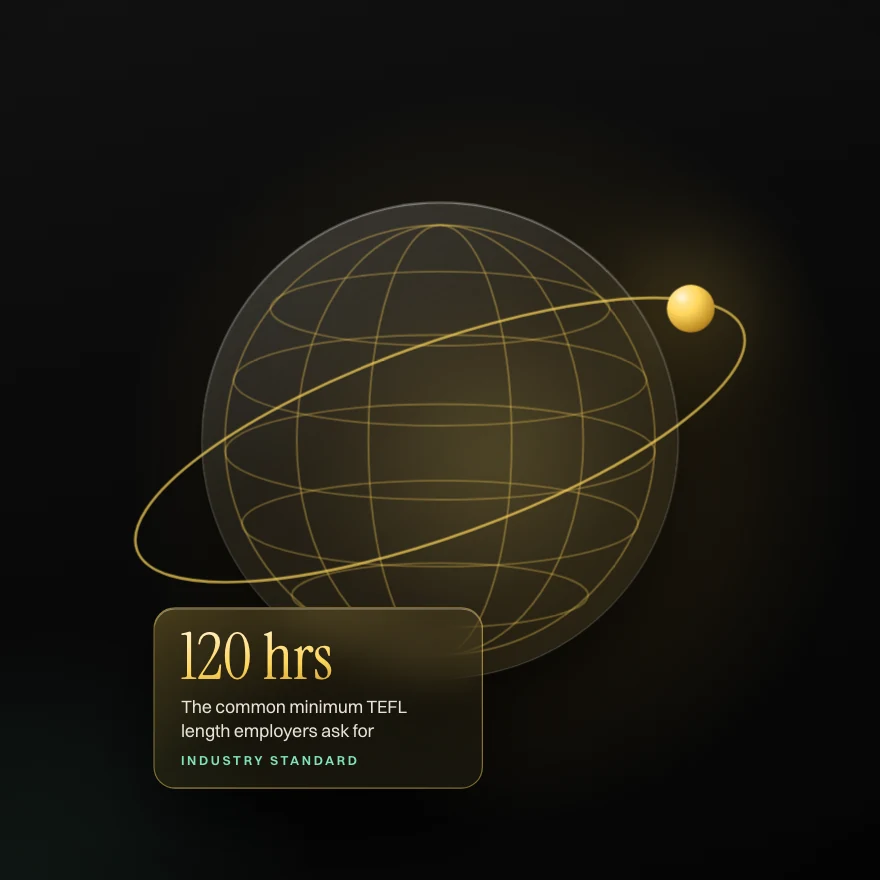
- 120 hours is the common minimum employers ask for.
- CELTA is more intensive and respected, especially for Europe and the Middle East.
- Online 120-hour TEFL courses are widely accepted, especially with teaching practice.
- Free TEFL courses are tasters; check whether employers in your target country accept them.
TEFL vs CELTA vs online teaching certificates

| 120-hour TEFL | CELTA | Free TEFL | |
|---|---|---|---|
| Provider | Many (check accreditation) | Cambridge English1 | Various |
| Length | 120+ hours | Intensive, ~120 hours with assessed teaching | Short |
| Teaching practice | Optional / varies | Assessed, required | Rarely |
| Employer acceptance | Widely accepted | Highest | Limited |
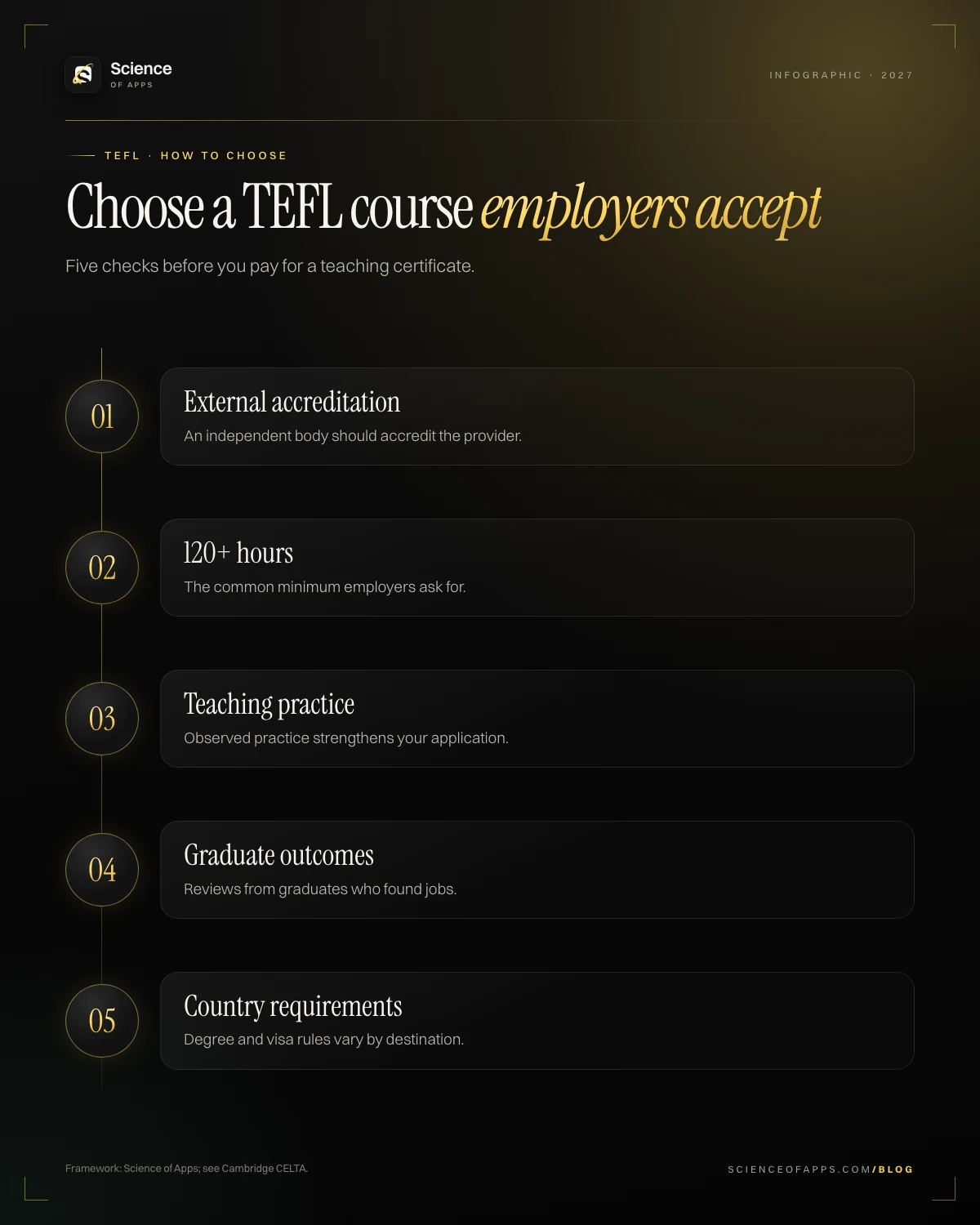
How to choose a TEFL course
- Check external accreditation from an independent body.
- Choose 120+ hours.
- Look for observed teaching practice.
- Check reviews from graduates who found jobs.
- Confirm requirements for your target country (some require a degree for visas).
Teaching certification online
Online 120-hour TEFL courses are widely accepted by online English schools and many employers abroad. For school-teacher licensing in your own country, you'll need a government-approved teacher certification program, which is different from TEFL.
TEFL certification free?
Free TEFL courses are a good way to test interest, but most employers expect a paid, accredited 120-hour course. Free Science of Apps English Level Test (CEFR A1–C2) can document your own English level, though it isn't accepted for visas.
Where TEFL can take you
Popular destinations include East and Southeast Asia, Latin America, Europe and the Middle East, plus online teaching. Requirements (degree, native-speaker status, visas) vary by country, so research your target market first.
Why 120 hours?
120 hours has become the common benchmark in job ads and among recruiters because it signals a substantial course covering grammar, lesson planning, classroom management and teaching skills, rather than a short introduction.
Prove it free: the tests that match this guide
Check your teaching readiness free before you buy a TEFL course. (Disclosure: Science of Apps publishes these tests.)
- TEFL Certification TestCheck your TEFL knowledge: lesson planning, grammar and classroom skills.Start free test →
- Teaching English Online TestSkills for online English teaching jobs.Start free test →
- Cambridge TKT (Teaching Knowledge Test) Practice TestPractise for Cambridge TKT, a recognized teaching knowledge test.Start free test →
- English Level TestConfirm your own English level (CEFR).Start free test →
How to check TEFL accreditation
Look for accreditation from a recognized, independent body and check that body's website lists the provider. Be wary of "accreditation" from organisations owned by the course provider.
Online teaching certificate programs
Online English schools often accept 120-hour TEFL certificates and value additional training in teaching online or teaching young learners. Specialist add-ons (Business English, teaching young learners) can improve job prospects.
Do you need a degree to teach English abroad?
Some countries require a bachelor's degree for work visas; others don't. Check visa rules for your target country before investing in a course.
Frequently asked questions
What TEFL certificate do I need?
Most employers ask for at least a 120-hour TEFL from an externally accredited provider; CELTA is the most respected alternative.
Is a free TEFL certificate accepted?
Usually not as a primary qualification. Free courses are useful tasters; employers expect an accredited 120-hour course.
TEFL or CELTA?
TEFL is cheaper and flexible; CELTA is more intensive and respected, especially in Europe and the Middle East.
Can I get a teaching certificate online?
Yes. Online 120-hour TEFL courses are widely accepted; school-teacher licensing requires a government-approved program.
Why 120 hours?
120 hours has become the common benchmark in job ads and among recruiters because it signals a substantial course covering grammar, lesson planning, classroom management and teaching skills, rather than a short introduction.
Do you need a degree to teach English abroad?
Some countries require a bachelor's degree for work visas; others don't. Check visa rules for your target country before investing in a course.
Sources
- Cambridge English: CELTA
- Science of Apps: free online certifications
- Checked November 11, 2026. Figures that change — fees, salaries, prices — are reviewed every six months; if something is out of date, tell us.
Where to go from here
- Supply chain certifications — the best supply chain and logistics certifications, including apics cscp and cpi
- Medical coding certification — how to get a medical coding certification
- Power BI PL-300 & Excel certification — how to earn the power bi pl-300 and microsoft excel certifications
- CertificationsAccredited vs non-accreditedWhat does 'accredited' really mean for a certification? How accreditation works and why it matters to employers.
- CertificationsCertifications for nurses, teachers & accountantsThe most valuable certifications for nurses (BLS, ACLS, CCRN), teachers (CTET, TEFL, CELTA) and accountants (CPA, CMA, ACCA), and what each one costs.
- CertificationsThe best certification appsThe best apps for learning on your phone and earning real certificates, compared on content, price and certificate value.
- Career guidesHow to teach English online in 2027: lesson planning, classroom language and instructions, error correction and feedback, online tools and engagement, pay and how platforms hire tutorsHow to teach English online in 2027: lesson planning, classroom language, error correction, online tools and engagement, pay and how platforms hire tutors.
- CertificationsFree online courses with certificatesBrowse 200+ genuinely free online courses that include a certificate, sorted by field, provider and time to finish. Updated every month.
- CertificationsThe best data science certificationsThe best data science certifications for 2027, from free options to university programs, ranked by cost, depth and job outcomes.

Get the ideas, not the noise.
Sign up with Google and we’ll send you short UX psychology tips by email — why people tap, stall and leave, and what to do about it. Unsubscribe anytime. Prefer something to keep? Get the free Laws of UX guide as a PDF.
Prove the skill before you pay for the exam.
1,200+ free, test-based certifications graded on our server. Pass and get a founder-signed certificate with a credential ID employers can verify.