 By
Quick answer: How do startups use Hacker News?
- What it is: a link and discussion site owned by Y Combinator, editorially independent from it.
- What belongs: 'anything that good hackers would find interesting'; most politics, crime, sports and celebrity news doesn't.
- How startups use it: Show HN for things people can try, Ask HN for questions, comments for expertise.
- Ranking: points divided by a power of time, adjusted by flags, anti-abuse software and moderators.
- Hard rule: don't ask anyone to upvote or comment.
Key takeaways
- Hacker News rewards curiosity and craft, not marketing copy.
- Show HN needs something people can try now; landing pages and waitlists don't qualify.
- Karma doesn't make your posts rank higher; good submissions and comments do.
- Voting rings get caught; one honest post beats ten coordinated ones.
- A launch on HN lasts hours; have a permanent page ready for the people who arrive late.
"Hacker News" is searched about 550,000 times a month worldwide (Google Keyword Planner, global 12-month average), mostly by people who already read it. This guide is for the founder who has heard that one good Hacker News thread can bring thousands of developers, and one bad one can bring a week of blunt criticism. It explains what Hacker News is, who runs it, how its ranking works, what Show HN, Ask HN and Launch HN are, and how startups use it without breaking the rules. Every rule here comes from HN's own FAQ and guidelines, checked on 18 November 2026. Jump to the three ways startups use it, the rules or the plan.
- Monthly searches for "hacker news", worldwide
- 550K
- Ways startups use it: Show HN, Ask HN, comments
- 3
- Hard rule: never ask for upvotes
- 1
- Ranking boost from high karma
- 0
What is Hacker News?
Hacker News (HN, sometimes called "orange site" after its header) is a site for sharing and discussing links. Its guidelines define what belongs in one line: anything that good hackers would find interesting, or more broadly anything that "gratifies one's intellectual curiosity". In practice that means programming, startups, science, security, design, history of technology and the occasional odd essay. The guidelines say most political, crime, sports and celebrity stories are off-topic unless they show an interesting new phenomenon.
Y Combinator owns and funds Hacker News. Its FAQ says the HN moderation team is editorially independent from YC, and that it moderates "less, not more" when YC or a YC startup is the topic, to avoid looking partial.
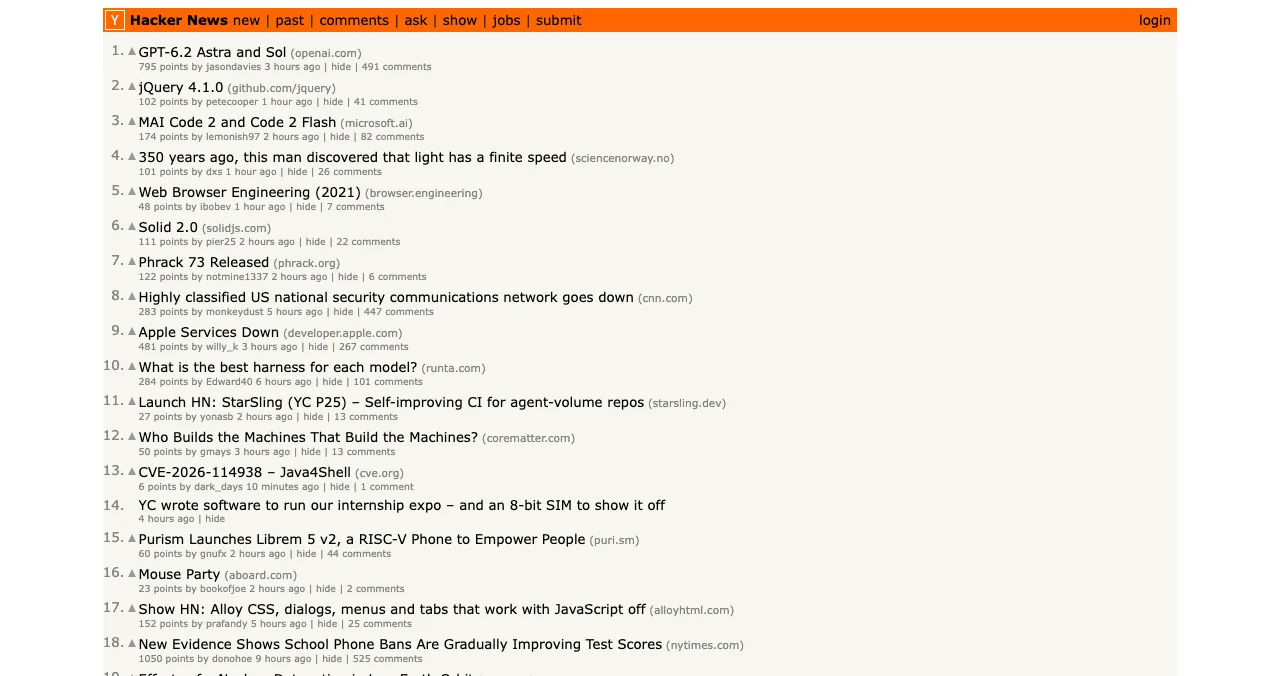
The page itself is deliberately plain: a numbered list of titles, each with its domain, points, the submitter, its age and a comment count. The top bar links to the sections a founder needs to know: new (everything, newest first), ask (Ask HN), show (Show HN), jobs and submit.
| Section | What it is | Who can post |
|---|---|---|
| Front page | Stories ranked by points, time and moderation | Anyone with an account submits; the community votes |
| new | Every submission, newest first | Everyone's posts appear here first |
| Ask HN | Questions and text posts | Any member |
| Show HN | Something you made that others can try | Any member, under Show HN rules |
| Launch HN | Launches by YC startups, placed on the front page | YC companies |
| jobs | Job ads from YC startups; no votes or comments | YC companies |
Table: The parts of Hacker News a founder should know (HN FAQ and front page, checked 18 Nov 2026)
How do startups use Hacker News?
There are three honest ways, and they suit different stages.

Show HN
Post something people can try right now: a tool, a library, an app, a game. The thread is the value: real users, real criticism, real questions about how you built it.
Ask HN
Ask experienced builders a real question: pricing, hiring, architecture, a hard technical problem. Text posts can't include links; add one in a comment if needed.
Comments
Answer questions in threads where you have expertise. Over months, useful comments build a reputation; a link to your product in every comment builds the opposite.
The HN guidelines put the line clearly: posting your own work occasionally is fine, but "please don't use HN primarily for promotion". The site exists for curiosity; promotion that doesn't serve curiosity gets flagged.
Show HN: the launch post
Show HN is where most startups launch on Hacker News. Its own rules say it's for something you've made that other people can play with: things people can run, or hold in their hands. Blog posts, sign-up pages, newsletters, lists, landing pages and fundraisers don't qualify. You post it as a normal submission whose title begins "Show HN:".
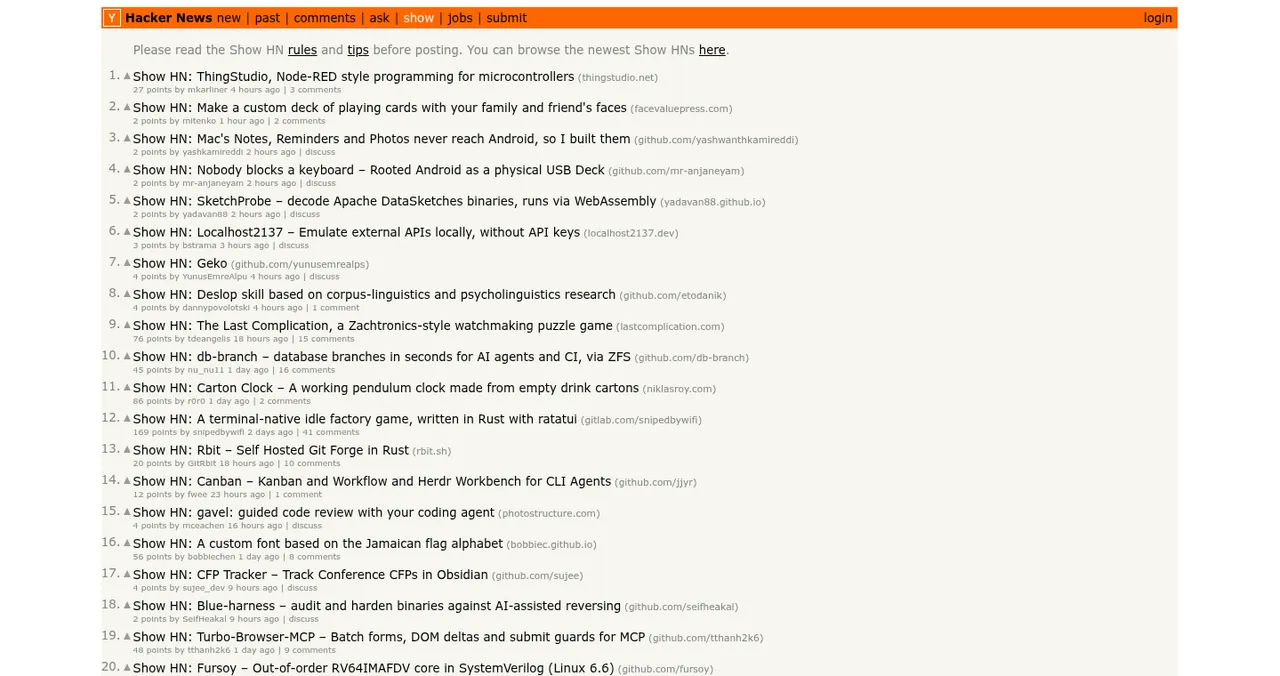
- Visibility: every Show HN appears on the newest Show page at once; after a small points threshold, it appears on the Show page itself, and it can reach the main front page like any story.
- Make it easy to try: the rules ask you to avoid sign-ups and emails where possible.
- Be there: stay in the thread, explain how and why you built it, and take criticism calmly.
- Updates: a minor version ("Foo 1.3.1 is out") usually isn't substantive enough; a major overhaul probably is.
Our Show HN guide covers titles, timing and the first comment in detail.
Ask HN: borrowing experience
Ask HN lists questions and other text submissions. You submit with the URL field blank. The FAQ notes text submissions can't contain links, so you add one as a regular comment. Founders use it for questions only experienced people can answer well: how to price a developer tool, whether to open-source a product, how others handled a tricky migration. Questions that are really an ad ("Ask HN: what do you think of my startup?") belong in a Show HN once there's something to try.
Launch HN: the YC-only route
The FAQ lists the few things HN gives Y Combinator: job ads and startup launches are placed on the front page, and YC founders' names appear in orange to other YC alumni. Those launches carry the title "Launch HN", as you can see in the front-page screenshot above. If you're not in YC, you don't need Launch HN; a good Show HN reaches the same readers through the same votes.
How does Hacker News ranking work?
The FAQ is unusually open about it. Stories are ranked by points divided by a power of the time since submission, and comments are ranked the same way. On top of that, rank is adjusted by:
- User flags from members who think a post breaks the guidelines or doesn't belong.
- Anti-abuse software, which drops some votes (including from voting rings).
- Software that demotes overheated discussions, so a flame war sinks.
- Account or site weighting.
- Moderator action.
So rank can't be worked out from votes and time alone. Two practical consequences for founders: votes in the first hour matter far more than votes later, and coordinated votes are likely to be discounted rather than counted.
Karma, flags, dead posts and vouching
| Term | What it means (per the HN FAQ) |
|---|---|
| Karma | Roughly upvotes minus downvotes on your posts; it does not make your posts rank higher |
| Down arrow | Appears only on comments, and only after a karma threshold |
| [flagged] | Users flagged the post as breaking the guidelines or not belonging on HN |
| [dead] | Killed by software, flags or moderators; hidden unless you turn on showdead |
| Vouch | Members above a small karma threshold can vouch to restore a dead post |
| Green username | A new account |
| Reposts | Fine if the story hasn't had significant attention in about a year; deleting and resubmitting isn't allowed |
Table: Hacker News terms founders run into (HN FAQ, checked 18 Nov 2026)
What are the Hacker News rules that matter to founders?
The guidelines are short; read them in full before your first post. These are the ones founders break most often:

- Don't solicit upvotes — "Don't solicit upvotes, comments, or submissions." Not from friends, not from your newsletter, not from a Slack channel
- Use the original title — no uppercase, no exclamation marks, no editorialising; drop the site name
- Link to the original source — not a press release about it or a post that summarises it
- No generated text — the guidelines ask you not to post generated or AI-edited comments, and not to automate posting
- Be kind — "Be kind. Don't be snarky." Respond to the strongest plausible reading of a criticism
- Not primarily for promotion — your own work occasionally, curiosity always
What do Hacker News readers respond to?
Read a few weeks of the Show page and the patterns are clear, and they match the guidelines:
- Something you can try in under a minute. A demo without a sign-up, a CLI with one install command, an open-source repo with a clear README.
- The how and the why. A first comment that explains the problem, how you built it and the trade-offs you made gets better discussion than a features list.
- Plain titles. "Show HN: Foo – diff two database schemas in the browser" beats any slogan.
- Founders who listen. Thanking a critic and fixing the bug they found the same day is the best marketing HN allows.
- Technical depth. HN readers include many engineers; they will open devtools and read your source.
What falls flat: marketing language, waitlists, gated demos, vague AI wrappers, and founders who argue with every criticism.
The Science of Apps Launchpad: the page to post before HN
A Hacker News thread is intense for a day, then it scrolls away. Readers who hear about you a week later need somewhere to land that isn't a dead thread. That's what a permanent listing is for.
- Free, forever: list in six short steps; automated checks and a human moderator review it.
- Permanent and findable: a public profile people find by the problem you solve, ranked by relevance, editorial picks and community interest, never payment.
- Badges you earn: Featured when you go live, Verified with a work email on your domain, Community favourite, Editor's pick and more, each linking back to your listing.
- Your product, tested end to end: a free baseline diagnosis of your landing page, discoverability and speed runs as you go live. A full investigation loads your product in a real browser on desktop and mobile and covers 22 areas.
- Areas of your product tested
- 22
- Automatic measurements, desktop and mobile
- 39
- Expert checks behind your login
- 74
- Verdicts that rank what to fix first
- 5
Why that matters on HN: the comments will find your broken sign-up on mobile, your slow first load and your confusing pricing within the hour. A report finds them first, privately, so the thread can be about what you built.
Find the rough edges first
List free, then order the report that fits: what new users see first, or the full diagnosis and a plan.

 Economy
See what new customers see
- Store listing and homepage, screen by screen
- Scorecard against 60 Laws of UX
- Customers, competitors and the fixes worth most
PremiumThe full diagnosis and the plan
- Every screen, every finding, every flow
- All 60 laws with evidence and fixes
- 8 strategy chapters and a 90-day roadmap
Researched from your live product and fact-checked against the evidence. Private to your team.
Which way of using Hacker News fits your startup?
| Your situation | Best use of HN |
|---|---|
| Idea or waitlist only | Read and comment; don't post a Show HN yet |
| Working product people can try without signing up | Show HN |
| Developer tool or open-source project | Show HN with the repo, and a first comment on how it works |
| A hard question about pricing, hiring or tech | Ask HN |
| You wrote something genuinely interesting about what you built | Submit the article as a regular story |
| You're in Y Combinator | Launch HN, arranged through YC |
Table: Which Hacker News route fits your stage
A one-week Hacker News plan
- Day 1
Make the permanent page
List free on the Launchpad so late readers have somewhere to land.
- Day 2
Fix the obvious
Read your baseline diagnosis; fix mobile sign-up, speed and anything Critical.
- Day 3
Remove friction
A demo without sign-up, a one-line install, a clear README.
- Day 4
Write the post
A plain "Show HN:" title and a first comment on how and why you built it.
- Day 5
Post and stay
Post when you can answer comments for several hours; reply to every real question.
- Day 6–7
Follow up
Ship the fixes people asked for and update your listing with what changed.
Mistakes founders make on Hacker News

- Asking for upvotes — against the guidelines, and the anti-abuse software discounts it
- Posting a landing page as a Show HN — wait until people can try the thing
- Marketing titles — uppercase, exclamation marks and slogans get flagged
- Posting and leaving — the thread is the launch; answer for hours
- Arguing with critics — thank them, fix the bug, reply with what changed
- Deleting and resubmitting — not allowed; a repost is fine only after about a year without significant attention
- No page to land on afterwards — keep a permanent listing so late readers find you
Ready to launch?
How we know
Every rule and mechanism here comes from Hacker News's own FAQ, guidelines and Show HN guidelines, and the front page as it appeared on 18 November 2026. Where the FAQ is silent (for example, on exact karma thresholds or new-account limits), we've said so rather than guessed. The search figure is Google Keyword Planner's global 12-month average. Science of Apps runs the Launchpad and has no relationship with Hacker News or Y Combinator.
Key terms, defined
- Hacker News (HN): a link-sharing and discussion site owned by Y Combinator, for stories that gratify intellectual curiosity.
- Show HN: a post sharing something you made that other people can try, titled "Show HN:".
- Ask HN: a text post asking the community a question.
- Launch HN: a Y Combinator startup's launch, placed on the front page.
- Karma: roughly the upvotes minus downvotes on a member's posts; it doesn't boost ranking.
- Flagged / dead: a post users flagged as off-guideline, or one killed by software, flags or moderators.
- Vouch: restoring a dead post when enough members above a small karma threshold vouch for it.
Frequently asked questions
How do startups use Hacker News?
In three main ways: a Show HN post for something people can try right now, an Ask HN post to get advice from experienced builders, and genuinely useful comments in threads about their field. The HN guidelines allow posting your own work occasionally but say not to use HN primarily for promotion, and never to ask anyone to upvote or comment.
What is Hacker News?
Hacker News is a site for sharing and discussing stories that 'good hackers would find interesting', such as technology, science, startups and programming. Y Combinator owns and funds it, but its FAQ says the HN team is editorially independent from YC. Anyone can create an account, submit links and comment.
Who owns Hacker News?
Y Combinator, the startup accelerator, owns and funds Hacker News. The HN FAQ says the moderation team is editorially independent and that it moderates 'less, not more' when YC or a YC startup is the topic. YC startups do get job ads and launch posts placed on the front page.
How does Hacker News ranking work?
According to the HN FAQ, stories are ranked by points divided by a power of the time since submission. Other factors also count: user flags, anti-abuse software, software that demotes overheated discussions, account or site weighting and moderator action. That's why rank can't be worked out from votes and time alone.
What is Hacker News karma?
Karma is roughly the upvotes minus downvotes on your posts and comments. The FAQ says higher karma doesn't make your submissions rank higher. Small karma thresholds unlock features such as flagging, vouching for dead posts and, on comments, the down arrow.
What is Launch HN?
Launch HN posts are launches by Y Combinator startups. The HN FAQ says one of the few things HN gives YC is that its startup launches are placed on the front page. If you're not in YC, the equivalent route is a Show HN, which any member can post.
Can I post my startup's landing page on Hacker News?
Not as a Show HN. The Show HN rules say landing pages, sign-up pages and fundraisers don't qualify, and that if your work isn't ready for people to try, you should come back when it is. A regular story about something genuinely interesting you learned is a different matter.
Why was my Hacker News post flagged or marked dead?
Posts are marked [flagged] when users flag them as breaking the guidelines, and [dead] when software, flags or moderators kill them. Dead posts can be restored if enough users with a small karma threshold vouch for them. Deleting and resubmitting isn't allowed.
Sources
- Hacker News — FAQ (checked 18 Nov 2026)
- Hacker News — Guidelines (checked 18 Nov 2026)
- Hacker News — Show HN guidelines (checked 17 Nov 2026)
- Hacker News — Front page (checked 18 Nov 2026)
- Science of Apps — Launchpad: launch your product free (checked 18 Nov 2026)
- Science of Apps — Product investigation (checked 18 Nov 2026)
- Science of Apps — Pricing: free listing, Economy and Premium reports (checked 18 Nov 2026)
- Checked November 18, 2026. Figures that change — fees, salaries, prices — are reviewed every six months; if something is out of date, tell us.
Where to go from here
- Show HN guide — how to post and land it
- Product Hunt vs Indie Hackers vs Hacker News — which to use when
- Indie Hackers guide — the slower, friendlier community
- Science of Apps - LaunchpadHacker News Show HN: what qualifies, how to post, how it reaches the Show page, and how to handle the commentsHow to post a Show HN in 2027: what qualifies, the rules, how posts reach the Show page, how to write the post and how to handle Hacker News comments.
- Science of Apps - LaunchpadProduct Hunt vs Indie Hackers vs Hacker News: three very different communities, what each rewards, and where your startup should go firstProduct Hunt vs Indie Hackers vs Hacker News: a launch day, a founder community and a Show HN thread compared, with the rules and which to use first.
- Science of Apps - LaunchpadHow to use Indie Hackers to launch and grow: what the community rewards, what to post, and how it fits with Product Hunt and Show HNHow to use Indie Hackers to launch: what the founder community rewards, posts that work, mistakes that get ignored, and where it fits with other launches.
- Science of Apps - LaunchpadCan you list a startup before launch, or without a website? Which platforms accept pre-launch, idea-stage and no-website startups, checked on each site's own rulesCan you submit a startup before launch or without a website? A table of 11 platforms' own rules (checked 18 Nov 2026) and what to do at idea stage.
- Science of Apps - LaunchpadStartup ideas for women founders in 2027: 30 ideas built on real problem signals, from care tech to deep tech, plus funding programmes for women that are open right now and how to launch free30 startup ideas for women founders, from care tech to deep tech, plus three funding programmes for women open now (checked 18 Nov 2026) and a free launch.
- Science of Apps - LaunchpadHow to get honest feedback on your startup idea: 10 places that work, and the questions that get useful answersHow to get honest feedback on a startup idea in 2027: customer interviews, r/roastmystartup, Indie Hackers, Peerlist, Show HN and the questions to ask.






Get the ideas, not the noise.
Sign up with Google and we’ll send you short UX psychology tips by email — why people tap, stall and leave, and what to do about it. Unsubscribe anytime. Prefer something to keep? Get the free Laws of UX guide as a PDF.
Launch day ends. Your listing shouldn't.
A Hacker News thread is busy for a day. A free Science of Apps Launchpad listing is a permanent page people find by the problem you solve, and your product is tested end to end with a detailed report before the comments find the rough edges.