 By
Quick answer: What is the Berkus method?
- Five elements: sound idea, prototype, quality team, strategic relationships, product rollout or sales.
- Up to $500,000 each in Berkus's original article, so a pre-revenue ceiling of about $2 million to $2.5 million.
- Filter first: the company must plausibly reach $20 million in revenue within five years.
- Pre-revenue only: Berkus says the method stops applying once revenue begins.
- Caps can move: his 2016 update lets investors set higher maximums by region and sector.
Key takeaways
- Berkus is a risk checklist with dollar signs attached, not a forecast.
- Each element is a ceiling; most startups score well below it on several.
- The prototype and rollout elements reward evidence you can show today.
- Use Berkus alongside the scorecard and VC methods, then negotiate.
- Once you have revenue, switch to revenue-based methods.
You have a product, maybe a prototype, no revenue, and an angel asking what you think the company is worth. There's no profit to multiply and no sales to extrapolate. The Berkus method was built for exactly this moment: it turns "how risky is this?" into a number. This guide explains Dave Berkus's five elements from his own article, works through an illustrative example, covers his 2016 update and shows which elements you can raise with evidence before the meeting. Every fact was checked on the primary source on 18 November 2026. Jump to the five elements, the worked example or raising your score.
What is the Berkus method?
The Berkus method is a pre-revenue valuation method created by Dave Berkus, an angel investor, in the mid-1990s and published in his book Winning Angels (2001), according to his own update. His 2012 article on berkus.com sets out the version most people quote: start from zero and add value for each element that reduces the risk of investing in a company that has no revenue yet.
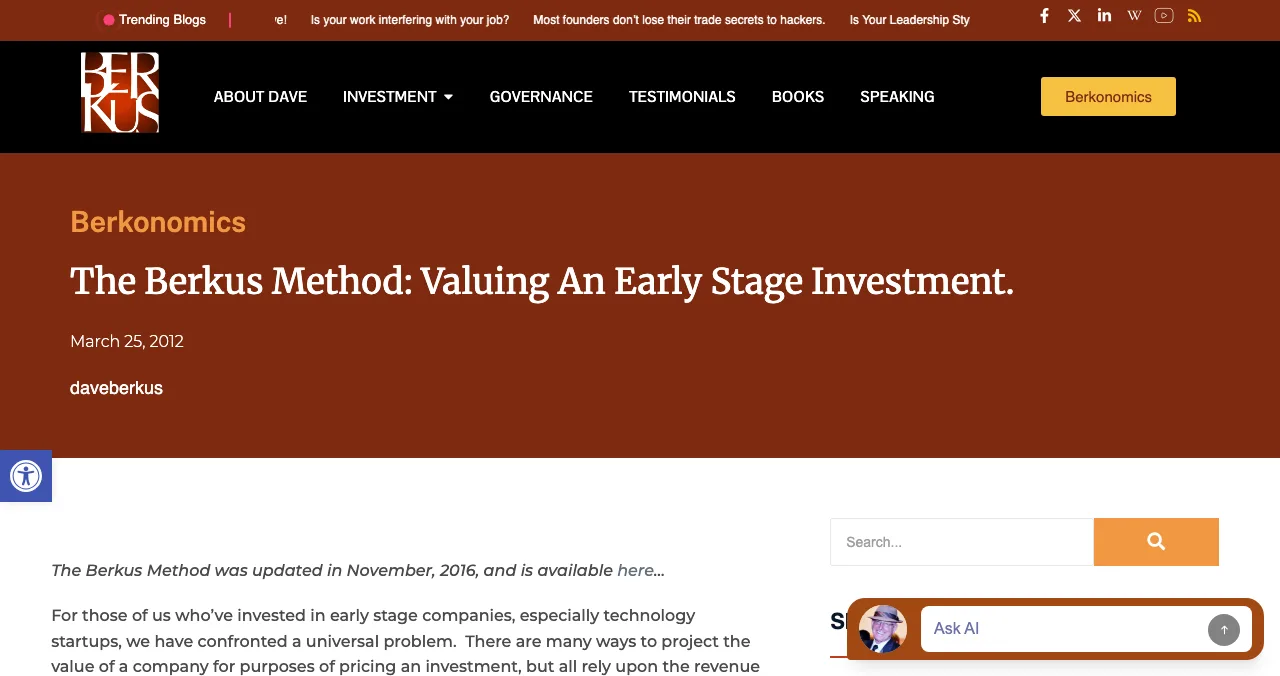
His reasoning is blunt. Founders' revenue forecasts are unreliable at this stage (his update says fewer than one in a thousand start-ups hit their projected revenues on time), so a valuation built on a five-year spreadsheet is fiction. Instead, he values what already exists.
Before any scoring, Berkus applies a filter: the company should have a plausible chance of reaching more than $20 million in revenue within five years. He describes that hurdle as his own rule of thumb that investors can adjust. If a startup can't pass it, the method isn't meant for it.
The five Berkus elements, and what each one de-risks
| Element | Risk it reduces | Maximum added (original) |
|---|---|---|
| Sound idea | Basic value and product risk | Up to $500,000 |
| Prototype | Technology risk | Up to $500,000 |
| Quality management team | Execution risk | Up to $500,000 |
| Strategic relationships | Market and competitive risk | Up to $500,000 |
| Product rollout or sales | Financial or production risk | Up to $500,000 |
Table: The Berkus method's five elements and caps, from Dave Berkus's 2012 article (checked 18 Nov 2026)
Berkus's article puts the pre-revenue ceiling at about $2 million, rising to about $2.5 million once the product has rolled out. Every figure is a maximum: an investor can give any element a fraction of the cap, or nothing.
Sound idea (basic value)
Is this a real problem with a large enough market that a solution could be worth something? Investors score it by how well you've shown the problem exists: customer conversations, a clear one-line value proposition, a reachable market. A clever idea nobody has validated scores low.
Prototype (technology risk)
Can it be built? A working prototype, in users' hands, shows that the core technology works and that the team can ship. A clickable mock-up is weaker evidence than a product a stranger can sign up for.
Quality management team (execution risk)
Can these people execute? Investors look at relevant experience, completeness of the team and whether the founders can recruit.
Strategic relationships (market risk)
Signed pilots, channel partners, distribution deals and well-known advisers reduce the risk that the product never reaches its market.
Product rollout or sales (production risk)
Has the product launched, and are people using it? This element is the bridge to revenue. Early users, a public launch and the first sales all count.
A worked Berkus method example (illustrative)
The company below is hypothetical. The scores show how an angel might reason, not what your startup is worth.

Hypothetical startup
A B2B scheduling app for clinics, three founders, pre-revenue.
Stage
Working beta, 40 clinics on a waitlist, one pilot letter of intent.
Filter
A plausible path to $20 million in revenue in five years: passes.
| Element | Evidence the investor sees | Score (illustrative) |
|---|---|---|
| Sound idea | 30 clinic interviews, clear pain around no-shows | $400,000 |
| Prototype | Working beta that new users can sign up for | $300,000 |
| Quality management team | Two repeat founders, no sales lead yet | $350,000 |
| Strategic relationships | One pilot letter of intent, no channel partner | $100,000 |
| Product rollout or sales | Public launch, waitlist, no paying customers | $150,000 |
| Pre-money valuation | $1,300,000 |

Table: Illustrative Berkus method valuation for a hypothetical pre-revenue startup
If this startup raised $300,000 on that number, the post-money valuation would be $1.6 million and the investor would own $300,000 ÷ $1.6 million = 18.75%. Our startup valuation guide explains the pre-money and post-money arithmetic in more detail.
Notice where the gaps are. The prototype scored $300,000 rather than $500,000 because the investor couldn't see evidence that new users succeed without help. The rollout scored $150,000 because there's a launch but no usage data. Both gaps can close in weeks, not years.
What did Berkus change in his 2016 update?
In November 2016 Berkus updated the method; the Angel Capital Association republished the update on its blog under the title "After 20 Years: Updating the Berkus Method of Valuation".
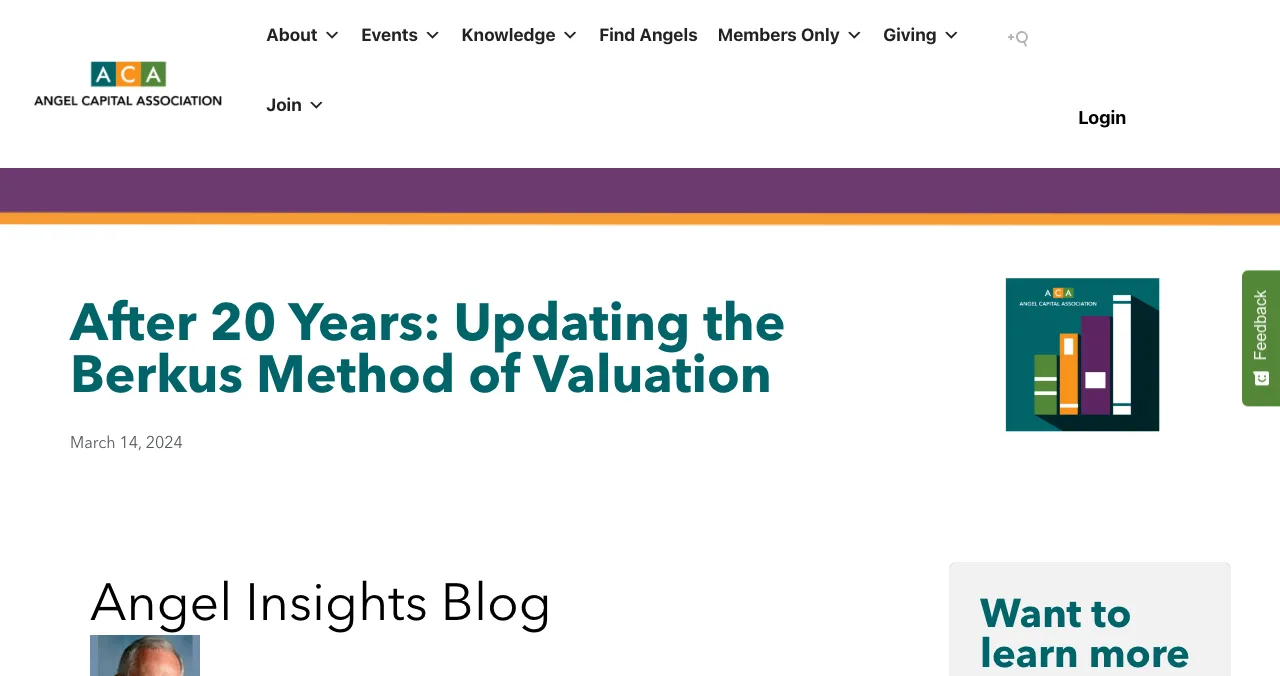

- Caps can rise or fall by place and sector: he cites an example of a $1.5 million maximum per element for a big-data startup in Silicon Valley against $500,000 in Nebraska
- Risks can be swapped: a medical-device startup might replace marketing risk with FDA-approval risk
- The matrix is a suggestion, not a form: investors should pick the risks that matter most to them
- Still pre-revenue only: "Once a company is in revenues, the Method is no longer applicable," in his words
- Room for a tenfold return: valuations should stay low enough to compensate investors for risk
He also notes that the added flexibility makes a simple method more complex. In practice, ask the investor what caps they use before debating your scores.
How the Berkus method compares with other valuation methods
| Method | Starts from | Best for | Main weakness |
|---|---|---|---|
| Berkus | Zero, adding value per element | Pre-revenue, very early | Fixed caps can lag the market |
| Scorecard | Median pre-money of comparable funded startups | Pre-revenue with local deal data | Needs a reliable baseline |
| VC method | Exit value ÷ target return | Venture-scale startups | Exit value is a guess |
| Comparables | Revenue multiples of similar companies | Revenue-stage startups | Needs revenue |
Table: Berkus method versus other startup valuation methods
Most angels triangulate: run two or three methods, see where they cluster, then negotiate around round size and ownership. The startup valuation hub covers the full set, and our Berkus and Scorecard calculator runs the numbers side by side.
How to raise your Berkus score with evidence
Every element is a risk, and risk falls when an investor can see proof. Here's what proof looks like for each, and where a public launch and an independent product test help. They don't help with all five, and we'll say so.
| Berkus element | Evidence that raises it | Does the Launchpad help? |
|---|---|---|
| Sound idea | Interviews, a clear one-liner, search demand | Partly: the free baseline checks how your landing page communicates |
| Prototype | A product strangers can use without help | Yes: the product investigation tests sign-up, onboarding and the core flow |
| Quality management team | Track record, hires, advisers | No |
| Strategic relationships | Signed pilots, partners, LOIs | No |
| Product rollout or sales | Public launch, users, early sales | Yes: a permanent public listing with a Featured badge, vouches and followers |
Table: Mapping the five Berkus elements to evidence a founder can show
The Science of Apps Launchpad: proof for the prototype and rollout

Listing is free, forever, in six short steps, with automated checks and human moderation. Ranking depends on relevance, editorial picks and community interest, never payment. You go live with a Featured badge, can earn Verified (with a work email on your domain), Community favourite and Editor's pick, and collect vouches and followers: public, dated signals of rollout.
For the prototype element, the product investigation is the stronger evidence. It loads your product in a real browser on desktop and mobile and tests it end to end, then hands you a detailed report.
- Areas tested across the journey
- 22
- Automatic measurements, desktop and mobile
- 39
- Expert heuristics on real screens
- 74
- Verdicts, from Good to Critical
- 5
Arrive
First impression
Discoverability, landing page, pricing, trust and speed.
Join
The first minutes
Sign-up, sign-in, recovery and onboarding.
Use
The everyday job
Core flow, dashboards, search, microcopy and error states.
Pay
Value into revenue
Paywall, upgrade, checkout and payments.
Stay
Coming back
Notifications, account, settings and help.
Every screen
Throughout
Accessibility, visual design and consistency.
Every finding is analyst-reviewed, private to your team and never affects your ranking. A free baseline diagnosis (landing page, discoverability, speed) runs as you go live.
Show investors a tested product
List free, then order the report that fits your round.

 Economy
See what new customers see
- Store listing and homepage, screen by screen
- Scorecard against 60 Laws of UX
- The fixes worth most
PremiumThe full diagnosis and the plan
- Every screen, every finding, every flow
- All 60 laws with evidence and fixes
- 8 strategy chapters and a 90-day roadmap
Fact-checked against the evidence. Private by default.
A two-week plan before your angel meeting
- Day 1
List the product
Create your free Launchpad listing; read the baseline diagnosis.
- Days 2–4
Fix the obvious
Close Critical findings in sign-up and the core flow.
- Days 5–8
Show rollout
Share the listing, collect vouches, get the first users through onboarding.
- Days 9–11
Paper the relationships
Turn verbal pilots into letters of intent.
- Days 12–14
Score yourself
Run Berkus and the scorecard; bring the evidence for each element.
Common Berkus method mistakes

- Scoring every element at the cap — $500,000 is a ceiling; claiming it everywhere signals you haven't understood the method
- Using it after revenue — Berkus says it no longer applies; use revenue-based methods
- Skipping the $20 million filter — a lifestyle business can be great and still not fit the method
- Treating a mock-up as a prototype — investors discount what users can't actually use
- Anchoring on one method — the first number said aloud sets the anchor; triangulate before you share one
Ready to launch?
How we know
The five elements, the $500,000 caps, the $2 million and $2.5 million ceilings, the $20 million filter and the pre-revenue limit come from Dave Berkus's 2012 article on berkus.com. The changes come from his 2016 update as republished by the Angel Capital Association. The scorecard comparison uses Bill Payne's 2019 revision on the ACA blog. All were read on 18 November 2026. The worked example is hypothetical. Science of Apps runs the Launchpad; its facts come from its homepage, investigation and pricing pages, checked the same day.
Key terms, defined
- Berkus method: a pre-revenue valuation that adds up to a set amount for each of five risk-reducing elements.
- Pre-revenue: a company that hasn't yet earned revenue from customers.
- Pre-money valuation: the company's value before new investment.
- Post-money valuation: pre-money valuation plus the new investment.
- Risk reduction: evidence that removes a reason the company might fail, such as a working prototype.
- Valuation cap: the most an element (or, in a SAFE, a conversion) is allowed to be worth.
Frequently asked questions
What is the Berkus method?
The Berkus method is a pre-revenue startup valuation method created by angel investor Dave Berkus. It adds up to $500,000 for each of five elements that reduce risk: a sound idea, a prototype, a quality management team, strategic relationships and product rollout or sales. The total is the pre-money valuation. Berkus says it applies only before a company has revenue.
What are the five factors of the Berkus method?
Sound idea (basic value and product risk), prototype (technology risk), quality management team (execution risk), strategic relationships (market and competitive risk), and product rollout or sales (financial or production risk). Each can add up to $500,000 in Berkus's original 2012 article, and investors can give any element much less.
What is the maximum Berkus method valuation?
In the original article, a pre-revenue company can reach about $2 million and a company that has rolled out its product about $2.5 million. Berkus's 2016 update says the maximums should change by region and industry, giving an example of $1.5 million per element in Silicon Valley against $500,000 in Nebraska.
When should you not use the Berkus method?
Don't use it once the company has revenue; Berkus says the method no longer applies then and actual revenue should drive the value. It also fits poorly for service businesses, which he says usually warrant lower values, and for companies that can't plausibly reach $20 million in revenue within five years.
Is the Berkus method still used in 2027?
Yes, mostly by angel investors and accelerators as a quick sanity check at pre-seed. Berkus himself updated it in 2016 to allow different caps and renamed risks, and the Angel Capital Association republished that update. Most investors combine it with the scorecard method, the VC method and comparable round data.
How is the Berkus method different from the scorecard method?
Berkus builds a value from zero by adding money for each risk removed. The scorecard method, from Bill Payne, starts with the median pre-money of comparable funded startups in your region and multiplies it up or down by weighted factors such as team, market and product. Scorecard therefore moves with the market; Berkus doesn't unless you change the caps.
How can a founder raise their Berkus score?
Reduce the risks the elements measure, and show proof. Ship a working prototype rather than a mock-up, put it in front of real users, document partnerships in writing and show early rollout. A public launch listing and an independent product test are evidence for the prototype and rollout elements; the team and relationships need their own proof.
Sources
- Dave Berkus — The Berkus Method: Valuing an Early Stage Investment, 25 Mar 2012 (checked 18 Nov 2026)
- Angel Capital Association — After 20 Years: Updating the Berkus Method of Valuation, by Dave Berkus (checked 18 Nov 2026)
- Angel Capital Association — Scorecard Valuation Methodology (Rev 2019), by Bill Payne (checked 18 Nov 2026)
- Kauffman Foundation — Valuation of Pre-revenue Companies: The Venture Capital Method, by Bill Payne (checked 18 Nov 2026)
- Science of Apps — Launchpad: list your startup free (checked 18 Nov 2026)
- Science of Apps — Product investigation: 22 areas (checked 18 Nov 2026)
- Science of Apps — Pricing: Economy and Premium reports (checked 18 Nov 2026)
- Checked November 18, 2026. Figures that change — fees, salaries, prices — are reviewed every six months; if something is out of date, tell us.
Where to go from here
- Startup valuation — every method, compared
- How to evaluate a startup — the 30-point framework
- Launch profile in your pitch — turn a listing into evidence
- Science of Apps - LaunchpadHow to calculate the valuation of a startup: a step-by-step calculator in tables for pre-money and post-money, the Berkus method, the scorecard method and the VC method, with a worked example and spreadsheet formulasCalculate the valuation of a startup in five steps: pre-money and post-money maths, then Berkus, scorecard and VC method worksheets, blended into a range.
- Science of Apps - LaunchpadPre-revenue startup valuation: how investors value a startup with no revenue, the methods they use, what published pre-seed valuation data shows and the evidence that raises your numberHow pre-revenue startups are valued: Berkus, scorecard and VC methods, dated pre-seed valuation data, and the evidence investors accept with no revenue.
- Science of Apps - LaunchpadScorecard method valuation step by step: Bill Payne's seven weighted factors, how to set the baseline, his worked example, a second illustrative example and how to raise your product scoreScorecard method valuation: start from the median pre-money of comparable funded startups, then weight seven factors. Bill Payne's steps and examples.
- Science of Apps - LaunchpadThe VC valuation method explained: the formula from exit value and target return to pre-money, dilution and retention, a worked example and how milestones lower the return investors demandThe VC valuation method divides a startup's expected exit value by the investor's target return to get post-money value. Formula, dilution and an example.
- Startups in IndiaStartup valuation: how to value your startup at pre-seed and seed, with methods and worked examplesHow to value a startup at pre-seed and seed: the methods investors use, a worked VC-method example, dilution maths and India's valuation report rules.
- Templates & toolsRICE prioritization: the formula, a worked calculator table and how to score features honestlyRICE prioritization explained: the Reach × Impact × Confidence ÷ Effort formula, scoring scales, a worked calculator table for five features and common traps.




Get the ideas, not the noise.
Sign up with Google and we’ll send you short UX psychology tips by email — why people tap, stall and leave, and what to do about it. Unsubscribe anytime. Prefer something to keep? Get the free Laws of UX guide as a PDF.
Launch day ends. Your listing shouldn't.
Two of the five Berkus elements, the prototype and the rollout, are things you can prove. List free on the Science of Apps Launchpad: your product goes live publicly and gets tested end to end, with a detailed report as evidence.