 By
Quick answer: Do investors look at launch traction?
- Link: a live product page in the deck and intro email.
- Numbers: sign-ups, active users, conversion, retention.
- Third-party proof: badges and vouches investors can verify.
- Placement: the traction slide, not the title slide.
- Honesty: interest isn't revenue; label each signal.
Key takeaways
- Investors check what you claim; make it checkable.
- Retention and revenue outweigh launch-day attention.
- A launch shows you can reach users, which is worth saying.
- Badges help when they're verifiable and relevant.
- One honest chart beats ten logos.
An investor reads your intro email, opens the deck and, within a minute, opens a new tab to check the product. What they find there does more for your credibility than any slide. A launch profile is often that page: a public listing with a description, screenshots, links and community signals. Used well in a pitch, it turns "we launched and people liked it" into something an investor can verify. Used badly, it's a row of badges that says nothing about the business. This guide covers which launch signals count, where they go and how to present them honestly, drawing on Sequoia's and YC's deck guidance as read on 17 November 2026. Jump to what counts, where it goes or what not to claim.
- Click an investor should need to see your product
- 1
- Kinds of traction proof: usage, revenue, third-party
- 3
- Traction slide where launch results belong
- 1
- Upvotes that count as revenue
- 0
Which launch signals investors can use
| Signal | What it shows | Weight | How to make it verifiable |
|---|---|---|---|
| Retained users from the launch | People came back | High | Cohort chart from your analytics |
| Paying customers from the launch | People paid | High | Count and MRR, consistent with your data room |
| Sign-ups and activation | Interest turned into use | Medium | Funnel numbers with dates |
| Third-party badges and vouches | Others checked or endorsed it | Supporting | Badges that link to their source |
| Leaderboard rank or upvotes | Attention on one day | Low on its own | Link to the launch page |
Table: Launch signals in an investor pitch, by weight (editorial guidance)
Sequoia's outline asks for the problem, solution, why now, market, competition, business model and, "if you have any", financials. Launch results sit under evidence that the solution works and that you can reach customers. YC's Aaron Harris warns that seed decks get muddled when founders pretend there's more detail than there is; one clear traction chart does more than a collage.
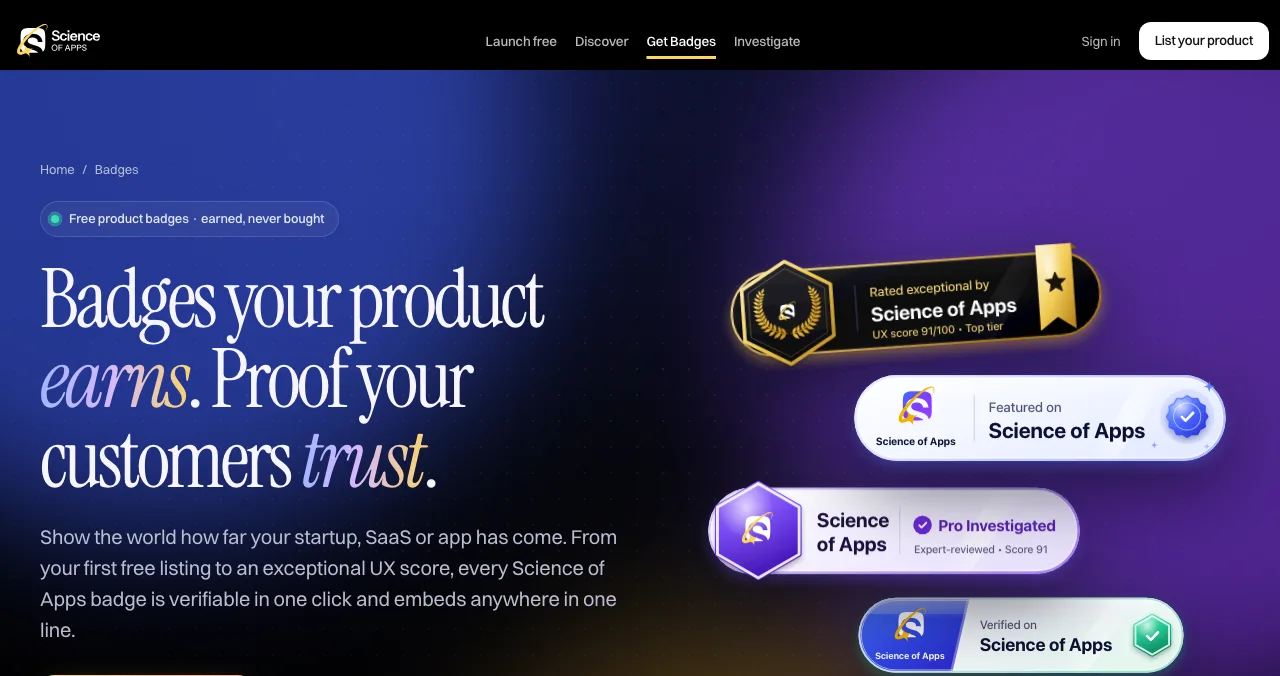
Science of Apps Launchpad badges are earned as a listing reaches each stage and are verifiable in one click: Featured (a published, moderated listing), Verified (proven domain ownership), Community favourite (25 vouches from trusted members) and, for products that release a UX investigation, Investigated with its score. In a pitch, Verified and Community favourite are the useful ones: they show the listing is really yours and that people vouched for it.
Where launch traction goes in the deck

- Intro email — one line: "Launched in March; 1,200 sign-ups, 340 active weekly", with the product link.
- Title slide — company name and one-liner only (per YC's template).
- Traction slide — the chart first, then the launch as the channel that produced it, with a small verifiable badge.
- Go-to-market slide — the launch as a tested channel and what you'll repeat.
- Appendix or data room — the funnel, cohort data and links.
What not to claim

- Sign-ups as users — say "sign-ups" and show the active number separately
- Upvotes as customers — attention isn't demand
- "#1 Product of the Day" without context — say what it led to
- Badges that don't link — investors will check
- Numbers that differ from Crunchbase or your data room — keep one source of truth
Mistakes

- A badge collage on the title slide
- No product link in the email
- Totals without trends — show week-by-week
- A launch with no follow-up data — measure what happened after
Ready to make it checkable?
How we know
Deck guidance comes from Sequoia's "Writing a Business Plan" and Aaron Harris's YC article; badge rules from the Science of Apps badges page; all read on 17 November 2026. The signal weights and placement steps are our editorial guidance, not investor survey data. Example numbers are illustrative.
Key terms, defined
- Launch profile: a permanent public product page on a launch platform.
- Traction slide: the deck slide showing evidence of demand.
- Cohort chart: how a group of users who joined together behaves over time.
- Data room: a shared folder of documents investors review in diligence.
- Verifiable badge: a badge that links to a source confirming it.
Frequently asked questions
Do investors look at launch traction?
They look at what it led to. A launch that brought sign-ups who stayed and paid is real evidence; a high rank with no follow-on usage isn't. Present the launch as a channel test with its results.
Should I put Product Hunt or launch badges in my pitch deck?
Only on the traction slide, small, and alongside the numbers it produced. A badge shows third-party recognition; the numbers show whether it mattered. Make sure any badge links to a page investors can check.
What traction metrics should an early startup show?
Whichever best shows demand at your stage: active users and retention for consumer products; paying customers, MRR and pipeline for B2B; activation rate if you're pre-revenue. Show trend, not just a total.
What is a launch profile?
A permanent public page for your product on a launch platform, with a description, screenshots, links and often community signals such as upvotes, vouches or badges.
How do I make traction claims verifiable?
Link to the live product and public profiles, use badges that link to their source, keep numbers consistent with your Crunchbase profile and data room, and be ready to show the analytics behind them.
What shouldn't I claim?
Don't present sign-ups as active users, upvotes as customers or a badge as a funding signal. Overclaiming early is the fastest way to lose an investor's trust.
Sources
- Y Combinator — How to build your seed round pitch deck (Aaron Harris; checked 17 Nov 2026)
- Sequoia Capital — Writing a Business Plan (checked 17 Nov 2026)
- Science of Apps — Launchpad badges (checked 17 Nov 2026)
- Science of Apps — Launchpad: launch your product free
- Checked November 17, 2026. Figures that change — fees, salaries, prices — are reviewed every six months; if something is out of date, tell us.
Where to go from here
- Pitch deck feedback — get it reviewed
- Startup valuation — what traction is worth
- Crunchbase alternatives — where investors look
- Science of Apps - LaunchpadHow to launch and promote a Chrome extension: the Chrome Web Store listing, the free launch sites that take extensions, and where users look for themHow to launch and promote a Chrome extension: the Web Store's one-time fee and listing, then Product Hunt, Show HN, DevHunt, AlternativeTo and a free profile.
- Science of Apps - LaunchpadProduct launch examples from public case studies (Tinder, DoorDash, Lyft, Airbnb's deck, Buffer's openness, YC's Launch YC) and the Laws of UX that explain why they workedProduct launch examples from public case studies (Tinder, DoorDash, Lyft, Airbnb, Buffer) and the behavioural principles behind them.
- Science of Apps - LaunchpadHow to launch a side project: where to post it (Show HN, Product Hunt, Indie Hackers, a permanent listing), how to launch on limited hours, and the signals it could be a startupHow to launch a side project on limited hours: where to post it (Show HN, Product Hunt, Indie Hackers, a listing) and signs it could be a startup.
- Career guidesPitch deck skills for 2027: telling a clear story, problem and solution slides, market size, traction, business model, competition, team, the ask, design that reads in under three minutes and handling investor questionsPitch deck skills for 2027: a clear story, problem, solution, market, traction, business model, team, the ask, fast-reading design and investor questions.
- Science of Apps - LaunchpadHow to launch an AI product: prove the outputs, describe the task not the model, pick free and paid launch sites, and make sure AI search can find youHow to launch an AI product in 2027: show real outputs, describe the task, launch on Product Hunt and AI directories, and get found by AI search engines.
- Science of Apps - LaunchpadFree G2 and Capterra alternatives for collecting your first reviews: Product Hunt reviews, AlternativeTo, SaaSHub and Launchpad vouches, and how to ask for them honestlyFree G2 alternatives for a new SaaS's first reviews: Product Hunt, AlternativeTo, SaaSHub, Launchpad vouches and G2's own free plan.
Get the ideas, not the noise.
Sign up with Google and we’ll send you short UX psychology tips by email — why people tap, stall and leave, and what to do about it. Unsubscribe anytime. Prefer something to keep? Get the free Laws of UX guide as a PDF.
Launch day ends. Your listing shouldn't.
A free, permanent Launchpad profile gives your deck a live product link with verifiable badges (Featured, Verified, Community favourite) that can't be bought, ranked by relevance, never payment.