 By
Quick answer: What makes a great product launch?
- Go where users are: Tinder on campus; DoorDash flyers at Stanford.
- A reason to act now: Lyft's ice cream plus ride credits.
- One clear sentence: Sequoia's 'company purpose', used by Airbnb.
- Trust in the open: Buffer's public metrics.
- A home page for the launch: one link everything points to.
Key takeaways
- Famous launches were often small and local at first.
- Clarity of the idea mattered more than polish.
- A tangible reason to try it now beats a generic announcement.
- Openness builds trust when you have no reputation.
- Copy the principle, not the stunt.
Launch case studies are usually told backwards: a famous company, a clever stunt, a hockey-stick chart. Look at the public accounts of how they actually started and a quieter pattern shows. They began small and local, explained the idea in a sentence, gave people a concrete reason to try it now, and earned trust in the open. This piece walks through examples from public sources, as read on 17 November 2026, and the behavioural principles that explain them. Jump to the examples, the pattern or applying it.
- Traits great launches share
- 4
- Campus, city or office cluster to start with
- 1
- Sentence to explain the idea
- 1
- Page every mention links to
- 1
Product launch examples
| Example | What they did | The principle | Source |
|---|---|---|---|
| Tinder | Pitched it to sororities and fraternities at USC | Go where users already gather | Lenny Rachitsky, 2020 |
| DoorDash | A site with PDF menus and flyers around Stanford, to test demand | Smallest real test | Lenny Rachitsky, 2020 |
| Lyft | Ice-cream drop-offs at startup offices with Lyft credits | A reason to try it now (reciprocity) | Lenny Rachitsky, 2020 |
| Airbnb | Used Sequoia's pitch guide to explain the idea | One clear sentence | Sequoia Capital |
| Buffer | Public dashboard of revenue, users and salaries | Trust through openness (social proof) | Buffer |
Table: Product launch examples from public sources (checked 17 Nov 2026)
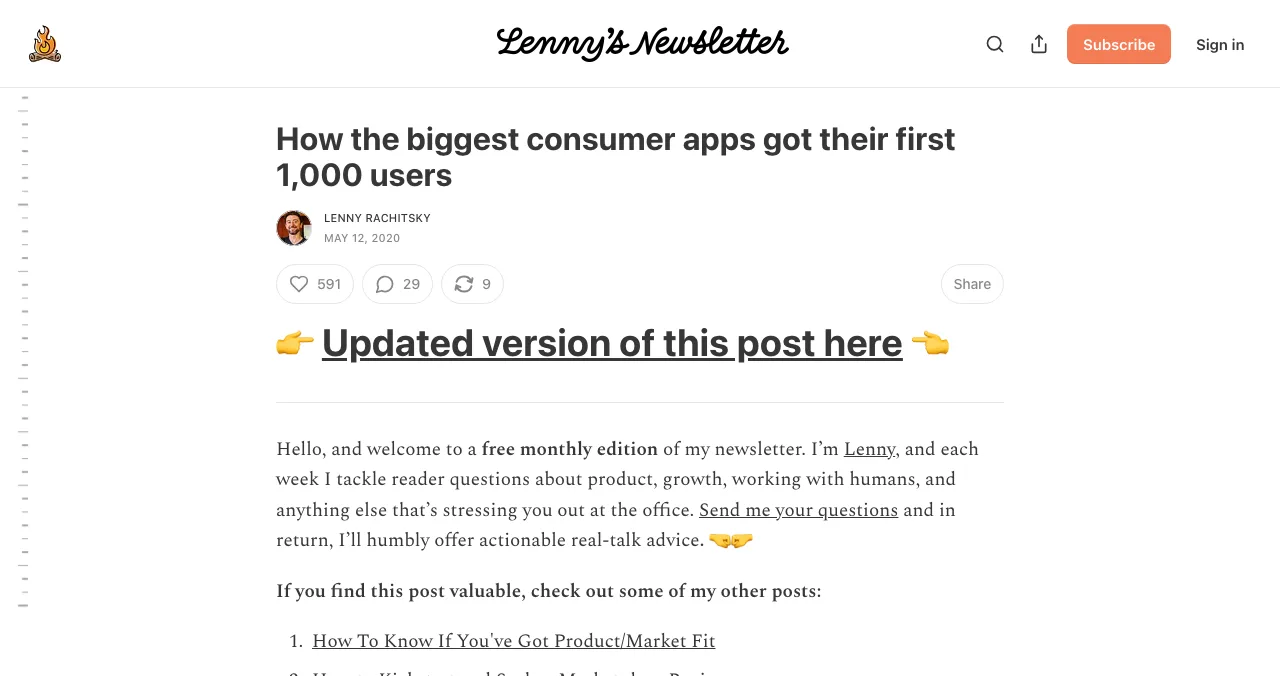
Lenny Rachitsky's 2020 research collected first-hand accounts from founders and early team members. DoorDash's first version was paloaltodelivery.com, with PDF menus and flyers around Stanford to see whether there was demand. Lyft's team arranged ice-cream sundae drop-offs at startup offices along with Lyft credits.
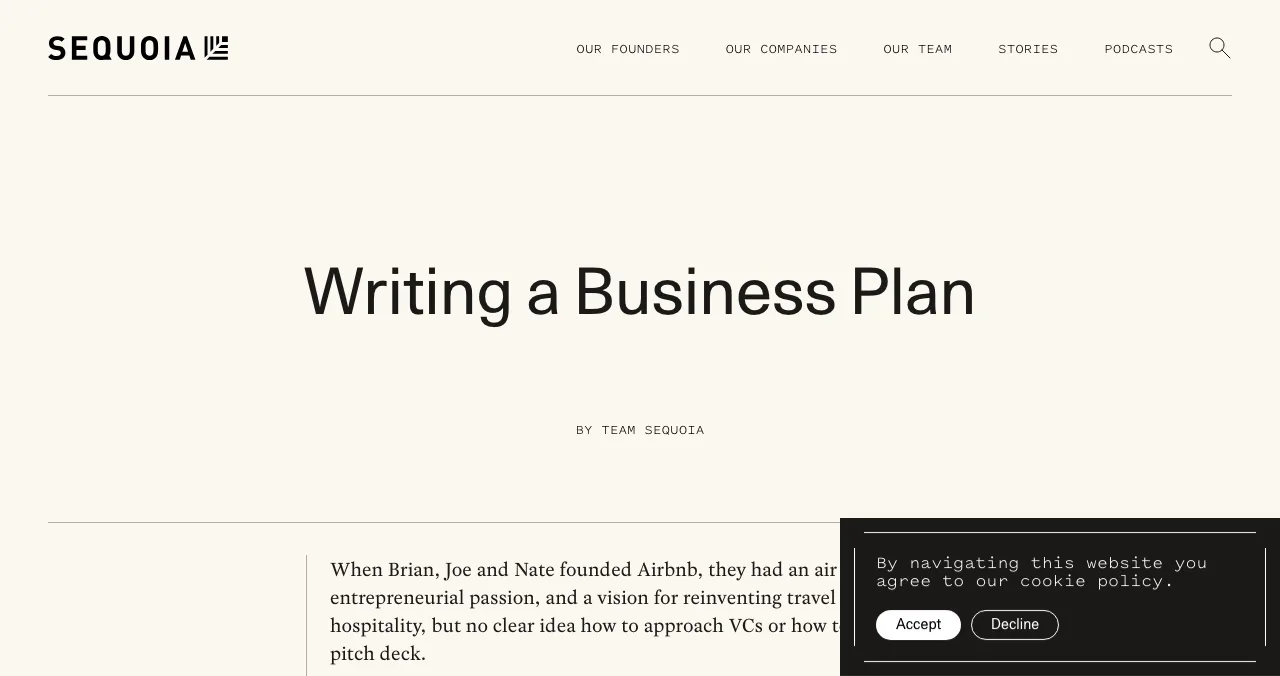
Sequoia says Airbnb's founders came across its guide to writing a business plan when they had "no clear idea" how to approach VCs, and that what it liked was "the clarity of their thinking". Its outline starts with the company's purpose in a single declarative sentence.
The pattern behind great launches

Start where users already are
A campus, a city, an office cluster, a community. Less effort for them to try it.
Explain it in one sentence
Clarity lowers cognitive load and makes the idea easy to pass on.
Give a reason to try it now
A credit, a free first use, a demo they can touch.
Build trust in the open
Real numbers, real people, real progress when you have no reputation yet.
What a launch website needs

- One sentence — what it does, for whom
- The product, shown — a screenshot or short demo
- One action — try it, join, or book
- Real proof — named quotes or honest numbers
- A permanent link — the page every post points to
See the landing page checklist for the full set.
Apply it to your launch

- Pick your campus — one community or place where your first users gather.
- Write the sentence — test it on five people.
- Choose the reason to try now — a credit, a free month, a live demo.
- Put up the page — a launch listing and your landing page.
- Share openly — what you launched, what happened, what's next.
Mistakes

- Copying the stunt — copy the principle
- Launching everywhere at once — start where users are dense
- A clever tagline nobody understands — clarity first
- No page to land on — every mention needs a link
Ready to launch?
How we know
Examples come from Lenny Rachitsky's 2020 research (first-hand accounts he collected), Sequoia's "Writing a Business Plan" and Buffer's open dashboard, read on 17 November 2026. The pattern and the Laws of UX links are our editorial analysis.
Key terms, defined
- Product launch: introducing a product to its first audience.
- Reciprocity: people's tendency to return a favour.
- Cognitive load: the mental effort a message or interface demands.
- Social proof: following what others like us do.
- Launch page: the page a launch's posts and mentions link to.
Frequently asked questions
What makes a great product launch?
Reaching people who have the problem, where they already are; explaining the product in one sentence; giving a concrete reason to try it now; and having one page that every mention links to. Public case studies of early launches show all four.
What are some famous product launch examples?
From Lenny Rachitsky's research: Tinder's founders pitched it to students on campus, DoorDash started with PDF menus and flyers around Stanford, and Lyft delivered ice cream with ride credits to startup offices. Airbnb's founders used Sequoia's pitch guide to explain their idea.
What should a product launch website include?
A one-line description of what it does and for whom, a product visual, one clear call to action, proof (real quotes or numbers), and a way to try it immediately. See our landing page checklist.
Can a small startup copy big launches?
Copy the principle, not the budget. Most famous launches began small and local: one campus, one city, one set of offices. That's the part a small startup can reproduce.
Why do these launches work psychologically?
Going where users are reduces effort; a free trial or credit lowers the cost of trying (reciprocity); a clear sentence reduces cognitive load; open numbers act as social proof and authority.
Where should I launch?
Where your users already gather, plus launch sites that give you a permanent page. See our list of places to launch a startup.
Sources
- Lenny's Newsletter — How the biggest consumer apps got their first 1,000 users (2020; checked 17 Nov 2026)
- Sequoia Capital — Writing a Business Plan (checked 17 Nov 2026)
- Buffer — Open metrics (checked 17 Nov 2026)
- Y Combinator — Launch YC (checked 17 Nov 2026)
- Checked November 17, 2026. Figures that change — fees, salaries, prices — are reviewed every six months; if something is out of date, tell us.
Where to go from here
- Product launch strategy — plan yours
- Landing page checklist — the launch page
- Laws of UX — why it works
- Science of Apps - LaunchpadHow to use launch traction in a startup pitch: which launch signals investors can verify, where they belong in the deck, and how to present them honestlyHow to use a launch profile and launch traction in your pitch: signals investors can verify, where they go in the deck and what not to overclaim.
- Science of Apps - LaunchpadHow to use Indie Hackers to launch and grow: what the community rewards, what to post, and how it fits with Product Hunt and Show HNHow to use Indie Hackers to launch: what the founder community rewards, posts that work, mistakes that get ignored, and where it fits with other launches.
- Science of Apps - LaunchpadRoast my landing page: 25 fixes founders hear in landing page roasts, each with the principle that explains itRoast my landing page, done properly: 25 landing page fixes for headlines, CTAs, pricing, trust and speed, each tied to a usability or behavioural principle.
- Science of Apps - LaunchpadHow to run a launch week, and why launching is a habit, not a day: every kind of launch a startup can do, from silent launches to feature dropsHow to run a launch week and launch repeatedly: silent launches, communities, Hacker News, Product Hunt, request-access waitlists and feature drops, in order.
- Science of Apps - LaunchpadHow to find early adopters: who they are, the ten places they gather, and how to turn them into your first users and championsHow to find early adopters for a startup: who they are, where they gather (communities, launch sites, BetaList), how to approach them and keep them.
- Science of Apps - LaunchpadThe Product Hunt launch mistakes that kill your ranking, or your launch, and how to avoid each oneThe Product Hunt launch mistakes that hurt ranking or get launches removed: asking for upvotes, new-account votes, vague taglines, broken flows and more.
Get the ideas, not the noise.
Sign up with Google and we’ll send you short UX psychology tips by email — why people tap, stall and leave, and what to do about it. Unsubscribe anytime. Prefer something to keep? Get the free Laws of UX guide as a PDF.
Launch day ends. Your listing shouldn't.
A free, permanent Launchpad profile is the page your launch points to, found by the problem you solve and ranked by relevance, never payment.