 By
Quick answer: What prompt validates an idea?
- Use AI to prepare: assumptions, competitors, interview scripts.
- Don't use it to decide: it can't observe real demand.
- Best prompt: 'List my riskiest assumptions and how to test each.'
- Interviews: ask about past behaviour, not opinions (The Mom Test).
- Real signal: sign-ups, repeat use, payment.
Key takeaways
- AI is a good thinking partner and a bad customer.
- Ask it to attack your idea, not praise it.
- Use it to write better interview questions.
- Check every factual claim it makes about markets or competitors.
- Validation happens with people, not prompts.
Paste a business idea into ChatGPT and ask whether it's good, and you'll usually get an encouraging answer with a list of strengths. That isn't validation; it's a mirror. AI models are useful for the preparation around validation: spotting the assumptions you haven't noticed, mapping alternatives, writing interview questions that don't lead. They can't tell you whether real people have the problem badly enough to pay. This list gives you 10 prompts that make AI a sharper thinking partner, then shows where the real test begins. Jump to the prompts, what AI can't do or the real test.
- Prompts in this list
- 10
- Thing AI can't do: observe your market
- 1
- Customer conversations to start with
- 10–20
- Real signals: sign-ups, repeat use, payment
- 3
10 prompts to validate a business idea
Replace the brackets with your details. Ask for criticism, not reassurance.
1. Riskiest assumptions
Here's my business idea: [idea, customer, price]. List the 10 assumptions it depends on, ranked by how likely each is to be wrong and how much it matters. For each, suggest the cheapest real-world test.
2. Who has the problem worst
Who experiences [problem] most often and most painfully? Describe three specific customer segments, how each solves it today and what that costs them.
3. Alternatives, including doing nothing
List every way people currently deal with [problem], including spreadsheets, hiring someone and ignoring it. For each, why would someone switch away from it?
4. Competitor map
Suggest products and services that solve [problem] for [customer]. For each, say what you're unsure about so I can verify it.
5. Interview questions (Mom Test style)
Write 10 customer interview questions about [problem] that ask about past behaviour, not opinions or hypotheticals, and never mention my product.
6. Pricing stress test
My customer is [segment] and I plan to charge [price]. What would they compare this price to? What would make them say it's too expensive?
7. Devil's advocate
Argue as strongly as you can that this idea will fail: [idea]. Be specific.
8. Smallest test
What's the smallest thing I could launch in a week to see whether [customer] will use or pay for [solution]?
9. Signals to watch
If this idea is working, what would I see in the first 30 days? If it isn't, what would I see? Give measurable signals.
10. Summarise interviews
Here are notes from [n] customer interviews: [notes]. What patterns repeat? What did people actually do, as opposed to say? What contradicts my assumptions?
What AI can't do

AI is good for
- Listing assumptions you missed
- Brainstorming segments and alternatives
- Drafting non-leading interview questions
- Summarising your interview notes
AI can't
- Observe whether people have the problem
- Tell you what they'll pay
- Guarantee its competitor facts are current
- Replace a conversation with a customer
The real test
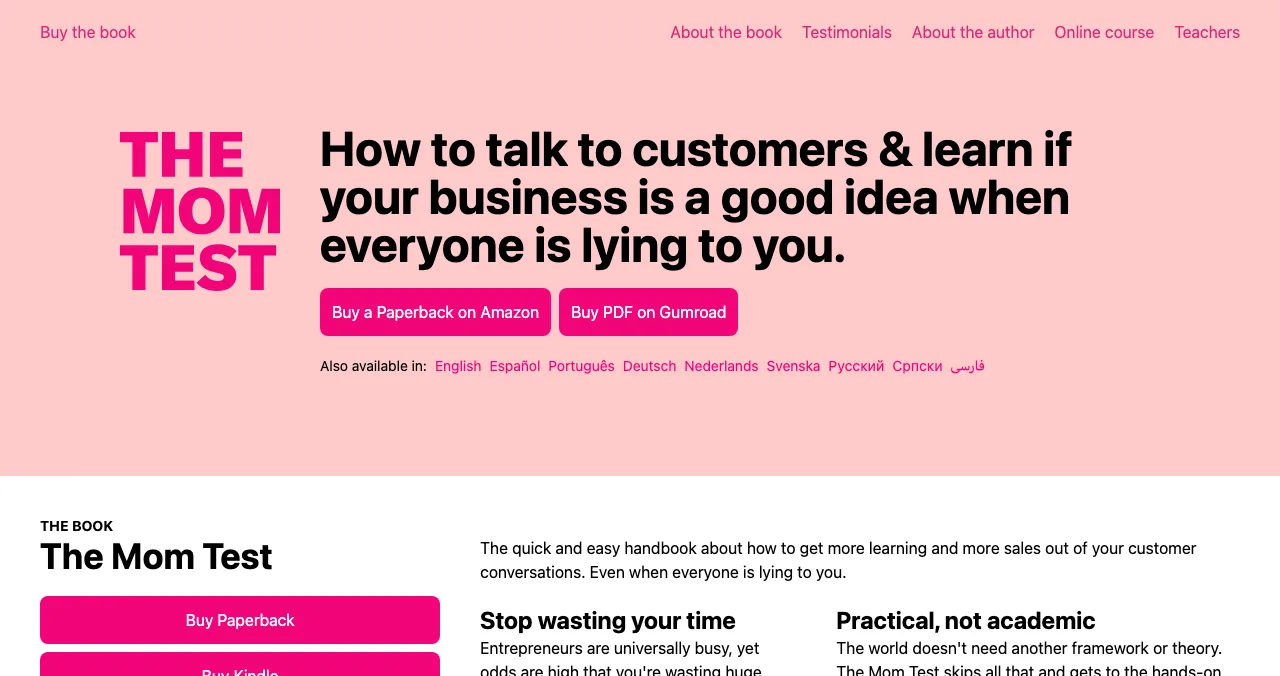
Rob Fitzpatrick's The Mom Test is subtitled "how to talk to customers and learn if your business is a good idea when everyone is lying to you". Its core idea: ask about people's lives and past behaviour, not your idea. Use prompt 5 to draft the questions, then:

- Find 10–20 people with the problem — in communities, your network, or through intros.
- Ask about the last time it happened — what they did, what it cost.
- Listen for money and time already spent — the strongest signal.
- Put something real in front of them — a page, a prototype or a manual service.
- Measure behaviour — sign-ups, repeat use, payment.
More in how to validate an app idea and the customer interview script.
Mistakes

- Asking AI "is this a good idea?" — you'll get encouragement
- Treating AI market sizes as facts — check every number
- Skipping interviews because the AI agreed
- Asking customers about your idea — ask about their lives
Ready to test with real people?
How we know
The Mom Test's subtitle comes from its website, read on 17 November 2026. The prompts, the 10–20 starting range and the limits are our editorial guidance; AI model behaviour varies by model and version.
Key terms, defined
- Validation: evidence that people have a problem and will pay to solve it.
- Assumption: something your idea depends on that you haven't proven.
- The Mom Test: a method for asking customers questions they can't answer politely.
- Leading question: a question that suggests the answer you want.
- Smallest test: the cheapest experiment that produces real evidence.
Frequently asked questions
What prompt validates an idea?
No prompt validates an idea on its own. The most useful is: 'List the riskiest assumptions behind this idea, ranked, and suggest the cheapest real-world test for each.' Then run those tests with real people.
Can ChatGPT validate my startup idea?
It can help you think: spot assumptions, list alternatives and draft interview questions. It can't tell you whether people will pay, because it can't observe your market. Treat its market facts as leads to check, not evidence.
What questions should I ask customers to validate an idea?
Ask about their past behaviour: the last time the problem happened, what they did, what it cost and what they tried. The Mom Test's core advice is to avoid asking whether they'd like your idea, because people are polite.
How many customer interviews do I need?
Enough to see patterns repeat; many founders start with 10–20 conversations with people who have the problem. Stop when you're hearing the same things.
Is a waitlist enough validation?
It's a weak signal. Sign-ups show curiosity; repeat use and payment show demand. Follow up with everyone who joins.
Can AI find competitors for my idea?
It can suggest names and categories, but check each one exists and does what the AI says; models can be out of date or wrong. Search, directories and launch sites confirm what's real.
Sources
- Rob Fitzpatrick — The Mom Test (checked 17 Nov 2026)
- Y Combinator — How to Talk to Users
- Y Combinator — How to Get Startup Ideas (Jared Friedman)
- Science of Apps — Launchpad: launch your product free
- Checked November 17, 2026. Figures that change — fees, salaries, prices — are reviewed every six months; if something is out of date, tell us.
Where to go from here
- Validate your app idea — the full method
- Customer interview script — the questions
- Micro SaaS ideas — ideas to test
- Career guidesHow to validate a business idea in 2027: problem interviews, riskiest assumptions, landing page and pre-order tests, concierge MVPs, pricing signals, success criteria and deciding whether to buildHow to validate a business idea in 2027: problem interviews, riskiest assumptions, landing pages, pre-orders, concierge MVPs, pricing signals and decisions.
- Science of Apps - LaunchpadHow to validate a startup idea in 7 days: a day-by-day plan to find out whether people will use and pay for itHow to validate a startup idea in 7 days: define the problem, find people who have it, run 10+ interviews, test demand with a page and a price, then decide.
- Science of Apps - LaunchpadStartup idea validator tools ranked honestly: AI validators (ValidatorAI, DimeADozen, IdeaProof) for research, and the real-world tests (interviews, waitlists, a live listing) that measure demandStartup idea validators ranked honestly: AI tools like ValidatorAI, DimeADozen and IdeaProof for research, and the real tests that measure demand.
- Science of Apps - LaunchpadHow to get honest feedback on your startup idea: 10 places that work, and the questions that get useful answersHow to get honest feedback on a startup idea in 2027: customer interviews, r/roastmystartup, Indie Hackers, Peerlist, Show HN and the questions to ask.
- Science of Apps - LaunchpadMarket research for startups: 9 free methods, from customer interviews and Google Trends to competitor reviews and public data, plus a market analysis and competitive analysis templateMarket research for startups, free: 9 methods from customer interviews to Google Trends and competitor reviews, plus market and competitive analysis steps.
- Science of Apps - LaunchpadHow to get testimonials from your first users: when to ask, five copy-paste request scripts, how to turn a reply into a usable quote, and the FTC rules on reviewsHow to get testimonials from your first users: ask at the moment of success, use five request scripts, get permission and follow the FTC review rules.




Get the ideas, not the noise.
Sign up with Google and we’ll send you short UX psychology tips by email — why people tap, stall and leave, and what to do about it. Unsubscribe anytime. Prefer something to keep? Get the free Laws of UX guide as a PDF.
Launch day ends. Your listing shouldn't.
Once you have something to show, a free, permanent Launchpad profile lets real people find it by the problem it solves, so you measure interest instead of guessing, ranked by relevance, never payment.