 By
Quick answer: Do AI startup idea validators work?
- AI validators: research and risks, not demand.
- DimeADozen: free 2-minute score; reports $9–$129.
- ValidatorAI and IdeaProof: quick AI idea analysis.
- Real tests: interviews, a waitlist, a live listing.
- Rule: behaviour (sign-ups, use, payment) beats scores.
Key takeaways
- An idea score is an opinion, not evidence.
- AI validators are best at fast desk research.
- Check their market facts before you rely on them.
- Customer conversations reveal problems AI can't see.
- A live page measures whether strangers actually care.
Type your idea into an AI validator and in two minutes you get a score, a market size and a list of competitors. It feels like validation. It's research, and useful research, but it can't tell you the one thing validation means: whether real people have this problem badly enough to use and pay for your solution. This list ranks idea validators honestly, putting the real-world tests first and the AI tools after, with prices from each tool's page as checked on 17 November 2026. Jump to the ranking, what AI validators are good for or the real tests.
Startup idea validators, ranked by evidence
 Test demand free
Customer interviews Most evidence
Past behaviour from people with the problem.
FreeReal evidence
Science of Apps Launchpad
A live page that shows whether strangers find and try it.
Free foreverReal behaviour
DimeADozen
Cited AI research reports.
Free score$9–$129
ValidatorAI
Quick AI idea analysis and comparison.
AIDesk research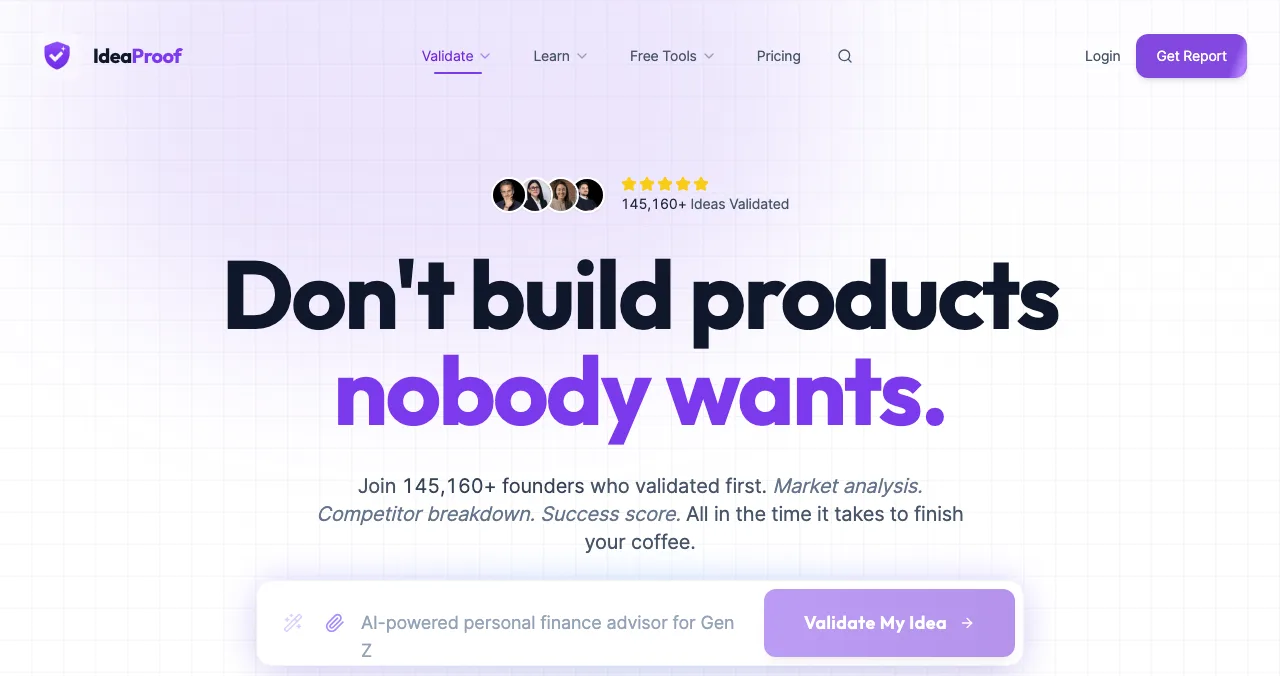
IdeaProof
A 120-second AI test.
Free testAI
Validators compared
| Validator | What it measures | Cost | Evidence type |
|---|---|---|---|
| Customer interviews | Real problems and past spending | Free | Behaviour (strong) |
| A live listing or waitlist | Whether strangers find, sign up and return | Free | Behaviour (strong) |
| DimeADozen | Market research with cited sources | Free score; $9; $129 report | Desk research |
| ValidatorAI | AI analysis and comparison with other ideas | See its site | AI opinion |
| IdeaProof | Quick AI market and competitor analysis | Free test; see its pricing | AI opinion |
Table: Startup idea validators compared by the evidence they produce (each tool's own page, checked 17 Nov 2026)
The list
1. Customer interviews
Ten to twenty conversations about people's past behaviour, not your idea. Free, slow and the strongest evidence you can get (interview script).
2. A live listing
A free, permanent listing people find by the problem they have. Whether strangers find it, click and sign up is real evidence no score can give.
3. DimeADozen
A free two-minute idea score, a $9 Starter, and a $129 Entrepreneur report it says typically runs 100+ pages with 500+ URL citations; one-time, with a 14-day money-back guarantee. Best for: cited desk research you'll verify.
4. ValidatorAI
An AI tool to validate and compare startup, product and small-business ideas; it says it has analysed 293,236 founders' ideas. Best for: a quick second opinion.
5. IdeaProof
Advertises a free 120-second AI test with market analysis, competitor breakdown and a success score. Best for: a fast first pass.
What AI validators are good for

Use AI validators for
- A fast map of competitors and alternatives
- Risks and assumptions to test
- Questions for customer interviews
Don't use them for
- Deciding whether to build
- Market sizes you haven't checked
- Replacing conversations with customers
The real tests

- Interview 10–20 people — about the last time they had the problem.
- Put up a page — a listing or landing page that states the problem and solution.
- Collect sign-ups — a waitlist (waitlist tools).
- Deliver something — a prototype or manual service to the first few.
- Measure behaviour — repeat use and payment.
Mistakes

- Treating a score as a green light
- Quoting AI market sizes without checking
- Skipping interviews because a tool agreed
- Measuring likes instead of sign-ups and payment
Ready to test with real people?
How we know
Tool details and prices come from each tool's homepage, read on 17 November 2026; figures are their own claims. We didn't test the quality of each tool's reports. The ranking by evidence type is our editorial judgement, with Science of Apps disclosed as our own.
Key terms, defined
- Idea validator: a tool or method for testing a business idea.
- Desk research: research from existing sources, without talking to customers.
- Validation: evidence that people will use and pay for a solution.
- Waitlist: a list of people asking to be notified at launch.
- The Mom Test: a method for asking customers questions they can't answer politely.
Frequently asked questions
Do AI startup idea validators work?
For research, yes: they summarise markets, competitors and risks quickly. For validation, no: they can't observe whether real people have the problem or will pay. Treat a score as a prompt for questions, then test with people.
Is there a free startup idea validator?
DimeADozen offers a free two-minute idea score, and IdeaProof advertises a free 120-second test. Customer interviews and a free listing are also free, and they test real behaviour.
How much does DimeADozen cost?
DimeADozen's homepage offered a free two-minute idea score, a $9 Starter, and a $129 Entrepreneur report it says typically runs 100+ pages with 500+ URL citations, one-time with a 14-day money-back guarantee, as checked on 17 November 2026.
What's the best way to validate a startup idea?
Talk to 10–20 people who have the problem about their past behaviour (The Mom Test approach), then put something real in front of them (a page, a prototype, a manual service) and measure sign-ups, repeat use and payment.
Can I trust an AI validator's market size?
Check it. AI-generated numbers can be outdated or invented; look for the source behind each figure and verify it yourself.
Should I pay for an AI validation report?
Only if it saves you research time you'd otherwise spend. It won't replace customer conversations or a real-world test.
Sources
- DimeADozen.ai (checked 17 Nov 2026)
- ValidatorAI (checked 17 Nov 2026)
- IdeaProof (checked 17 Nov 2026)
- Rob Fitzpatrick — The Mom Test
- Science of Apps — Launchpad: launch your product free
- Checked November 17, 2026. Figures that change — fees, salaries, prices — are reviewed every six months; if something is out of date, tell us.
Where to go from here
- Prompts to validate an idea — use AI well
- Validate your app idea — the full method
- Customer interview script — the questions
- Science of Apps - LaunchpadHow to validate a startup idea in 7 days: a day-by-day plan to find out whether people will use and pay for itHow to validate a startup idea in 7 days: define the problem, find people who have it, run 10+ interviews, test demand with a page and a price, then decide.
- Science of Apps - LaunchpadChatGPT prompts to validate a business idea: 10 copy-paste prompts for assumptions, competitors, interview questions and risks, and why AI can't replace talking to customersChatGPT prompts to validate a business idea: 10 prompts for assumptions, competitors and interview scripts, plus why AI can't replace customers.
- Science of Apps - LaunchpadHow to get honest feedback on your startup idea: 10 places that work, and the questions that get useful answersHow to get honest feedback on a startup idea in 2027: customer interviews, r/roastmystartup, Indie Hackers, Peerlist, Show HN and the questions to ask.
- How to make an appHow to validate an app idea before you write a single line of codeValidate an app idea in two weeks without code: problem interviews, demand signals, landing-page and fake-door tests, pre-sales and a concierge MVP.
- Science of Apps - LaunchpadProduct Hunt pre-launch: the pre-launch dashboard, building your audience weeks ahead, and the waitlists and listings that work alongside itProduct Hunt pre-launch, explained: the pre-launch dashboard, building an audience weeks ahead, a waitlist, BetaList and a draft listing while you build.
- Science of Apps - LaunchpadFree tools for startups to launch with: the $0 stack by stage (validate, collect interest, launch, get found, measure, prove trust) with each free tier checkedFree tools for startups to launch with, by stage: Tally, LaunchList, Product Hunt, Launchpad, Search Console, Clarity, PageSpeed and WAVE.




Get the ideas, not the noise.
Sign up with Google and we’ll send you short UX psychology tips by email — why people tap, stall and leave, and what to do about it. Unsubscribe anytime. Prefer something to keep? Get the free Laws of UX guide as a PDF.
Launch day ends. Your listing shouldn't.
A free, permanent Launchpad listing shows whether real people find and try your product, found by the problem you solve and ranked by relevance, never payment.