 By
Quick answer: What are the biggest startup trends this year?
- AI: $102B, or 64% of global venture funding in Q3 2026 (Crunchbase News).
- Megarounds: a record 27 companies raised $1B+ in Q3 2026.
- Physical AI: aerospace, robotics, data centres, chips and energy each raised $10B+ in Q3.
- Exits: total exit value up 164% to nearly $800B in 2025 (Startup Genome).
- On the Launchpad: new products increasingly ship an API or MCP server for AI agents.
Key takeaways
- Money is concentrating: fewer, bigger rounds, mostly in AI and mostly in the US.
- Physical AI (robots, chips, data centres, energy) is the second wave after software AI.
- Defence and space are now mainstream venture categories.
- Exits are back, which recycles capital to new founders.
- For a new startup, being callable by AI agents is becoming a distribution channel.
Trend pieces about startups are usually vibes with a chart. This one sticks to dated numbers: Crunchbase's Q3 2026 global funding data, Startup Genome's Global Startup Ecosystem Report 2026, the Crunchbase Unicorn Board as of 17 November 2026, and our own count of what new founders are launching on the Science of Apps Launchpad, all checked on 18 November 2026. You get seven startup trends for 2027, the trending startups behind each, and what they mean if you're launching now. Jump to the trends at a glance, trending startups or what new founders are building.
- Of global venture funding went to AI in Q3 2026
- 64%
- Companies raised $1B+ rounds in Q3, a record
- 27
- Global venture funding in Q1–Q3 2026
- $679B
- Rise in exit value in 2025, per Startup Genome
- 164%
The startup trends for 2027, at a glance
| Trend | The number | Source and date |
|---|---|---|
| AI takes most of the money | $102B, 64% of global venture funding in Q3 2026 | Crunchbase News, 5 Oct 2026 |
| Megarounds at a record | 27 companies raised $1B+ in Q3; about a third of all VC | Crunchbase News, 5 Oct 2026 |
| Money concentrates in the US | US 57% of Q3 funding; SF Bay Area 24% | Crunchbase News, 5 Oct 2026 |
| Physical AI | Aerospace, robotics, data centres, chips, energy each $10B+ in Q3 | Crunchbase News, 5 Oct 2026 |
| Robotics | Q3 robotics funding up 185% | Crunchbase News, 27 Oct 2026 |
| Defence tech | Series A value up about 60%, deal count up 15% | Startup Genome GSER 2026 |
| Exits return | Exit value up 164% to nearly $800B in 2025 | Startup Genome GSER 2026 |
Table: Startup trends for 2027, from 2026 data (each source's own page, checked 18 Nov 2026)
1. AI takes most of the money
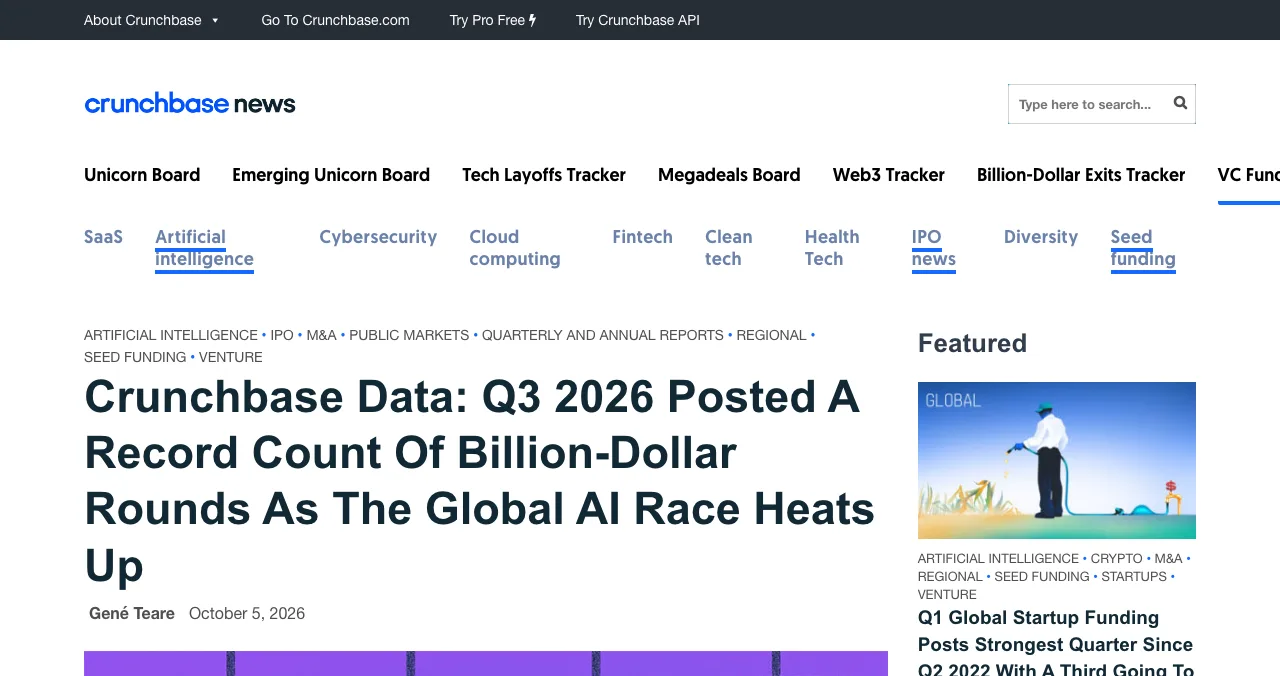
Global venture funding was $159 billion in Q3 2026, with close to 6,000 startups funded, and AI-related startups across the stack took $102 billion of it, according to Crunchbase. That share was down from the two previous quarters but 14 points above Q3 2025. Startup Genome's longer view is starker: AI-native funding grew 218% from 2021 to 2025 while overall tech funding shrank 36%, and late-stage AI-native funding more than doubled in 2025 to $108 billion, over half of all late-stage funding.
What it means for you: AI is no longer a category; Startup Genome calls it a general-purpose technology. Investors will ask how you use it, even if you don't sell it.
2. Megarounds hit a record
A record 27 companies raised rounds of $1 billion or more in Q3 2026, up from 16 in Q2 and 14 in Q1, and those 27 took around a third of all venture capital raised in the quarter. Databricks and Safe Superintelligence each raised $5 billion. Crunchbase notes large funds are also writing jumbo early rounds: rounds of $100 million or more made up half of early-stage financings in Q3.
What it means for you: capital is plentiful at the top and selective below it. Most founders will raise in a market where traction, not trend, gets the meeting.
3. Money concentrates in a few places
US startups took $91 billion, about 57% of global venture funding in Q3 2026, and the San Francisco Bay Area alone took 24%. Startup Genome's 2026 report says North America now gets 64% of global late-stage funding, up from 56% in 2021, and that Silicon Valley's ecosystem value passed $3 trillion, nearly three times the next largest.
What it means for you: if you're outside these hubs, distribution online matters more. Launch globally from day one and make your product findable by problem, wherever the buyer is.
4. Physical AI is the second wave
Crunchbase reported that aerospace, robotics, data centres, semiconductors and energy each raised $10 billion or more in Q3 2026, and that Q3 robotics funding jumped 185% as the US and China led a push into physical AI. The board reflects it: Waymo ($126 billion), Crusoe ($31 billion), Skild AI ($14 billion) and Applied Intuition ($15 billion) are all among the most valuable private companies.
5. Defence and space go mainstream
Startup Genome says defence-tech Series A value rose about 60% and deal counts 15%. On the Crunchbase board, Anduril Industries ($61 billion), Shield AI ($29 billion) and Helsing ($18 billion) are all in the top 50.
6. Exits are back
Startup Genome puts total exit value up 164% year on year to nearly $800 billion in 2025, still below the 2021 peak, with AI-native exit value up more than 500% to $243 billion. Crunchbase's Q3 report lists large IPOs: ChangXin Memory Technologies raised $8.6 billion at an $85.5 billion value, Shein listed at a $26.3 billion valuation and Bending Spoons debuted at $18.4 billion.
What it means for you: exits recycle money and talent into new startups, which usually means more angel and seed capital a year or two later.
7. Products built for AI agents, not just people
This is the trend we can see in our own data. New products increasingly expose an API or a Model Context Protocol (MCP) server, so AI agents can use them directly. See the Launchpad data below.
Trending startups: the biggest rounds of Q3 2026
| Trending startup | What happened in Q3 2026 | Valuation on the Crunchbase board (17 Nov 2026) |
|---|---|---|
| Databricks | Raised $5B | $190B |
| Safe Superintelligence | Raised $5B | $32B |
| Crusoe | Raised more than $3B | $31B |
| Moonshot AI | Raised more than $3B | $50B |
| Mistral AI | Raised more than $3B | $24B |
| Nscale | Raised more than $3B | $15B |
| The Boring Company | Raised more than $3B | $23B |
| Kling AI | Raised more than $3B | $18B |

Table: Trending startups by money raised in Q3 2026 (Crunchbase News, 5 Oct 2026; valuations from the Crunchbase Unicorn Board, 17 Nov 2026)
What new founders are building: Launchpad data
Funding data shows where money goes; it doesn't show what new founders ship. Every product listed on the Science of Apps Launchpad has a structured profile (category, pricing model, platforms), so we can count. The sample is small: the five new listings from other founders live on 18 November 2026. We report counts, not percentages, and will re-run this monthly as the Launchpad grows.
| Signal | Count (of 5) | Listings |
|---|---|---|
| Offers an API | 3 | AgentSEO, OrdoGrid, Jev Agent |
| Offers a remote MCP server for AI agents | 2 | AgentSEO, Jev Agent |
| Freemium pricing | 4 | Xun Qiao, AgentSEO, OrdoGrid, Jev Agent |
| Usage-based (credits) pricing | 1 | MyLookStory |
| AI at the core (serves agents or generates output) | 3 | AgentSEO, Jev Agent, MyLookStory |
| Finance and accounting category | 2 | Xun Qiao, OrdoGrid |

Table: What new founders listed on the Science of Apps Launchpad (live listings, checked 18 Nov 2026)

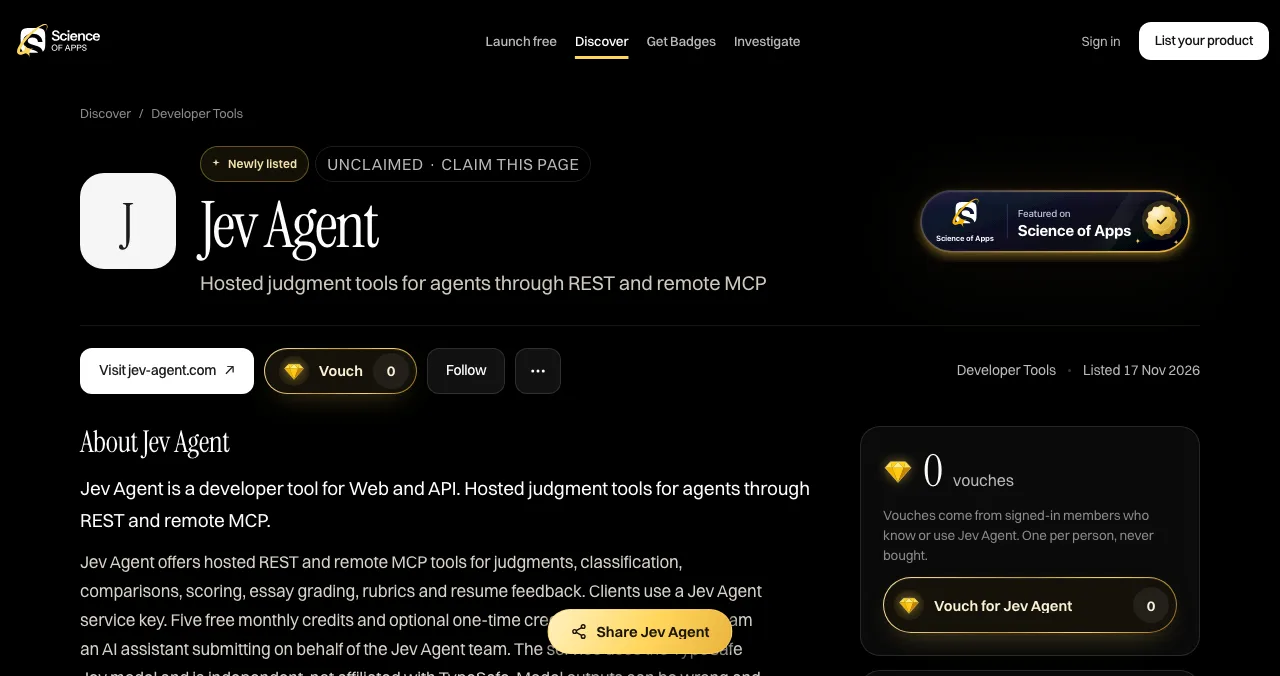
Two readings, held loosely. First, freemium is the default for a new product: a free tier lowers the cost of trying. Second, founders are designing for a buyer that's partly software: when an agent picks a tool, the "user" never sees your landing page. That makes clear documentation and a findable public profile more important, not less. It's also why being described accurately in AI answers matters; see our AI startup ideas and SaaS ideas for where these trends leave room to build.
Your product, tested end to end
A trend gets you a first visit; your product decides whether people stay. Every product live on the Launchpad gets a free baseline diagnosis of landing page, discoverability and speed, and a full investigation tests it end to end in a real browser on desktop and mobile, with findings private to your team and never used for ranking.
- Areas of your product tested
- 22
- Automatic measurements, desktop and mobile
- 39
- Expert checks behind your login
- 74
- Verdicts that rank what to fix first
- 5
See what your first users actually hit
List free, then order the report that fits: what new customers see first, or the full diagnosis and a plan.

 Economy
See what new customers see
- Store listing and homepage, screen by screen
- Scorecard against 60 Laws of UX
- Customers, competitors and the fixes worth most
PremiumThe full diagnosis and the plan
- Every screen, every finding, every flow
- All 60 laws with evidence and fixes
- 8 strategy chapters and a 90-day roadmap
Researched from your live product and fact-checked against the evidence.
Which trend should you build on?
| If you are… | The trend that matters most | First move |
|---|---|---|
| A solo founder or small team | Agent-ready products, freemium | Ship an API or MCP endpoint and a free tier |
| Building AI applications | AI's share of funding | Pick one industry workflow and own it |
| Building hardware or robotics | Physical AI | Find a paying pilot customer before the big raise |
| Outside a major hub | Concentration | Launch globally online from day one |
| Raising a seed round | Megarounds at the top | Lead with traction, not the trend |
Table: Which startup trend matters for your stage
Mistakes when chasing startup trends

- Building for the headline — a trend tells you where money went last quarter, not what your customer needs
- Bolting on AI — users notice; earn trust with output they can check
- Copying a megaround's playbook — $5 billion rounds don't transfer to a seed-stage company
- Following the crowd uncritically — social proof works on founders too
Ready to launch into 2027?
How we built this report
Funding figures are from Crunchbase News's Q3 2026 global report (5 October 2026) and its Q3 robotics report (27 October 2026). Ecosystem, exit and defence-tech figures are from Startup Genome's Global Startup Ecosystem Report 2026, launched on 17 June 2026. Valuations are from the Crunchbase Unicorn Board, last updated 17 November 2026. Launchpad counts are from the five live listings by other founders on 18 November 2026; product details are as founders state them. Everything was read on 18 November 2026. Science of Apps runs the Launchpad. We refresh this report monthly.
Key terms, defined
- Startup trend: a sustained shift in what startups build or how they're funded, visible across several datasets.
- Megaround: a single funding round of $100 million or more; Crunchbase also tracks $1 billion-plus rounds.
- AI-native: a startup built around AI from the start (Startup Genome's term).
- Physical AI: AI that acts in the physical world, such as robots, vehicles, chips and data centres.
- Exit: an IPO or acquisition that lets founders and investors sell shares.
- MCP: the Model Context Protocol, a standard that lets AI agents call a product's tools.
Frequently asked questions
What are the biggest startup trends this year?
AI's dominance of funding (64% of global venture capital in Q3 2026, per Crunchbase News), a record 27 rounds of $1 billion or more in one quarter, physical AI such as robotics, chips and data centres, rising defence and space investment, and a recovery in exits, which Startup Genome puts at nearly $800 billion in 2025.
Which startups are trending right now?
By money raised, the trending startups of Q3 2026 were Databricks and Safe Superintelligence (each raised $5 billion) and Crusoe, Moonshot AI, Mistral AI, Nscale, The Boring Company and Kling AI (each over $3 billion), per Crunchbase News. Among brand-new startups, agent-ready developer tools are trending on the Launchpad.
Is AI still the top startup trend for 2027?
Every dataset we read says yes. Crunchbase counted $102 billion of Q3 2026 venture funding going to AI, and Startup Genome reports AI-native funding grew 218% from 2021 to 2025 while overall tech funding shrank 36%. The trend is shifting from chatbots to infrastructure, agents and physical AI.
Where is startup funding concentrated?
In the United States and in a few cities. Crunchbase says US startups took $91 billion, about 57% of global venture funding, in Q3 2026, and the San Francisco Bay Area alone took 24%. Startup Genome says North America now gets 64% of global late-stage funding, up from 56% in 2021.
What are new startups building?
On the Science of Apps Launchpad in November 2026, three of five new products from other founders offer an API and two offer a remote MCP server, so AI agents can use them directly. Four of five are freemium. It's a small sample, so we report counts rather than percentages and update monthly.
How do you track startup trends?
We combine public funding data (Crunchbase News quarterly reports, the Crunchbase Unicorn Board), Startup Genome's annual Global Startup Ecosystem Report and our own counts of new listings on the Science of Apps Launchpad, each with its date. We refresh this report monthly and note when figures change.
Sources
- Crunchbase News — Q3 2026 posted a record count of billion-dollar rounds as the global AI race heats up, 5 Oct 2026 (checked 18 Nov 2026)
- Crunchbase News — Q3 robotics startup funding jumps 185% as US and China lead physical AI push, 27 Oct 2026 (checked 18 Nov 2026)
- Startup Genome — Global Startup Ecosystem Report 2026, key insights (checked 18 Nov 2026)
- Startup Genome — State of the Global Startup Economy, GSER 2026 (checked 18 Nov 2026)
- Crunchbase News — The Crunchbase Unicorn Board, last updated 17 Nov 2026 (checked 18 Nov 2026)
- Science of Apps — Launchpad homepage and live listings (checked 18 Nov 2026)
- Science of Apps — Product investigation (checked 18 Nov 2026)
- Checked November 18, 2026. Figures that change — fees, salaries, prices — are reviewed every six months; if something is out of date, tell us.
Where to go from here
- AI startup ideas — what to build next
- SaaS ideas — ideas with demand
- AI startup list — new and leading AI startups
- Science of Apps - LaunchpadThe Global Startup Ecosystem Report 2026, summarised: the top 40 global startup ecosystems, the top emerging ecosystems, the six success factors and the key findings on AI, funding and exits from Startup Genome's reportGlobal Startup Ecosystem Report 2026 in brief: Silicon Valley, New York and London lead the global startup ecosystem. The top 40, emerging leaders, key data.
- Science of Apps - LaunchpadAverage Series A valuation: what Carta's State of Private Markets Q3 2026 data shows, how it compares with seed and Series B, why medians mislead, and the traction a startup needs to showThe median Series A valuation in 2026 was $63.3 million through Q3, per Carta's data on US startups. What sits behind it and the traction investors expect.
- Science of Apps - LaunchpadThe top 100 startup companies in the world by valuation, from the Crunchbase Unicorn Board as of 17 November 2026: the top 10 startups, the full top 100 list, what the ranking shows, and the new startups rising on the Science of Apps LaunchpadThe top 100 startup companies in the world by valuation (Crunchbase, 17 Nov 2026): the top 10 startups, the full list, and new startups rising on the Launchpad.
- Science of Apps - LaunchpadWhere to get pitch deck feedback for free: founder peers, angels you won't pitch, investor assessments and communities, plus a self-review against YC's and Sequoia's outlinesWhere to get free pitch deck feedback: founders who raised, angels you won't pitch, investor assessments and a self-review using YC and Sequoia.
- Science of Apps - LaunchpadStartup newsletters that feature new products: how to get into Product Hunt's newsletter, TLDR, Ben's Bites, Launching Next and Tiny Startups, and which are paid placementsStartup newsletters that feature new products: Product Hunt (1.5M+ readers), TLDR, Ben's Bites, Launching Next and Tiny Startups, and how each picks.
- Science of Apps - LaunchpadThe VC valuation method explained: the formula from exit value and target return to pre-money, dilution and retention, a worked example and how milestones lower the return investors demandThe VC valuation method divides a startup's expected exit value by the investor's target return to get post-money value. Formula, dilution and an example.


Get the ideas, not the noise.
Sign up with Google and we’ll send you short UX psychology tips by email — why people tap, stall and leave, and what to do about it. Unsubscribe anytime. Prefer something to keep? Get the free Laws of UX guide as a PDF.
Launch day ends. Your listing shouldn't.
Every product listed on the Science of Apps Launchpad adds to the original data in this report, and its founder gets a free permanent listing and a test of the product with a detailed report.