 By
Quick answer: What startup ideas does Y Combinator want?
- 11 requests in YC's Winter 2027 Requests for Startups (RFS).
- Theme: AI moving into factories, data centres, government and space.
- Optional: YC says the requests are a fraction of what it funds.
- Paul Graham's rule: look for problems, ideally your own.
- Just an idea is fine: YC says about 40% of funded companies in each batch are just an idea.
Key takeaways
- YC's RFS tells you which problems partners think are opening up now, and why.
- The Winter 2027 list is less about chatbots and more about the physical and public economy.
- Paul Graham's 2012 essay still explains why sitting down to think up ideas rarely works.
- A request is a direction, not a business; you still need customers who confirm the problem.
- Test a YC-style idea with buyers before you apply or build.
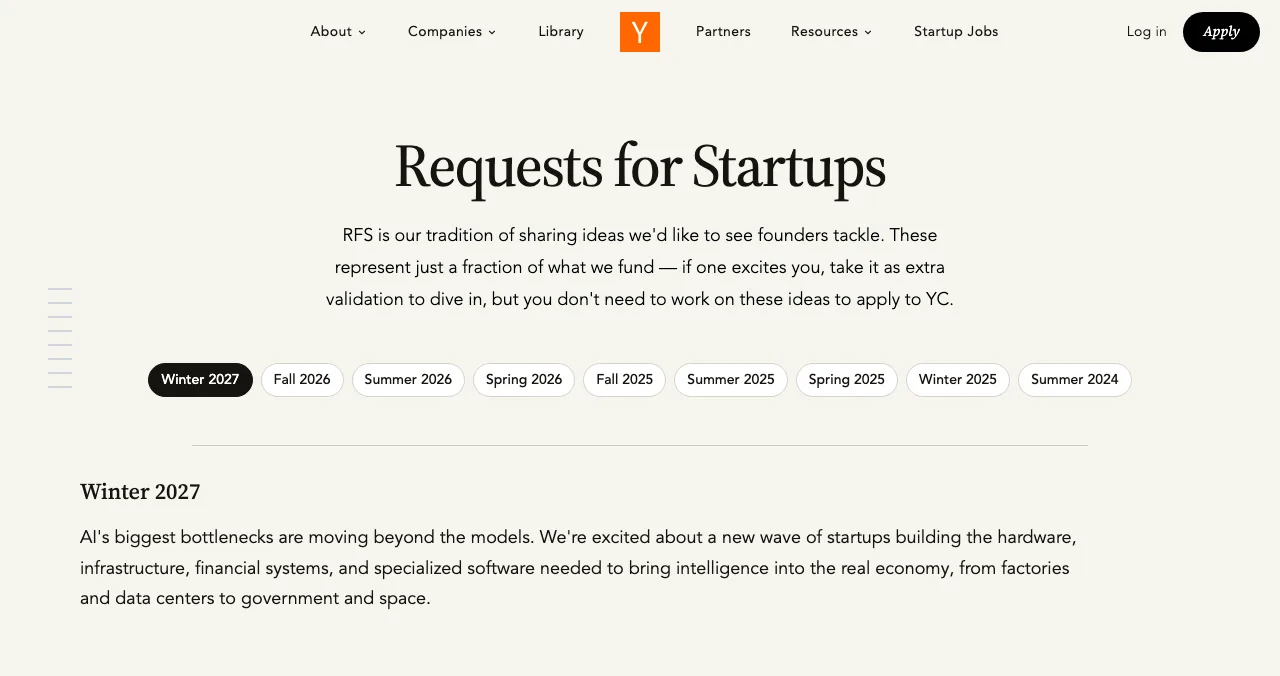
Every batch, Y Combinator publishes a short list of problems its partners want founders to work on: the Requests for Startups, or RFS. It's the closest thing to a public wish list from one of the best-known accelerators, and each request explains why the problem is opening up now, the part of an idea that's hardest to judge alone. This guide covers all 11 Y Combinator startup ideas for the Winter 2027 batch, what Paul Graham's classic essay says about getting ideas, what YC's FAQ says about applying with just an idea, and how to test a YC-style idea free. Everything was checked on YC's own pages on 18 November 2026. Jump to the 11 requests, Paul Graham's essay or testing your idea.
What startup ideas does Y Combinator want in 2027?
YC frames the Winter 2027 list around one idea: AI's biggest bottlenecks are moving beyond the models, into hardware, infrastructure, finance and specialised software for the real economy.
| # | Request | YC partner | The problem in one line |
|---|---|---|---|
| 1 | Startups in a World of Abundant Space Access | Ankit Gupta | Business models that only work once launch costs fall |
| 2 | The $15-an-Hour Expert | Brad Flora | AI that lets workers without credentials do specialist work (tax, claims, billing) |
| 3 | Robots Made in America | Diana Hu | Robots and their domestic supply chain: magnets, motors, gears, sensors, batteries |
| 4 | LLMs That Write Well | Jared Friedman | A model tuned for natural writing, not just code and maths |
| 5 | Plaid for Government Benefits | Gustaf Alströmer | Consent-based retrieval of verified income, tax and residency records |
| 6 | Wall Street for the Physical Buildout | Brad Flora | Lending, leasing and hedging for robots, GPU clusters and data centres |
| 7 | Vertical Foundation Models | Diana Hu | Models for manufacturing, energy and biology |
| 8 | AI for City Hall | Gustaf Alströmer | Permitting, code review, 311, licensing and inspections |
| 9 | Data Center Supply Chain | Jared Friedman | Bottlenecks in transformers, switchgear, cooling and electrical steel |
| 10 | AI for the Air-Gapped Economy | Brad Flora | On-premises AI and accreditation for offline organisations |
| 11 | Own Your Intelligence | Jon Xu | Tools for companies to build their own models on proprietary data |
Table: Y Combinator's Requests for Startups, Winter 2027 (ycombinator.com/rfs, checked 18 Nov 2026)
The 11 Y Combinator ideas, explained
Below, each request in plain words, who it suits, and a first step that costs nothing. The "who it suits" and "first step" notes are ours, not YC's.
1. Abundant space access
If reusable rockets cut the cost per kilogram by orders of magnitude, new businesses become possible. Suits founders from aerospace. First step: list three businesses that fail at today's launch prices and work at a tenth of them.
2. The $15-an-hour expert
AI tools that let people without formal credentials do specialist work in taxes, insurance claims and medical billing. Suits founders who have done that work. First step: shadow someone doing it for a day.
3. Robots made in America
Robots plus the domestic supply chain behind them, as new US content rules arrive. YC's page notes China produced 94% of sintered rare-earth magnets in 2024. Suits hardware founders. First step: map one robot's bill of materials by country.
4. LLMs that write well
Jared Friedman argues training for code and maths has made model prose more robotic. Suits ML researchers. First step: blind-test outputs with readers who don't know which model wrote what.
5. Plaid for government benefits
Pull verified records from government sources, with consent, so people qualify for several programmes at once. YC's page points to Medicaid re-checks every six months starting in 2027. First step: list the documents one programme asks for.
6. Wall Street for the physical buildout
Lenders, leasing firms, securitisation and hedging for robots, GPU clusters and data centres. Suits finance founders. First step: price one lease.
7. Vertical foundation models
Models for manufacturing, energy or biology that work with little task-specific training. Suits founders with proprietary data access. First step: secure a data partner before writing code.
8. AI for city hall
Speeding up permitting, code review, 311, licensing and inspections. First step: read a month of your city's public 311 data and count the request types.
9. Data-centre supply chain
Shortages of transformers, switchgear, cooling and electrical steel. Suits founders from utilities, construction or procurement. First step: interview three procurement leads about lead times.
10. AI for the air-gapped economy
On-premises AI, deployment tools and security accreditation for organisations that can't connect to the internet, such as defence contractors and hospitals. First step: ask an IT lead what blocked their last AI pilot.
11. Own your intelligence
Help companies build and improve their own specialised models on their own data, instead of only renting frontier models. First step: offer one fine-tune as a service.
Startup ideas, Y Combinator style: what the list tells you
Three patterns run through the Winter 2027 requests, and they're useful even if you never apply:
- "Why now" is explicit. Every request names the change that makes it possible: cheaper launches, new content rules, Medicaid re-checks, data-centre demand.
- Unglamorous problems. Permits, switchgear, billing appeals. Paul Graham called the habit of avoiding such work "schlep blindness".
- Industry access matters. Most requests are hard to start without having worked in the field, which is YC's top recipe for ideas.
From a request to a wedge: a worked example
A request is too broad to build. The work is narrowing it to one buyer, one task and one first sale. Here is how that might look for "AI for city hall". This is a hypothetical illustration, not a real company.

- Pick one task — of permitting, code review, 311, licensing and inspections, choose the one with the longest queue in your city. Public dashboards and council minutes often show it.
- Pick one buyer — the city may buy slowly; the applicant (an architect or small builder) may pay faster to avoid resubmissions.
- Define the result — for example, "an application that passes the first review", not "AI for permits".
- Do it by hand first — review five real applications against the published code and note every reason one would bounce.
- Charge for the manual version — if builders pay for a pre-check done by a person, software that does it faster has a market.
- Then build — automate the checks you did most often, and keep a person on the rest.
The same narrowing works for every request on the list: "data-centre supply chain" becomes "lead-time alerts for one class of transformer"; "the $15-an-hour expert" becomes "a guided workflow for one type of insurance appeal". The narrower the first version, the sooner you learn whether anyone pays.
Paul Graham: how to get startup ideas
Paul Graham's essay "How to Get Startup Ideas" (November 2012) is still one of the clearest answers to the question. Its argument, in brief:

- Look for problems — the best ideas come from problems, ideally your own; most startups fail by solving problems nobody has
- Organic, not brainstormed — sitting down to think up ideas tends to produce plausible-sounding bad ones
- Live in the future — be at the leading edge of a changing field and you'll notice what's missing
- A deep well beats a shallow hole — a few people who want something urgently beat many who want it a little
- Beware schlep blindness — founders avoid tedious problems, which leaves them less contested
- Turn off the unsexy filter — whether a problem seems glamorous says little about its value
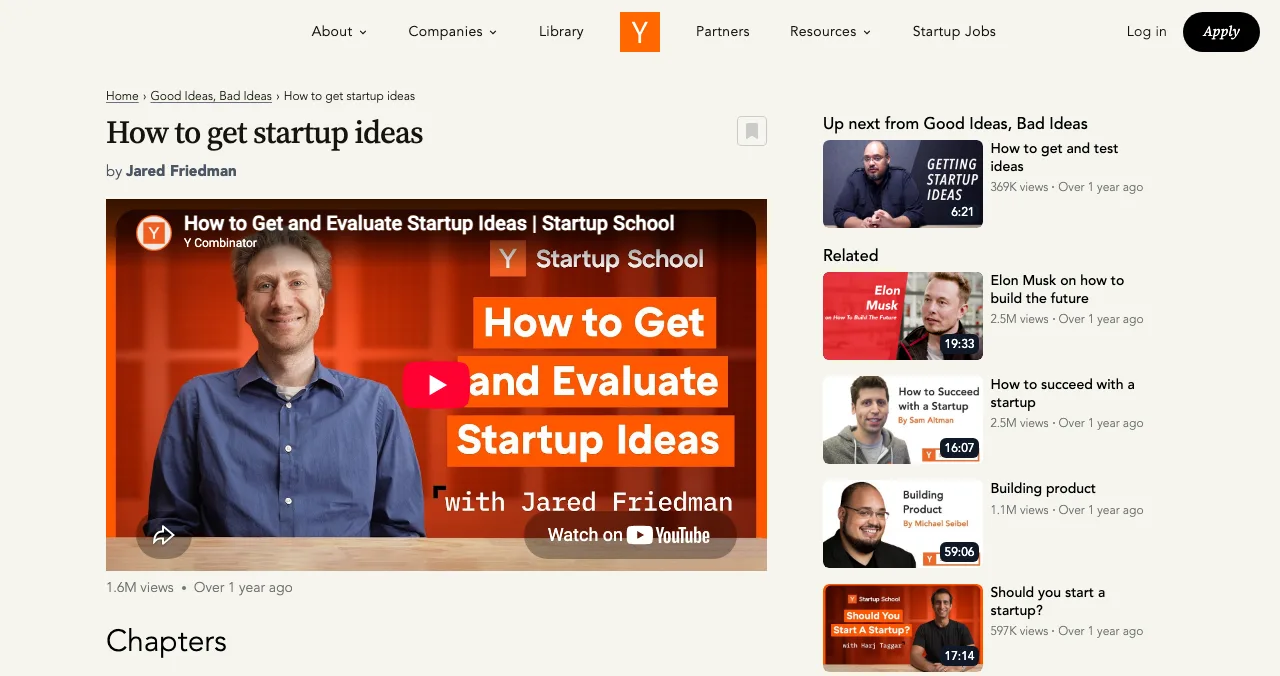
His most-quoted line: "Live in the future, then build what's missing." YC's Jared Friedman later turned the same thinking into seven recipes, best first; our guide to how to find startup ideas summarises them.
Applying to YC with an idea
- Just an idea?
- About 40% of funded companies per batch, YC says
- Students
- Can apply; full-time during the batch if accepted
- Standard deal
- $500,000 ($125k for 7% + $375k uncapped MFN SAFE)
- Winter 2027
- Jan–Mar, in person in San Francisco
- Catch
- On-time deadline (2 Nov) has passed; late applications considered
- Cost: YC charges no fees; its standard deal is described on its deal page.
- When: the Winter 2027 batch runs January to March; YC's apply page says late applications are considered, without a promised response time.
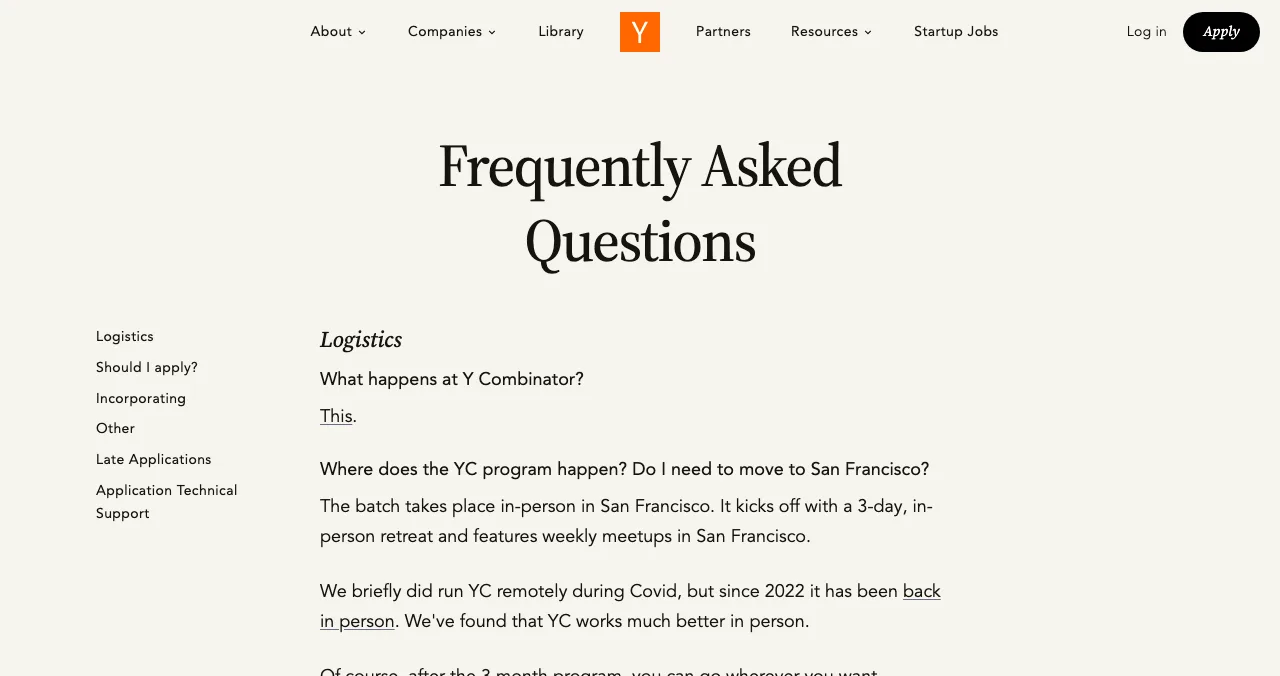
- Rules: the batch is in person in San Francisco, starting with a three-day retreat.
- Other options: see our startup accelerator list for programmes with different terms.
Which YC request fits your background?
| Your background | Requests to look at |
|---|---|
| Aerospace or hardware | Space access; robots made in America |
| Finance or lending | Wall Street for the physical buildout |
| Government, social work, benefits | Plaid for government benefits; AI for city hall |
| Billing, tax, insurance operations | The $15-an-hour expert |
| ML research | LLMs that write well; vertical foundation models |
| Enterprise IT or security | AI for the air-gapped economy; own your intelligence |
| Utilities, construction, procurement | Data-centre supply chain |
Table: Matching YC's Winter 2027 requests to founder backgrounds (Science of Apps editorial)
How to test a YC-style idea before you build

- Read the request twice — note the "why now" and who has the problem.
- Find ten people with the problem — ex-colleagues first; ask about the last time it happened.
- Sell the manual version — a report, an audit or a done-for-you service.
- Put up one page — what it does, for whom, and a way to get in touch.
- List it free — a Launchpad profile gives the idea a permanent, findable page.
- Apply with evidence — what ten users told you is stronger than any pitch.
The Launchpad is free to list, forever, and ranks by relevance, editorial picks and community interest, never payment. Once your page is live, a free baseline diagnosis checks your landing page, discoverability and speed. When there's a product behind it, a full investigation tests it end to end in a real browser on desktop and mobile, with every finding approved by an analyst.
- Areas of your product tested
- 22
- Automatic measurements, desktop and mobile
- 39
- Expert checks behind your login
- 74
- Verdicts that rank what to fix first
- 5
See your product the way a partner will
List free, then order the report that fits your stage.

 Economy
See what new customers see
- Store listing and homepage, screen by screen
- Scorecard against 60 Laws of UX
- The fixes worth most
PremiumThe full diagnosis and the plan
- Every screen, every finding, every flow
- All 60 laws with evidence and fixes
- 8 strategy chapters and a 90-day roadmap
Private to your team. Never affects ranking.
Mistakes with Y Combinator ideas

- Copying the title, not the problem — "AI for city hall" is a direction; pick one task in one city
- No industry access — most of these requests need buyers you can reach this month
- Building before selling — a manual service proves demand faster than a model
- Treating the RFS as required — YC says plainly you don't need these ideas to apply
- Ignoring the schlep — the tedious part (accreditation, procurement) is often the moat
Ready to launch?
How we know
The 11 requests, their authors and the facts in them come from YC's Requests for Startups page (Winter 2027 edition); the application facts from YC's FAQ, deal and apply pages; the essay summary from Paul Graham's "How to Get Startup Ideas" (November 2012). All were read on 18 November 2026. "Who it suits" and "first step" notes are our editorial suggestions. Science of Apps runs the Launchpad and has no affiliation with Y Combinator.
Key terms, defined
- Requests for Startups (RFS): YC's published list of problems it would like founders to tackle.
- Batch: a YC cohort, such as Winter 2027, that runs together for three months.
- SAFE: a simple agreement for future equity, YC's standard investment instrument.
- MFN: "most favoured nation", a term that converts on the best terms given to later investors.
- Schlep blindness: Paul Graham's term for founders' tendency to avoid tedious problems.
- Air-gapped: a system with no connection to the internet, common in defence and healthcare.
Frequently asked questions
What startup ideas does Y Combinator want?
For Winter 2027, Y Combinator lists 11 Requests for Startups: space access, the $15-an-hour expert, robots made in America, LLMs that write well, Plaid for government benefits, Wall Street for the physical buildout, vertical foundation models, AI for city hall, the data-centre supply chain, AI for the air-gapped economy, and owning your own intelligence. YC says it funds much more than these.
Do I need to work on a YC Request for Startups to get in?
No. YC's RFS page says the requests represent just a fraction of what it funds, and that you don't need to work on these ideas to apply. If one excites you, YC suggests taking it as extra validation. Most YC companies apply with their own idea.
What does Paul Graham say about how to get startup ideas?
In his November 2012 essay, Paul Graham says the way to get startup ideas is to look for problems, preferably ones you have yourself. He argues that deliberately brainstorming produces plausible but bad ideas, that the best ideas often look like toys or schleps, and that you should live in the future, then build what's missing.
Can I apply to Y Combinator with just an idea?
Yes. YC's FAQ says it would be a mistake to wait, and that on average about 40% of the companies it funds in each batch are just an idea. It recommends applying as soon as you have a founding team and an idea you are excited about.
How much does Y Combinator invest?
YC's standard deal is $500,000: $125,000 on a post-money SAFE for 7% of the company, plus $375,000 on an uncapped MFN SAFE that converts on the terms of the lowest-cap SAFE issued before the priced round. YC says the investment isn't milestone-based and it charges no fees.
Where can I see older Y Combinator ideas?
The RFS page has tabs for earlier editions, back to Summer 2024 when we checked on 18 November 2026. YC's Startup Library also hosts Jared Friedman's talk 'How to get startup ideas', which lists seven recipes for generating ideas; our guide to finding startup ideas summarises it.
Can students apply to Y Combinator?
Yes. YC's FAQ says you can apply while a full-time student or employee, but founders are expected to work full-time on the company during the batch if accepted. It also offers Early Decision for students who want to join the batch after graduating.
Sources
- Y Combinator — Requests for Startups, Winter 2027 (checked 18 Nov 2026)
- Y Combinator — Frequently Asked Questions (checked 18 Nov 2026)
- Y Combinator — The YC deal (checked 18 Nov 2026)
- Y Combinator — Apply: Winter 2027 batch (checked 18 Nov 2026)
- Paul Graham — How to Get Startup Ideas, November 2012 (checked 18 Nov 2026)
- Y Combinator Startup Library — How to get startup ideas (Jared Friedman) (checked 18 Nov 2026)
- Science of Apps — Launchpad: list your product free (checked 18 Nov 2026)
- Science of Apps — Product investigation: 22 areas (checked 18 Nov 2026)
- Checked November 18, 2026. Figures that change — fees, salaries, prices — are reviewed every six months; if something is out of date, tell us.
Where to go from here
- How to find startup ideas — YC's seven recipes
- Startup accelerator list — YC and the alternatives
- 100 startup ideas — with a signal for each
- Science of Apps - LaunchpadThe Y Combinator startup directory explained: what's in it, how to search YC startups, Launch YC, and how non-YC founders can get the same kind of visibilityHow the Y Combinator startup directory works: search and filter YC companies by batch and hiring status, what Launch YC is, and how non-YC startups get found.
- Science of Apps - LaunchpadUnique startup ideas for 2027: 25 innovative ideas from unusual Reddit requests, YC's less obvious requests and unglamorous problems, and how to validate a unique idea before you build it25 unique and innovative startup ideas for 2027 from odd Reddit requests, YC's less obvious requests and unsexy problems, plus how to validate one.
- Science of Apps - LaunchpadHow to find startup ideas: the common mistakes, YC's seven recipes for generating ideas, and how to test one before you buildHow to find startup ideas: the mistakes to avoid and YC's seven recipes, from your own expertise to broken industries, plus how to test an idea fast.
- Science of Apps - Launchpad100 startup ideas for 2027, each tied to a real problem signal from YC's Requests for Startups, Reddit threads or official data, and how to test any of them free before you build100 startup ideas for 2027, each tied to a real problem signal: YC's requests, dated Reddit threads and official data. Plus a free way to test yours.
- Science of Apps - LaunchpadHow to run a launch week, and why launching is a habit, not a day: every kind of launch a startup can do, from silent launches to feature dropsHow to run a launch week and launch repeatedly: silent launches, communities, Hacker News, Product Hunt, request-access waitlists and feature drops, in order.
- Science of Apps - LaunchpadScience of Apps Launchpad vs Uneed vs Peerlist: which free launch site suits your startup, compared by cost, waiting time, ranking, audience and how long you stay visibleUneed, Peerlist and the Science of Apps Launchpad compared: cost, waiting time, ranking, audience and permanence, with a plan for using all three in one month.



Get the ideas, not the noise.
Sign up with Google and we’ll send you short UX psychology tips by email — why people tap, stall and leave, and what to do about it. Unsubscribe anytime. Prefer something to keep? Get the free Laws of UX guide as a PDF.
Launch day ends. Your listing shouldn't.
Building on one of YC's requests? List it free on the Science of Apps Launchpad for a permanent, findable profile, early feedback, and your product tested end to end with a detailed report.