 By
Quick answer: What are some unique startup ideas?
- 25 unique startup ideas from four sources of unusual ideas.
- Sources: odd Reddit requests, YC's less obvious requests, unsexy problems, field collisions.
- Every idea has a dated signal you can read yourself.
- Unique isn't a moat: two Reddit requests in this list were built by their posters within weeks or months.
- Validate first: search, ten conversations, a page and a free listing.
Key takeaways
- Most innovative startup ideas sound strange at first and obvious later.
- Ideas that seem unique often already exist; search before you build.
- Uniqueness fades; execution and distribution last.
- Unglamorous problems are often less contested than clever ones.
- A public page tests curiosity; a payment tests demand.
The most innovative startup ideas rarely come from sitting down to think of something nobody has thought of. They come from noticing: an odd request in a forum, a rule that just changed, a tedious job everyone avoids. This guide collects 25 unique startup ideas from four places where unusual ideas show up, each tied to a source you can read (Reddit threads with their dates, Y Combinator's Winter 2027 Requests for Startups, Paul Graham's essay on ideas). Then it covers the part that matters more than uniqueness: validating the idea before you build it, because a unique idea stays unique for about as long as it takes someone else to read the same thread. Sources were checked on 18 November 2026. Jump to the ideas or validation.
- Unique startup ideas
- 25
- Sources of unusual ideas
- 4
- Reddit requests in this list later built by their posters
- 2
- To validate one in public
- $0
Where do unique startup ideas come from?
Paul Graham's 2012 essay argues that deliberately brainstorming produces plausible-sounding bad ideas, and that good ones come from noticing what's missing, especially in places other founders avoid because the problem looks tedious or unglamorous. The four sources below are where that noticing pays off.
| Source | Why ideas there are unusual | Example signal |
|---|---|---|
| Odd requests | People describe needs no product category covers yet | r/SomebodyMakeThis threads, 2025–2026 |
| YC's less obvious requests | Partners spot shifts before they're crowded | YC RFS, Winter 2027 |
| Unsexy problems | Founders filter them out, so few compete | Paul Graham's "schlep blindness" |
| Field collisions | Knowledge from two fields rarely sits in one head | Your own background |
Table: Four sources of unique startup ideas (Science of Apps editorial)
25 unique and innovative startup ideas
Source 1: odd requests from Reddit
These are paraphrased from r/SomebodyMakeThis threads. The ideas are the posters'; our notes on testing them are editorial.

1. Letters to future descendants · 30 Mar 2026
A poster who never knew their grandparents wants to leave letters, voice and video recordings delivered decades later. 53 comments. Test: sell a guided recording session to grandparents.
2. A social space open only at night · 1 May 2026
A calm platform for night-shift workers, new parents and insomniacs that opens around 10pm local time, keeps optional anonymity, and erases everything at sunrise. Test: run nightly sessions in an existing chat app for a month.
3. Scammer time-wasting as a service · 5 Jan 2026
Forward a scammer's contact details and someone wastes their time for you, sending a recording as proof. Test: offer it to ten people who complain about scam texts.
4. Who owns what · 5 Jun 2026
A public, wiki-like database of corporate ownership, wealth and influence, so people can see who's behind the brands they buy. 44 comments. Test: publish ownership maps for one product category.
5. A journal written from your phone's data · 1 Aug 2026
Photos, places and activity turned into a short story of your day, for people who like the idea of journaling but stare at a blank page. Test: make five people's weekly journals by hand.
6. Event-first dating · 10 Mar 2026
Post an event you're going to and match with someone to go with. The poster later updated the thread to say they'd built it. Lesson: a unique idea can be built in weeks.
7. Birthday gifts from strangers · 27 Dec 2025
Artists, poets and bakers offer work that strangers can receive on their birthday. The poster later updated the thread to say they'd built it too. Lesson: distribution, not the idea, decides the winner.
Source 2: YC's less obvious Winter 2027 requests
Most of YC's Winter 2027 list is about AI reaching factories, data centres and government. Some requests stand out as genuinely unusual for a startup accelerator. Our Y Combinator startup ideas guide covers all 11.
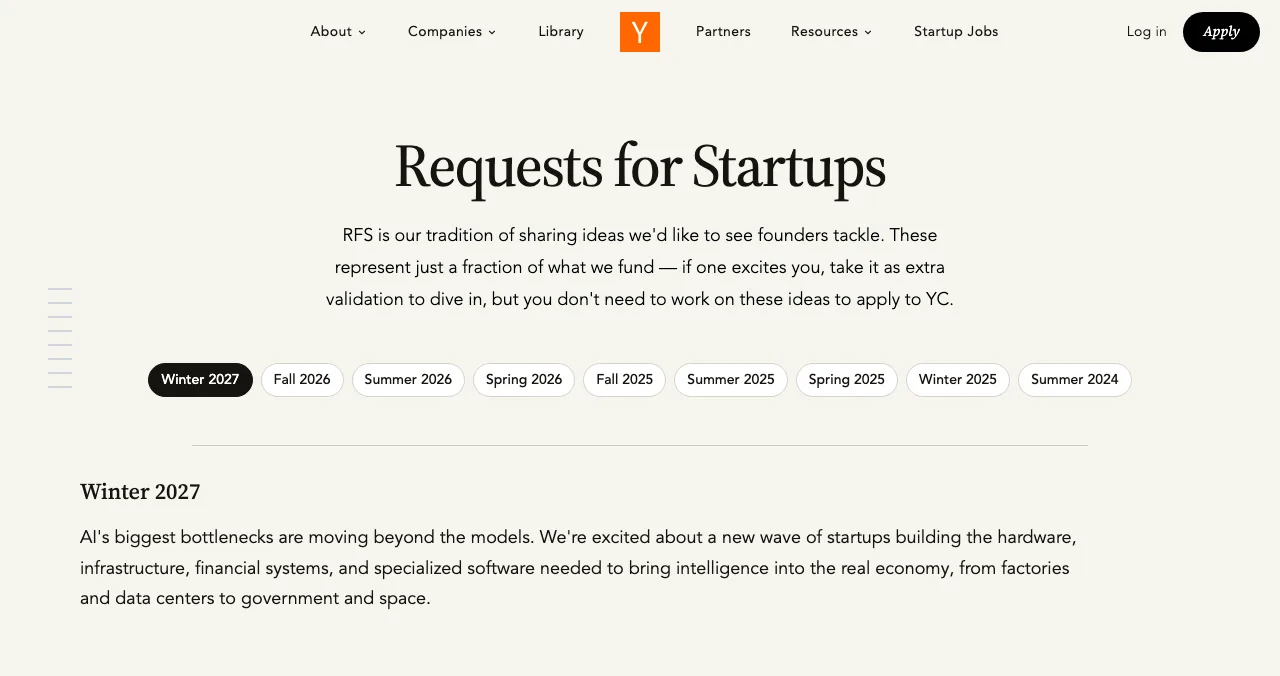
| # | Idea | YC request (partner) | Why it's unusual |
|---|---|---|---|
| 8 | A business that only works once launch costs fall | Abundant space access (Ankit Gupta) | You build for a cost curve, not today's prices |
| 9 | An LLM tuned for natural, pleasant writing | LLMs that write well (Jared Friedman) | Argues current models write worse in some ways |
| 10 | Securitisation for robots and GPU clusters | Wall Street for the physical buildout (Brad Flora) | Finance, not software, as the product |
| 11 | A supplier network for US-made robot magnets and motors | Robots made in America (Diana Hu) | Supply chain as a startup |
| 12 | Credential-free experts in medical billing | The $15-an-hour expert (Brad Flora) | Makes specialist work accessible |
Table: Unusual startup ideas from YC's Winter 2027 requests (ycombinator.com/rfs)
Source 3: unsexy problems
Paul Graham calls it "schlep blindness": founders' tendency not to see ideas that involve tedious work. The ideas below are unique mostly because they're unglamorous.
| # | Idea | Why few build it | First test |
|---|---|---|---|
| 13 | Decoding 3PL invoices for online sellers | Reading eight-page invoices is dull | Audit one invoice |
| 14 | Accreditation packaging for offline AI | Paperwork-heavy | Interview one compliance lead |
| 15 | Parts sourcing for 1970s farm machinery | Small, scattered market | Source five parts |
| 16 | Overdue-balance chasing for family firms | Awkward and slow | Chase one firm's invoices |
| 17 | Municipal 311 triage for small towns | Slow government sales | Analyse one town's data |
| 18 | Purchase-order and invoice matching for job shops | Boring back office | Match one month |
Table: Unglamorous startup ideas few founders choose (Science of Apps editorial)
Source 4: field collisions
Innovative startup ideas often come from someone who knows two fields that rarely meet. These are illustrative pairings, not proven businesses.
| # | Collision | Idea |
|---|---|---|
| 19 | Archiving + family care | Voice archives of grandparents' stories, transcribed and searchable |
| 20 | Game design + physiotherapy | Rehab exercises built as short, scored games |
| 21 | Logistics + food banks | Routing surplus produce from farms to food banks in real time |
| 22 | Law + design | Contracts rewritten as visual, plain-language flows |
| 23 | Insurance + weather data | Payouts for small farms triggered by local rainfall |
| 24 | Music + language learning | Learning a language from song lyrics you choose, with licensed content |
| 25 | Accessibility + maps | Step-free and changing-table maps crowdsourced by parents |
Table: Innovative startup ideas from combining fields (Science of Apps editorial, illustrative)
How to spot unique ideas yourself
Lists like this one are a starting point. The ideas you'll be best placed to build are the ones you notice yourself, and noticing is a habit you can practise.

- Keep a "that's annoying" note — every time something wastes your time or money, write it down with the date
- Read requests, not launches — r/SomebodyMakeThis and professional subreddits show needs; launch sites show what's already built
- Watch for rule changes — new regulations, deadlines and standards create new chores overnight, as YC's requests on Medicaid re-checks and US content rules show
- Ask "why is this still manual?" — about every spreadsheet, phone call and printout you see at work
- Spend time with people unlike you — night-shift workers, farmers, caregivers; their problems are invisible from a laptop
- Combine your two fields — the overlap between what you studied and what you do is where few others look
Paul Graham's suggestion is to live in the future and build what's missing: work at the edge of something that's changing fast, and the gaps become obvious to you before they're obvious to everyone. A list of 25 notes collected over a month will usually contain one or two ideas better than anything here, because they come with your own evidence attached.
Why unique isn't enough
Two of the r/SomebodyMakeThis requests above, event-first dating and birthday gifts from strangers, were later built by the people who posted them, according to their own thread updates. That's good news for those posters and a warning for everyone else: once an idea is public, uniqueness is temporary. What lasts is evidence that people want it, the relationships you build with first users, and how fast you learn. YC's Jared Friedman makes the same point from the other side: Google was about the 20th search engine.
So treat uniqueness as a head start, not a strategy. Use the weeks before anyone else notices to do the things that are hard to copy: talk to the people who asked for it, get them using a first version, and learn what they'd pay. A founder with twenty committed early users and a clear picture of their problem is in a stronger position than one with a more original idea and none. If you later find a competitor, don't panic; read their reviews, find the users they serve badly, and serve those users better.
How do you validate a unique startup idea?

- Search for the problem, not your name for it — Google, app stores, Product Hunt, the Launchpad's Discover page.
- Read competitors' reviews — complaints are your opening.
- Ten conversations — about the last time the problem happened.
- Describe the result on one page — no feature list; one sentence on who it's for and what they get.
- List it free — a permanent Launchpad profile tests whether strangers find and follow it.
- Ask for a commitment — a pre-order, deposit or pilot. Interest isn't demand.
More in how to validate a startup idea, and tools compared in startup idea validators.
The Launchpad is free to list, forever: six short steps, automated checks and a human moderator, ranked by relevance, editorial picks and community interest (vouches and follows), never payment. Followers and vouches give you an early read on interest. Going live unlocks a free baseline diagnosis of your landing page, discoverability and speed. Once there's a product, a full investigation tests it end to end, with every finding approved by an analyst.

- Areas of your product tested
- 22
- Automatic measurements, desktop and mobile
- 39
- Expert checks behind your login
- 74
- Verdicts that rank what to fix first
- 5
Find out whether strangers get it
List free, then order the report that fits your stage.

 Economy
See what new customers see
- Store listing and homepage, screen by screen
- Scorecard against 60 Laws of UX
- The fixes worth most
PremiumThe full diagnosis and the plan
- Every screen, every finding, every flow
- All 60 laws with evidence and fixes
- 8 strategy chapters and a 90-day roadmap
Private to your team. Never affects ranking.
A two-week validation plan
- Days 1–2
Search
Map every existing solution; read their reviews.
- Days 3–7
Ten conversations
Past behaviour, workarounds, spending.
- Days 8–9
One page
The result in one sentence, a sign-up or pre-order form.
- Day 10
List free
Your Launchpad profile goes live; share it with everyone you spoke to.
- Days 11–14
Ask for commitment
Pre-orders, deposits or a pilot. Count them.
Mistakes with unique ideas

- Assuming nobody has done it — search three ways before deciding
- Keeping it secret — you can't validate in private
- Confusing novelty with need — "interesting" is not "I'd pay"
- Explaining instead of showing — unfamiliar ideas need a concrete example; see mental model
- Waiting to be perfect — someone else may read the same thread
Ready to validate?
How we chose
We chose ideas that are unusual in at least one way: an odd request (r/SomebodyMakeThis threads named by date), a less obvious YC Winter 2027 request, an unglamorous problem, or a combination of fields. Sources were read on 18 November 2026; Reddit posts are paraphrased and posters' claims, including that they built their ideas, are their own. Field-collision ideas are our illustrations. Science of Apps runs the Launchpad.
Key terms, defined
- Unique startup idea: an idea few or no companies are pursuing, usually because the need is new, odd or unglamorous.
- Innovative startup idea: an idea that solves a problem in a new way, whether or not the problem is new.
- Schlep blindness: Paul Graham's term for overlooking ideas that involve tedious work.
- Validation: evidence, ideally payment, that people want what you plan to build.
- Pre-order: a customer paying before the product exists; the strongest validation signal.
Frequently asked questions
What are some unique startup ideas?
Unique startup ideas with real signals include a time-capsule service for letters and recordings to future descendants, a calm social space open only at night, a paid service that wastes scammers' time and sends you proof, a 'who owns what' database of corporate ownership, and YC's Winter 2027 request for an LLM that writes naturally. Each is tied to a dated source in this guide.
How do I come up with innovative startup ideas?
Paul Graham's advice is to notice rather than brainstorm: live at the edge of a changing field and build what seems missing, and turn off the filters that reject unglamorous or tedious problems. In practice, read requests and complaints in communities, watch for new rules or technologies, and combine knowledge from two fields you know.
Is a unique idea better than a proven one?
Not necessarily. A proven market means buyers already exist and you can compete on execution; a unique idea may have no market at all. The strongest position is often a familiar problem solved in a new way. YC's Jared Friedman points out that Google was about the 20th search engine.
How do I check if my startup idea already exists?
Search Google with several phrasings of the problem, not your product name; search app stores, Product Hunt and the Science of Apps Launchpad; and ask ten people with the problem what they use today. If you find competitors, read their reviews: complaints show where a new entrant could win.
Should I keep my unique idea secret?
Usually no. Ideas are cheap and execution is hard, and you can't validate an idea without talking about it. Two posters in r/SomebodyMakeThis shared ideas in public and later updated their threads to say they'd built them. Share the problem widely; keep only genuinely proprietary data or technology private.
How do I validate a unique startup idea quickly?
Search for existing solutions, have ten conversations about the problem, put up a one-page site that describes the result, and list it free on the Launchpad. Then ask for a commitment: a pre-order, a deposit or a signed pilot. Interest without commitment means the idea needs work.
Sources
- Reddit — r/SomebodyMakeThis: letters, voice or video recordings for my descendants, 30 Mar 2026 (checked 18 Nov 2026)
- Reddit — r/SomebodyMakeThis: a digital space that only exists at night, 1 May 2026 (checked 18 Nov 2026)
- Reddit — r/SomebodyMakeThis: pay someone to waste a scammer's time, 5 Jan 2026 (checked 18 Nov 2026)
- Reddit — r/SomebodyMakeThis: Who Owns What? transparency app, 5 Jun 2026 (checked 18 Nov 2026)
- Reddit — r/SomebodyMakeThis: journaling app from your phone's data, 1 Aug 2026 (checked 18 Nov 2026)
- Reddit — r/SomebodyMakeThis: event-date matching app, 10 Mar 2026 (checked 18 Nov 2026)
- Reddit — r/SomebodyMakeThis: birthday gifts for strangers, 27 Dec 2025 (checked 18 Nov 2026)
- Y Combinator — Requests for Startups, Winter 2027 (checked 18 Nov 2026)
- Paul Graham — How to Get Startup Ideas, November 2012 (checked 18 Nov 2026)
- Y Combinator Startup Library — How to get startup ideas (Jared Friedman) (checked 18 Nov 2026)
- Science of Apps — Launchpad: list your product free (checked 18 Nov 2026)
- Checked November 18, 2026. Figures that change — fees, salaries, prices — are reviewed every six months; if something is out of date, tell us.
Where to go from here
- 100 startup ideas — with a signal for each
- Validate a startup idea — the full method
- Startup idea validators — tools compared
- Science of Apps - Launchpad100 startup ideas for 2027, each tied to a real problem signal from YC's Requests for Startups, Reddit threads or official data, and how to test any of them free before you build100 startup ideas for 2027, each tied to a real problem signal: YC's requests, dated Reddit threads and official data. Plus a free way to test yours.
- Science of Apps - LaunchpadHow to find startup ideas: the common mistakes, YC's seven recipes for generating ideas, and how to test one before you buildHow to find startup ideas: the mistakes to avoid and YC's seven recipes, from your own expertise to broken industries, plus how to test an idea fast.
- Science of Apps - Launchpad50 tech startup ideas for 2027, grouped by the technical shift that makes each one newly possible, with the problem signal behind it and how to launch and test a software startup free50 tech startup ideas for 2027, grouped by the shift that makes each possible now, from air-gapped AI to permit software, plus a free way to launch yours.
- Ideas50 app ideas worth building in 2027 — with the user, the problem and who pays50 app ideas for 2027 across health, money, learning, local commerce, family, climate and AI — each with the user problem, who pays and a one-week test.
- Science of Apps - LaunchpadChatGPT prompts to validate a business idea: 10 copy-paste prompts for assumptions, competitors, interview questions and risks, and why AI can't replace talking to customersChatGPT prompts to validate a business idea: 10 prompts for assumptions, competitors and interview scripts, plus why AI can't replace customers.
- Science of Apps - LaunchpadHow to validate a startup idea in 7 days: a day-by-day plan to find out whether people will use and pay for itHow to validate a startup idea in 7 days: define the problem, find people who have it, run 10+ interviews, test demand with a page and a price, then decide.
Get the ideas, not the noise.
Sign up with Google and we’ll send you short UX psychology tips by email — why people tap, stall and leave, and what to do about it. Unsubscribe anytime. Prefer something to keep? Get the free Laws of UX guide as a PDF.
Launch day ends. Your listing shouldn't.
Validate before you build: put your unique idea on a free, permanent Launchpad profile, see who's interested, and get your product tested end to end with a detailed report once it's live.