 By
Quick answer: Does a dopamine detox actually work?
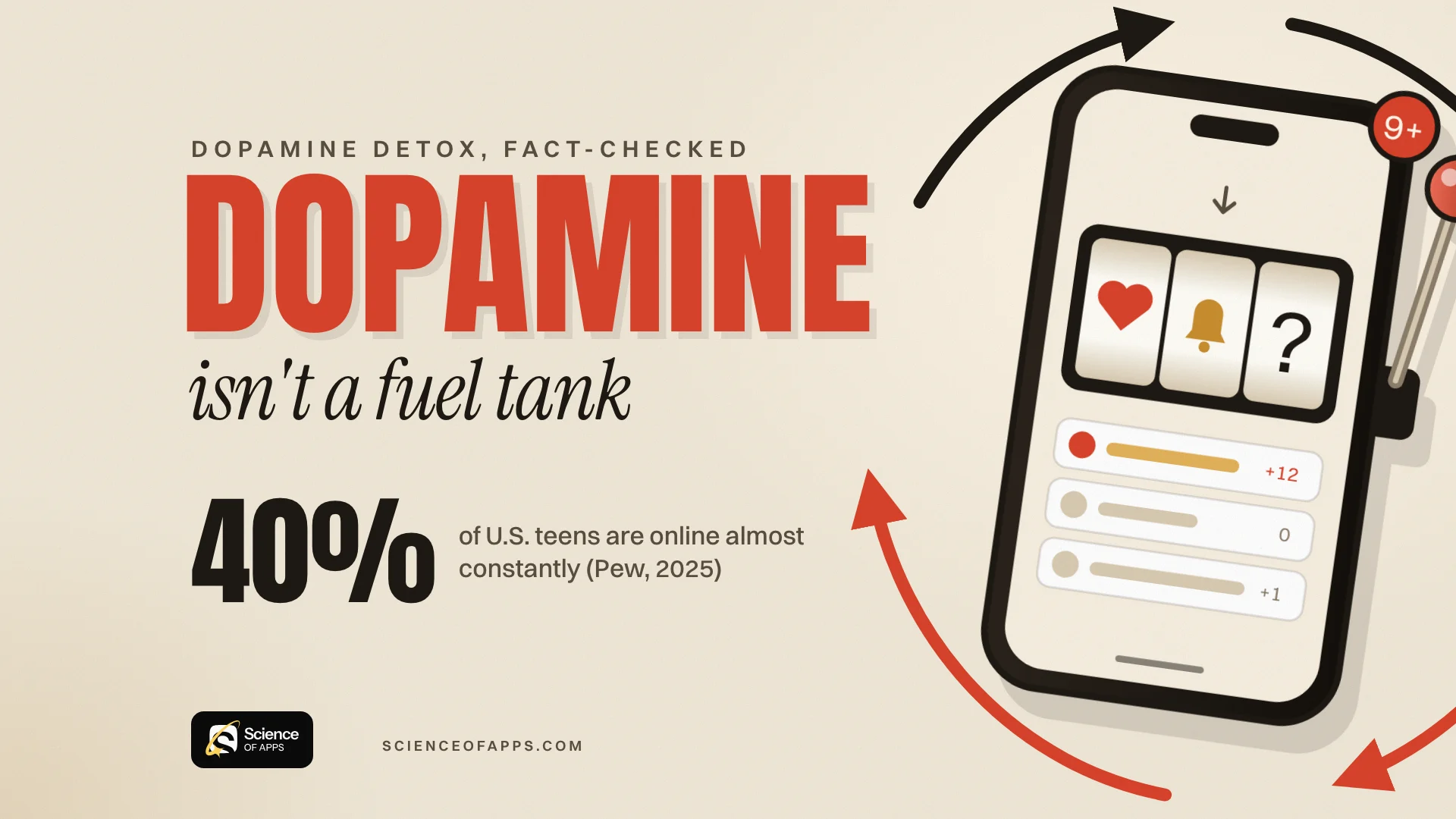
- 40% of U.S. teens ages 13 to 17 say they are online almost constantly, down from 46% in 2024 but up from 24% in 2014-15 (Pew Research Center, 2025).
- U.S. teens averaged 4.8 hours a day on social media across seven platforms, and 51% spent at least four hours (Gallup, 2023).
- A model fit to a randomized experiment in the American Economic Review estimated that self-control problems cause 31% of social media use (Allcott et al., 2022).
Key takeaways
- The share of teens online almost constantly jumped from 24% in 2014-15 to 46% by 2022 and held there for three surveys.
- 40% of U.S. teens ages 13 to 17 say they are online almost constantly, down from 46% in 2024 but up from 24% in 2014-15 (Pew Research Center, 2025).
- U.S. teens averaged 4.8 hours a day on social media across seven platforms, and 51% spent at least four hours (Gallup, 2023).
The word dopamine has become shorthand for everything wrong with phones. "Dopamine detox" videos promise a reset; headlines say apps "flood" the brain. The neuroscience is more specific, and more useful. Dopamine is less a pleasure fuel than a learning signal, and that is exactly what makes well-built feeds so sticky.
This explainer pairs that science with the latest usage data. The headline number comes from Pew Research Center’s Teens, Social Media and AI Chatbots 2025 report, a survey of 1,458 U.S. teens conducted Sept. 25 to Oct. 9, 2025 and published Dec. 9, 2025. Time-spent figures come from Gallup’s 2023 Familial and Adolescent Health Survey, fielded June 26 to July 17, 2023.
What does the data say about dopamine and social media use?
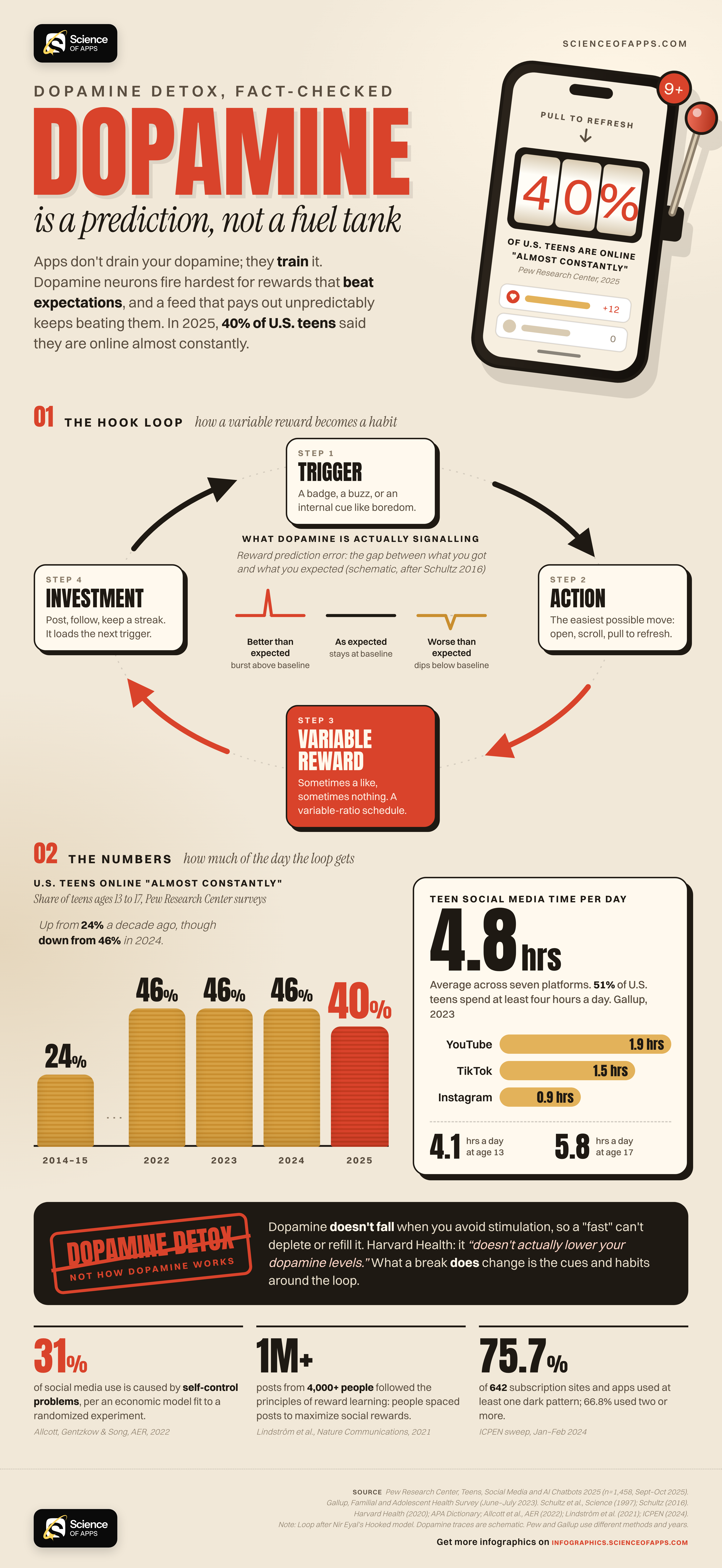
The table below shows every figure in the infographic, with its source and date.
| Measure | Value | Source, date |
|---|---|---|
| U.S. teens online almost constantly, 2025 | 40% | Pew, Sept–Oct 2025 |
| U.S. teens online almost constantly, 2024 | 46% | Pew, 2024 |
| U.S. teens online almost constantly, 2023 | 46% | Pew, 2023 |
| U.S. teens online almost constantly, 2022 | 46% | Pew, 2022 |
| U.S. teens online almost constantly, 2014–15 | 24% | Pew, 2014–15 |
| Teen social media time per day (7 platforms) | 4.8 hrs | Gallup, June–July 2023 |
| Teens spending 4+ hours a day on social media | 51% | Gallup, 2023 |
| Daily time on YouTube | 1.9 hrs | Gallup, 2023 |
| Daily time on TikTok | 1.5 hrs | Gallup, 2023 |
| Daily time on Instagram | 0.9 hrs | Gallup, 2023 |
| Social media time at age 13 / age 17 | 4.1 / 5.8 hrs | Gallup, 2023 |
| Share of social media use caused by self-control problems (model estimate) | 31% | Allcott et al., AER, 2022 |
| Social media posts analysed for reward learning | 1M+ (from 4,000+ people) | Lindström et al., Nature Communications, 2021 |
| Subscription sites/apps with at least one dark pattern (of 642) | 75.7% | ICPEN sweep, Jan–Feb 2024 |
| Subscription sites/apps with two or more dark patterns | 66.8% | ICPEN sweep, Jan–Feb 2024 |
Pew's trend is worth reading carefully. The share of teens online almost constantly jumped from 24% in 2014-15 to 46% by 2022 and held there for three surveys. In 2025 it fell to 40%, which Pew describes as a slight dip from the previous year. Daily use stayed near-universal: 97% of teens use the internet every day, and 36% use at least one of YouTube, TikTok, Instagram, Snapchat or Facebook almost constantly. TikTok alone reached 21%, up from 16% in 2022.
Gallup measured something different: estimated hours. Its 2023 survey of 1,591 adolescents found 4.8 hours a day on average, rising from 4.1 hours for 13-year-olds to 5.8 hours for 17-year-olds. Because Pew and Gallup ask different questions in different years, treat them as two views of the same behaviour, not as one series.
What does dopamine actually do in the brain?
The key study is Schultz, Dayan and Montague’s 1997 paper in Science, which linked the fluctuating output of dopamine neurons in primates to errors in predicting rewards. In a 2016 review, Wolfram Schultz summarised the pattern: most midbrain dopamine neurons are activated by more reward than predicted, stay at baseline for a fully predicted reward, and show depressed activity when the reward is less than predicted.
That is a reward prediction error: the signal tracks surprise, not pleasure as such. It is a teaching signal. When something turns out better than expected, the brain updates so you are more likely to repeat what came before it. Once a reward becomes perfectly predictable, the dopamine response to the reward itself fades.
How are apps addictive? The variable reward loop
Now add the slot machine. The APA Dictionary of Psychology defines a variable-ratio schedule as intermittent reinforcement in which a response is rewarded after a variable number of responses. A pull-to-refresh that sometimes shows twelve new likes and sometimes shows nothing works on similar logic. Because the payout is uncertain, it keeps having the chance to beat expectations.
Product designer Nir Eyal formalised this as the Hooked model: a trigger (a notification or a feeling like boredom), an action (open, scroll), a variable reward, and an investment (posting, following, keeping a streak) that loads the next trigger. The infographic above draws that loop around a phone that doubles as a slot machine.
There is direct evidence that people behave this way online. Lindström and colleagues analysed over one million posts from over 4,000 people across several platforms and found behaviour that conformed to reward learning: users spaced their posts to maximise the rate of social rewards. And Allcott, Gentzkow and Song reported in the American Economic Review in 2022 that temporary incentives to cut social media use had persistent effects, suggesting habit formation; their model attributes 31% of social media use to self-control problems.
What the evidence does not show is that a feed acts on the brain like a drug. Schultz's review notes that drugs of addiction hijack and amplify the dopamine signal; apps work through ordinary learning. That distinction matters, because it points to different fixes.
Does a dopamine detox work, or is it a myth?
As a literal description, "dopamine detox" is a misnomer. In Harvard Health Publishing, Peter Grinspoon, MD, explains that dopamine rises in response to rewards but doesn't actually decrease when you avoid overstimulating activities, so a fast does not lower your levels or let "depleted stores" refill. Cameron Sepah, the psychiatrist who coined the idea, told the New York Times (as quoted by Harvard Health) that the title is "not to be taken literally"; his version was based on cognitive behavioral therapy.
So the useful part of a detox is behavioural. Turning off notifications removes external triggers. Moving an app off the home screen raises the cost of the action. Scheduled offline time breaks the link between a cue, like boredom, and the reflexive reach for the phone. None of this changes how much dopamine you have; it changes what your brain learns to predict.
What this means for app builders
The same loop that builds a healthy habit can trap a user, and the difference is in the design choices. Regulators are watching: an ICPEN sweep of 642 subscription websites and apps in early 2024 found that 75.7% used at least one dark pattern and 66.8% used two or more.
Ethical habit design pairs the variable reward with real value: a language app's surprise review or a fitness app's new personal best. Dark patterns manufacture urgency or hide the exit. Practical rules for builders:
- Make the reward the user's goal, not the session length. Measure outcomes (lessons finished, budgets kept) alongside time spent.
- Give feeds an end. A "you're all caught up" state turns an open-ended variable schedule into a finished task.
- Batch notifications and let users choose them. Every external trigger should earn its interruption.
- Keep exits as easy as entries: one-tap cancel, visible auto-renew settings, no confirmshaming.
- Use streaks with grace days so investment builds commitment without punishing a missed day.
Methodology and sources
Figures were read directly from each primary source on Nov 27, 2026. Pew values for 2014-15, 2022, 2023 and 2025 are the printed data labels in the chart "4 in 10 teens say they're online 'almost constantly'" in Pew's 2025 report; the 2024 value (46%) is also stated in Pew's 2024 report. Gallup figures are from its October 2023 article. Neuroscience claims are limited to what the cited abstracts state; the dopamine traces in the infographic are schematic illustrations of the pattern Schultz (2016) describes, not recorded data. Pew (share online almost constantly) and Gallup (self-reported hours) use different questions, samples and years and are not combined. No values were estimated or read from bar lengths.
The full list of sources, with links, is below.
Frequently asked questions
Does a dopamine detox actually work?
Not in the way the name suggests. Harvard Health (Peter Grinspoon, MD, 2020) explains that dopamine does not decrease when you avoid stimulating activities, so a dopamine "fast" does not lower or reset your dopamine levels. Breaks from your phone can still help, because they interrupt the cues and routines that keep a habit running.
Is dopamine the pleasure chemical?
That is an oversimplification. Peer-reviewed work by Wolfram Schultz and colleagues (Science, 1997; Dialogues in Clinical Neuroscience, 2016) shows that most midbrain dopamine neurons signal a reward prediction error: they fire more when a reward is better than predicted, stay at baseline when it is exactly as predicted, and dip when it is worse.
Why are social media apps so addictive?
Many feeds pay out on something like a variable-ratio schedule, where a response is reinforced after an unpredictable number of tries (APA Dictionary of Psychology). Unpredictable rewards keep producing positive prediction errors. A 2022 American Economic Review study estimated that self-control problems cause 31% of social media use.
How many teens are online almost constantly?
According to Pew Research Center's survey of 1,458 U.S. teens conducted Sept. 25 to Oct. 9, 2025, 40% of teens ages 13 to 17 say they use the internet almost constantly. That is down from 46% in 2022, 2023 and 2024, but up from 24% in 2014-15.
How much time do teens spend on social media each day?
Gallup's 2023 Familial and Adolescent Health Survey of 1,591 U.S. adolescents found an average of 4.8 hours a day across seven social media platforms, with 51% spending at least four hours a day. YouTube (1.9 hours) and TikTok (1.5 hours) took the largest shares.
Sources
- Pew Research Center — Teens, Social Media and AI Chatbots 2025 (published Dec 9, 2025; survey Sept 25–Oct 9, 2025, n=1,458)
- Pew Research Center — Teens, Social Media and Technology 2024 (published Dec 12, 2024)
- Gallup — Teens Spend Average of 4.8 Hours on Social Media Per Day (Jonathan Rothwell, Oct 13, 2023)
- Schultz W, Dayan P, Montague PR — A neural substrate of prediction and reward. Science 275(5306):1593–9 (1997)
- Schultz W — Dopamine reward prediction error coding. Dialogues in Clinical Neuroscience 18(1):23–32 (2016)
- Harvard Health Publishing — Dopamine fasting: Misunderstanding science spawns a maladaptive fad (Peter Grinspoon, MD, Feb 26, 2020)
- APA Dictionary of Psychology — variable-ratio schedule (updated Apr 19, 2018)
- Allcott H, Gentzkow M, Song L — Digital Addiction. American Economic Review 112(7):2424–63 (2022)
- Lindström B et al. — A computational reward learning account of social media engagement. Nature Communications 12:1311 (2021)
- ICPEN — Sweep finds majority of websites and mobile apps use dark patterns in the marketing of subscription services (July 9, 2024)
- Nir Eyal — The Hooked Model (framework for trigger, action, variable reward, investment)
- Checked November 29, 2026. Figures that change — fees, salaries, prices — are reviewed every six months; if something is out of date, tell us.
Where to go from here
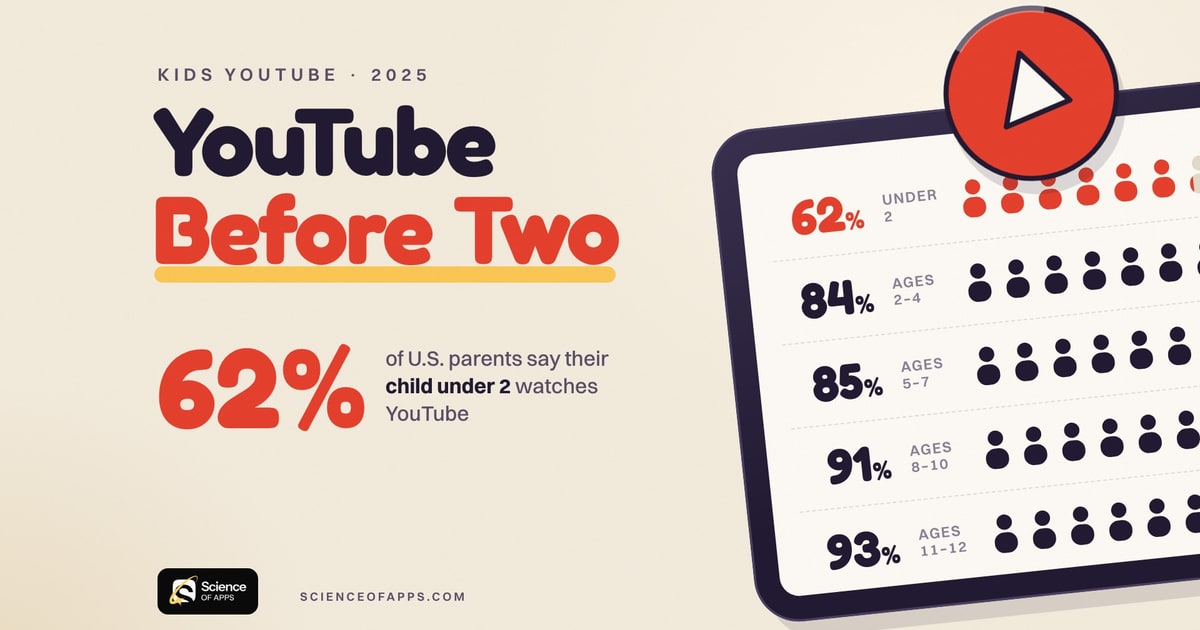
- Kids YouTube Statistics: 62% of Under-2s Watch, 93% by Age 12 — Science of Apps Infographics
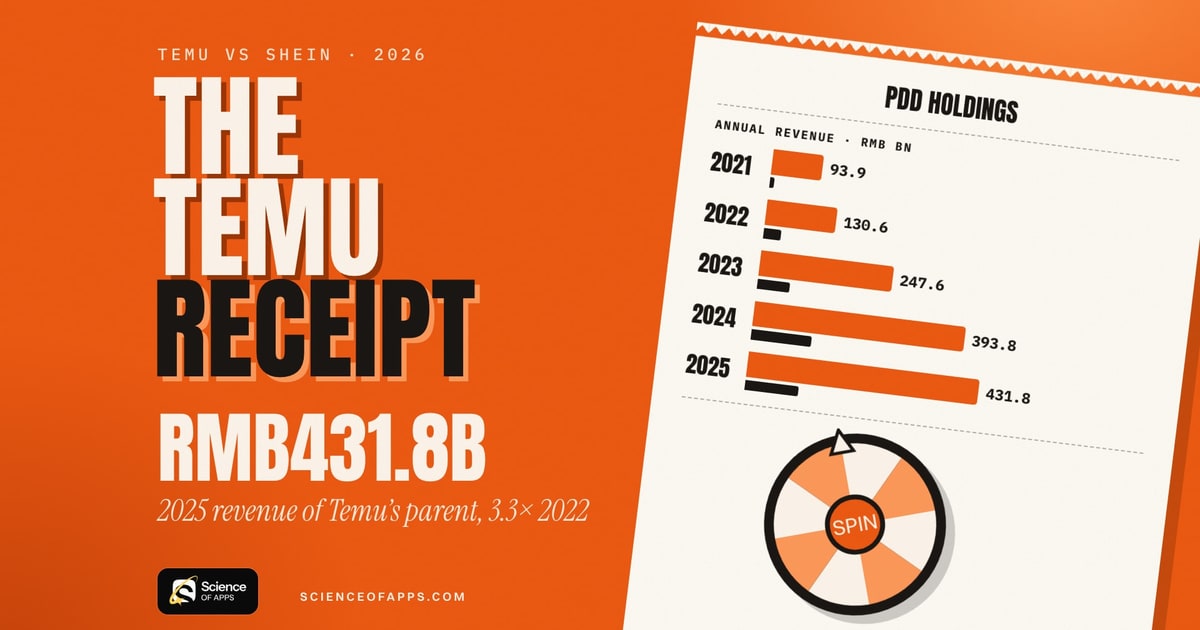
- Temu vs Shein in 2026: The Numbers Behind the Rise (and Is Temu Safe?) — Science of Apps Infographics
- Science of Apps InfographicsKids YouTube Statistics: 62% of Under-2s Watch, 93% by Age 12Kids YouTube data: 62% of U.S. parents say their child under 2 watches YouTube (Pew, 2025), up from 45% in 2020. Daily use, minutes per day and what it means.
- Science of Apps InfographicsTemu vs Shein in 2026: The Numbers Behind the Rise (and Is Temu Safe?)Temu's parent made RMB431.8B in 2025 but profit fell 12%; US downloads dropped 73% in spring 2025 and the EU fined Temu €200M. The data, and is Temu safe?
- Science of Apps - LaunchpadIs SEO dead? What the data says about AI search vs SEO for startups: Pew's click study, Google's own traffic claims and where a founder's hours should goIs SEO dead? Pew found fewer clicks when AI summaries appear; Google says clicks are stable. What both mean for a startup's AI search vs SEO plan.
- Everyday design scienceWho invented infinite scroll? Aza Raskin built it in 2006, and has spent years warning about itAza Raskin invented infinite scroll in 2006 to save clicks, and now regrets it. How it works on the brain, what research shows and how regulators are acting.
- Science of Apps InfographicsStarlink Countries in 2026: Where It Works and How Many Subscribers It HasStarlink's map lists service as available in 173 of 255 countries and territories (Nov 2026), 71 coming soon. SpaceX reports 13.6M subscribers.
- Science of Apps - LaunchpadSocial media marketing for startups: which platform to pick for your buyers (with 2026 usage data), what to post, a 30-day plan and calendar, and how to turn followers into usersSocial media marketing for startups: which platform fits your buyers (2026 usage data), what to post, a 30-day calendar and how to turn followers into users.


Get the ideas, not the noise.
Sign up with Google and we’ll send you short UX psychology tips by email — why people tap, stall and leave, and what to do about it. Unsubscribe anytime. Prefer something to keep? Get the free Laws of UX guide as a PDF.
See what your own users' numbers are telling you.
A behavioral UX audit of your app or SaaS product: why users hesitate, stall and leave, and a prioritized fix list. Fixed price, 2–4 weeks.