 By
Quick answer: How many countries have Starlink in 2026?
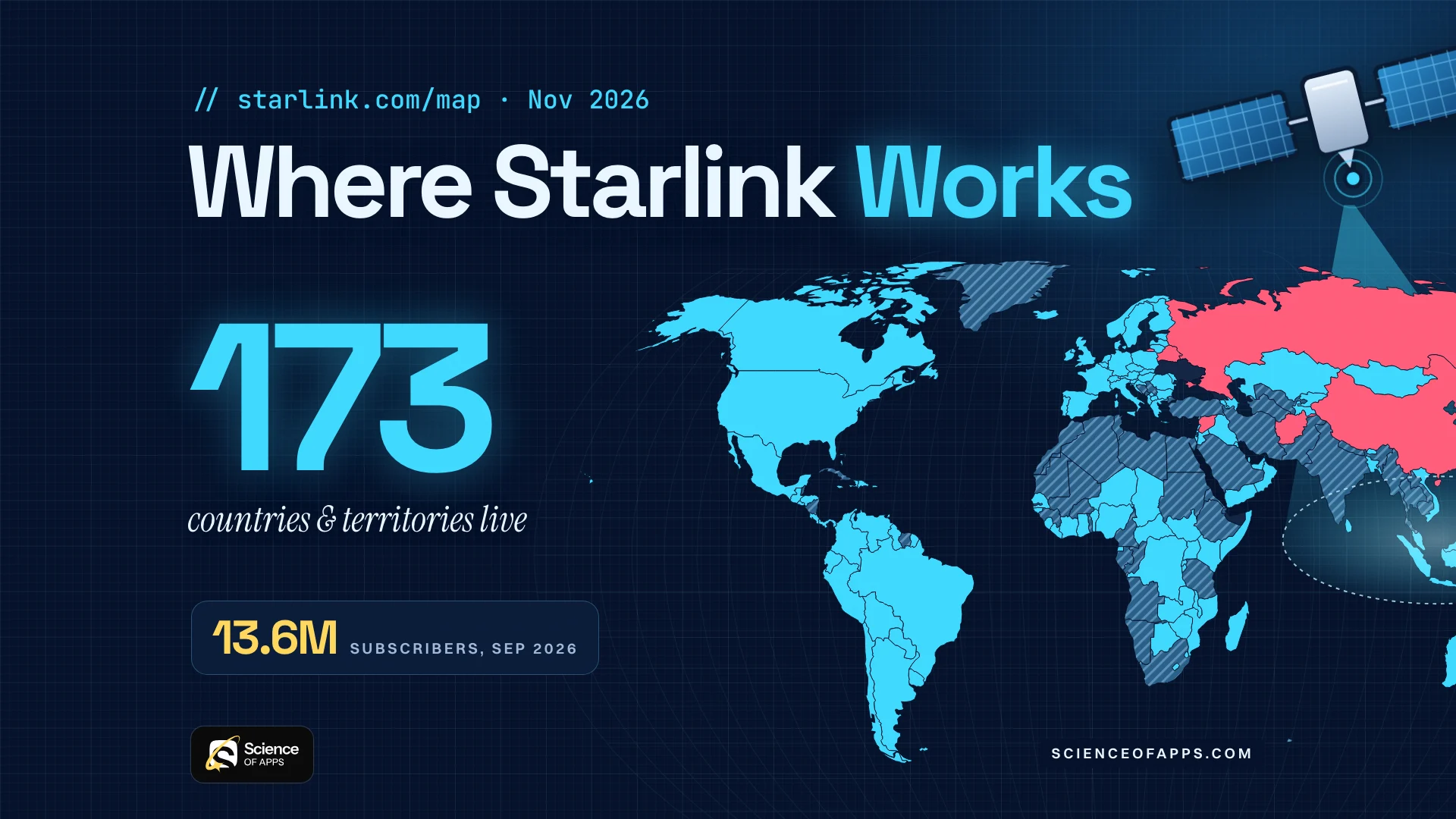
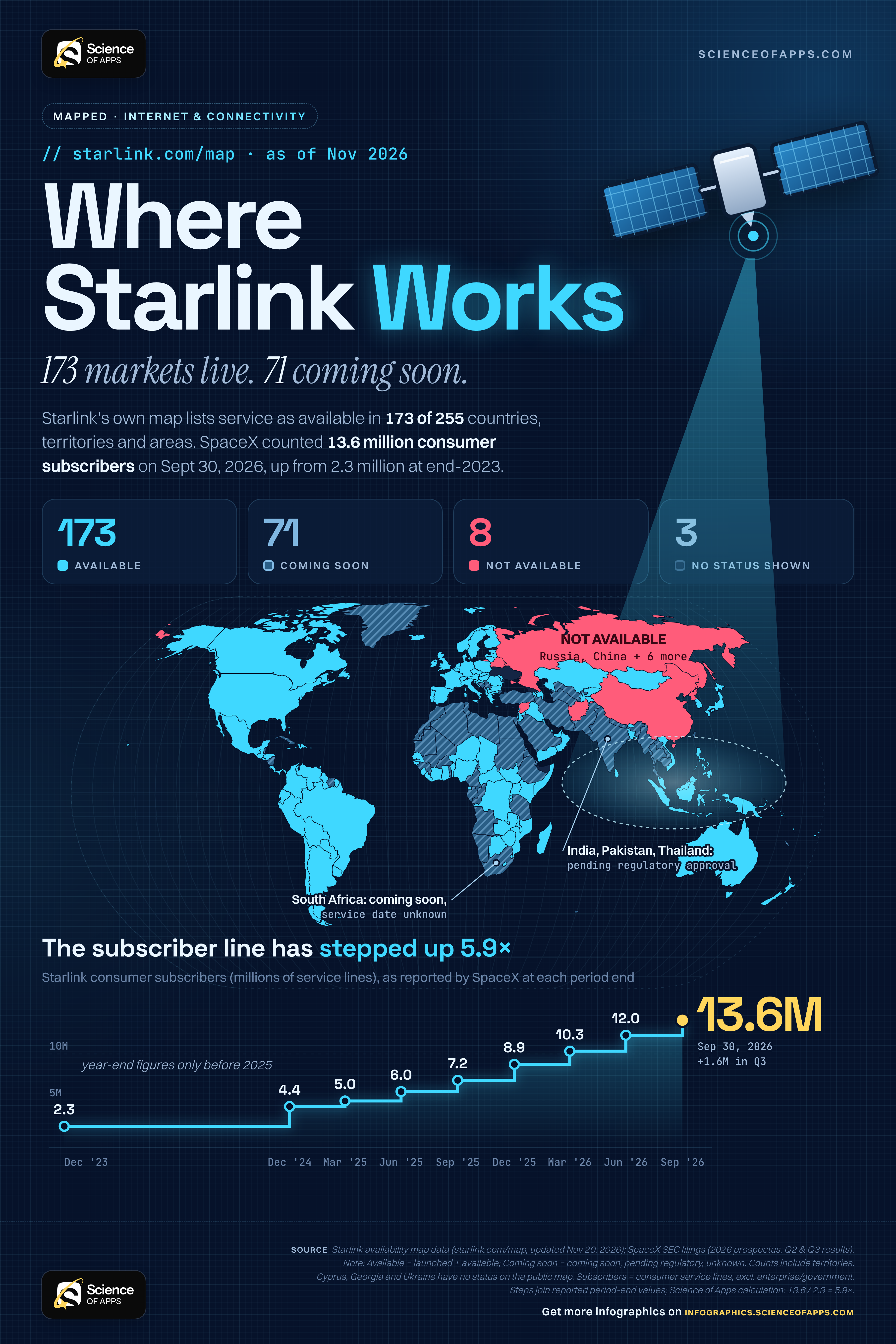
- Starlink is available in 173 countries, territories and areas on its own map (data updated Nov 20, 2026); 71 more are coming soon, including India, Pakistan and Thailand, which await regulators.
- SpaceX counted 13.6 million Starlink consumer subscribers on Sept 30, 2026, 5.9 times the 2.3 million it had at the end of 2023.
- Growth came with cheaper plans: monthly ARPU fell from $99 in 2023 to $69 in Q3 2026, according to SpaceX filings.
Key takeaways
- SpaceX reported 13.6 million Starlink consumer subscribers as of September 30, 2026, up 1.6 million in a single quarter, according to its Q3 2026 earnings release.
- The closest official geography is the market footprint: SpaceX says its 164 markets as of March 2026 were "collectively home to more than 3.3 billion people" (prospectus).
- Starlink is available in 173 countries, territories and areas on its own map (data updated Nov 20, 2026); 71 more are coming soon, including India, Pakistan and Thailand, which await regulators.
Starlink now sells satellite internet in more places than almost any other home broadband provider. Its official coverage map marks 173 of 255 countries, territories and other areas as available, and SpaceX's latest filing puts the base at 13.6 million consumer subscribers. This guide shows which Starlink countries are live, which are coming soon, and how fast the Starlink user base has grown.
Country statuses come from the data file behind starlink.com/map, last updated on November 20, 2026 and downloaded on November 27, 2026. Subscriber figures come from SpaceX's SEC filings: the June 2026 IPO prospectus (end-2023 to March 2026), and the Q2 2026 and Q3 2026 earnings releases. Starlink does not publish user counts by country, so this article reports only global totals.
How many countries is Starlink available in?
The table below shows how Starlink's own map data sorts all 255 country and territory entries, followed by every subscriber figure SpaceX has filed with the SEC. Starlink's map uses seven internal status codes; its legend groups "launched" and "available" as Available, and "coming soon", "pending regulatory" and "unknown" as Coming soon.
| Map status | Countries, territories and areas | Examples |
|---|---|---|
| Available | 173 | United States, Brazil, Japan, Indonesia, Nigeria, Kenya, Vietnam, Bangladesh |
| Coming soon | 71 | India, Pakistan, Thailand, Saudi Arabia, Türkiye, South Africa, Egypt |
| Not available | 8 | Afghanistan, Belarus, China, Hong Kong, Macao, North Korea, Russia, Syria |
| No status shown | 3 | Cyprus, Georgia, Ukraine |
| Total | 255 |
| As of | Subscribers (millions) | SEC source |
|---|---|---|
| Dec 31, 2023 | 2.3 | 424B4 prospectus |
| Dec 31, 2024 | 4.4 | 424B4 prospectus |
| Mar 31, 2025 | 5.0 | 424B4 prospectus |
| Jun 30, 2025 | 6.0 | Q2 2026 release |
| Sep 30, 2025 | 7.2 | Q3 2026 release |
| Dec 31, 2025 | 8.9 | 424B4 prospectus |
| Mar 31, 2026 | 10.3 | 424B4 prospectus |
| Jun 30, 2026 | 12.0 | Q2 2026 release |
| Sep 30, 2026 | 13.6 | Q3 2026 release |
Where is Starlink available, and where is it coming soon?
Starlink is available across nearly all of the Americas, Europe, Oceania and much of Africa and Southeast Asia. On the map data dated November 20, 2026, the United States, Canada, Mexico, Brazil, the United Kingdom, Germany, France, Japan, South Korea, Indonesia, the Philippines, Vietnam, Nigeria, Kenya and Australia all carry a live status.
The 71 coming soon entries are not all alike. Three of the most populous, India, Pakistan and Thailand, are coded explicitly as pending regulatory approval. Brunei, Saudi Arabia and Türkiye are also flagged "Pending regulatory approval" in their map tooltips. Another 35 areas, among them Angola, Cambodia, Laos, Namibia, Serbia, Tanzania and Tunisia, show "Starting in 2026". Twenty-two, including South Africa, Ethiopia, Taiwan and Myanmar, say the service date is unknown.
Eight places are marked as not available: Afghanistan, Belarus, China, Hong Kong, Macao, North Korea, Russia and Syria. Cyprus, Georgia and Ukraine carry an "exclude" code that suppresses any status on the public map. That does not tell us whether service works there, so we leave them unclassified.
Why do official country counts differ? Starlink's 2025 Progress Report cited 155+ countries and markets. SpaceX's prospectus said 164 countries, territories and other markets as of March 31, 2026, and its Q3 2026 Form 10-Q says 174. The map's 173 counts uninhabited territories and Antarctica too, so treat all of these as market counts rather than sovereign countries.
How many Starlink users are there?
SpaceX reported 13.6 million Starlink consumer subscribers as of September 30, 2026, up 1.6 million in a single quarter, according to its Q3 2026 earnings release. That is up from 7.2 million a year earlier and 2.3 million at the end of 2023, so the base grew 5.9 times in 33 months (our calculation from the filed figures).
Two caveats matter when people ask how many Starlink users there are. First, a subscriber is a service line, not a person. SpaceX's prospectus notes that the number of individual end users is "likely meaningfully higher" because a household can share one line. Second, the count excludes managed enterprise and government customers in aviation, maritime and similar contracts; SpaceX says it has "hundreds of thousands" of those on top.
Growth has come with lower prices per user. Monthly average revenue per user was $99 in 2023, $91 in 2024 and $81 in 2025 (prospectus), then $69 in Q3 2026, versus $83 a year earlier (Q3 release). SpaceX says fees vary "based on geographic market", so cheaper markets and plans are a larger share of the mix.
Does Starlink publish users by country?
No. Neither Starlink's map nor SpaceX's filings break subscribers out by country, so any per-country Starlink user number you see is an estimate from a third party or a local regulator, not from the company. The closest official geography is the market footprint: SpaceX says its 164 markets as of March 2026 were "collectively home to more than 3.3 billion people" (prospectus). Starlink's own 2025 Progress Report opens by noting that one-third of humanity remains offline.
What this means for app builders
Every available country on this map is also a potential app market, often one where your analytics show sparse, slow or no usage today. When a household goes from no broadband to a satellite link, the first sessions decide whether your app becomes a habit. Three things follow from the data above.
Design for the first connection, not the average one. New users in rural and remote areas judge an app in its first minute. Keep onboarding light: small first downloads, deferred asset loading and an offline-first core. Laws of UX such as the Doherty Threshold (people stay engaged when the system responds within about 400 ms) apply even more on new or shared connections.
Price for the market, not the headline. Starlink's own ARPU fell from $99 to $69 as it moved into more markets. Subscription apps should expect the same mix shift: regional price tiers, annual plans paid in local currency, and paywall tests segmented by country.
Watch the coming-soon list as a launch calendar. India, Pakistan and Thailand are waiting on regulators, and 35 areas are flagged "Starting in 2026". Localising store listings and payment methods ahead of a switch-on is cheaper than catching up afterwards.
Methodology and sources
We downloaded the JSON data file that powers starlink.com/map (public-files/availability.json; server last-modified November 20, 2026) on November 27, 2026, and counted the 255 country-level entries by status. We grouped statuses exactly as the map's own legend code does. Available covers "launched" (162) and "available" (11). Coming soon covers "coming_soon" (64), "pending_regulatory" (3) and "unknown" (4). Not available covers "blacklisted" (8), and no status covers "exclude" (3). Subscriber and ARPU figures are taken verbatim from SpaceX's SEC filings. SpaceX renamed the metric "Starlink consumer subscribers" in Q3 2026 and says it is the same metric previously disclosed as "Starlink Subscribers". The 5.9× growth multiple is our calculation (13.6 ÷ 2.3 = 5.91), rounded to one decimal. The step chart joins reported period-end values; SpaceX did not report quarterly values before 2025 in these filings. No values were read from chart images.
The full list of sources, with links, is below.
Frequently asked questions
How many countries have Starlink in 2026?
Starlink's official map lists service as available in 173 of 255 countries, territories and other areas, based on map data updated November 20, 2026. SpaceX's Q3 2026 Form 10-Q, filed in October 2026, describes coverage across 174 countries, territories and other markets.
Is Starlink available in India?
Not yet. As of November 20, 2026, Starlink's map lists India with a pending regulatory approval status, alongside Pakistan and Thailand. All three appear as coming soon on the public map.
How many people use Starlink?
SpaceX reported 13.6 million Starlink consumer subscribers on September 30, 2026. Each subscriber is a service line that several people can share, and the figure excludes enterprise and government contracts, so the number of individual users is higher.
Where is Starlink not available?
Starlink's map marks eight places as not available: Afghanistan, Belarus, China, Hong Kong, Macao, North Korea, Russia and Syria. Cyprus, Georgia and Ukraine show no status on the public map.
Where does this data come from, and how current is it?
The figures come from Starlink: Availability map, SpaceX: Third Quarter 2026 Results, SpaceX: Second Quarter 2026 Results and others, each linked in the sources below. We downloaded the JSON data file that powers starlink.com/map (public-files/availability.json; server last-modified November 20, 2026) on November 27, 2026, and counted the 255 country-level entries by status. We grouped statuses exactly as the map's own legend code does.
Sources
- Starlink: Availability map
- SpaceX: Third Quarter 2026 Results, Form 8-K Exhibit 99.1 (Oct 20, 2026)
- SpaceX: Second Quarter 2026 Results, Form 8-K Exhibit 99.1 (Aug 4, 2026)
- SpaceX: Prospectus, Form 424B4 (Jun 12, 2026)
- SpaceX: Form 10-Q for the quarter ended Sep 30, 2026 (Oct 22, 2026)
- Starlink: Progress 2025 report (PDF) (accessed Nov 27, 2026)
- Checked November 29, 2026. Figures that change — fees, salaries, prices — are reviewed every six months; if something is out of date, tell us.
Where to go from here
- The Most Valuable AI Companies in the World (November 2026) — Science of Apps Infographics
- Inflation Since 2020: What Got More Expensive and What Got Cheaper — Science of Apps Infographics
- Architecture & engineeringUNESCO World Heritage Sites in India: all 45, with a map, dates and what makes each one specialIndia has 45 UNESCO World Heritage Sites as of 2026, after Sarnath: 37 cultural, 7 natural, 1 mixed. All of them on one map, with dates and design notes.
- Science of Apps - LaunchpadProduct Hunt pre-launch: the pre-launch dashboard, building your audience weeks ahead, and the waitlists and listings that work alongside itProduct Hunt pre-launch, explained: the pre-launch dashboard, building an audience weeks ahead, a waitlist, BetaList and a draft listing while you build.
- Science of Apps - LaunchpadHow to make a coming soon page that collects sign-ups: what to put on it, a coming soon page template, free builders and waitlist page tools compared, and what to do on launch dayHow to make a coming soon page that collects sign-ups: a coming soon page template, free builders and waitlist page tools, and what to do on launch day.
- Science of Apps - LaunchpadGame launch platforms for indie developers: Steam ($100 per game, recoupable), itch.io (open revenue sharing), the mobile app stores, and where to find beta testersGame launch platforms for indie developers: Steam's $100 fee and coming-soon rule, itch.io's open revenue share, app stores and beta testers.
- Science of Apps - LaunchpadA startup directory submission tracker you build yourself: the columns, 24 real rows with cost, link type and review time checked on each site, the formulas, and how many directories to submit toBuild a directory submission tracker in 10 minutes: the columns, 24 real rows with cost, rel and review time checked 18 Nov 2026, and the formulas to use.
- Science of Apps - LaunchpadList of unicorn companies and unicorn startups as of November 2026: how many unicorns there are, the top 25 by valuation, unicorns by country, how the Crunchbase and CB Insights unicorn lists differ, and tomorrow's unicornsA list of unicorn companies as of 17 Nov 2026: 1,931 startups worth $1B+, the top 25, unicorns by country, and how the CB Insights unicorn list differs.

Get the ideas, not the noise.
Sign up with Google and we’ll send you short UX psychology tips by email — why people tap, stall and leave, and what to do about it. Unsubscribe anytime. Prefer something to keep? Get the free Laws of UX guide as a PDF.
See what your own users' numbers are telling you.
A behavioral UX audit of your app or SaaS product: why users hesitate, stall and leave, and a prioritized fix list. Fixed price, 2–4 weeks.