QGIS Practice Test
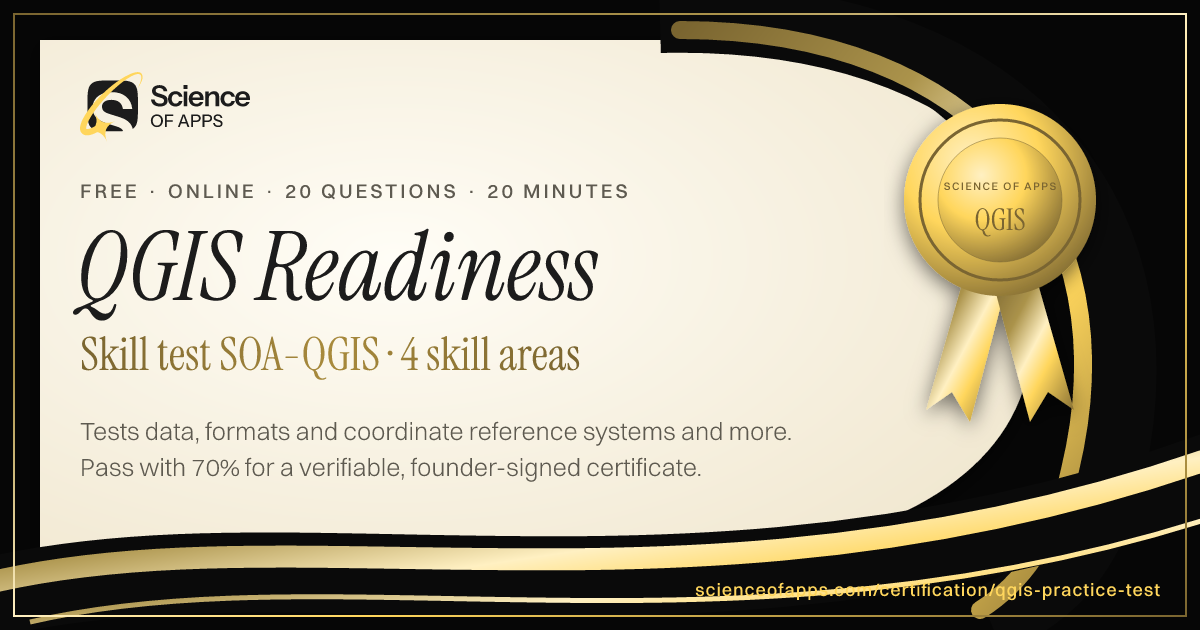
Tests practical QGIS skills for GIS work — data, formats and coordinate reference systems, vector analysis and attributes, raster analysis and terrain, and cartography, automation and services — written to the QGIS User Manual, QGIS Training Manual, PyQGIS Developer Cookbook, EPSG registry and OGC standards for 2026. It is an independent practice test; QGIS has no official exam. Pass to earn QGIS Readiness SOA-QGIS.
- Intermediate difficulty.Assumes hands-on experience in the role.
- 20 scenario questions
- 20 minutes, timed
- 70% to pass · 90% for distinction
- Free no sign-up needed
- LinkedIn-ready · add it to your profile in one clickSee how ↓

 Founder, Science of Apps
What is the QGIS Practice Test?
- Career Booster
- Quality Assured
- Exclusive Certification
Updated for 2026 and 2027 exams. Covers data, formats and coordinate reference systems, vector analysis and attributes, raster analysis and terrain and cartography, automation and services.
The QGIS Practice Test is a free intermediate-level, 20-minute skill test from Science of Apps. It tests practical QGIS skills for GIS work — data, formats and coordinate reference systems, vector analysis and attributes, raster analysis and terrain, and cartography, automation and services — written to the QGIS User Manual, QGIS Training Manual, PyQGIS Developer Cookbook, EPSG registry and OGC standards for 2026. It is an independent practice test; QGIS has no official exam. Score 70% or more on its 20 questions to earn a verifiable QGIS Readiness certificate (SOA-QGIS). Every question is based on published standards and research — including QGIS User Manual (QGIS Project), QGIS Training Manual (QGIS Project), EPSG Geodetic Parameter Dataset (IOGP) — and each answer is explained with its source.
Built for your job title
GIS analyst or technician, Urban or environmental planner, Geospatial data scientist, Surveyor or cartographer and Researcher using spatial data — and anyone who wants quick, verifiable proof of QGIS knowledge for a CV or LinkedIn in 2026 and 2027.
- GIS analyst or technician
- Urban or environmental planner
- Geospatial data scientist
- Surveyor or cartographer
- Researcher using spatial data
What the test covers
Four skill areas with 5 questions each, drawn from a bank of 10 per area, so a retake brings questions you haven't seen.
Data, Formats and Coordinate Reference Systems
25%- Formats
- CRS
- Projections
Vector Analysis and Attributes
25%- Geoprocessing
- Joins
- Expressions
Raster Analysis and Terrain
25%- DEMs
- Raster calculator
- Interpolation
Cartography, Automation and Services
25%- Layouts
- Styling
- PyQGIS
- OGC
Based on published standards
The questions are original scenarios, and each one names the public standard, official guide or research it draws on — shown under the question while you answer, and linked in your review. These are the sources behind this test:
- QGIS User ManualQGIS Project30 questions
- QGIS Training ManualQGIS Project5 questions
- EPSG Geodetic Parameter DatasetIOGP2 questions
- OGC standards (WMS, WFS, GeoPackage and more)Open Geospatial Consortium2 questions
- PyQGIS Developer CookbookQGIS Project1 question
Try a sample question
The default file format QGIS uses for new vector layers is
- KML (.kml)
- CSV (.csv)
- GeoPackage (.gpkg)
- Shapefile (.shp)
Show the answer
C. GeoPackage (.gpkg) — GeoPackage. The real test has 20 questions like this.
How the test works
20 minutes, 20 questions
One question per screen, with a progress bar and a countdown. Your progress is saved on this device if you need to pause.
Graded on our server
Answers reach the page only after you submit, so the certificate can only be earned by passing.
Every answer explained
Pass or not, you see every question with the right answer, why, and the source behind it. Pass mark 70%, distinction 90%.
Your certificate
Founder-signed, with a QR code and credential ID. Download PDF or PNG, add to LinkedIn, and it's emailed to you.
What you earn
Pass, then add it to LinkedIn in one click
No typing. The Add to LinkedIn button opens your profile’s Licenses & certifications form already filled in: the certificate name, Science of Apps as the issuer, the issue date, your credential ID and a link recruiters can use to verify it.
- 1Take the 20-minute test
- 2Score 70% or more
- 3Click Add to LinkedIn

QGIS Readiness
Science of Apps
Show credential ↗Try another skill test
- ProfessionalSOA-PA
Product Analytics Certification
Certifies that you can turn product data into decisions — metrics and instrumentation, funnels and conversion, retention and cohorts, and A/B testing and statistics.
Difficulty: AdvancedEarn Certified Product Analyst → - 10 minSOA-DLIT
Data Literacy Certification
Tests the everyday ability to read, question and communicate with data — chart reading, averages and percentages, data sources, bias and drawing sound conclusions.
Difficulty: BeginnerTake the 10-minute test → - 10 minSOA-XLF
Microsoft Excel Certification Test (Fundamentals)
Tests core Excel skills — cell references, essential formulas, sorting and filtering, tables, basic charts, conditional formatting and PivotTables.
Difficulty: BeginnerTake the 10-minute test →
Frequently asked questions
What is the QGIS Practice Test?
The QGIS Practice Test is a free intermediate-level, 20-minute skill test from Science of Apps. It tests practical QGIS skills for GIS work — data, formats and coordinate reference systems, vector analysis and attributes, raster analysis and terrain, and cartography, automation and services — written to the QGIS User Manual, QGIS Training Manual, PyQGIS Developer Cookbook, EPSG registry and OGC standards for 2026. It is an independent practice test; QGIS has no official exam. Score 70% or more on its 20 questions to earn a verifiable QGIS Readiness certificate (SOA-QGIS). Every question is based on published standards and research — including QGIS User Manual (QGIS Project), QGIS Training Manual (QGIS Project), EPSG Geodetic Parameter Dataset (IOGP) — and each answer is explained with its source.
Is there a free QGIS practice test for 2026?
Yes. Science of Apps has a free QGIS Practice Test built on the current exam outline for 2026 and 2027. It covers data, formats and coordinate reference systems, vector analysis and attributes, raster analysis and terrain and cartography, automation and services, scores you instantly and issues a verifiable certificate.
How do I take the QGIS Practice Test for free?
Read the four skill areas on this page, then take the 20-minute test online — no fee, course or sign-up. You see every answer explained when you finish. Score 70% or more and you get a QGIS Readiness certificate straight away, on screen, as a PDF and by email, with a credential ID anyone can verify.
Are the QGIS Practice Test questions based on real standards?
Yes. The questions are original scenarios written by Science of Apps, and each one is based on a public source you can read: QGIS User Manual (QGIS Project); QGIS Training Manual (QGIS Project); EPSG Geodetic Parameter Dataset (IOGP); OGC standards (WMS, WFS, GeoPackage and more) (Open Geospatial Consortium); PyQGIS Developer Cookbook (QGIS Project). The source is shown under each question and linked in the answer review. Science of Apps doesn't copy questions from other tests.
What does the QGIS Practice Test cover?
Four skill areas with five questions each, drawn from a bank of 10 per area so a retake brings new questions: Data, Formats and Coordinate Reference Systems (Formats, CRS and Projections); Vector Analysis and Attributes (Geoprocessing, Joins and Expressions); Raster Analysis and Terrain (DEMs, Raster calculator and Interpolation); Cartography, Automation and Services (Layouts, Styling, PyQGIS and OGC). Every question is an original scenario written to the 2026–2027 standard, with the published source named under it.
Who should take the QGIS Practice Test?
GIS analyst or technician, Urban or environmental planner, Geospatial data scientist, Surveyor or cartographer and Researcher using spatial data. It suits anyone who wants a quick, verifiable way to show QGIS knowledge in 2026 and 2027, from students and career switchers to experienced professionals.
What is QGIS?
QGIS is a free, open-source geographic information system for viewing, editing, analysing and mapping spatial data. It reads many vector and raster formats, connects to databases such as PostGIS and web services such as WMS and WFS, and can be automated with Python (PyQGIS).
How do people show QGIS skills without an official exam?
Since QGIS has no vendor exam, people show skill with portfolios of maps and analyses, training course certificates and practical tests like this one, which cover the tasks employers expect.
Can I take the QGIS Practice Test from any country?
Yes. The test is online, in English and free everywhere — people take it from India, the US, the UK, Europe, Africa, Latin America and Asia-Pacific. Your certificate is dated with your own local date and can be verified from anywhere at scienceofapps.com/certification/verify/.
How long is the QGIS Practice Test?
20 questions — 5 from each of 4 skill areas — with a 20-minute limit. You need 70% (14 of 20) to pass and 90% for distinction.
How hard is the QGIS Practice Test?
We rate it Intermediate: assumes hands-on experience in the role. It has 20 scenario questions — 5 from each of 4 skill areas — and a 20-minute limit. You need 70% (14 of 20) to pass and 90% for distinction.
How much do Science of Apps certifications cost?
Nothing. There is no fee to take a test, to receive the certificate, to have it emailed or to verify it, and no sign-up.
How are the tests graded?
On our server, not in your browser. The answers never reach the page until you submit, so a certificate can only be earned by passing. Each certificate gets a unique credential ID stored by Science of Apps.
What happens if I don't pass?
You see your score for each area and every question with the correct answer and why, with the published source behind it. You can retake after 30 minutes, and the retake draws questions you haven't seen yet.
Do the certificates expire?
No. Every certificate is dated, so it always shows when you passed. Retake a test any time for a newer date or a higher score.
Can I add the certificate to LinkedIn?
Yes. After you pass, Add to LinkedIn opens the Licenses & certifications form with the certificate name, Science of Apps as the issuer, the issue date, your credential ID and the verification link filled in. You can also download it as a PDF or PNG, and it's emailed to you as a PDF.
How can an employer verify my certificate?
Every certificate has a credential ID and a QR code. Scanning it, or entering the ID at scienceofapps.com/certification/verify/, shows the holder's name, the certification, the score and the issue date from our records.
Are these accredited qualifications?
No. They are Science of Apps' own assessments of applied skill. They aren't issued by a university or standards body, and they work best alongside a portfolio that shows the skills in real work.
2402 more certifications to collect
Data Analytics & Business Intelligence
- Product Analytics Certification30 min · Advanced
- Data Literacy Certification10 min · Beginner
- Microsoft Excel Certification Test (Fundamentals)10 min · Beginner
- Advanced Excel Certification Test15 min · Intermediate
- Excel for Business Analysis Certification15 min · Intermediate
- SQL Certification Test (Fundamentals)10 min · Beginner
- Advanced SQL Assessment20 min · Advanced
- Data Cleaning and Preparation Certification15 min · Intermediate
- Data Visualization Certification Test (Fundamentals)10 min · Beginner
- Power BI Analyst Assessment15 min · Intermediate
- Tableau Data Visualization Certification15 min · Intermediate
- Google Sheets Certification Test10 min · Beginner
- Python for Data Analysis Certification15 min · Intermediate
- Statistics for Data Analysts Certification15 min · Intermediate
- Business Intelligence Test10 min · Beginner
- Business Analyst Certification15 min · Intermediate
- Data Storytelling and Presentation Certification10 min · Beginner
- Dashboard Design and KPI Selection Certification15 min · Intermediate
- A/B Testing and Experimentation Certification20 min · Advanced
- Customer and Marketing Analytics Certification15 min · Intermediate
- Data Quality and Governance Certification15 min · Intermediate
- Data Engineering Certification Test (Fundamentals)15 min · Intermediate
- Machine Learning Certification Test (Fundamentals)15 min · Intermediate
- AI and Machine Learning Model Evaluation Certification20 min · Advanced
- Statistical Reasoning Assessment15 min · Intermediate
- Data-Driven Decision-Making Test10 min · Beginner
- Operations Research Certification20 min · Advanced
- Decision Science & Optimization Certification15 min · Intermediate
- Business Analytics Certification20 min · Intermediate
- Power Query Test20 min · Intermediate
- Big Data Certification20 min · Intermediate
- Data Warehouse Certification20 min · Intermediate
- dbt Certification Test20 min · Intermediate
- PySpark Certification Test (Apache Spark)20 min · Intermediate
- Snowflake SnowPro Core Practice Test20 min · Intermediate
- Databricks Data Engineer Associate Practice Test20 min · Intermediate
- ETL & Data Pipeline Test20 min · Intermediate
- Data Modeling Certification20 min · Intermediate
- Predictive Analytics Certification20 min · Intermediate
- PL-300 Practice Test20 min · Intermediate
- Pandas Quiz20 min · Intermediate
- NumPy Quiz20 min · Intermediate
- scikit-learn Quiz20 min · Intermediate
- R Programming Test20 min · Intermediate
- DP-900 Practice Test15 min · Beginner
- DP-600 Practice Test25 min · Advanced
- DP-700 Practice Test25 min · Advanced
- CompTIA Data+ Practice Test20 min · Intermediate
- AWS Data Analytics Certification Test20 min · Intermediate
- Azure Data Analytics Certification Test20 min · Intermediate
- Google Cloud Data Analytics Certification Test20 min · Intermediate
- Matplotlib Quiz20 min · Intermediate
- Data Science Certification Test20 min · Intermediate
- SAS Base Programming Practice Test20 min · Intermediate
- Oracle DBA Practice Test (OCP)25 min · Advanced
- Esri ArcGIS Practice Test20 min · Intermediate
- DP-300 Practice Test (Azure Database Administrator)20 min · Intermediate
- Neo4j Certification Practice Test20 min · Intermediate
- Qlik Sense Certification Practice Test20 min · Intermediate
- Alteryx Designer Core Practice Test20 min · Intermediate
- Google Associate Data Practitioner Practice Test15 min · Beginner
- Bioinformatics Certification Test20 min · Intermediate
- Sports Analytics Professional Certification20 min · Intermediate
- Causal Inference for Data Science Certification25 min · Advanced
- Competitive Data Science Certification20 min · Intermediate
- Football Analytics Certification20 min · Intermediate
- Time-Series Forecasting with Machine Learning Certification20 min · Intermediate
- Bayesian Statistics & Probabilistic Programming Certification25 min · Advanced
- Geospatial Data Science with Python Certification20 min · Intermediate
- Data Science for Social Good Certification20 min · Intermediate
- Basketball & Baseball Analytics Certification20 min · Intermediate
- Cricket Analytics Certification20 min · Intermediate
- Network Science & Social Network Analysis Certification25 min · Advanced
- Fantasy Sports Analytics Test15 min · Beginner
- Google Data Analytics Certificate Practice Test20 min · Intermediate
- CDMP Practice Test20 min · Intermediate
- Lean Six Sigma White Belt Certification15 min · Beginner
- GIS Practice Test (GISP)20 min · Intermediate
- Tableau Desktop Foundations (Desktop Specialist) Practice Test20 min · Intermediate
- Apache Kafka (CCDAK) Practice Test20 min · Intermediate
- Google Professional Data Engineer Certification25 min · Advanced
- Apache Airflow Certification20 min · Intermediate
- Informatica PowerCenter Certification20 min · Intermediate
- Oracle Database SQL Practice Test20 min · Intermediate
- Adobe Analytics Certification20 min · Intermediate
- Databricks Data Analyst Certification20 min · Intermediate
- Snowflake Data Engineer Certification20 min · Intermediate
- Tableau Certified Data Analyst Certification20 min · Intermediate
- KNIME Practice Test20 min · Intermediate
- IBM SPSS Statistics Practice Test20 min · Intermediate
- Cassandra Certification20 min · Intermediate
- Looker Certification20 min · Intermediate
- Looker Studio Certification Practice Test20 min · Intermediate
- MicroStrategy (Strategy One) Practice Test20 min · Intermediate
- Six Sigma Master Black Belt Certification25 min · Advanced
- SnowPro Advanced: Architect Practice Test25 min · Advanced
- Jupyter Certification20 min · Intermediate
- QGIS Practice TestYou're here
- Talend Certification20 min · Intermediate
- Teradata Certification20 min · Intermediate
- Databricks Machine Learning Certification20 min · Intermediate
- Domo Certification20 min · Intermediate
- Minitab Certification20 min · Intermediate
- Excel for Finance Practice Test20 min · Intermediate
- Financial Analytics Practice Test20 min · Intermediate
- Fivetran Practice Test20 min · Intermediate
- Master Data Management Practice Test25 min · Advanced
- MongoDB DBA Practice Test20 min · Intermediate
- DAX Practice Test20 min · Intermediate
- GIS Analyst Practice Test20 min · Intermediate
- IBM Cognos Practice Test20 min · Intermediate
- IBM Db2 Practice Test20 min · Intermediate
- LiDAR Practice Test20 min · Intermediate
- Matillion Practice Test20 min · Intermediate
- Stata Practice Test20 min · Intermediate
- JMP Practice Test20 min · Intermediate
- Photogrammetry Certification20 min · Intermediate
- Remote Sensing Certification20 min · Intermediate
- Neo4j Graph Data Science Practice Test20 min · Intermediate
- Oracle MySQL Database Administrator Practice Test20 min · Intermediate
Foundation
AI & Generative AI
- AI UX Design Certification30 min · Advanced
- Prompt Engineering Certification30 min · Intermediate
- AI Product Manager Certification30 min · Advanced
Software Engineering & Web Development
- HTML & CSS Certification Test10 min · Beginner
- JavaScript Certification Test (Fundamentals)10 min · Beginner
- TypeScript Certification Test (Fundamentals)15 min · Intermediate
Digital Marketing, SEO, AEO & Growth
- Conversion Rate Optimization (CRO) Certification30 min · Advanced
- App Store Optimization (ASO) Certification30 min · Intermediate
- Growth Marketing Certification30 min · Intermediate
UX/UI, Design, Research & Creative
- UX Design Certification30 min · Intermediate
- UI Design Certification30 min · Intermediate
- Product Design Certification30 min · Intermediate
Product, Project Management & Business Analysis
- Product Manager Certification30 min · Intermediate
- Design Leadership Certification30 min · Advanced
- Agile Product Owner Certification30 min · Intermediate
Cybersecurity, IT, Cloud & DevOps
- Cybersecurity Certification Test (Fundamentals)10 min · Beginner
- Security Awareness Certification Test (Phishing Detection)10 min · Beginner
- Network Security Certification Test (Fundamentals)15 min · Intermediate
Sales, Customer Success & Support
- Sales Fundamentals Certification10 min · Beginner
- Consultative Selling Certification15 min · Intermediate
- B2B Sales Development Representative Certification10 min · Beginner
Human Resources & People Management
- Human Resources Certification Test (Fundamentals)10 min · Beginner
- Talent Acquisition Certification Test10 min · Beginner
- Technical Recruitment Certification15 min · Intermediate
Finance, Accounting, Operations & Entrepreneurship
- Financial Literacy Test (for Professionals)10 min · Beginner
- Accounting Certification Test (Fundamentals)10 min · Beginner
- Bookkeeping Certification Test (Fundamentals)10 min · Beginner
Communication, Leadership & Transferable Skills
- Critical Thinking Test10 min · Beginner
- Attention to Detail Test10 min · Beginner
- Cognitive Bias Test10 min · Beginner
Languages
- English Level Test30 min · Beginner
- American Sign Language (ASL) Foundations Test25 min · Intermediate
- App & Software Localization Test25 min · Intermediate
Healthcare, Education, Legal Operations & Sustainability
- Healthcare Administration Certification Test (Fundamentals)10 min · Beginner
- Medical Office Administration Certification10 min · Beginner
- Healthcare Data Privacy Awareness Certification10 min · Beginner
Test Prep, Academics & Aptitude
- SAT Math Practice Test20 min · Advanced
- SAT Reading and Writing Practice Test20 min · Advanced
- ACT Practice Test (English, Math, Reading & Science)20 min · Advanced
Language Exam Prep
- IELTS Academic Practice Test with Band Score20 min · Advanced
- IELTS General Training Practice Test20 min · Advanced
- TOEFL iBT Practice Test20 min · Advanced
Office & Productivity Software
- Microsoft Word Skills Certification15 min · Intermediate
- Microsoft PowerPoint Skills Certification15 min · Intermediate
- Microsoft Outlook Skills Certification10 min · Beginner
Engineering, Architecture, Construction & Safety
- Mechanical Engineering Practice Test (FE-Style)20 min · Advanced
- Electrical Engineering Practice Test (FE-Style)20 min · Advanced
- Civil Engineering Practice Test (FE-Style)20 min · Advanced
Hospitality, Travel & Retail
- Hospitality Management Certification10 min · Beginner
- Food Safety Certification10 min · Beginner
- Hotel Revenue Management Certification15 min · Intermediate
Cognitive Ability & Pre-Employment Tests
- IQ Test20 min · Intermediate
- Numerical Reasoning Test20 min · Intermediate
- Verbal Reasoning Test20 min · Intermediate
Personality & Career Assessments
- Hogan Assessment Practice Test11 min · Beginner
- Big Five Personality Test10 min · Beginner
- Enneagram Test11 min · Beginner
Health, Fitness & Wellness
- Personal Trainer Practice Test (NASM, ACE & ISSA)20 min · Intermediate
- ACSM Practice Test (CPT & EP)20 min · Intermediate
- Yoga Teacher Certification Test (RYT 200)15 min · Beginner
Beauty & Cosmetology
- Nail Technician Practice Test15 min · Beginner
- Cosmetology Practice Test15 min · Beginner
- Esthetician Practice Test15 min · Beginner
Business Software, ERP & CRM
- Sage Accounting Software Certification Test20 min · Intermediate
- Salesforce Certified Associate Practice Test15 min · Beginner
- HubSpot Content Marketing Certification Practice Test20 min · Intermediate
Consulting, Strategy & Industry Leadership
- AI for Management Consultants Certification20 min · Intermediate
- Chief of Staff Certification Test20 min · Intermediate
- Market Sizing & Estimation Certification15 min · Beginner
Law, Policy & Global Affairs
- AI for Lawyers & Legal Practice Certification20 min · Intermediate
- Geopolitical Risk Analysis Certification20 min · Intermediate
- AI for Public Policy Professionals Certification20 min · Intermediate
Frontier Science & Deep Tech
- Quantum Computing Certification Test (Fundamentals)20 min · Intermediate
- Neurotechnology & Brain-Computer Interfaces Certification20 min · Intermediate
- Nuclear Fission & Fusion Energy Fundamentals Certification20 min · Intermediate
Creative Arts, Writing & Media
- Creative Writing Certification15 min · Beginner
- Game Design Certification20 min · Intermediate
- Screenwriting Certification20 min · Intermediate
Hobbies, Culture & Lifestyle
- Chess Strategy & Tactics Test15 min · Beginner
- Philosophy Fundamentals Test15 min · Beginner
- Stoic Philosophy for Modern Leaders Test15 min · Beginner
Global Business & Country Markets
- India Stack & Digital Public Infrastructure Certification20 min · Intermediate
- Indian Startup Ecosystem & Fundraising Certification20 min · Intermediate
- Indian Capital Markets Fundamentals Certification15 min · Beginner
Read before you test
- Career guides by Science of Apps for 2027How to pass Azure Data Scientist Associate (DP-100) in 2027: a 10-week study plan and tips that workHow to pass Azure Data Scientist Associate (DP-100) in 2027: a 10-week study plan, exam format and cost, the best free resources and practice-test tips.
- Law of UX · Product strategyGall's LawA complex system that works has invariably evolved from a simple system that worked; complex systems designed from scratch rarely work.
- Career guidesHow to get a machine learning job in 2027: what ML hiring managers test, and the projects that prove you can shipHow to get a machine learning job in 2027: the ML fundamentals, coding and system-design skills employers test, the interview loop, pay and a 12-week plan.
- Making moneyPassive income for developers: 12 ideas that hold up — and the work behind them12 passive income ideas for developers — micro-SaaS, templates, plugins, courses, APIs, open-source sponsorships — with honest effort and income expectations.
- Career guides by Science of Apps for 2027How to pass Tableau Certified Data Analyst in 2027: a 8-week study plan and tips that workHow to pass Tableau Certified Data Analyst in 2027: a 8-week study plan, exam format and cost, the best free resources and practice-test tips.
- Career guides by Science of Apps for 2027How to pass Microsoft PL-300 (Power BI Data Analyst) in 2027: a 8-week study plan and tips that workHow to pass Microsoft PL-300 (Power BI Data Analyst) in 2027: a 8-week study plan, exam format and cost, the best free resources and practice-test tips.
Get the ideas, not the noise.
Sign up with Google and we’ll send you short UX psychology tips by email — why people tap, stall and leave, and what to do about it. Unsubscribe anytime. Prefer something to keep? Get the free Laws of UX guide as a PDF.