 By
Quick answer: Is SEO still worth it with AI search?
- Not dead: Google says organic clicks are stable year on year.
- But fewer clicks per AI answer: Pew saw 8% vs 15% click rates.
- Same foundation: indexable pages that answer specific questions.
- New work: allow AI search crawlers; be the quotable source.
- For startups: answer buyer questions first, track both channels.
Key takeaways
- Both sides have data; neither says search traffic has vanished.
- Queries with quick answers lose clicks; deeper questions keep them.
- Startups usually lack the brand searches AI summaries erode most.
- The same page work serves Google, AI Overviews and assistants.
- Measure clicks, AI referrals and citations, not rank alone.
"SEO is dead" has been declared every few years since the 2000s. This time the claim has a better argument: AI summaries now answer many questions on the results page itself, so fewer people click through. A founder deciding where to spend the next 20 hours wants to know whether that changes the plan. The honest answer comes from two sources that disagree in tone but not in substance: Pew Research Center's click study and Google's own traffic statement, both read on 17 November 2026. Jump to the data, what it means for startups or the plan.
- Visits with a result click when an AI summary appeared (Pew)
- 8%
- Visits with a result click without one
- 15%
- Visits where a link inside the summary was clicked
- 1%
- Google's description of total organic clicks, year on year
- Stable
Is SEO dead? What the data says
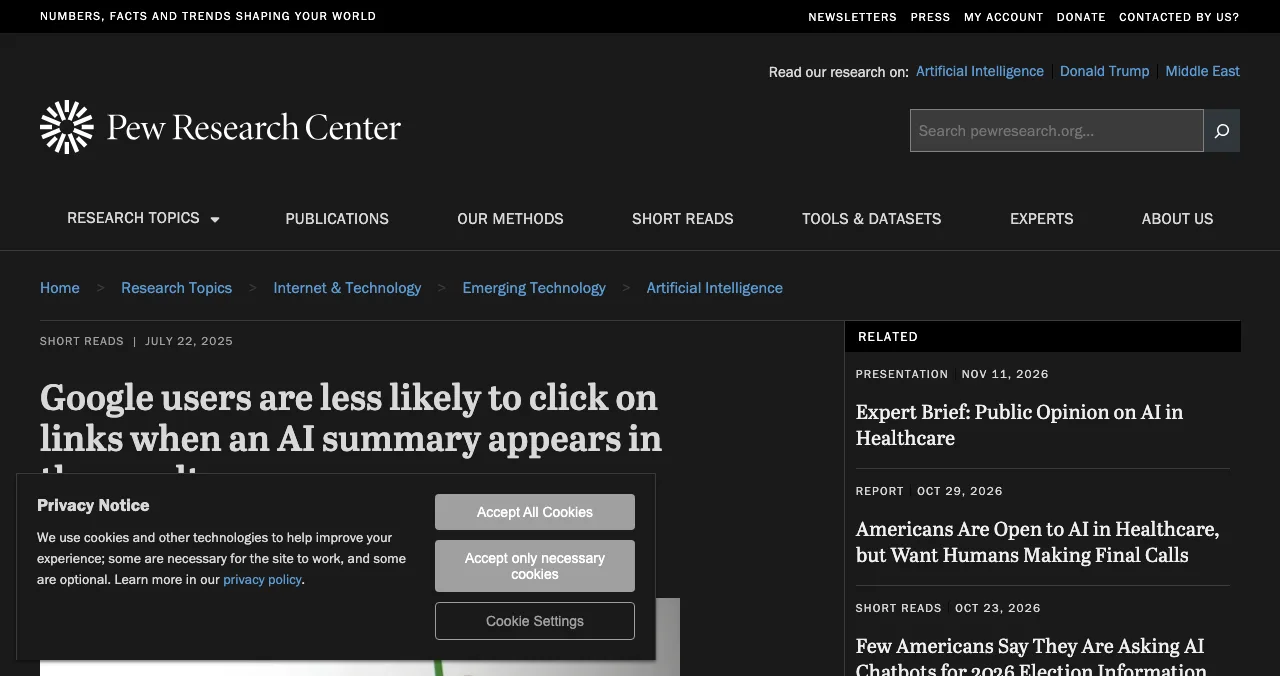
No, but quick-answer queries send fewer clicks. Pew analysed the March 2025 browsing of 900 US adults who agreed to share it. 58% ran at least one Google search that produced an AI summary. When a summary appeared, users clicked a traditional result in 8% of visits; without one, 15%. They ended their browsing session on 26% of pages with a summary, against 16% without.
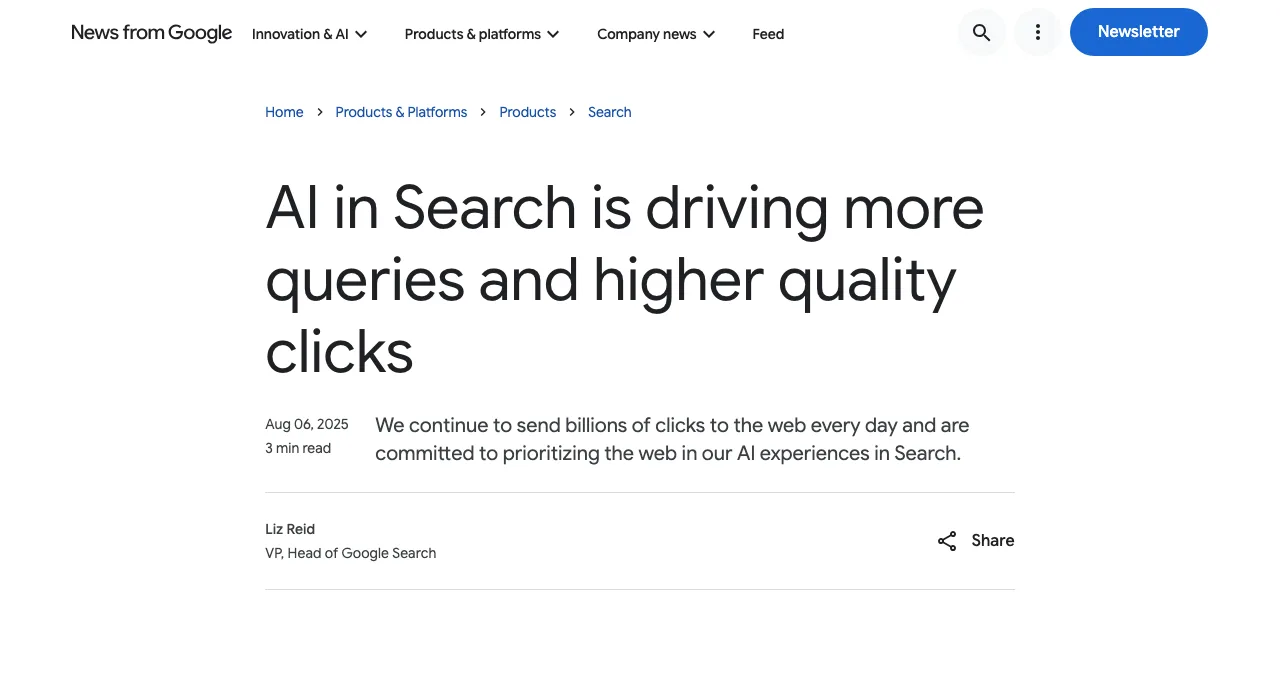
Google's Head of Search, Liz Reid, wrote in August 2025 that total organic click volume from Google Search had been "relatively stable year-over-year", that it was sending slightly more quality clicks (where users don't quickly click back) and that third-party reports of dramatic declines used flawed methods. Her explanation: people search more, ask longer questions and see more links, while quick-answer questions ("when is the next full moon") get fewer clicks, as they did with earlier answer features.
| Question | Pew (independent panel) | Google (its own data) |
|---|---|---|
| Fewer clicks with AI summaries? | Yes: 8% vs 15% of visits | For quick-answer queries, yes |
| Total clicks falling? | Not measured | No: "relatively stable" |
| Click quality | Not measured | Slightly more quality clicks |
| Links inside the summary | Clicked in 1% of visits | More links shown per page |
Table: AI search and clicks, Pew vs Google (Pew, 22 Jul 2025; Google, 6 Aug 2025; both checked 17 Nov 2026)
What it means for a startup
Most of the clicks AI summaries absorb are quick facts: definitions, dates, conversions. A startup rarely wins those anyway. What a startup needs is the click from someone with a problem who wants to compare options, and Google's own reasoning says those deeper questions keep sending people through. The risk is real for one kind of page: the generic explainer a startup writes to "do content". That page now competes with a summary that answers it in two lines.

- Hurt most — short definitions and generic how-tos with one-line answers
- Hurt less — comparisons, pricing, "best X for Y", detailed guides
- Barely touched — your own brand name and product pages
- New upside — being one of the few sources an AI answer cites
AI search vs SEO: one foundation
Google's documentation says there are no additional technical requirements to appear in AI Overviews or AI Mode: a page must be indexed and eligible for a snippet. Other assistants run their own search crawlers (OpenAI's OAI-SearchBot, for example), which you must not block. Everything else is the same work. Our LLM SEO vs SEO comparison sets it out line by line.
| Work | Helps Google ranking | Helps AI answers |
|---|---|---|
| Indexable, crawlable pages | Yes | Yes |
| Answer-first pages for buyer questions | Yes | Yes, easier to quote |
| Consistent company facts across profiles | Yes | Yes, assistants describe you correctly |
| Links from relevant sites | Yes | Yes, through discovery |
| Allowing AI search crawlers | No effect | Yes |
| Short generic definitions | Fewer clicks now | Rarely cited |
Table: Where a startup's SEO work pays off in Google and in AI answers (editorial summary from Google's and OpenAI's documentation, checked 17 Nov 2026)
The plan for the next 90 days

- Check you're findable — Search Console, a sitemap, and robots.txt that doesn't block Googlebot or AI search crawlers.
- List the questions buyers ask — from sales calls, support and communities; skip generic definitions.
- Write one answer-first page per question — the answer in the first lines, then the detail only you have.
- Make your facts consistent — the same name, one-liner and links on your site and every profile (entity SEO).
- Measure both — Google clicks in Search Console; AI referrals in analytics; ask assistants your buyers' questions monthly.
What most "SEO is dead" takes get wrong

- Treating all queries alike — quick answers lose clicks; buying questions don't
- Confusing publishers with startups — news sites lose the most; startups rarely had those clicks
- Chasing AI-only tricks — Google says llms.txt and special AI schema aren't needed for its features
- Stopping the basics — AI features depend on the same index
- Measuring rank only — track clicks, referrals and citations
Ready for both?
How we know
Click figures come from Pew Research Center's July 2025 short read on its panel of 900 US adults (March 2025 browsing). Google's position comes from Liz Reid's August 2025 post and Google Search Central's AI features documentation, all read on 17 November 2026. Pew measured click rates per visit, not total traffic; Google reports on its own aggregate data, which isn't published in full. The plan and the "hurt most" grouping are our editorial judgement.
Key terms, defined
- AI Overview: Google's AI-generated summary shown above some results.
- AI Mode: Google's conversational AI search experience.
- Quality click: Google's term for a click where the user doesn't quickly return.
- AI search crawler: a bot that fetches pages for an assistant's answers.
- LLM SEO: optimising to be cited by AI assistants.
Frequently asked questions
Is SEO dead because of AI search?
No. Google says total organic click volume has been relatively stable year on year. What has changed is that AI summaries answer quick questions on the results page, so those queries send fewer clicks. Pages that answer deeper questions still earn them.
Is SEO still worth it with AI search?
For most startups, yes, because the same work feeds both: Google's AI features draw on its index, and its guidance says there are no extra technical requirements for them. A crawlable page that answers a specific question can rank, appear in an AI Overview and be cited by assistants.
Do AI Overviews reduce clicks?
Pew Research Center's 2025 analysis of 900 US adults' browsing found users clicked a traditional result in 8% of visits to pages with an AI summary, against 15% without. Links inside the summary were clicked in 1% of visits. Google disputes broad traffic-decline claims and says clicks are higher quality.
What is the difference between AI search and SEO?
SEO aims to rank in a list of results; AI search optimisation aims to be cited in a generated answer. The foundations are shared. The differences are which crawlers you allow, how answers are shown and how you measure success.
Should a startup focus on SEO or AI search?
Do both with one plan: pages that answer the exact questions buyers ask, consistent facts about your company across profiles, and no blocked search crawlers. Then measure Google clicks in Search Console and AI referrals in your analytics.
What is LLM SEO vs traditional SEO?
LLM SEO is optimising to be quoted by assistants such as ChatGPT, Claude and Perplexity. It is mostly traditional SEO plus allowing each assistant's search crawler and writing answer-first. See our side-by-side comparison for the details.
Sources
- Pew Research Center — Google users are less likely to click on links when an AI summary appears in the results (22 Jul 2025; checked 17 Nov 2026)
- Google — AI in Search is driving more queries and higher quality clicks (Liz Reid, 6 Aug 2025; checked 17 Nov 2026)
- Google Search Central — AI features and your website (checked 17 Nov 2026)
- Google Search Central — Optimizing your website for generative AI features on Google Search (updated 10 Jul 2026)
- OpenAI — Overview of OpenAI crawlers
- Checked November 17, 2026. Figures that change — fees, salaries, prices — are reviewed every six months; if something is out of date, tell us.
Where to go from here
- LLM SEO vs SEO — side by side
- Rank in ChatGPT — the assistant side
- What is AEO? — answer engines
- Science of Apps - Launchpadllms.txt for startups: what the file is, what Google says about it for Search and AI Overviews, and when it's still worth addingWhat llms.txt is, why Google says Search and AI Overviews don't use it, and when a startup should still add one, with a simple template.
- Science of Apps - LaunchpadThe AI search optimization checklist: crawler access, content, corroboration and measurement for Google AI Overviews, ChatGPT, Claude and PerplexityA 2027 AI search optimization checklist: crawler access, answer-first content, corroboration and measurement for AI Overviews, ChatGPT, Claude and Perplexity.
- Science of Apps - LaunchpadLLM SEO vs traditional SEO side by side: what stays the same, what changes, which crawlers matter and how to measure each, using Google's and AI companies' own docsLLM SEO vs traditional SEO, side by side: the foundations that stay the same, what changes (crawlers, answers, citations, measurement) and what to skip.
- Science of Apps - LaunchpadGenerative engine optimization for startups: what the research shows, and a plan to get cited by AI answersGEO for startups in 2027: what the original GEO research found, how to get cited by ChatGPT, Perplexity, Claude and Google AI, and a 30-day plan.
- Science of Apps - LaunchpadChatGPT SEO for startups: how to get your product recommended and cited by ChatGPT, from OpenAI's own rulesChatGPT SEO for startups in 2027: what OpenAI says makes a site eligible for ChatGPT search, and how to get your product recommended and cited.
- AI & vibe codingWhat is GEO? Generative engine optimization explained, with what the research foundWhat GEO (generative engine optimization) is, how it differs from SEO and AEO, what the research found, and a checklist to get cited.
Get the ideas, not the noise.
Sign up with Google and we’ll send you short UX psychology tips by email — why people tap, stall and leave, and what to do about it. Unsubscribe anytime. Prefer something to keep? Get the free Laws of UX guide as a PDF.
Launch day ends. Your listing shouldn't.
A free, permanent Launchpad profile is a crawlable page stating what you do and who it's for, which both search engines and AI assistants can find, ranked by relevance and never by payment.