 By
Quick answer: What is F6S used for?
- F6S: free to join; apply to accelerators, grants and funding; software deals; startup jobs.
- F6S's own numbers: 6.7 million members, 15.7k accelerators, grants and funding opportunities, 12.9k startup jobs.
- Launchpad: a free, permanent product listing users find by problem; ranked by relevance, never payment.
- Only the Launchpad tests your product and hands you a detailed report.
- Use both: F6S for programmes, the Launchpad for users and evidence.
Key takeaways
- F6S is an application hub: programmes, deals and jobs, not a customer channel.
- Every programme on F6S sets its own terms; vet equity, cost and track record yourself.
- Software deals are worth it only for tools you'd use anyway; read the conditions.
- Accelerators look for traction; a public listing with vouches is visible evidence.
- A product report gives you specific, credible answers for application forms.
"F6S" is searched about 14,800 times a month worldwide (Google Keyword Planner, global 12-month average), usually by founders who've been sent there to apply for an accelerator or claim a software deal, and who then wonder what else it's for. F6S is a programme and perks hub: accelerators, grants, funding, software discounts and jobs. It isn't where customers find products. This comparison puts F6S beside the free Science of Apps Launchpad, which is built for exactly that, using each one's own pages as checked on 17–18 November 2026. Jump to the comparison, when to use each or the plan.
Science of Apps Launchpad vs F6S
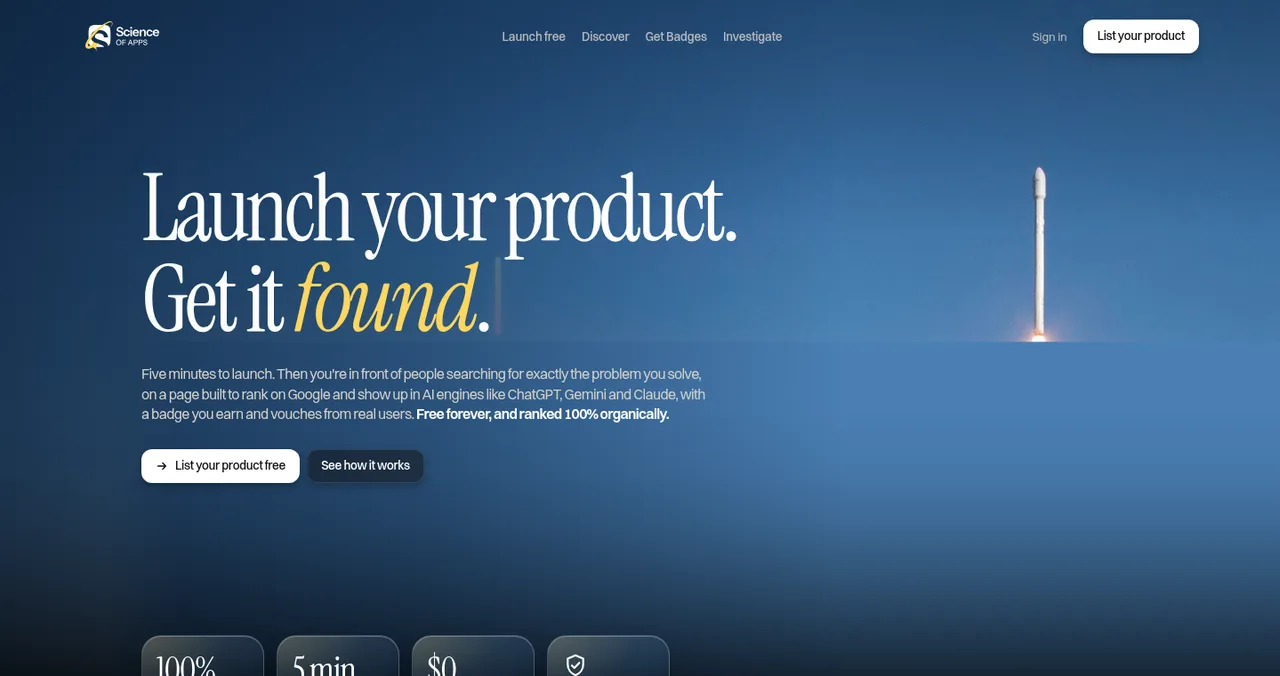 List free
Science of Apps Launchpad For users
A free, permanent product listing users find by problem, plus your product tested with a detailed report.
Free foreverFor users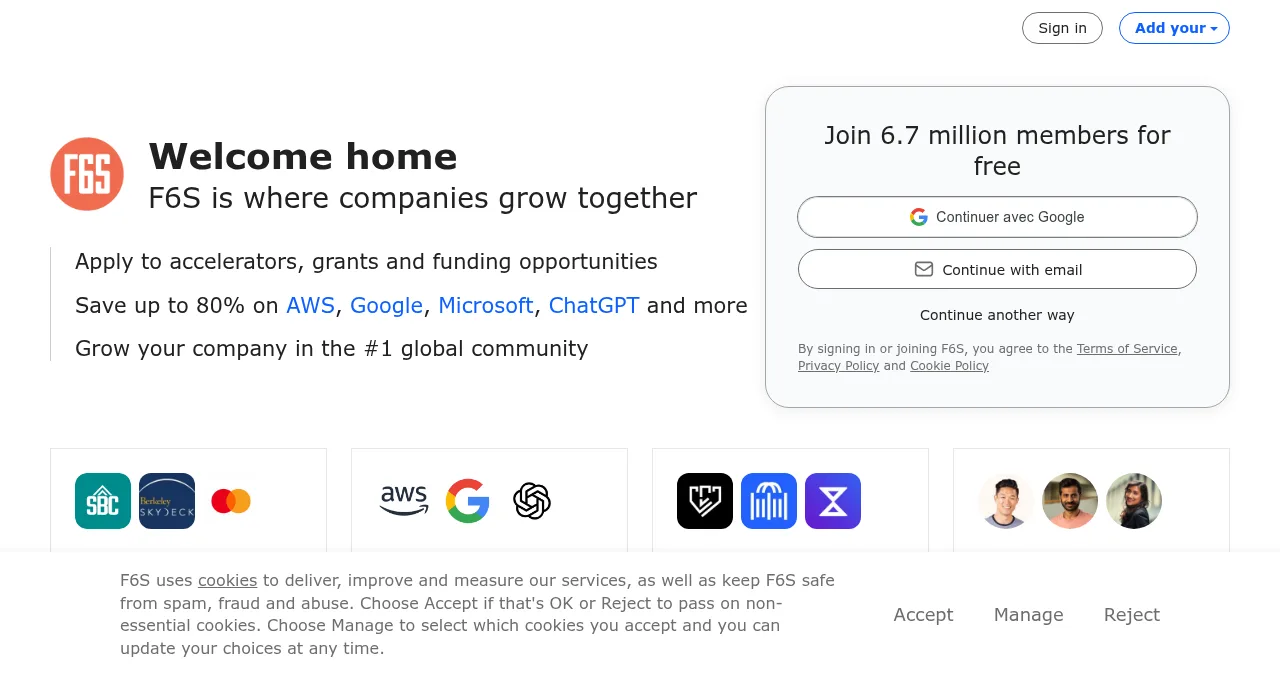
F6S
Apply to accelerators, grants and funding; save on software; find startup jobs.
Free to joinFor programmes
F6S vs the Launchpad, side by side
The difference is direction. On F6S you apply to programmes and redeem deals. On the Launchpad, users come to your product.
| Science of Apps Launchpad | F6S | |
|---|---|---|
| What it's used for | Getting a product found by users, and tested | Applying to accelerators, grants and funding; software deals; jobs |
| Cost | Free, forever | Free to join; each programme and deal has its own terms |
| Scale it reports | 22-area product investigation; 0 paid placements | 6.7m members; 15.7k programmes; 12.9k startup jobs |
| Who visits | People looking for a product to solve a problem | Founders, programme organisers and job seekers |
| Your page shows | Product, screenshots, video, founder, badges, vouches | Company and founder profile for applications |
| Ranking | Relevance, editorial picks, community interest; never payment | Not applicable; you apply to each programme |
| Product test and report | Yes | No |
Table: Science of Apps Launchpad vs F6S (each site's own pages, checked 17–18 Nov 2026)
Science of Apps Launchpad: where users find your product
- Cost
- Free, forever
- Audience
- People searching by problem
- Visible for
- Permanent
- Ranking
- Relevance, never payment
- Included
- A product test and detailed report
- Cost: free to list, forever; revenue comes from optional reports and an optional, labelled Premium listing, and paying never changes organic ranking.
- Getting listed: six short steps, automated checks and a human moderator.
- Being found: by the problem you solve, through search, collections and editorial picks.
- Proof that programmes can see: Featured on going live, Verified for a work email on your domain, then earned badges such as Community favourite and Editor's pick, plus vouches and followers.
- Accepts: startups, SaaS, mobile apps, AI products, developer tools, browser extensions, games and open source.
The evidence an application form asks for
Accelerator forms ask what you've built, who uses it and what you've learned. The Launchpad's product test gives you specific answers. A baseline check of landing page, discoverability and speed runs free as you go live.
- Areas of your product tested
- 22
- Automatic measurements, desktop and mobile
- 39
- Expert checks behind your login
- 74
- Verdicts that rank what to fix first
- 5
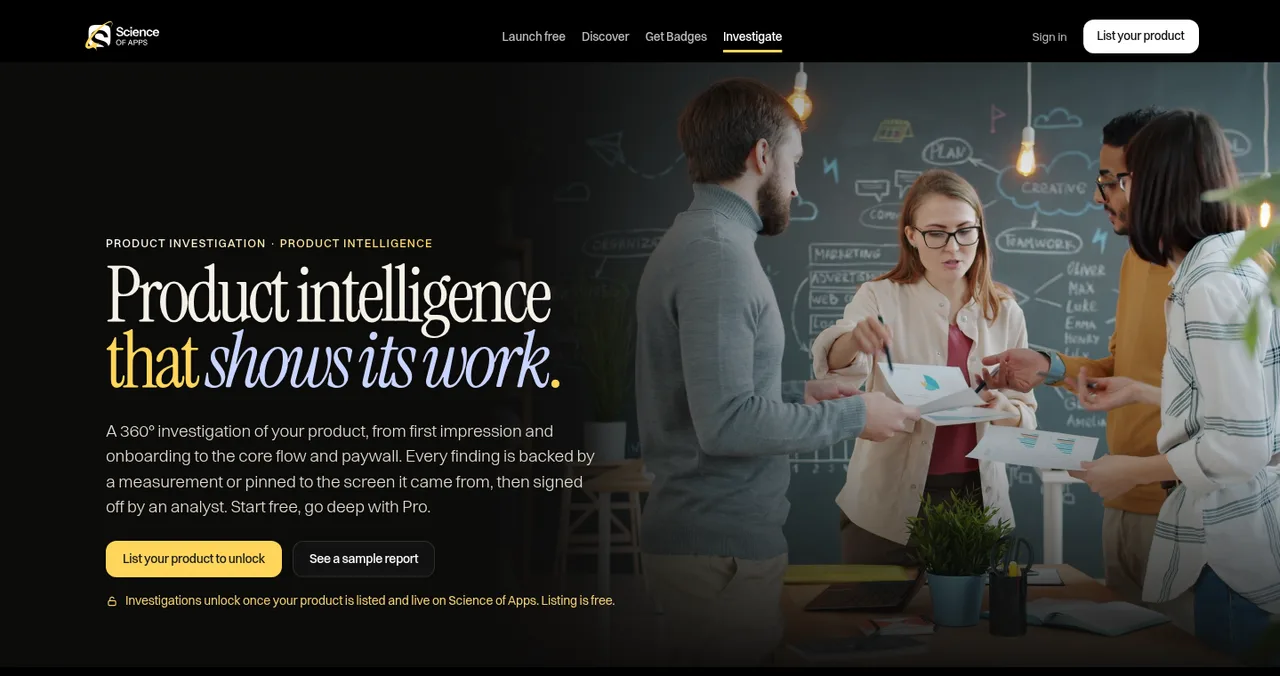
Know your product's weak spots before a panel does
List free, then order the report that fits: the first impression, or the full diagnosis with a 90-day roadmap.

 Economy
See what new customers see
- Store listing and homepage, screen by screen
- Scorecard against 60 Laws of UX
- Customers, competitors and the fixes worth most
PremiumThe full diagnosis and the plan
- Every screen, every finding, every flow
- All 60 laws with evidence and fixes
- 8 strategy chapters and a 90-day roadmap
Researched from your live product and fact-checked against the evidence. Private to your team.
Best for: users now, and credible evidence for every application later.
F6S: programmes, perks and jobs
- Cost
- Free to join
- Members
- 6.7 million (its figure)
- Programmes
- 15.7k accelerators, grants and funding
- Deals
- Up to 80% off software
- Catch
- Each programme sets its own terms
F6S's own summary is clear: apply to 15.7k accelerators, grants and funding; save up to 80% on AWS, Google, Microsoft, ChatGPT and more; find 12.9k startup jobs; join 6.7 million members for free. What it does better than the Launchpad is breadth of opportunities: one profile, many programmes to apply to.
- Programmes: accelerators, grants and funding opportunities run by third parties. Some take equity, some charge, some do neither; read each programme's own terms.
- Deals: software discounts from large providers. Check credit expiry, eligibility and whether the offer converts to a paid plan.
- Jobs: a startup jobs board for hiring and job seekers.
- Operator: F6S Network Limited; F6S is a registered trademark.
Best for: founders applying to accelerators or grants, claiming software credits, or hiring. Our F6S review covers how to vet programmes.
What is F6S used for, and when do you need the Launchpad?
| You need… | Use | Why |
|---|---|---|
| An accelerator or grant | F6S | Thousands of programmes, one profile |
| Cloud or software credits | F6S deals | Discounts from large providers |
| To hire your first engineer | F6S jobs (or Wellfound) | Startup-focused job boards |
| Users who find you by problem | Launchpad listing | Permanent, ranked by relevance |
| To know what to fix before a demo day | Launchpad product test | Evidence-backed findings, prioritised |
| Investor visibility | Crunchbase | The record investors look up |
Table: When to use F6S and when to use the Science of Apps Launchpad
How to use both: a three-week plan
- Week 1
List and test
List on the Launchpad; read the baseline check; fix critical findings in sign-up and onboarding.
- Week 1
Join F6S
Complete your profile; shortlist programmes and check each one's equity, cost and alumni.
- Week 2
Earn early proof
Ask first users to vouch on your listing; earn Verified with a work email.
- Week 3
Apply
Link your Launchpad listing in each application; quote specific fixes you made from the report.
Mistakes to avoid

- Expecting customers from F6S — it's built for programmes, deals and jobs
- Applying to every programme — check equity, cost and alumni before you apply
- Redeeming deals you won't use — credits expire; some convert to paid plans
- Applying with no product link — panels look for something they can try
- Claiming traction you can't show — a public listing and real vouches are verifiable
Panels, like users, remember the strongest and the last moments of a pitch, the peak-end rule: a product demo that ends on a clear result beats a long feature tour.
Ready to list?
How we compared them
F6S's figures and description come from its homepage, read on 17–18 November 2026 (its site blocks automated browsers, so we read its published page summary). The Launchpad's terms come from its homepage, investigation page and pricing page, read on 18 November 2026. The 14,800 monthly searches figure is Google Keyword Planner's global 12-month average. Science of Apps runs the Launchpad and has no relationship with F6S.
Key terms, defined
- Accelerator: a fixed-term programme that supports startups, often in exchange for equity.
- Grant: non-dilutive funding; you don't give up equity.
- Startup deal: a discount or credit on software for eligible startups.
- Equity: a share of ownership in your company.
- Permanent listing: a product page that stays live and findable after any launch.
- Vouch: on the Science of Apps Launchpad, a public endorsement from a real user.
Frequently asked questions
What is F6S used for?
Founders use F6S to find and apply to accelerators, grants and funding opportunities, to get startup discounts on software (it advertises savings of up to 80% with providers such as AWS, Google, Microsoft and ChatGPT), and to find or post startup jobs. It's an application and perks hub rather than a place customers browse for products.
Is F6S free?
Yes, joining is free: F6S's homepage invites you to join 6.7 million members for free. Individual programmes, grants and deals listed on F6S have their own terms, so read each one before you apply or redeem, especially anything that takes equity or converts to a paid plan.
Is F6S legit?
F6S is a long-running platform operated by F6S Network Limited, and F6S is a registered trademark. The programmes and deals listed on it are run by third parties, so judge each opportunity on its own: who runs it, what it costs, what equity it takes, and what past participants say about it.
What's the difference between F6S and the Science of Apps Launchpad?
F6S connects founders with programmes, funding, software deals and jobs. The Science of Apps Launchpad connects products with users: a free, permanent listing found by the problem you solve, ranked by relevance and community interest rather than payment, with your live product tested and a detailed report on what to fix first.
Will listing on the Launchpad help my accelerator application?
It can give you evidence. Application forms ask about traction and product quality; a public listing with vouches, followers and a Verified badge shows real interest, and a product report gives you specific findings and fixes to describe. It won't replace the traction itself, and accelerators decide on their own criteria.
What are alternatives to F6S?
It depends on the job. For angel groups and US incorporation, Gust. For investor visibility, Crunchbase. For hiring, Wellfound. For Indian government schemes, Startup India. For customers and a product test, the Science of Apps Launchpad. Our F6S review compares them in detail.
Sources
- F6S — Homepage: accelerators, grants, funding, deals and jobs; free membership (checked 18 Nov 2026)
- Science of Apps — Launchpad: launch your product free (checked 18 Nov 2026)
- Science of Apps — Product investigation (checked 18 Nov 2026)
- Science of Apps — Pricing: free listing, Economy and Premium reports (checked 18 Nov 2026)
- Gust — Homepage and pricing (checked 17 Nov 2026)
- Crunchbase — Product pricing (checked 18 Nov 2026)
- Checked November 18, 2026. Figures that change — fees, salaries, prices — are reviewed every six months; if something is out of date, tell us.
Where to go from here
- F6S review and alternatives — is F6S worth joining?
- Gust vs F6S vs Crunchbase — three platforms, three jobs
- Launchpad vs Crunchbase — investors vs customers
- Science of Apps - LaunchpadAn honest F6S review: what the free F6S membership gives founders (programmes, grants, software deals, jobs), how to judge its opportunities, and the best alternatives by jobAn honest F6S review: free membership, 15.7k listed accelerators and grants, software deals up to 80% off, how to vet programmes, and F6S alternatives by job.
- Science of Apps - LaunchpadIndie Hackers vs the Science of Apps Launchpad: a founder community for building in public, or a permanent product listing for users, with your product tested. What each is for and how to use bothIndie Hackers is where founders share the journey; the Launchpad is where users find the product. What each does, what works on each, and how to use both.
- Science of Apps - LaunchpadGust vs F6S vs Crunchbase: which startup platform to join for funding, accelerators, perks or visibility, compared by the job each does and what it costsGust vs F6S vs Crunchbase compared by job: Gust for incorporation and angel groups, F6S for accelerators and perks, Crunchbase for investor visibility.
- Science of Apps - LaunchpadThe B2B software directory guide for 2027: where to launch B2B software free, from G2 and Capterra to SaaSHub and Product Hunt, with each one's terms checkedWhere to launch B2B software free: the Launchpad, G2's free plan, Capterra, SaaSHub and Product Hunt, plus what B2B buyers check first. Terms checked Nov 2026.
- Science of Apps - LaunchpadCrunchbase vs the Science of Apps Launchpad: a free company profile investors look up, or a free product listing customers find, with your product tested. What each does, what it costs and which to set up firstCrunchbase is where investors look you up; the Launchpad is where customers find your product. What each costs, what it does, and why most startups need both.
- Science of Apps - LaunchpadScience of Apps Launchpad vs Product Hunt: a permanent free listing with a product report, or one big launch day? A fair comparison of cost, ranking, visibility and what each gives youScience of Apps Launchpad vs Product Hunt compared: cost, ranking, how long you stay visible and the product report. Which to use, and why most use both.

Get the ideas, not the noise.
Sign up with Google and we’ll send you short UX psychology tips by email — why people tap, stall and leave, and what to do about it. Unsubscribe anytime. Prefer something to keep? Get the free Laws of UX guide as a PDF.
Launch day ends. Your listing shouldn't.
F6S helps you apply to programmes and save on software. The Science of Apps Launchpad gives your product a free, permanent page users find, and tests it with a detailed report you can cite in every application.