 By
Quick answer: What is product-led growth?
- What: the product acquires, activates and retains users.
- How: a free plan or trial; upgrade after a real result.
- Fits when: value comes alone, in minutes, at a self-serve price.
- Key metric: activation, and time to first value.
- First job: fix onboarding before adding acquisition.
Key takeaways
- PLG is a go-to-market choice, not a growth hack.
- Free users only matter if they reach a real result.
- Freemium suits wide, low-cost use; trials suit faster value.
- Onboarding is where most PLG products lose people.
- Many products end up hybrid: self-serve plus sales for big accounts.
Think of how you started using Slack or Dropbox, the examples ProductLed itself uses. You didn't book a demo; you signed up, got something done and later paid, or brought your team. That pattern, product-led growth, is now the default ambition for SaaS founders, often before they've asked whether it fits their product. This guide explains what PLG is, when it fits, how freemium and trials differ, which numbers matter and why onboarding is the whole game for an early startup, drawing on ProductLed's definition and NN/g's onboarding research as read on 17 November 2026. Jump to what PLG is, does it fit? or the onboarding checklist.
- Jobs the product does: acquire, activate, retain
- 3
- Free models: freemium and free trial
- 2
- Metric to fix first: activation
- 1
- Time to first value PLG needs
- Minutes
What is product-led growth?
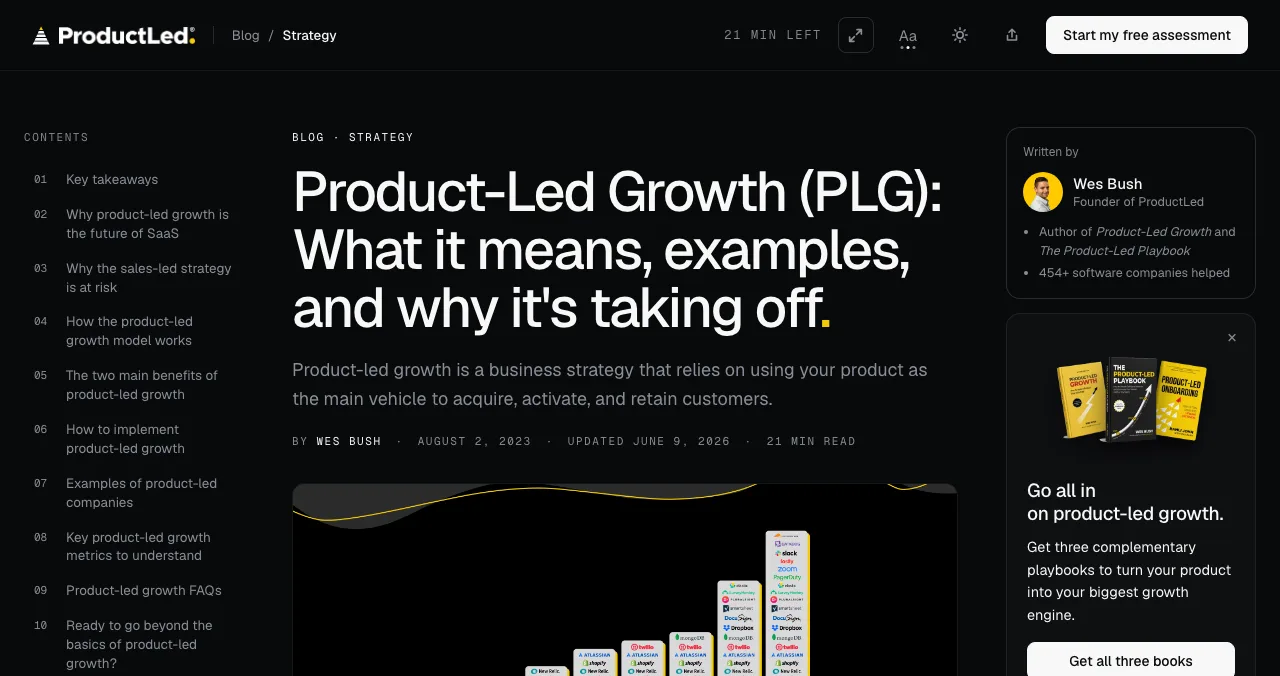
ProductLed's Wes Bush defines product-led growth as "a business strategy that relies on using your product as the main vehicle to acquire, activate, and retain customers." Customers experience the product for free, through freemium or a trial, and upgrade once they reach a meaningful outcome. Sales-led companies, by contrast, move each buyer through a sales cycle that usually starts with a demo.
| Product-led | Sales-led | |
|---|---|---|
| First touch | Sign up and try | Book a demo |
| Who drives it | The user | A salesperson |
| Price point | Self-serve | Often higher, negotiated |
| Key metric | Activation, free-to-paid | Pipeline, win rate |
| Cost to acquire | Lower per user | Higher per customer |
Table: Product-led vs sales-led growth (editorial summary; ProductLed definition checked 17 Nov 2026)
Does PLG fit your product?

PLG fits when
- A user can reach value alone in minutes
- The user can also pay, or easily get approval
- The price works without a meeting
- Many potential users, each worth a modest amount
Sales-led fits better when
- Setup needs data imports, integrations or training
- Several people must approve the purchase
- Each customer is worth a lot and needs tailoring
- The value only shows after weeks of use
Many products end up hybrid: self-serve for individuals and small teams, founder-led sales for larger accounts. YC's sales playbook covers the sales half; our go-to-market canvas helps you choose.
Freemium or free trial?
| Freemium | Free trial | |
|---|---|---|
| How it works | A free plan, forever | Full product, for a limited time |
| Best when | Wide appeal, low cost to serve | Value shows quickly, costly to run free |
| Upgrade trigger | Limits, team features, scale | The trial ending |
| Risk | Free users who never pay | Users who don't activate in time |
Table: Freemium vs free trial for product-led startups (editorial guidance)
The PLG metrics that matter

- Activation rate — the share of sign-ups who reach your first meaningful result
- Time to first value — minutes from sign-up to that result
- Free-to-paid conversion — of activated users, not all sign-ups
- Retention — activated users still active after 30 days
- Expansion — teams adding seats or upgrading plans
Define the "first meaningful result" concretely: the first invoice sent, the first report shared, the first teammate invited. Everything in onboarding should move people toward it.
Onboarding: where PLG is won
NN/g defines onboarding as getting users familiar with a new interface, including any necessary setup, and groups its components into feature promotion, customisation and instructions. In a PLG product, onboarding has one job: get the user to the first meaningful result as fast as possible.

- Sign-up asks only what's needed — no card unless the model needs it
- One question to personalise — role or goal, used to choose the first screen
- Sample data or templates — no empty first screen
- A visible path to the first result — a short checklist shows progress (goal-gradient effect)
- Skip tours users can't skip — teach in context instead
- A nudge if they stall — a helpful email, not a sales sequence
- The upgrade appears after value — not before the first result
For the full version, run the SaaS onboarding audit.
Mistakes

- Choosing PLG because it's fashionable — check the fit first
- Counting sign-ups — measure activation
- A free plan with everything — no reason to upgrade
- A trial too short for the value to show
- Hiding pricing — self-serve buyers need to see it
Ready to test your onboarding?
How we know
The PLG definition comes from ProductLed's article by Wes Bush; the onboarding definition and components from NN/g's onboarding analysis; both read on 17 November 2026. Comparison tables, metrics and the checklist are our editorial guidance.
Key terms, defined
- Product-led growth (PLG): growth driven mainly by users trying and adopting the product.
- Freemium: a permanently free plan alongside paid ones.
- Activation: a new user reaching a first meaningful result.
- Time to first value: how long that takes.
- Hybrid motion: self-serve plus sales for larger accounts.
Frequently asked questions
What is product-led growth?
A business strategy that relies on the product as the main vehicle to acquire, activate and retain customers. Users try it for free, through a freemium plan or a trial, and upgrade once they've experienced a meaningful outcome, often without speaking to sales.
Is product-led growth right for my startup?
It fits when users can reach value on their own within minutes, the person using it can also buy it, and the price works without a sales call. It's a poor fit for complex setups, long approval chains or high prices without a cheaper entry point.
Freemium or free trial?
Freemium (a permanently free tier) suits products with wide appeal and low cost to serve, where free users spread the word. A free trial suits products whose value shows quickly and that are expensive to run free forever. Both depend on onboarding.
What metrics matter for PLG?
Activation rate (the share of sign-ups who reach a first meaningful result), time to first value, free-to-paid conversion and retention of activated users. Sign-ups alone say little.
What's the difference between PLG and sales-led growth?
In sales-led growth, a salesperson takes the buyer through a sales cycle, usually starting with a demo. In product-led growth, the buyer tries the product first and upgrades on their own; sales, if any, helps larger accounts later.
How does onboarding affect PLG?
It decides whether free users ever reach value. NN/g defines onboarding as getting users familiar with a new interface, including setup, through feature promotion, customisation and instructions. Fewer, faster steps to a real result usually beat longer tours.
Sources
- ProductLed — Product-Led Growth (PLG): What it means, examples, and why it's taking off (Wes Bush; checked 17 Nov 2026)
- Nielsen Norman Group — Mobile-App Onboarding: An Analysis of Components and Techniques (Alita Kendrick, 21 Jun 2020)
- Y Combinator — The Sales Playbook For Founders (Tom Blomfield)
- Science of Apps — Laws of UX: Goal-Gradient Effect
- Checked November 17, 2026. Figures that change — fees, salaries, prices — are reviewed every six months; if something is out of date, tell us.
Where to go from here
- SaaS onboarding audit — 20 checks
- Go-to-market strategy — the one-page canvas
- App marketing strategy — launch to scale
- Career guidesProduct-led growth skills employers want in 2027: free trials and freemium, time to value, activation, product-qualified leads, expansion, virality and PLG metricsProduct-led growth skills employers want in 2027: freemium and trials, time to value, activation, product-qualified leads, expansion, virality and PLG metrics.
- Science of Apps - LaunchpadHow to launch a SaaS product in 2027: from private beta to public launch to the first paying customersHow to launch a SaaS in 2027, step by step: private beta, pricing, onboarding that activates, a permanent page, launch days, and turning trials into customers.
- Science of Apps - LaunchpadHow to market a SaaS in 2027: positioning, being found by buyers, content that gets cited, launches and a product that convertsHow to market a SaaS in 2027: sharp positioning, alternatives directories, search and AI visibility, launches, founder-led sales and a trial that converts.
- Science of Apps - LaunchpadA UX audit for SaaS onboarding: 20 checks from sign-up to first value, each tied to a Law of UX (Hick's, goal-gradient, Zeigarnik, default effect) with a severity scaleA UX audit for SaaS onboarding: 20 checks from sign-up to first value, each tied to a Law of UX like Hick's Law and the goal-gradient effect.
- Science of Apps - LaunchpadGrowth hacking for startups in 2027: the tactics that still work (unscalable outreach, referral loops, product-led growth), the ones that now break rules, and the dark patterns to avoidGrowth hacking for startups in 2027: the tactics that still work, the ones that now break platform rules or the law, and dark patterns to avoid.
- Science of Apps - LaunchpadPre-launch marketing for startups: a six-week plan from waitlist to launch day, with the channels, assets and rules that matterPre-launch marketing for startups: a 6-week plan with a waitlist, building in public, early adopters, launch assets and a scheduled launch date.
Get the ideas, not the noise.
Sign up with Google and we’ll send you short UX psychology tips by email — why people tap, stall and leave, and what to do about it. Unsubscribe anytime. Prefer something to keep? Get the free Laws of UX guide as a PDF.
Launch day ends. Your listing shouldn't.
List free on the Launchpad and, once live, get a free report on your landing page, discoverability and speed; deeper reports test sign-up, onboarding and the paywall end to end.