 By
Quick answer: How should a startup do content marketing?
- Publish what only you can: product facts, comparisons, real how-tos, original data, founder experience.
- Google's AI features use core Search systems: SEO basics still apply; no special markup or llms.txt needed.
- Avoid commodity content: Google's own example is '7 Tips for First-Time Homebuyers'.
- Start with five pages buyers ask about before they buy.
- Measure sign-ups, plus Search Console's Generative AI performance report.
Key takeaways
- A startup can't out-publish incumbents; it can out-specific them.
- Every page should answer one real question in its first paragraph.
- Distribution is half the work: a page nobody sees can't be cited.
- Your product facts should match everywhere they appear.
- Judge content by sign-ups and citations, not word count.
Most startup blogs die the same way: a burst of generic posts in month one ("10 productivity tips"), no traffic, no sign-ups, and a quiet last post from a year ago. Meanwhile buyers ask Google and AI assistants exactly the questions your team could answer better than anyone. This guide sets out content marketing for startups that ranks on Google and gets cited in AI answers: what Google itself says works in its AI features, the five pages to publish first, a 90-day plan, distribution, and how to measure it. Google's guidance was checked on its own Search Central pages on 18 November 2026. Jump to what Google says, the first five pages or the 90-day plan.
- Pages to publish before anything else
- 5
- Strong page a week: a sustainable pace
- 1
- Special files or markup Google needs for AI features
- 0
- Days before you judge the programme
- 90
How should a startup do content marketing?
Publish the answers only you can give, to the questions buyers ask before they choose, and put each one where those buyers will see it. A startup can't outspend incumbents on volume; it can be more specific, more current and more honest.
| Content type | Why it works for a startup | AI-search value |
|---|---|---|
| Product facts page | Buyers and AI systems need accurate basics | High: the source for "what is X?" |
| Honest comparison | Buyers are already comparing; be in the comparison | High: cited for "X vs Y" and alternatives |
| How-to from real use | Shows the product doing the job | Medium to high for task questions |
| Original data or research | Nobody else has it | High: unique, citable numbers |
| Founder experience and lessons | First-hand expertise | Medium; builds trust and links |
| Generic tips listicle | Easy to write | Low: commodity content |
Table: Startup content types and their value in search and AI answers (Science of Apps editorial framework, informed by Google's guidance checked 18 Nov 2026)
What does Google say works in AI search?
Google's guide to optimising for its generative AI features is the most direct statement any search company has made on this. The points that matter for a startup content plan:
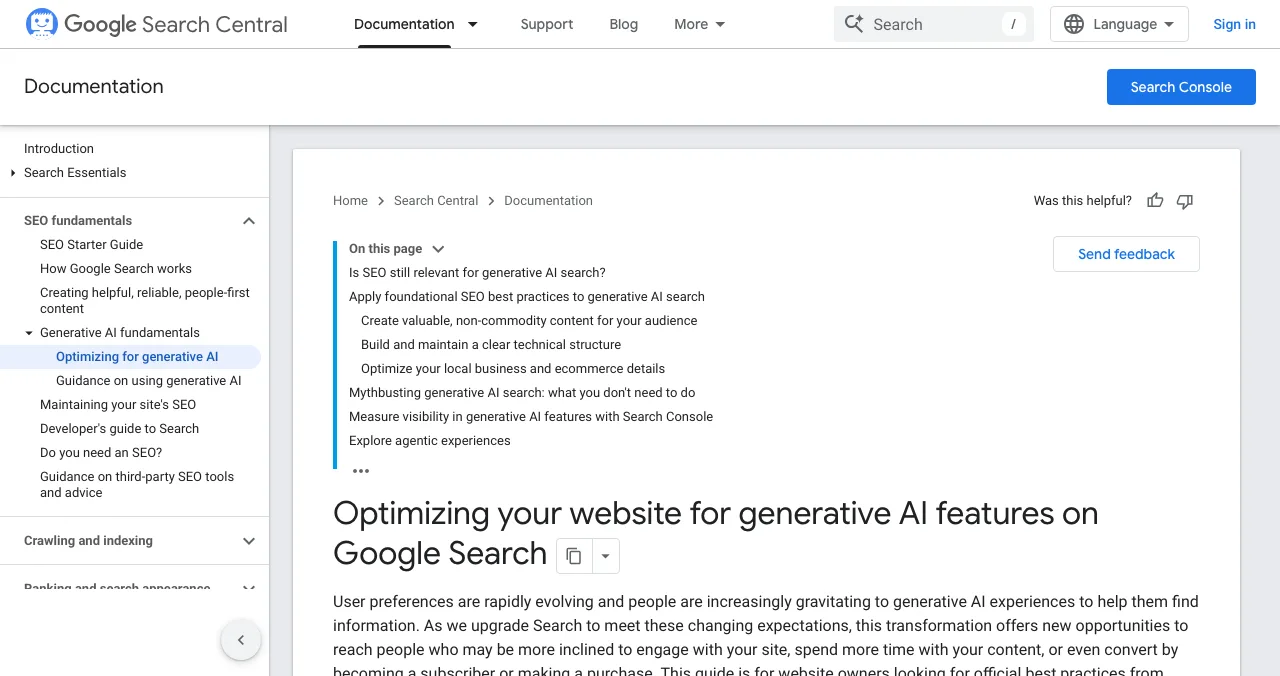
- Same systems. Generative AI features in Search rely on Google's core ranking and quality systems, so SEO best practices still apply.
- Unique beats generic. Google says to "focus on developing unique, expert-led content that provides value beyond common knowledge", and uses "7 Tips for First-Time Homebuyers" as its example of commodity content.
- Eligibility. A page must be indexed and eligible to be shown in Search with a snippet.
- No special files. You don't need new machine-readable files, AI text files, markup or Markdown to appear; structured data isn't required for generative AI search, though it still helps for rich results.
- No shortcut mentions. Seeking inauthentic "mentions" across the web isn't as helpful as it might seem.
- Measurement. Google points to the Generative AI performance report in Search Console.
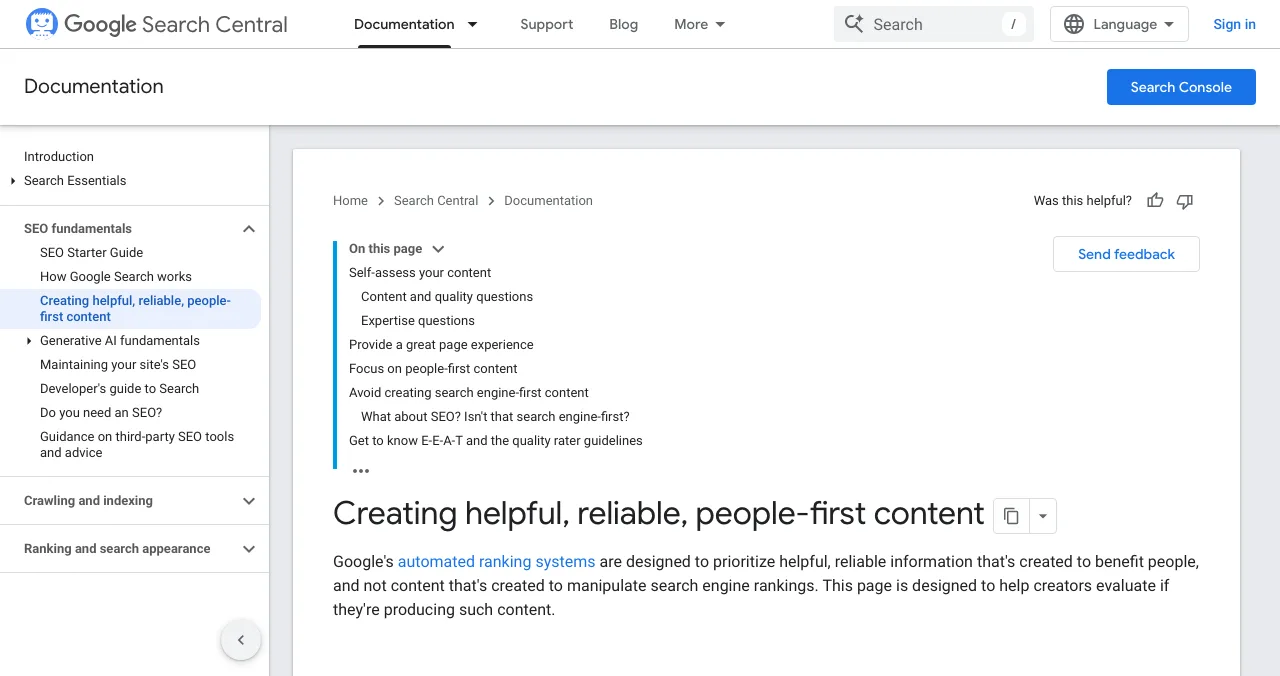
Google's helpful content guidance adds the "Who, How and Why" test: make it clear who wrote the content (it strongly encourages accurate bylines), explain how it was made, including any automation, and make sure the reason it exists is to help people, not to attract search visits. It names trust as the most important part of E-E-A-T.
The first five pages to publish

- The product facts page. What it is, who it's for, what it does, what it costs, what it doesn't do. One sentence answer at the top. This is the page AI systems should quote when someone asks "what is [your product]?".
- The honest comparison. "[Your product] vs [the alternative buyers know]". Accurate facts about them, dated; where they're better; who should pick which.
- The core how-to. "How to [the job your product does]", written from real use, with screenshots, working whether or not the reader picks your product.
- The "is it right for you?" page. Who it's for and, just as important, who it isn't for. Buyers trust products that turn some people away.
- One original insight. Data from your product (anonymised and aggregated), a survey you ran, or what you learned building it. The one page nobody else can write.
Each page should open with a direct answer in the first two sentences, use question-shaped headings where they're natural, and carry a byline from a real person on your team. See the answer engine optimisation guide for the answer pattern.
How do you get startup content found?
A page nobody sees can't be cited. Distribution is half the work, and for a new site it comes before search traffic does.
- Where your buyers already are. Share each page once, adapted, in the communities and social channels your buyers use (see how to announce a launch on LinkedIn and X).
- Newsletters in your niche. Offer the original insight as a short piece or data point.
- Directory and profile descriptions. Keep your product facts identical on your site, your directory listings and your social profiles, so every source says the same thing.
- Internal links. Link each new page from your product page and from older posts.
- Search Console. Submit the sitemap and check each page is indexed.
Your Launchpad profile as a citation anchor

Your own product page is the primary source. A Launchpad profile is a second, moderated page that repeats the same facts: description, category, pricing model, screenshots, links and the founder behind it. Keeping the two identical is the point; consistent facts across sources are easier for people and machines to trust. It's free to list, forever, in six short steps; every listing is checked automatically and reviewed by a person; ranking is by relevance, editorial picks and community interest, never payment.
Once you're live, your product is tested end to end. A free baseline diagnosis checks your landing page, discoverability and speed as you go live, and a full investigation covers the whole journey. Content brings visitors to the product; the report tells you whether the product keeps them.
- Areas examined, from discoverability to every screen
- 22
- Automatic measurements, desktop and mobile
- 39
- Expert heuristics
- 74
- Verdicts, analyst-reviewed
- 5
See what your readers see when they click
List free, then order the report that fits your stage.

 Economy
See what new customers see
- Store listing and homepage, screen by screen
- Scorecard against 60 Laws of UX
- The fixes worth most
PremiumThe full diagnosis and the plan
- Every screen, every finding, every flow
- All 60 laws with evidence and fixes
- 8 strategy chapters and a 90-day roadmap
Fact-checked against the evidence. Private by default. Never affects ranking.
Which content should you start with?
| Your startup | Start with | Then |
|---|---|---|
| B2B SaaS | Product facts and the main comparison | How-tos for each use case |
| Developer tool | Docs-quality how-to and quick start | Benchmarks and changelog posts |
| Consumer app | Store listing copy and the "is it for you" page | Short how-to videos and guides |
| AI product | Product facts with clear limits and data handling | Honest comparisons; original evaluations |
| Marketplace | One side's guide (usually supply) | Category pages with real listings |
Table: Where to start content marketing, by product type (Science of Apps editorial framework)
A 90-day content marketing plan
- Week 1
Questions
List the 10 questions buyers ask; check what ranks and what AI assistants answer.
- Week 2
Product facts
Publish the product page; mirror the facts on your Launchpad profile and other listings.
- Week 3–4
Comparison and how-to
One honest comparison, one core how-to.
- Week 5–6
Fit and insight
The "is it right for you" page; one original insight.
- Week 7–10
Distribute and extend
Share each page where buyers are; one new page a week from the question list.
- Week 12
Measure
Sign-ups per page, Search Console impressions, AI mentions. Double down on what works.
Mistakes

- Commodity posts — generic tips that a thousand sites already cover
- Publishing for volume — Google warns against content made primarily to attract search visits
- No byline — Google strongly encourages accurate authorship where readers expect it
- Facts that disagree — different prices or descriptions on your site and your listings
- No distribution — publishing and waiting
- Judging in week two — give a page months, and judge it on sign-ups
- AI-written filler — summaries of what already exists add nothing worth citing
Ready to launch?
How we know
Google's positions come from its generative AI optimisation guide, its helpful-content guidance, its AI features documentation and its spam policies, all read on Search Central on 17–18 November 2026. The content types, decision table and plan are Science of Apps' editorial framework, not results from a study. Science of Apps runs the Launchpad.
Key terms, defined
- Content marketing: publishing useful content that attracts and helps potential customers, so they come to you.
- Commodity content: content that repeats common knowledge without unique insight; Google's example is "7 Tips for First-Time Homebuyers".
- E-E-A-T: experience, expertise, authoritativeness and trust; Google says trust matters most.
- Citation anchor: a stable page that states your product's facts, which other sources and AI systems can rely on.
- Generative AI performance report: the Search Console report Google points to for measuring performance in its AI features.
- Distribution: getting each piece of content in front of the people it's for.
Frequently asked questions
How should a startup do content marketing?
Start narrow. Write down the ten questions buyers ask before they choose a product like yours, then publish answers only you can give: what your product does and costs, honest comparisons with alternatives, how-to guides from real use, and any original data you have. Publish one strong page a week, share each one where your buyers are, and judge it by sign-ups.
Does content marketing work for AI search?
Yes, through the same route as Google Search. Google's guide to its generative AI features says they rely on its core ranking and quality systems, that SEO best practices remain relevant, and that you should focus on unique, expert-led content that provides value beyond common knowledge. Other AI assistants also read and cite the web, so clear, specific pages help there too.
Do I need llms.txt or special markup for AI search?
Not for Google. Its AI optimisation guide says you don't need to create new machine-readable files, AI text files, markup or Markdown to appear in Google Search, and that structured data isn't required for generative AI search. Structured data can still make pages eligible for rich results, so it's worth adding where it fits.
What content should a startup publish first?
Five pages: a clear product page with features, pricing and who it's for; a comparison with the alternative buyers consider most; a how-to guide for the main job your product does; an honest 'is it right for you' page that says who shouldn't use it; and one piece of original insight, such as data from your product or a founder's lessons.
How often should a startup publish content?
Consistency beats volume. One genuinely useful page a week is a strong pace for a small team, and one every two weeks is fine if each page is better than what already ranks. Publishing many thin pages to look active works against you: Google warns about content made primarily to attract search visits.
How do I measure content marketing results?
Track three things: sign-ups or key events from each page in GA4, impressions and clicks in Google Search Console (including its Generative AI performance report for AI features), and whether AI assistants mention you when you ask them your buyers' questions. Review monthly; content usually takes months, not days, to pay off.
Should a startup use AI to write content?
Use it as an assistant, not an author. Google's helpful-content guidance focuses on whether content is helpful and original, and encourages explaining how content was made, including automation. Pages that merely summarise what's already online add little. Use AI for outlines and editing, and add the first-hand experience, data and judgement only your team has.
Sources
- Google Search Central — Optimizing your website for generative AI features on Google Search (checked 18 Nov 2026)
- Google Search Central — Creating helpful, reliable, people-first content (checked 18 Nov 2026)
- Google Search Central — AI features and your website (checked 17 Nov 2026)
- Google Search Central — Spam policies for Google web search (checked 18 Nov 2026)
- Google — Search Console (checked 18 Nov 2026)
- Science of Apps — Launchpad homepage (checked 18 Nov 2026)
- Checked November 18, 2026. Figures that change — fees, salaries, prices — are reviewed every six months; if something is out of date, tell us.
Where to go from here
- Answer engine optimisation — the answer pattern, in depth
- SEO for startups — the technical basics
- Generative engine optimisation — how AI engines pick sources
- Science of Apps - LaunchpadGenerative engine optimization for startups: what the research shows, and a plan to get cited by AI answersGEO for startups in 2027: what the original GEO research found, how to get cited by ChatGPT, Perplexity, Claude and Google AI, and a 30-day plan.
- Science of Apps - LaunchpadHow to rank in ChatGPT, Gemini, Claude and Perplexity: each engine's own rules, side by side, and what works across all of themHow to rank in ChatGPT, Gemini, Claude and Perplexity in 2027: each engine's crawler rules side by side, and the content that gets cited by all four.
- Science of Apps - LaunchpadHow to market a SaaS in 2027: positioning, being found by buyers, content that gets cited, launches and a product that convertsHow to market a SaaS in 2027: sharp positioning, alternatives directories, search and AI visibility, launches, founder-led sales and a trial that converts.
- Science of Apps - LaunchpadSEO for startups: a prioritised plan for the first six months, from getting indexed to pages that answer buyers' questions, using Google's own starter guideSEO for startups, month by month: get indexed, fix the basics, earn a few relevant links and publish pages answering buyers' questions, per Google's own guide.
- Science of Apps - LaunchpadLLM SEO vs traditional SEO side by side: what stays the same, what changes, which crawlers matter and how to measure each, using Google's and AI companies' own docsLLM SEO vs traditional SEO, side by side: the foundations that stay the same, what changes (crawlers, answers, citations, measurement) and what to skip.
- Science of Apps - LaunchpadHow ChatGPT, Google's AI features, Claude and Perplexity choose which products to recommend, from what they publish, and what that means for your startupHow ChatGPT, Google AI Overviews, Claude and Perplexity recommend products: search, fan-out, sources and corroboration, and how a startup gets included.

Get the ideas, not the noise.
Sign up with Google and we’ll send you short UX psychology tips by email — why people tap, stall and leave, and what to do about it. Unsubscribe anytime. Prefer something to keep? Get the free Laws of UX guide as a PDF.
Launch day ends. Your listing shouldn't.
A permanent Launchpad profile is a consistent, citable page of your product facts, and your product is tested end to end with a detailed report.