 By
Quick answer: What is the difference between a product page and a landing page?
- Product page: everything about one product; evergreen; found by search.
- Landing page: one campaign, one audience, one action; often temporary.
- Website: the whole company, many pages, your domain.
- First: a product page; a free Launchpad listing gives you one in six short steps.
- Then: landing pages per campaign; a full website when you outgrow one page.
Key takeaways
- The difference is the job: describe the product, convert a campaign, or represent the company.
- A product page is evergreen; a landing page can be thrown away after the campaign.
- Search engines and AI answers quote product pages, not campaign pages.
- One product rarely needs a multi-page website on day one.
- Every page type sends people to the same product, so the product has to hold them.
"Do I need a website, a landing page or a product page?" is one of the first questions a founder asks, and the answers online often blur the three. They aren't the same thing, and picking the wrong one first wastes a week. This comparison sets out what each page type is for, what goes on it, and the order most early products should build them in. Platform details were checked on the Launchpad's own pages on 20 November 2026. Jump to the comparison, which first? or the plan.
Product page vs landing page vs website, side by side
The difference is the job each page does.
| Product page | Landing page | Website | |
|---|---|---|---|
| Job | Describe one product fully | Convert one campaign | Represent the whole company |
| Lifespan | Evergreen | Often temporary | Evergreen |
| Traffic | Found through search, AI answers, directories | Sent by you: ads, email, posts | Mixed |
| Calls to action | A few (try, buy, learn more) | One | Many |
| Navigation | Light | Usually none | Full |
| Pages | One | One | Many |
| Needs a domain | No, if hosted (e.g. a Launchpad listing) | Usually your own | Yes |
| Typical cost to start | Free | Free on a builder subdomain | A builder plan plus a domain |
Table: Product page vs landing page vs website (Science of Apps editorial comparison)
What is a product page?
A product page is the canonical description of one product. It answers, in order: what is it, who is it for, what problem does it solve, what does it look like, what does it cost, and where do I try it. Because it stays up and answers real questions, it's the page search engines and AI assistants are most likely to quote. Google's guidance on people-first content rewards exactly this: pages written to help someone who arrived with a question.
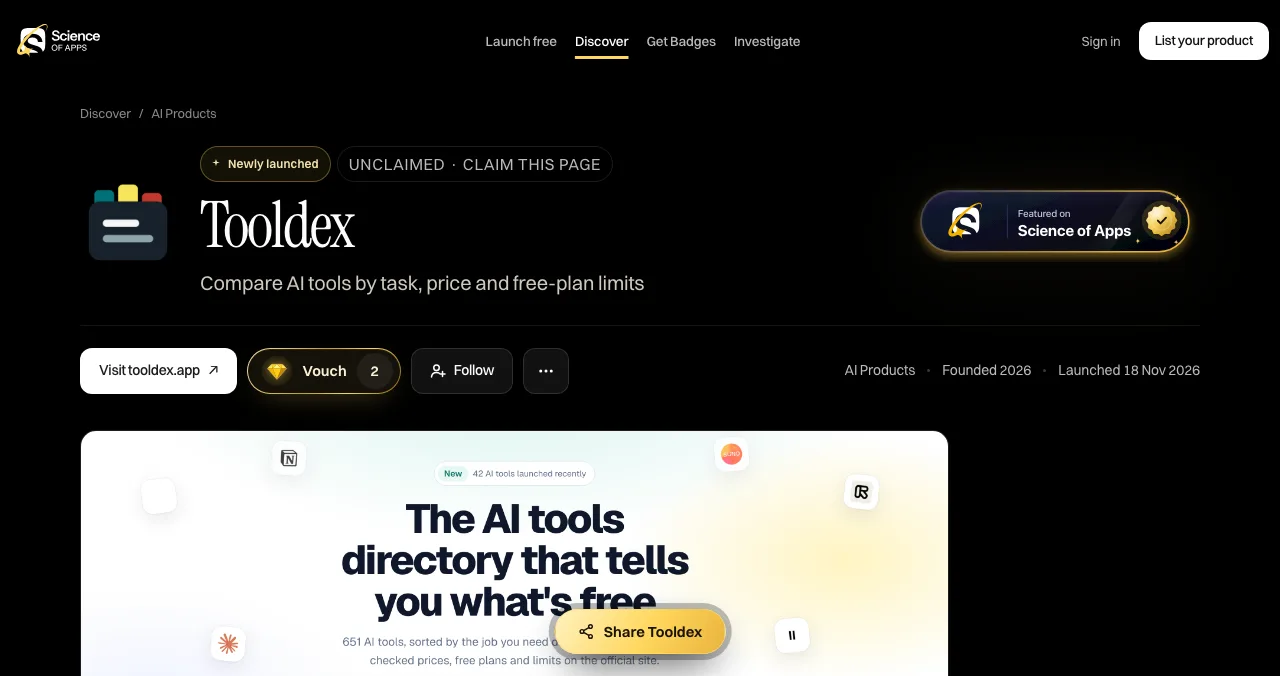
A live Launchpad profile shows the anatomy well: a tagline, "About", "The problem it solves", "Who it's for", an "At a glance" box (website, category, pricing model, year founded, platforms), questions answered from the product's own site, vouches, the founder, and earned badges.
What is a landing page?
A landing page is where a specific campaign lands: an ad, a launch post, an email, a partnership. It strips out navigation and pushes one action, because every extra link is a way to leave. You might run several at once, one per audience ("for agencies", "for students"), and retire them when the campaign ends. Fewer choices help: Hick's law says decisions slow down as options grow. Our landing page conversion checklist covers what makes one convert.
What is a website?
A website is the company's home: several pages on your own domain, usually a home page, product and pricing pages, about, blog, docs and legal pages. It's where landing pages and product pages often live once you have it. It's also the most work: a builder plan, a domain, and someone to keep it current. See Webflow vs WordPress vs Framer and Wix vs Squarespace vs Shopify when you get there.
Which do you need first?
| Your stage | First | Then | Later |
|---|---|---|---|
| Idea or prototype | Product page | Landing page for the waitlist | Website |
| Launching one product | Product page | Landing pages for each launch channel | Website |
| Running paid ads | Landing page per ad group | Product page for organic search | Website |
| Several products, a blog, docs | Website | Product page per product | Landing pages per campaign |
Table: Which page to build first, by stage
For most early products the answer is a product page. It's the page you'll send to everyone, and it keeps working after the launch. That's the gap the Launchpad fills.
A free product page on the Launchpad
- Cost
- Free, forever
- Steps
- Six short steps; save as a draft any time
- Live
- After automated checks and a person's review
- Found by
- The problem you solve, category, collections
- Not
- A website builder, host or domain registrar
The Launchpad calls each listing "a canonical product record": one record per product, findable by problem, audience and category, with a public profile, a custom link and your first badge. You fill in six short steps (name, story, details, media and links, and the founder), it's checked automatically and reviewed by a person, and it goes live with a Featured badge. Ranking is by relevance, editorial picks and community interest, never payment.
Once it's live, the product behind the page can be tested end to end.
- Areas of your product tested
- 22
- Automatic measurements, desktop and mobile
- 39
- Expert checks behind your login
- 74
- Verdicts that rank what to fix first
- 5
Check what people find after they click
List free, then order the report that fits your stage.

 Economy
See what new customers see
- Store listing and homepage, screen by screen
- Scorecard against 60 Laws of UX
- Customers, competitors and the fixes worth most
PremiumThe full diagnosis and the plan
- Every screen, every finding, every flow
- All 60 laws with evidence and fixes
- 8 strategy chapters and a 90-day roadmap
Fact-checked against the evidence. Private to your team, and never affects ranking.
A plan: from one page to a website
- Week 1
Product page
List on the Launchpad; your permanent link.
- Week 2
First landing page
One page for your launch channel, with one call to action.
- Month 2
Own domain
Move the landing page onto your domain.
- Month 3+
Website
Add pricing, docs and a blog when you have more to say.
Mistakes

- Building a website before you have one clear message — the extra pages dilute it
- Sending ad traffic to a product page — use a focused landing page
- Expecting a campaign page to rank — temporary pages rarely do
- Different promises on different pages — keep one consistent description everywhere
- Polishing pages while the product leaks — check the sign-up and first session too
Ready to launch?
How we know
The comparison is Science of Apps' editorial framework, informed by Google Search Central's SEO starter guide and its guidance on people-first content. Launchpad details come from its homepage, launch, pricing and investigation pages and a live public profile, read on 20 November 2026. Science of Apps runs the Launchpad.
Key terms, defined
- Product page: the evergreen, canonical description of one product.
- Landing page: a single page built for one campaign and one action.
- Website: a set of pages on your own domain representing the company.
- Product landing page: one page about one product, designed to drive one action.
- Canonical product record: the Launchpad's term for a product's single, authoritative listing.
Frequently asked questions
What is the difference between a product page and a landing page?
A product page describes one product completely and stays up: what it does, who it's for, screenshots, pricing and links. A landing page is built for a specific campaign, ad or audience, and pushes one action, such as signing up or joining a waitlist. Product pages get found through search; landing pages receive traffic you send.
What is the difference between a landing page and a website?
A website is a set of pages on your own domain: home, product, pricing, about, blog, help. A landing page is a single page, often on that website, designed for one goal with few distractions, usually without the full navigation. Many startups launch with a landing page and grow it into a website.
What is a product landing page?
A product landing page combines both ideas: one page about one product, designed to drive one action. It's the most common first page for a startup: headline, problem, product screenshots, how it works, proof and a single call to action. A Launchpad listing gives you a structured one free.
Do I need a website or a landing page first?
For one early product, a product page or landing page first. A full website makes sense when you have several things to say: multiple products, a blog, documentation, careers. Until then, a single page that explains the product and links to where people can try it does the job.
Can a product page rank on Google?
Yes, if it answers what people search for. Product pages that state the problem in the searcher's words, show the product and stay up for a long time tend to be indexed and quoted. Temporary campaign landing pages usually aren't. Launchpad profiles are built to be indexed by Google and read by AI engines.
Is a Launchpad listing a landing page or a website?
Neither exactly: it's a product page. It describes one product at a permanent custom link, with discovery, vouches and badges built in. It isn't a website builder, host or domain registrar, and you can't design custom layouts. Link it to your own landing page or website when you have one.
Sources
- Science of Apps — Launchpad homepage: what you get, FAQ (checked 20 Nov 2026)
- Science of Apps — Launch page: a canonical product record (checked 20 Nov 2026)
- Science of Apps — Example live profile: Tooldex (checked 20 Nov 2026)
- Science of Apps — Pricing (checked 20 Nov 2026)
- Science of Apps — Product investigation (checked 20 Nov 2026)
- Google Search Central — SEO starter guide (checked 20 Nov 2026)
- Google Search Central — Creating helpful, reliable, people-first content (checked 20 Nov 2026)
- Checked November 20, 2026. Figures that change — fees, salaries, prices — are reviewed every six months; if something is out of date, tell us.
Where to go from here
- Landing page conversion checklist — make a landing page convert
- Free product page — the step-by-step walkthrough
- Webflow vs WordPress vs Framer — when you need a full website
- Science of Apps - LaunchpadWhat a website for a startup needs on day one: a checklist of pages and checks, a startup website template, the free and cheap ways to build one, and how to test it the way a stranger wouldWhat a website for a startup needs on day one: the pages, the checks, a startup website template, and free ways to build and test it before launch.
- Science of Apps - LaunchpadWebsite audit vs UX audit vs product audit: what each one checks, where each one stops, what each costs in time, and which audit you need at your stageWebsite audit vs UX audit vs product audit: what each checks, where each stops and which audit you need, with free tools for each and a free route.
- Science of Apps - LaunchpadThe best waitlist tools for a startup launch, with prices checked: LaunchList, Waitlister, GetWaitlist, Tally, plus what a waitlist landing page needs to convertThe best waitlist tools with prices checked: LaunchList, Waitlister, GetWaitlist and Tally, plus what a waitlist landing page needs to convert.
- Science of Apps - LaunchpadThe best AI website generator for your project: nine AI website makers compared on free plans, verified prices and what they build, plus how a generated site gets its first visitorsThe best AI website generator by job: 9 AI website makers, from Durable and Wix to Framer and v0, with free plans, verified prices and how to get visitors.
- Science of Apps - LaunchpadA landing page review checklist for startups: 36 evidence-based checks for clarity, trust, speed, mobile and the call to action, with the research behind eachA landing page review checklist for startups: 36 checks for the first 10 seconds, trust, speed, mobile and the call to action, from NN/g and Google research.
- Science of Apps - LaunchpadSEO for startups: a prioritised plan for the first six months, from getting indexed to pages that answer buyers' questions, using Google's own starter guideSEO for startups, month by month: get indexed, fix the basics, earn a few relevant links and publish pages answering buyers' questions, per Google's own guide.
Get the ideas, not the noise.
Sign up with Google and we’ll send you short UX psychology tips by email — why people tap, stall and leave, and what to do about it. Unsubscribe anytime. Prefer something to keep? Get the free Laws of UX guide as a PDF.
Launch day ends. Your listing shouldn't.
A Science of Apps Launchpad listing is a free, permanent product page with its own link and discovery built in, and your product can be tested end to end with a detailed report once it's live.