 By
Quick answer: How do I build trust with no customers?
- Founder proof: real names, faces, relevant experience.
- Product proof: a demo or screenshots of it working.
- Process proof: public progress, open numbers, a changelog.
- Third-party proof: verifiable badges, vouches, press.
- Never: fake reviews, invented user counts, unauthorised logos.
Key takeaways
- Before customers, people trust the founder and the product's honesty.
- Verifiable beats impressive: a link to the source does the work.
- Small, specific numbers are more credible than vague big ones.
- Every fake signal is a risk to your reputation and, in places, the law.
- Swap in customer proof as soon as you have it.
Every landing page template has a row for logos and a carousel of five-star quotes. A startup on launch day has neither. So founders reach for the shortcuts: "Trusted by 10,000+ users" (it's 40), a row of famous logos (one person there signed up once), a quote from "Rahul, CEO" who doesn't exist. Visitors have seen all of it before, and some of it is now illegal in the US. Social proof works because people look to others like them when they're unsure (the law of social proof). Before you have customers, the honest version comes from other places. Here are 12, as checked on 17 November 2026. Jump to the 12 ways, badges or what never to fake.
- Honest ways to show proof early
- 12
- Kinds of proof: founder, product, process, third-party
- 4
- Click to verify a good badge
- 1
- Fake reviews, numbers or logos
- 0
The four kinds of early social proof
| Kind | What it proves | Examples |
|---|---|---|
| Founder proof | Real people who know the problem | Names, photos, relevant experience |
| Product proof | It works | A demo video, real screenshots, a free trial |
| Process proof | You're honest and moving | Open metrics, a changelog, build-in-public posts |
| Third-party proof | Others vouch for you | Verifiable badges, vouches, press, accelerator |
Table: Social proof a startup can show before it has customers (editorial framework)
12 honest ways to show social proof
- Put the founders on the page — names, faces and why you know this problem (authority).
- Show the product working — a 60-second demo beats any adjective.
- Quote your beta users — real names, specific outcomes, written permission (scripts).
- Use small, true numbers — "42 clinics in Pune" beats a vague "thousands".
- Publish a changelog — weekly shipping shows the product is alive.
- Share open metrics — even a few numbers, like Buffer's public dashboard.
- Earn launch-site badges — from listings people can click and check.
- Collect community vouches — one click from people who've tried it.
- Get verified — prove you own your domain where platforms offer it.
- Show where you've been featured — real articles, linked.
- Name your backers or programme — accelerator, grant, angel, if public.
- Show security and privacy basics — a clear policy and where data is stored.
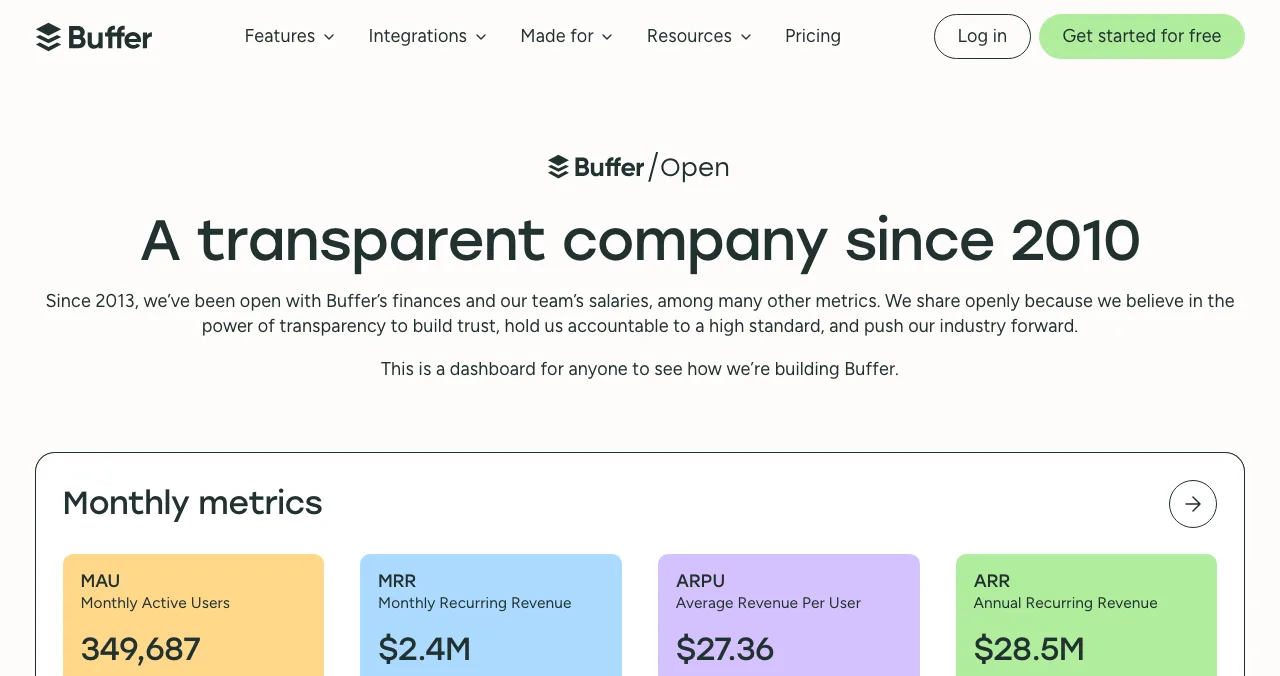
Buffer says it has shared its finances and salaries openly since 2013, and its dashboard shows live monthly metrics. You don't need to share that much. A monthly post with three honest numbers does the same job at a smaller scale.
Verifiable badges
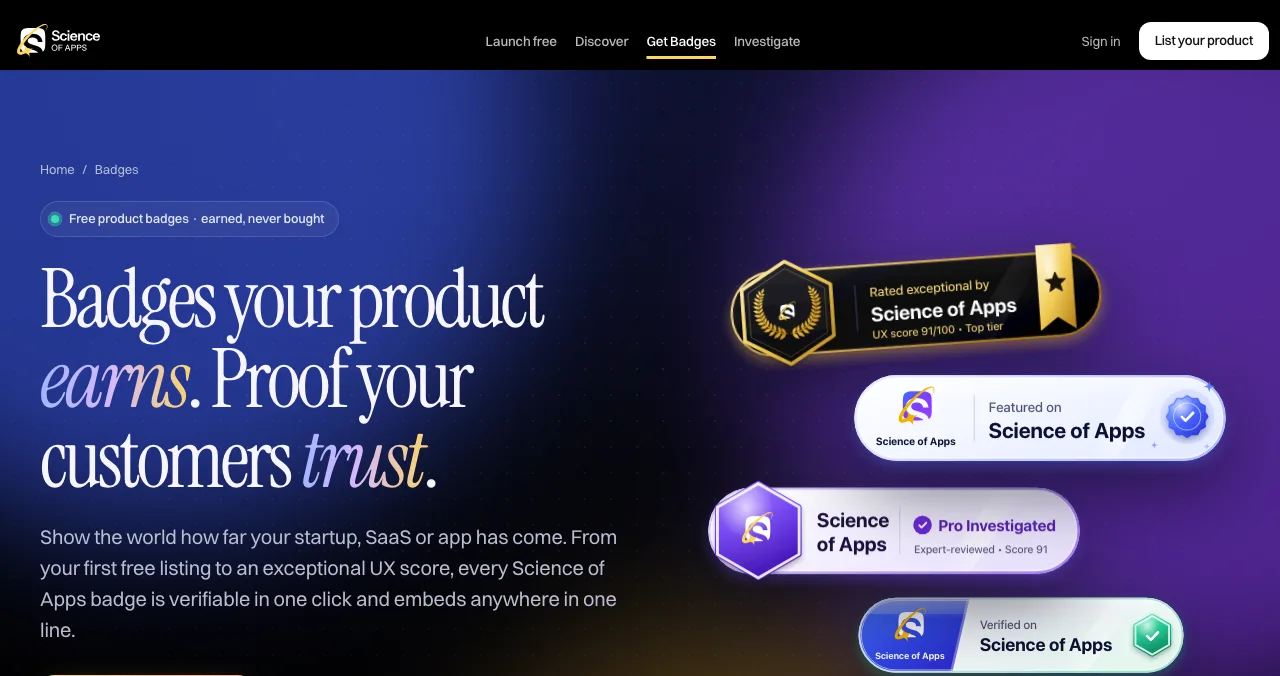
A badge is only proof if a visitor can check it. Science of Apps Launchpad badges unlock as a listing reaches each stage, are verifiable in one click and can't be bought:
| Badge | How it's earned |
|---|---|
| Featured | Publish a free, moderated listing |
| Verified | Prove you own the product's domain |
| Community favourite | 25 vouches from trusted members |
| Editor's pick | Chosen by editors for a curated collection |
| Investigated / Rated exceptional | A released UX investigation; 85+ for Rated exceptional |
Table: Science of Apps Launchpad badges and how each is earned (badges page, checked 17 Nov 2026)
What never to fake
The US FTC's reviews and testimonials rule, in effect since 21 October 2024, covers fake or false reviews and testimonials, buying reviews conditioned on what they say, undisclosed insider reviews, review suppression and fake indicators of social media influence such as bought followers or views.

- Fake reviews or testimonials — including "composite" customers
- Invented or inflated numbers — sign-ups presented as active users
- Logos without permission — or of companies that don't use you
- Bought followers, views or upvotes — they also break platform rules
- False scarcity — fake countdowns and "only 3 spots left"
Replace it as you grow
- Before launch
Founder and product proof
Who you are; a demo; a waitlist count if true.
- Launch
Third-party proof
Launch badges, vouches, first mentions.
- First 10 customers
Testimonials
Specific, named quotes with permission.
- First 100
Numbers and logos
Real counts; logos with written OK; case studies.
Mistakes

- Copying a big company's proof layout — empty rows look worse than none
- Badges that don't link anywhere — make them clickable
- Vague praise — specific outcomes persuade
- Hiding the founders — early on, they're the strongest proof
- Proof far from the decision — put it next to the sign-up button
Ready to earn proof?
How we know
Badge requirements come from the Science of Apps badges page; the rule's sections from the US FTC's guidance; Buffer's figures from its open dashboard; all read on 17 November 2026. The four-kinds framework and the 12 ways are our editorial guidance, grounded in the social proof and authority principles in our Laws of UX library. This isn't legal advice.
Key terms, defined
- Social proof: following what others like us do or endorse.
- Authority bias: giving more weight to people with relevant expertise.
- Verifiable badge: a badge that links to a source confirming it.
- Vouch: a one-click endorsement from a trusted member.
- Open metrics: business numbers a company shares publicly.
Frequently asked questions
How do I build trust with no customers?
Show the people behind the product, show the product working (a demo or real screenshots), publish honest progress, collect quotes from beta users, and earn verifiable third-party signals like launch badges and community vouches. Be specific and linkable, and never fake anything.
What is social proof?
The tendency to follow what other people, especially people like us, are doing or endorsing. On a website it shows up as testimonials, user counts, reviews, logos and badges.
Do 'featured on' badges help?
They can, when they're relevant to your audience and verifiable. A badge that links to a real listing lets a visitor check it in one click. Unverifiable badges, or badges from sites nobody has heard of, add little.
Can I show user numbers if they're small?
Yes, if they're true and framed honestly. '42 clinics in Pune' is specific and credible. Inflating numbers or counting sign-ups as active users is misleading.
Is it OK to use company logos of beta users?
Only with permission from the company, and only if they actually use the product. Many companies have rules about logo use; ask in writing.
What social proof should I avoid?
Fake reviews or testimonials, bought followers or views, invented user counts, logos you don't have permission for, and countdown timers or 'only 3 left' claims that aren't true.
Sources
- US FTC — The Consumer Reviews and Testimonials Rule: Questions and Answers (checked 17 Nov 2026)
- Science of Apps — Launchpad badges (checked 17 Nov 2026)
- Buffer — Open metrics (checked 17 Nov 2026)
- Science of Apps — Laws of UX: Social Proof
- Checked November 17, 2026. Figures that change — fees, salaries, prices — are reviewed every six months; if something is out of date, tell us.
Where to go from here
- Social proof — the law behind it
- Collect testimonials — scripts
- Startup badges — do they help?
- Science of Apps - LaunchpadDo startup badges and 'featured on' badges help conversions? The psychology, the evidence gap, what makes a badge credible, where to place it and how to test it yourselfDo 'featured on' startup badges help conversions? What social proof research supports, why verifiable badges beat decorative ones, and how to A/B test your own.
- Science of Apps - LaunchpadPre-launch marketing for startups: a six-week plan from waitlist to launch day, with the channels, assets and rules that matterPre-launch marketing for startups: a 6-week plan with a waitlist, building in public, early adopters, launch assets and a scheduled launch date.
- Science of Apps - LaunchpadRoast my landing page: 25 fixes founders hear in landing page roasts, each with the principle that explains itRoast my landing page, done properly: 25 landing page fixes for headlines, CTAs, pricing, trust and speed, each tied to a usability or behavioural principle.
- Science of Apps - LaunchpadHow to use launch traction in a startup pitch: which launch signals investors can verify, where they belong in the deck, and how to present them honestlyHow to use a launch profile and launch traction in your pitch: signals investors can verify, where they go in the deck and what not to overclaim.
- Science of Apps - LaunchpadGrowth hacking for startups in 2027: the tactics that still work (unscalable outreach, referral loops, product-led growth), the ones that now break rules, and the dark patterns to avoidGrowth hacking for startups in 2027: the tactics that still work, the ones that now break platform rules or the law, and dark patterns to avoid.
- How to make an appHow to validate an app idea before you write a single line of codeValidate an app idea in two weeks without code: problem interviews, demand signals, landing-page and fake-door tests, pre-sales and a concierge MVP.


Get the ideas, not the noise.
Sign up with Google and we’ll send you short UX psychology tips by email — why people tap, stall and leave, and what to do about it. Unsubscribe anytime. Prefer something to keep? Get the free Laws of UX guide as a PDF.
Launch day ends. Your listing shouldn't.
A free Launchpad listing earns a Featured badge; prove you own your domain for Verified; 25 trusted vouches earn Community favourite. Every badge is verifiable and can't be bought.