 By
Quick answer: What is the easiest startup to start?
- 30 startup ideas for beginners in five low-risk groups.
- Easiest start: a service using a skill you have, sold to people you can reach.
- Low risk means: little money, no code, buyers you can talk to this week.
- 30-day plan: idea on day 1, first payment by day 14, launch on day 30.
- Free launch: a permanent Launchpad listing and a baseline check.
Key takeaways
- Your first startup should teach you to sell, not to raise money.
- Boring, recurring problems are the safest place to start.
- Charging from the first customer is the cleanest test of demand.
- Complex products that work grow out of simple ones that worked.
- A deadline (day 30) beats a perfect plan.
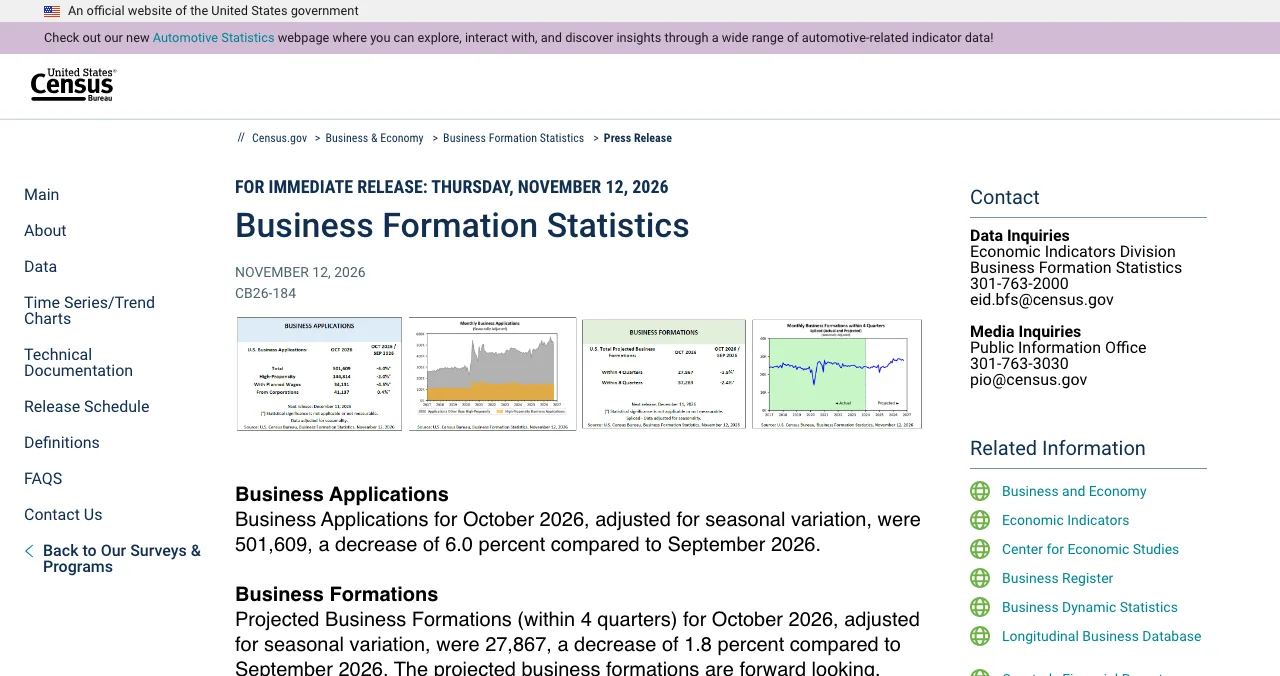
Your first startup has one job: to teach you how to find a problem, sell a solution and deliver it. It doesn't need to be big, clever or funded. In October 2026 alone, the US Census Bureau counted 501,609 business applications (seasonally adjusted), so you're in large company. Many first-time founders build first and sell later; this guide flips that. It gives 30 low-risk startup ideas for beginners, explains what makes a startup easy to start, and lays out a 30-day plan that ends with your launch on day 30. Sources were checked on 18 November 2026. Jump to what "easy" means, the 30 ideas or the 30-day plan.
What is the easiest startup to start?
The easiest startup is one that scores "yes" on five questions. The more yeses, the lower the risk.
| Question | Why it lowers risk |
|---|---|
| Can you sell it this week? | You learn about demand in days, not months |
| Can you deliver it by hand? | No code, no build time, no technical co-founder |
| Do you already have the skill? | No training period before revenue |
| Can you reach buyers directly? | No ad budget needed |
| Is the problem recurring? | One customer can become a monthly customer |
Table: Five questions that make startup ideas easy for beginners (Science of Apps editorial)
A February 2026 r/smallbusiness thread asking for the best "boring" businesses people had seen succeed drew more than 470 replies naming cleaning, junk removal, pest control and bookkeeping. Boring, recurring problems are where beginners should look first, and where software for those businesses is still thin.
30 startup ideas for beginners
Each idea is rated on risk (low or very low) and starts as a service. "First sale" is a realistic first customer you can approach this week.
1. Clean-ups for small businesses
| # | Idea | Risk | First sale |
|---|---|---|---|
| 1 | Bookkeeping clean-up before tax season | Very low | A local shop owner |
| 2 | Google Business Profile tidy-up | Very low | A restaurant with old hours |
| 3 | Overdue-invoice chasing | Low | A family firm with unpaid bills |
| 4 | Inbox and shared-drive organisation | Very low | A small office |
| 5 | Subscription and software audit | Low | A 10-person company |
| 6 | Price-list and menu updates across platforms | Very low | A café on delivery apps |
Table: Clean-up startup ideas for beginners (Science of Apps editorial)
2. Set-ups people put off
A poster helping at a family practice described in r/smallbusiness (21 February 2026) losing about a quarter of appointment slots to no-shows, and the owner's reluctance to ask for deposits. Many owners know the fix and never set it up.
| # | Idea | Risk | First sale |
|---|---|---|---|
| 7 | Online booking with deposits | Low | A salon or tutor |
| 8 | Review-request automation | Very low | A dentist or mechanic |
| 9 | Simple online ordering for a local shop | Low | A bakery or butcher |
| 10 | Email newsletter set-up and first issue | Very low | A gym or studio |
| 11 | Before-and-after photo galleries for trades | Low | A cleaner or painter |
| 12 | Digital forms to replace paper intake | Very low | A clinic or nursery |
Table: Set-up startup ideas for beginners (signal: r/smallbusiness, 21 Feb 2026)
3. Local guides and data
| # | Idea | Risk | First sale |
|---|---|---|---|
| 13 | Price guide for one local trade | Very low | Homeowners via a community group |
| 14 | Accessibility guide for one neighbourhood | Very low | Parents, wheelchair users |
| 15 | New-resident guide for one town | Very low | Estate agents to give clients |
| 16 | Local grant and programme list for one sector | Low | Farms or nonprofits |
| 17 | Childcare availability tracker for one area | Low | Parents' groups |
| 18 | Event calendar for one niche | Very low | Venues and organisers |
Table: Local guide startup ideas for beginners (Science of Apps editorial)
4. Tools for a problem you have
You're the first customer, so you know when it's working.
| # | Idea | Risk | First sale |
|---|---|---|---|
| 19 | Clean recipe cards from any link | Low | Fellow home cooks |
| 20 | Renter's move-in and move-out evidence checklist | Very low | Friends who rent |
| 21 | Caregiver organiser for a parent's accounts | Low | Other adult children |
| 22 | Group-trip cost splitter for one kind of trip | Low | Your travel group |
| 23 | Kids' activity schedule for co-parents | Low | Parents at your school |
| 24 | Pet-care rota for shared households | Very low | Housemates |
Table: Personal-problem startup ideas for beginners (signals: r/SomebodyMakeThis requests, 2025–2026)
5. Teach what you know
| # | Idea | Risk | First sale |
|---|---|---|---|
| 25 | Spreadsheet skills for one job | Very low | Colleagues |
| 26 | Interview practice for one role | Very low | Graduates you know |
| 27 | Starter kit for one hobby | Low | A hobby group |
| 28 | Workshop on one software tool for small businesses | Low | A local business association |
| 29 | Templates for one profession | Very low | People in your industry |
| 30 | Exam-prep for one subject | Very low | Students a year behind you |
Table: Teaching startup ideas for beginners (Science of Apps editorial)
How to run your first ten conversations
The conversations in days 2–6 of the plan matter more than the idea you start with. Beginners usually pitch; the goal is to listen. Rob Fitzpatrick's book The Mom Test is the standard reference; the questions below follow its spirit of asking about the past, not opinions about the future.

- "When did this last happen?" — gets a real story instead of a hypothetical
- "What did you do about it?" — reveals the workaround you're competing with
- "What did that cost you?" — in money, hours or stress
- "Have you looked for something better?" — if not, the pain may be mild
- "Who else has this problem?" — your next conversation, and a hint at the market
- Never ask "would you buy this?" — people say yes to be kind
Take notes in the person's own words; you'll reuse them on your page on day 21. After ten conversations, one idea usually stands out because people describe it with more detail, more cost and more irritation than the others. That's the one to sell.
Two more habits make the conversations count. First, talk to people you don't know well: a friend of a friend, a shop owner on your street, someone in an online community for that trade. Friends soften their answers. Second, end every conversation by asking for something small: an introduction to someone else with the problem, a look at the spreadsheet they use today, or permission to show them a first version in two weeks. People who say yes to a small ask are your most likely first customers; people who won't share even a spreadsheet are telling you the problem isn't painful enough.
What to charge first. Pick a price that would make the first customer pause but not refuse. If nobody hesitates, you're too cheap; if everyone refuses, either the price or the problem is wrong. Ask the people who say no what they'd pay instead; their answer is data.
Which beginner startup idea should you pick?
| If you… | Pick from | Because |
|---|---|---|
| Work in an office | Group 1 or 5 | You already have the skills |
| Like setting up tools | Group 2 | Owners will pay to skip the hassle |
| Know your area well | Group 3 | Local knowledge is hard to copy |
| Have a nagging personal problem | Group 4 | You're customer number one |
| Have very little time | Group 5 | One template or workshop at a time |
Table: Choosing startup ideas for beginners (Science of Apps editorial)
An August 2026 r/Entrepreneur thread asked people what makes them money but they'd never recommend starting; it drew around 400 replies. Read threads like that before you choose: they show the hidden costs of businesses that look easy from outside.
A 30-day plan: from idea to launch
- Day 1
Pick three ideas
From the list above, or from your own work and life.
- Days 2–6
Ten conversations
Two per day; ask about the last time the problem happened, not about your idea.
- Day 7
Choose one
The idea with the most pain and the easiest-to-reach buyers.
- Days 8–10
Offer it
Message five potential customers with a simple offer and a price.
- Days 11–14
First delivery
Deliver by hand; ask for feedback and a testimonial.
- Days 15–20
Two more customers
Charge the full price; write down every step you repeat.
- Days 21–25
One page
A one-page site: one-liner, who it's for, price, contact or sign-up form.
- Days 26–29
Fix and prepare
Ask three people to read the page; fix what confuses them.
- Day 30
Launch
List it free on the Launchpad; share with everyone you spoke to.
Our guide to how to launch a startup covers what comes after day 30.
Day 30: launch on the Science of Apps Launchpad
On day 30, list your startup free: six short steps, checked automatically and by a person, ranked by relevance, editorial picks and community interest, never payment. You go live with a Featured badge, and a free baseline diagnosis checks your landing page, discoverability and speed, telling you what to fix first. When there's a product behind the page, a full investigation tests it end to end in a real browser on desktop and mobile.
- Areas of your product tested
- 22
- Automatic measurements, desktop and mobile
- 39
- Expert checks behind your login
- 74
- Verdicts that rank what to fix first
- 5
An outside view of what you've built
The listing and baseline check are free. Reports are optional.

 Economy
See what new customers see
- Store listing and homepage, screen by screen
- Scorecard against 60 Laws of UX
- The fixes worth most
PremiumThe full diagnosis and the plan
- Every screen, every finding, every flow
- All 60 laws with evidence and fixes
- 8 strategy chapters and a 90-day roadmap
Private to your team. Never affects ranking.
Beginner basics: registration, money and tools
The US Small Business Administration lists its launch steps as: pick a location, choose a business structure, choose a name, register, get tax IDs, apply for licences and permits, open a business bank account, and get insurance. Which you need on day 1 depends on your country, state and what you sell; for a manual service tested with a few customers, many founders start simple and formalise as revenue grows. Ask a local accountant if unsure.
| Need | Free option, checked 18 Nov 2026 |
|---|---|
| Sign-up or order form | Tally's free plan: unlimited forms and submissions |
| A co-founder later | YC Co-Founder Matching, free |
| A launch page that lasts | Science of Apps Launchpad listing, free forever |
Table: Free tools for beginner founders (each provider's page, checked 18 Nov 2026)
Beginner mistakes

- Building an app first — Gall's law: complex systems that work evolve from simple ones that worked
- Not charging — free customers tell you little about demand
- Picking the "big" idea — save it for startup number two
- Talking only to friends — they're kind; strangers are honest
- No deadline — without a day 30, launch drifts forever
- Comparing yourself to funded startups — your first goal is three paying customers
Ready to launch?
How we chose
Ideas were chosen for low risk: sellable within a week, deliverable by hand, using common skills, with buyers a beginner can reach. Signals come from Reddit threads named by subreddit and date; the business applications figure from the US Census Bureau; launch steps from the SBA; tools from Tally and Y Combinator; all read on 18 November 2026. Ideas and risk ratings are editorial judgements. Science of Apps runs the Launchpad.
Key terms, defined
- Low-risk startup: one you can test with little money, no code and buyers you can reach directly.
- Service-first: delivering the result by hand before building software.
- Recurring problem: one that comes back regularly, so customers can pay regularly.
- First moment of value: when a customer first gets a real result from you.
- Launch: making your product publicly available and findable, not finishing it.
Frequently asked questions
What is the easiest startup to start?
A service built on a skill you already have, sold to people you can reach this week: tidying a small firm's bookkeeping, fixing websites, setting up online booking, or publishing a local price guide. You need no code or investment, you learn to sell immediately, and the tasks you repeat show you which software to build later.
What are good startup ideas for beginners with no experience?
Pick a problem from your own life or job, where you're the customer. Good beginner startup ideas include a clean recipe tool if you cook, a renter's move-in checklist if you rent, or a caregiver's account organiser if you look after a parent. Your experience of the problem is the experience that matters most.
How much money do I need to start a startup as a beginner?
Often close to nothing. Free form builders, payment providers with no set-up fees and free listings cover the first month. Spend on a domain when you're ready to share your page with strangers, and on registration when local rules or contracts require it. Keep a written cost log from day one.
Do I need a technical co-founder for my first startup?
Not for any idea in this guide. Each starts as a service you deliver by hand. If the idea works and you need software, you can use no-code tools, learn enough to build a simple version, or look for a co-founder; YC runs a free co-founder matching platform.
How long does it take to launch a first startup?
The plan in this guide launches on day 30: ten conversations in the first week, a first paid delivery by day 14, a one-page site by day 25 and a free listing on day 30. It won't be finished, and it shouldn't be. Launching early shows you what customers actually want.
What are the riskiest startup ideas for beginners?
Ideas that need large upfront spending (hardware, inventory, paid ads), regulatory approval (health, finance), or two-sided marketplaces that only work at scale. They're not bad ideas, but they're hard first projects. Start with something you can sell by hand, learn the basics, then take on bigger risks.
Sources
- Reddit — r/smallbusiness: What's the best boring business you've seen someone build into a cash machine?, 17 Feb 2026 (checked 18 Nov 2026)
- Reddit — r/Entrepreneur: what's making you money that you'd never recommend starting, 11 Aug 2026 (checked 18 Nov 2026)
- Reddit — r/smallbusiness: no-show deposits thread, 21 Feb 2026 (checked 18 Nov 2026)
- Rob Fitzpatrick — The Mom Test (book site) (checked 18 Nov 2026)
- US Small Business Administration — Launch your business (checked 18 Nov 2026)
- US Census Bureau — Business Formation Statistics, released 12 Nov 2026 (checked 18 Nov 2026)
- Y Combinator — Co-founder matching (checked 18 Nov 2026)
- Tally — Pricing: free plan (checked 18 Nov 2026)
- Science of Apps — Launchpad: list your product free (checked 18 Nov 2026)
- Checked November 18, 2026. Figures that change — fees, salaries, prices — are reviewed every six months; if something is out of date, tell us.
Where to go from here
- How to launch a startup — the full guide
- Low cost startup ideas — 35 under $500
- Validate a startup idea — the tests in depth
- Science of Apps - LaunchpadStartup ideas for students: 40 ideas you can launch with no money, the free tools that make it possible, and a zero-budget plan from first conversation to a live listing40 startup ideas for students that cost nothing to start, the free student tools that make it possible, and a zero-budget plan to launch before term ends.
- Science of Apps - Launchpad50 tech startup ideas for 2027, grouped by the technical shift that makes each one newly possible, with the problem signal behind it and how to launch and test a software startup free50 tech startup ideas for 2027, grouped by the shift that makes each possible now, from air-gapped AI to permit software, plus a free way to launch yours.
- Science of Apps - LaunchpadHow to market a startup with no money: the free channels that work, in the order to use them, and what each costs in time insteadHow to market a startup with no money: direct outreach, communities, free launch sites, directories, content and AI search, in order, with the time each costs.
- Science of Apps - LaunchpadHow to run a launch week, and why launching is a habit, not a day: every kind of launch a startup can do, from silent launches to feature dropsHow to run a launch week and launch repeatedly: silent launches, communities, Hacker News, Product Hunt, request-access waitlists and feature drops, in order.
- Science of Apps - LaunchpadHow to get your first 100 users without paid ads: a channel-by-channel plan founders can start todayHow to get your first 100 users without paid ads in 2027: your network, communities, launch sites, directories, content and one-to-one outreach, step by step.
- Science of Apps - LaunchpadPre-launch marketing for startups: a six-week plan from waitlist to launch day, with the channels, assets and rules that matterPre-launch marketing for startups: a 6-week plan with a waitlist, building in public, early adopters, launch assets and a scheduled launch date.

Get the ideas, not the noise.
Sign up with Google and we’ll send you short UX psychology tips by email — why people tap, stall and leave, and what to do about it. Unsubscribe anytime. Prefer something to keep? Get the free Laws of UX guide as a PDF.
Launch day ends. Your listing shouldn't.
Day 30 of the plan is launch day: list your startup free on the Science of Apps Launchpad for a permanent profile, a free baseline check of your page, and a product test when you're ready.