 By
Quick answer: What is a startup launchpad and is it free?
- A startup launchpad is where founders list a new product so people can find it.
- Three types: launch-day leaderboards, curated features and permanent listings.
- Not an accelerator: a launchpad lists your product; an accelerator invests in your company.
- Free options exist: Product Hunt and the Science of Apps Launchpad are free.
- The Science of Apps Launchpad adds vouches, badges and a test of your product.
Key takeaways
- "Launchpad" covers three different models; know which one you're using.
- Launch-day sites give a spike; permanent listings give compounding discovery.
- A launchpad is about users and visibility; an accelerator is about capital and coaching.
- Look for ranking you can't buy, moderation, and listings that don't expire.
- List permanently first, then use launch days for spikes.
"Launchpad" gets used for three different things in the startup world: a rocket metaphor, a programme that invests in you, and a website where you list a product so people can find it. This explainer is about the third. A startup launchpad is the place your product goes public, and choosing the right one decides whether launch day is the start of discovery or the end of it. We'll cover how launchpads work, the three main types, how they differ from directories and accelerators, and how to list your startup free. Facts were checked on each platform's own pages on 17–18 November 2026. Jump to the three types, launchpad vs accelerator or how to list.
What is a startup launchpad?
A startup launchpad is a website where founders list or launch a new product so that early users, journalists and investors can discover it. A good one gives you three things: a public page about your product, an audience that's looking for new products, and some signal of quality, such as votes, vouches, editorial picks or badges.
The three types of launchpad
| Type | How it works | Example | Visible for | Cost |
|---|---|---|---|---|
| Launch-day leaderboard | Products go live on a set day and compete for votes | Product Hunt, Uneed, Peerlist Launchpad | A day or a week, then an archive page | Free, with paid options on some |
| Curated feature | Editors choose which products to feature | BetaList | A featured slot | Paid on BetaList |
| Permanent listing | A profile people find by problem or category, any time | Science of Apps Launchpad | Permanent | Free |
Table: The three types of startup launchpad (each platform's own pages, checked 17–18 Nov 2026)
Most founders use more than one: a permanent listing as the home, and launch days for spikes. See the best product launch platforms for the full comparison.
Launchpad vs accelerator vs directory
| Launchpad | Accelerator | Directory | |
|---|---|---|---|
| What it gives you | Visibility and early users | Money, coaching, network | A database entry |
| What it takes | Usually nothing | Equity (YC's standard deal invests $500,000) | Usually nothing, or a listing fee |
| Selection | Moderation or votes | Competitive application | Little or none |
| Time involved | Minutes to list | Months of programme | Minutes |
Table: Launchpad, accelerator and directory compared
Accelerators such as Y Combinator invest in your company; its published standard deal is $500,000. A launchpad doesn't take equity; it puts your product in front of people. For the programmes, see our startup accelerator list.
The Science of Apps Launchpad: a free launchpad that tests your product
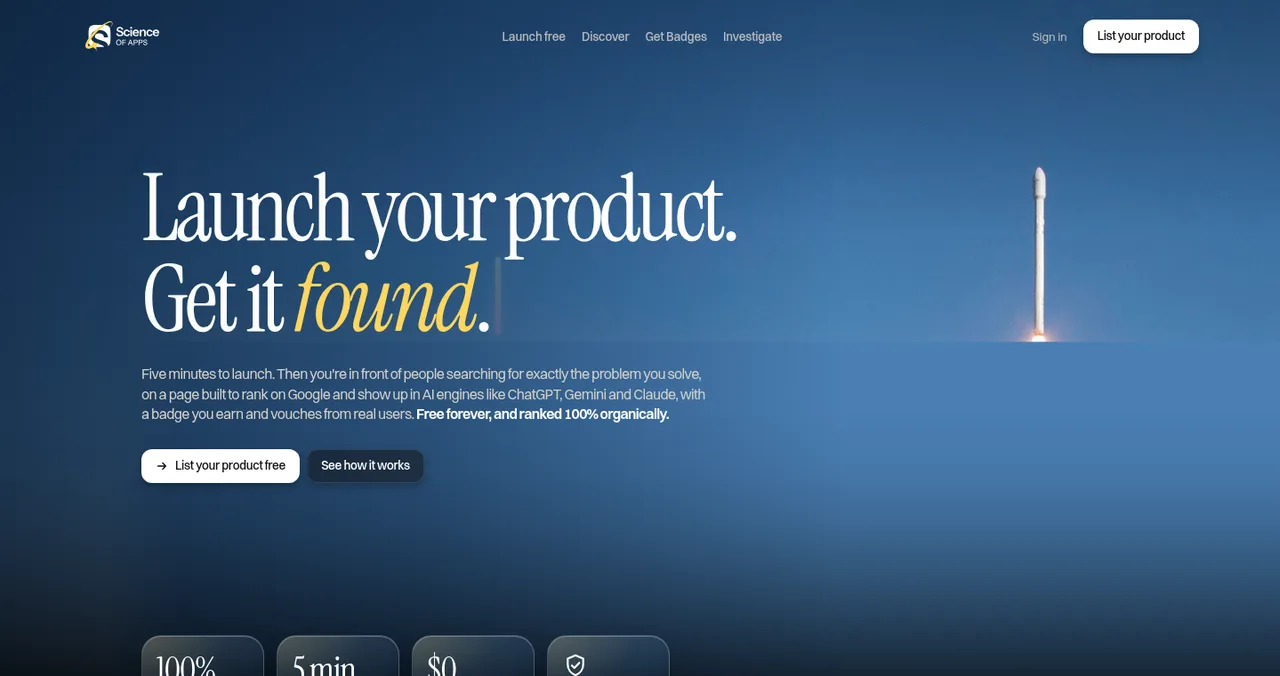
The Science of Apps Launchpad is a permanent-listing launchpad. It's free to list, forever, and its homepage describes it as five minutes to launch with rankings that are 100% organic.

List
Name, story, details, media and links, and the founder behind it, in six short steps. Save a draft any time.
Vouch
Real users vouch for products and follow them. Vouches are public social proof and feed ranking.
Earn badges
Featured when you go live, then Verified, Community favourite, Editor's pick and more, each linking back so anyone can check it.
Get diagnosed
A free baseline check of your landing page, discoverability and speed runs as you go live; full investigations and reports go deeper.
What makes it different from other launchpads is the last card. Once your listing is live, your product can be tested across 22 areas, from the first search result to settings, with 39 automatic measurements and 74 expert checks. Every finding comes with evidence, a verdict and a next step.
- Areas of your product tested
- 22
- Automatic measurements
- 39
- Expert checks
- 74
- Badges you can earn
- 7
Your startup, diagnosed
Listing is free. If you want the detail, order the report that fits your stage.

 Economy
See what new customers see
- Store listing and homepage, screen by screen
- Scorecard against 60 Laws of UX
- The fixes worth most
PremiumThe full diagnosis and the plan
- Every screen, every finding, every flow
- All 60 laws with evidence and fixes
- 8 strategy chapters and a 90-day roadmap
Researched from your live product and fact-checked against the evidence.
How to list your startup on a launchpad

- Write one sentence — what the product does and for whom, in plain words.
- Gather media — a logo, three to five real screenshots and, ideally, a 30–60 second video.
- Check the first-run experience — sign up in a clean browser; fix anything broken.
- List permanently first — so every later launch links to one canonical page.
- Pick launch days — Product Hunt, Peerlist or Uneed, spaced a week or more apart.
- Collect vouches and reviews — ask real users, never buy them.
- Update as you ship — a listing that changes with the product keeps being found.
What to look for in a launchpad

- Ranking you can't buy — paid placement should be labelled and separate
- Moderation — a person reviews listings, so the neighbourhood stays trustworthy
- Permanence — your page stays live after launch day
- A real audience — people who browse or search for new products
- Something you learn — feedback, votes, vouches or a report
Badges and vouches matter because they're social proof: visitors look for evidence that real people already use a product.
Ready to list?
How we know
Platform rules come from each platform's own pages: Product Hunt's help centre, BetaList's help page, Y Combinator's published deal and the Science of Apps Launchpad's homepage, pricing and investigation pages, read on 17–18 November 2026. Science of Apps runs the Launchpad.
Key terms, defined
- Startup launchpad: a platform where founders list or launch a product so people can discover it.
- Launch day: the day a product competes on a launch leaderboard.
- Permanent listing: a profile that stays live and findable after launch day.
- Accelerator: a programme that invests in startups for equity and coaches them.
- Vouch: a public endorsement from a real user.
- Canonical page: the one page about your product that every other post links to.
Frequently asked questions
What is a startup launchpad?
A platform where founders list or launch a new product so early users, journalists and investors can discover it. Launchpads range from one-day leaderboards like Product Hunt to curated features like BetaList and permanent listings like the Science of Apps Launchpad.
Is a startup launchpad free?
Many are. Product Hunt is free to launch on, Peerlist Launchpad mentions no fee, Uneed has a free waiting line, and the Science of Apps Launchpad is free forever. BetaList and There's An AI For That charge to list.
How do I list my startup on a launchpad?
Prepare a one-line description, screenshots or a short video, your link and a founder profile. On the Science of Apps Launchpad that's six short steps; automated checks and a moderator review it before it goes live with a Featured badge.
What's the difference between a launchpad and an accelerator?
A launchpad lists your product so people find it, usually free and without taking equity. An accelerator such as Y Combinator or Techstars invests money for equity and runs a programme of coaching. Many startups use both.
What's the difference between a launchpad and a startup directory?
Directories are databases organised by category, often with little curation. Launchpads add a launch moment, a community that votes or vouches, and moderation. The Science of Apps Launchpad combines a permanent directory listing with community vouches and a product test.
What does the Science of Apps Launchpad give me for free?
A public profile with a custom link, screenshots and video, a Featured badge when you go live, organic discovery by problem, vouches, followers, earned badges and a free baseline check of your landing page, discoverability and speed.
Sources
- Science of Apps — Launchpad homepage (checked 18 Nov 2026)
- Science of Apps — Pricing (checked 18 Nov 2026)
- Science of Apps — Product investigation (checked 18 Nov 2026)
- Product Hunt Help Center — How Product Hunt works
- BetaList — Help and FAQ (checked 17 Nov 2026)
- Y Combinator — The YC deal
- Checked November 18, 2026. Figures that change — fees, salaries, prices — are reviewed every six months; if something is out of date, tell us.
Where to go from here
- Best product launch platforms — compared
- Places to launch a startup — the full list
- Free startup directories — where to list
- Science of Apps - LaunchpadThe Y Combinator startup directory explained: what's in it, how to search YC startups, Launch YC, and how non-YC founders can get the same kind of visibilityHow the Y Combinator startup directory works: search and filter YC companies by batch and hiring status, what Launch YC is, and how non-YC startups get found.
- Science of Apps - LaunchpadHow to market an AI tool in 2027: positioning by task, AI directories, AI search, demos and the trust that makes people payHow to market an AI tool in 2027: position by task, list in AI directories, get cited by AI search, show real outputs and earn trust that converts.
- Science of Apps - LaunchpadStartup launch platforms vs directories: what each one is, how they rank products, how long you stay visible, and when a startup needs whichLaunch platforms vs startup directories: a launch site gives you a spike on one day; a directory keeps you findable. Definitions, a table and when to use each.
- Science of Apps - LaunchpadThe best startup platforms in India for a launch: an India-first list covering Startup India, the Science of Apps Launchpad, Product Hunt, YourStory, Tracxn and CrunchbaseThe best startup platforms in India for a launch: Startup India, the Launchpad, Product Hunt, YourStory, Tracxn and Crunchbase, with costs.
- Science of Apps - LaunchpadWhere to launch your startup in 2027: 24 launch sites, directories and communities, each checked on its own pages24 places to launch your startup in 2027, free and paid: launch sites, directories, AI directories, databases and communities, each checked and dated.
- Science of Apps - LaunchpadHow to get your first 100 users without paid ads: a channel-by-channel plan founders can start todayHow to get your first 100 users without paid ads in 2027: your network, communities, launch sites, directories, content and one-to-one outreach, step by step.



Get the ideas, not the noise.
Sign up with Google and we’ll send you short UX psychology tips by email — why people tap, stall and leave, and what to do about it. Unsubscribe anytime. Prefer something to keep? Get the free Laws of UX guide as a PDF.
Launch day ends. Your listing shouldn't.
The Science of Apps Launchpad is a free startup launchpad: a permanent profile found by the problem you solve, community vouches and badges, and your product tested with a detailed report.