 By
Quick answer: Can a startup be added to Wikidata?
- Yes, if it's notable: Wikidata accepts items that meet at least one of its three notability criteria.
- Independent sources first: news coverage, official registries; not your own site or listings.
- Promotional or unsourced items get deleted under Wikidata's deletion policy.
- Keep it factual: inception, founders, website, headquarters, industry, identifiers, each referenced.
- Wikipedia is a higher bar: significant coverage in multiple independent, reliable secondary sources.
Key takeaways
- Wikidata is a data source, not a marketing channel; treat it like a public record.
- Most pre-seed startups aren't ready for Wikidata yet, and that's fine.
- Coverage you earn (press, registries, awards) is what makes an item stick.
- Consistent official profiles help search engines connect your brand even before you qualify.
- Disclose your connection and let the sources do the talking.
Founders hear that Wikidata "feeds the knowledge graph" and that AI engines read it, and the next thought is: let's add our startup this afternoon. Sometimes you can. Often you shouldn't yet. Wikidata is an open, community-run knowledge base with a notability policy and a deletion policy, and items built to promote a company without independent sources get nominated and removed. This guide explains when a startup qualifies, the sources a company entry needs, how to create a clean, referenced item step by step, and what to do instead if you're not there yet. Every rule here was checked on Wikidata's and Wikipedia's own policy and help pages on 18 November 2026. Jump to the notability test, the step-by-step or the not-yet plan.
- Notability criteria; an item must meet one
- 3
- Rule that matters most: independent references
- 1
- Special markup Google needs for AI features
- 0
- Stable identifier your company gets if it qualifies
- 1
Can a startup be added to Wikidata?
Yes, if it meets Wikidata's notability policy. An item is acceptable if it meets at least one of three criteria:
| Criterion | What it means | Does a startup usually meet it? |
|---|---|---|
| 1. Sitelink | The item links to a valid page on a Wikimedia project such as Wikipedia | Only if it already has a Wikipedia article |
| 2. Entity with references | A clearly identifiable entity that can be described using serious and publicly available references | The realistic route, once independent sources exist |
| 3. Structural need | The item is needed to make statements in other items more useful | Occasionally, e.g. as the employer or developer in a notable item |
Table: Wikidata's three notability criteria and how they apply to startups (Wikidata:Notability, checked 18 Nov 2026)
The policy page says its wording is intentionally a bit vague, that disagreements go to a request for deletion, and that "the final decision is always up to the community". It also suggests asking at Wikidata:Requests for new items if you're unsure.
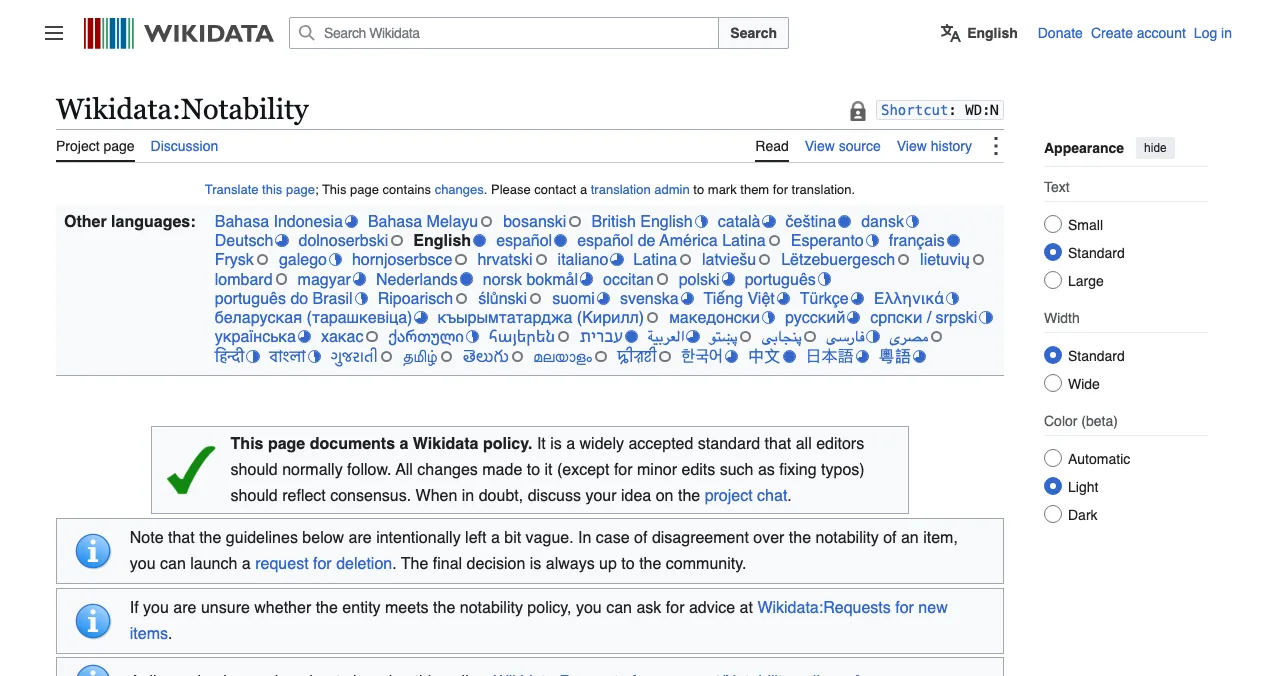
What counts as "serious and publicly available references" for a company? Independent coverage in a reliable publication, an entry in an official business register, or a recognised award or programme listing. Your own website, your press release and directory profiles you created yourself (including a Launchpad listing) can confirm basic facts, but they don't show that anyone independent has described you.
Why AI engines and knowledge graphs care
Wikidata stores facts as structured statements about items, each with a permanent ID (Google, for example, is Q95). Search engines, AI assistants and countless apps read that data. A well-sourced item helps machines:
- Disambiguate you from other companies, products or words with the same name.
- Connect the dots between your website, your founders, your headquarters and your official profiles through identifier properties.
- Trust the facts because each statement carries a reference.
Keep this in proportion. Google's guide to its generative AI features says there is no special schema.org markup or machine-readable file you need to appear in them, and that seeking inauthentic mentions isn't as helpful as it might seem. A Wikidata item is a public record of facts that are already true and already reported, not a ranking lever. For the on-site side, see entity SEO for startups.
What happens to promotional or unsourced items?
They get deleted. Wikidata's deletion policy says items may be deleted when they don't meet the notability requirements, and that other pages may be deleted if they are clearly vandalism or promotional material. Anyone can nominate an item at Wikidata:Requests for deletions; administrators act on the community's decision.
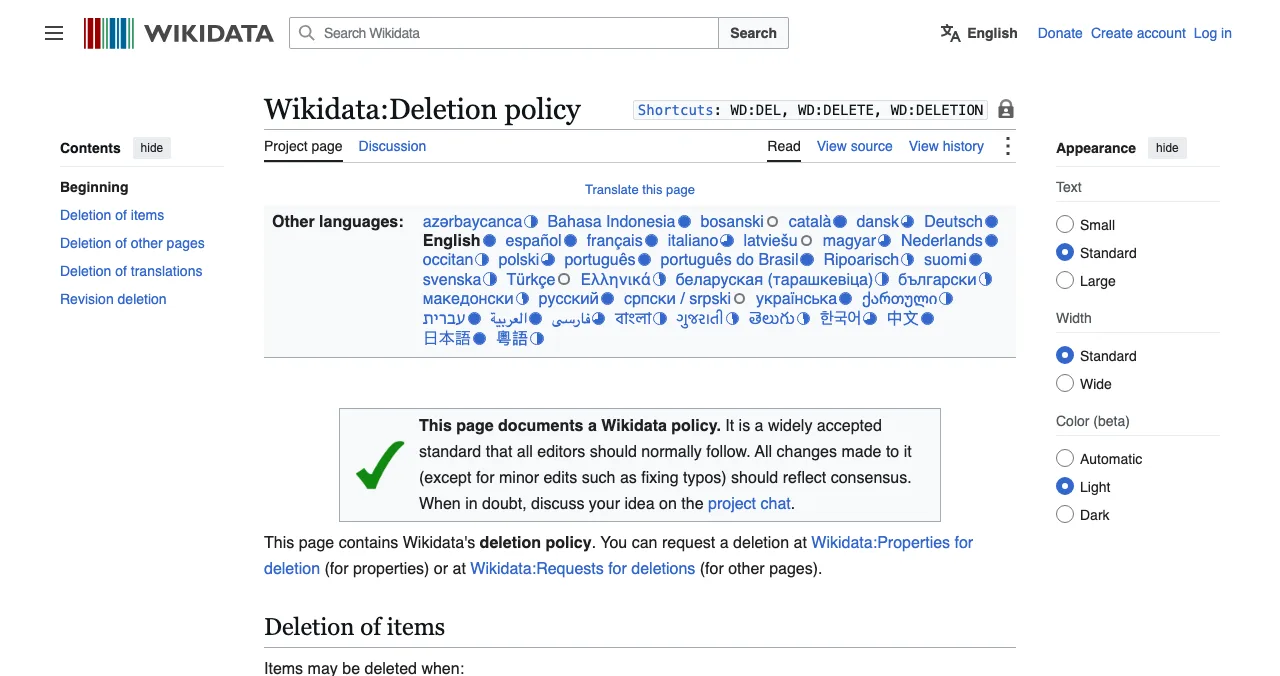
The patterns that attract a deletion request are predictable: a description written like a tagline ("the leading AI platform for…"), statements with no references, references that all point to the company's own site, and an account that only ever edits items about one company. Avoid all four and you're treating Wikidata the way its community expects.
Wikipedia for startups: a higher bar
Wikipedia and Wikidata are different projects. Wikipedia's notability guideline for organisations) presumes a company notable only if it has had significant coverage in multiple reliable secondary sources that are independent of it. It specifically excludes press releases, paid or sponsored content, the company's own publications, routine business news such as funding rounds and product launches, and inclusion in "best of" lists or directories.
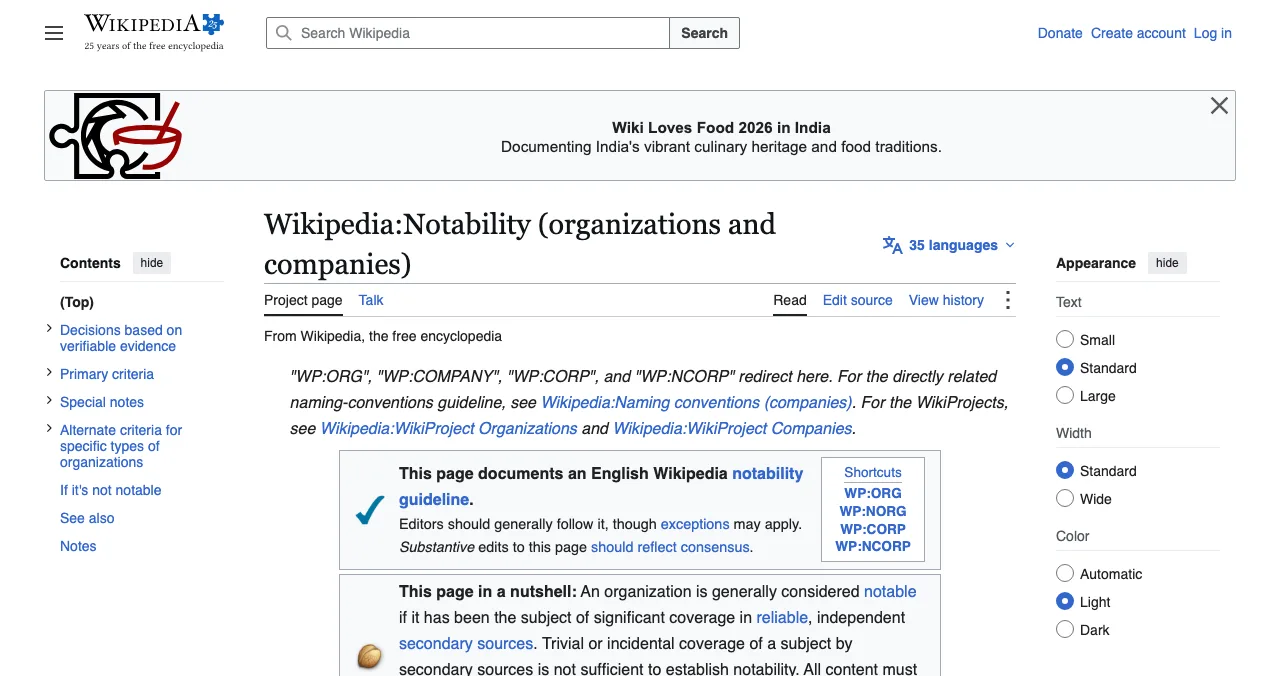
Wikipedia's conflict of interest guideline strongly discourages editing articles about your own company directly; it asks you to disclose the connection, propose changes on the talk page and submit new articles through Articles for Creation. Paid editors must disclose who is paying them. Most startups should not try to get a Wikipedia article; let one happen when the coverage exists.
How to create a Wikidata company entry, step by step

- Search first. Search Wikidata for your company name, former names and your domain. Duplicates are merged, not kept, so extend an existing item rather than creating another.
- Collect your references. At least two or three independent, public sources: news articles about the company, an official registry entry, a recognised award. Save the URLs and the dates you read them.
- Create an account and disclose. Log in, and say on your user page that you are connected to the company. It's the honest thing to do and it makes the community more likely to trust your edits.
- Create the item. Use "Create a new item" with a label (the company's name), a neutral description of a few words ("software company based in Bengaluru", not a slogan) and any aliases.
- Add core statements. The table below lists the usual ones.
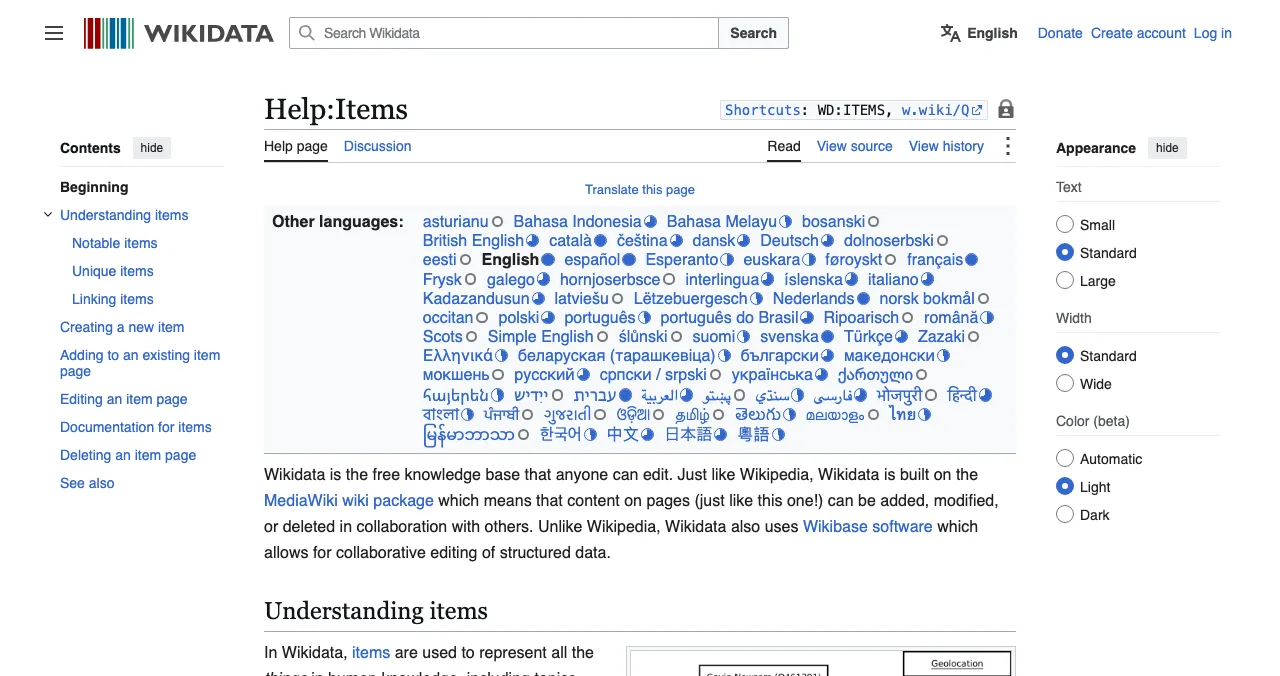
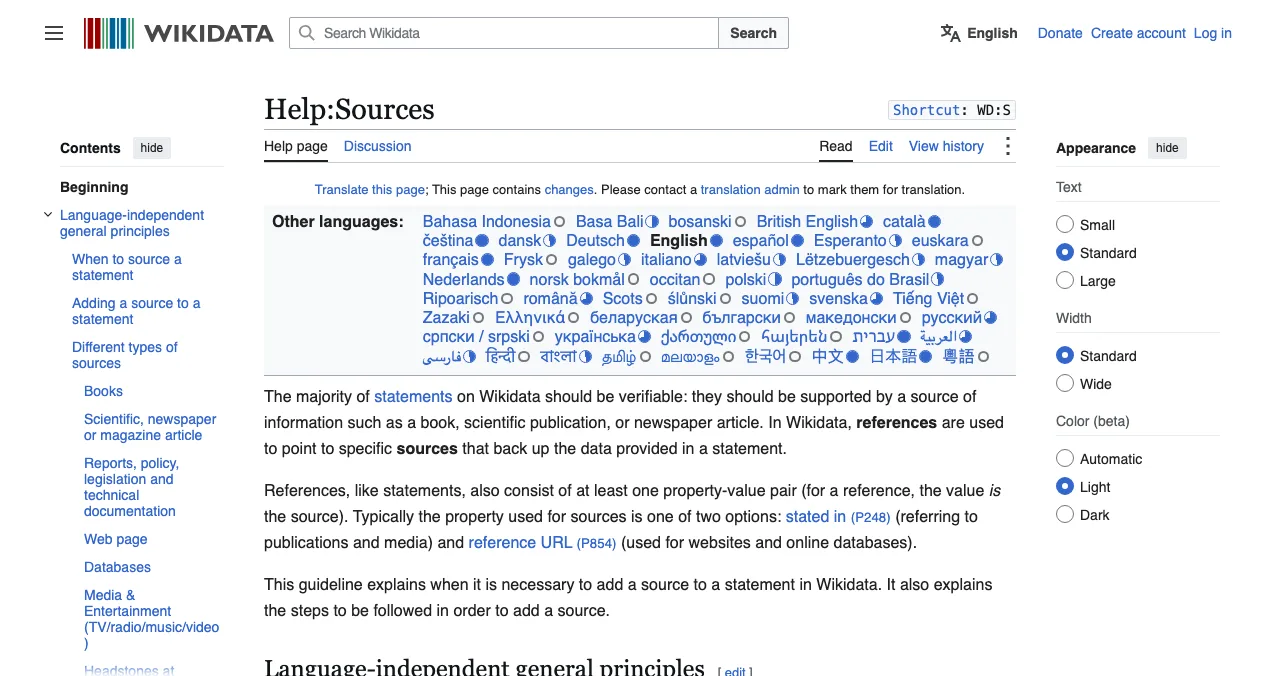
- Reference every statement. Add a reference with reference URL (P854) and retrieved (P813), or stated in (P248) when the source is itself a Wikidata item. Wikidata's help page says Wikipedia is not an acceptable source.
- Add identifiers. Link the official profiles that have Wikidata properties, such as Crunchbase organization ID (P2088) and LinkedIn company or organization ID (P4264).
- Link it from your site. Add the item's URL to the sameAs list in your Organization structured data.
- Leave it alone. Watch the item, correct factual errors with sources, and don't add marketing claims later.
| Property | ID | Example value | Good reference |
|---|---|---|---|
| instance of | P31 | business (Q4830453) | Registry entry or news article |
| official website | P856 | https://yourstartup.com/ | Your own site is acceptable here |
| inception | P571 | 2024 | Registry entry |
| founder | P112 | The founder's item, if notable | News coverage naming the founders |
| headquarters location | P159 | City item | Registry entry |
| country | P17 | Country item | Registry entry |
| industry | P452 | Industry item | Independent coverage |
| Crunchbase organization ID | P2088 | your-startup | The Crunchbase profile |
| LinkedIn company or organization ID | P4264 | your-startup | The LinkedIn page |
Table: Common statements on a Wikidata company item (property IDs checked on Wikidata, 18 Nov 2026; example values illustrative)
Look at how similar companies in your country and industry are modelled before you choose values; follow the existing pattern rather than inventing one.
What if your startup doesn't qualify yet?
Most pre-seed and seed startups don't, and nothing is lost by waiting. Do the work that makes the item legitimate later and helps search engines connect your entity now:

- Consistent name everywhere — the same company name, description and logo on your site and every profile
- Organization structured data — name, logo, url and sameAs links to your official profiles (entity SEO)
- Official profiles you control — LinkedIn, Crunchbase, a permanent Launchpad profile, your app store pages
- A registered company — registry entries are among the best references later
- Independent coverage — earned press, podcasts and roundups that describe what you do (startup press release)
- A dated "about" page — founding year, founders, location; the facts a future editor will need
Where the Launchpad fits
What a Launchpad profile does do is give your product one more consistent, moderated, permanent page with your website and the founder behind it, which you can include in your own sameAs list. It's free to list, forever, in six short steps, checked automatically and reviewed by a person, and ranked by relevance, editorial picks and community interest, never payment. A Verified badge confirms a work email on your domain.
Once live, your product is tested end to end: a free baseline diagnosis of your landing page, discoverability and speed, and a full investigation on request.
- Areas of your product examined
- 22
- Automatic measurements, desktop and mobile
- 39
- Expert heuristics on the screens behind the login
- 74
- Verdicts, from Good to Critical
- 5
Make the product worth writing about
List free, then order the report that fits your stage.

 Economy
See what new customers see
- Store listing and homepage, screen by screen
- Scorecard against 60 Laws of UX
- The fixes worth most
PremiumThe full diagnosis and the plan
- Every screen, every finding, every flow
- All 60 laws with evidence and fixes
- 8 strategy chapters and a 90-day roadmap
Fact-checked against the evidence. Private by default. Never affects ranking.
Mistakes that get startup items deleted

- Creating the item before independent sources exist — fails the notability test
- Citing only your own website — confirms facts, not notability
- Citing Wikipedia — Wikidata's help page says it isn't an acceptable source
- Marketing language in the description — "leading", "innovative", "best-in-class"
- Creating items for every product, founder and investor — each needs its own notability
- Hiding the connection — disclose it on your user page
- Duplicating an existing item — search first; duplicates are merged
Ready to launch?
How we know
The notability criteria come from Wikidata:Notability; deletion rules from Wikidata:Deletion policy and Requests for deletions; referencing rules from Help:Sources and the proposed Verifiability guideline; item basics from Help:Items. Property IDs were checked through Wikidata's own API. Wikipedia's company notability and conflict-of-interest rules come from its guidelines. Google's position on markup and mentions comes from its generative AI optimisation guide. All were read on 18 November 2026. Example values are illustrative. Science of Apps runs the Launchpad.
Key terms, defined
- Wikidata: a free, collaborative knowledge base of structured data run by the Wikimedia community.
- Item: a Wikidata entry for one thing, with a permanent ID beginning with Q.
- Property: a type of statement, with an ID beginning with P, such as inception (P571).
- Notability (Wikidata): meeting at least one of three criteria: a sitelink, an identifiable entity with serious public references, or a structural need.
- Knowledge graph: a network of entities and the relationships between them, used by search engines and AI systems.
- sameAs: a structured-data property listing other URLs that describe the same entity.
Frequently asked questions
Can a startup be added to Wikidata?
Yes, if it meets Wikidata's notability policy. The usual route for a company is the second criterion: a clearly identifiable entity that can be described using serious and publicly available references. For a startup, that means independent sources such as news articles or official business registries. A company with only its own website and directory listings usually isn't ready, and the item may be deleted.
What sources does a Wikidata company entry need?
Wikidata's help page on sources says statements should be backed by reliable sources such as newspapers, books and journals, and that Wikipedia itself is not an acceptable source. Use independent news coverage and official registries where you can. Your own website can support basic facts like the official URL, but it can't establish that the company is notable on its own.
Will my Wikidata item be deleted?
It might be. Wikidata's deletion policy lets administrators delete items that don't meet the notability requirements, and anyone can nominate an item at Requests for deletions; the community decides. Items written like adverts, with no independent references, are the most likely to go. If you're unsure, Wikidata's notability page suggests asking at Requests for new items first.
Why does Wikidata matter for SEO and AI search?
Wikidata is a large, open, structured knowledge base that many systems read. A well-sourced item gives your company a stable identifier and connects it to your website, founders and official profiles, which helps machines tell you apart from similarly named things. It is not a ranking shortcut, and Google says no special markup is needed to appear in its AI features.
Is Wikidata the same as Wikipedia for startups?
No. Wikidata stores structured facts and has its own notability policy; Wikipedia publishes articles and has a stricter bar. Wikipedia's guideline for companies needs significant coverage in multiple reliable, independent, secondary sources, and it excludes press releases, routine funding news and inclusion in best-of lists or directories. Many companies have a Wikidata item but no Wikipedia article.
Can I create a Wikidata item for my own company?
Wikidata is open for anyone to edit, but writing about your own company is a conflict of interest. Wikipedia's guideline asks people with a conflict of interest to disclose it and propose changes rather than edit directly. On Wikidata, disclose your connection on your user page, keep statements strictly factual and sourced, and accept the community's decision.
What should a startup do before it qualifies?
Build the record that would make it qualify: register the company, earn independent coverage, and keep your official profiles consistent (website, LinkedIn, Crunchbase, a permanent directory profile). Add Organization structured data with sameAs links on your site. When independent sources exist, revisit Wikidata.
Sources
- Wikidata — Wikidata:Notability (checked 18 Nov 2026)
- Wikidata — Wikidata:Deletion policy (checked 18 Nov 2026)
- Wikidata — Help:Sources (checked 18 Nov 2026)
- Wikidata — Help:Items (checked 18 Nov 2026)
- Wikidata — Wikidata:Requests for deletions (checked 18 Nov 2026)
- Wikidata — Wikidata:Verifiability, proposed guideline (checked 18 Nov 2026)
- Wikipedia — Notability (organizations and companies) (checked 18 Nov 2026)
- Wikipedia — Conflict of interest (checked 18 Nov 2026)
- Google Search Central — Optimizing your website for generative AI features (checked 18 Nov 2026)
- Checked November 18, 2026. Figures that change — fees, salaries, prices — are reviewed every six months; if something is out of date, tell us.
Where to go from here
- Entity SEO for startups — how Google understands your brand
- Get listed on Crunchbase — an identifier Wikidata links to
- Get recommended by ChatGPT — the AI-search side
- Science of Apps - LaunchpadHow to get your startup listed on Crunchbase: register, authenticate, create the profile and make it completeHow to add your company to Crunchbase in 2027: register free, connect a social account, create the profile, verify you work there and fill in every field.
- Science of Apps - LaunchpadFounder personal branding that gets a startup found: how a founder's brand on LinkedIn and beyond builds trust, how to link the founder and product as entities search engines can connect, and a 60-day playbookFounder personal branding that gets a startup found: build a founder brand on LinkedIn, link founder and product as connected entities, and a 60-day playbook.
- Science of Apps - LaunchpadHow to start a startup in 2027: nine steps from a real problem to paying customers, including how to create a startup company, build an MVP, launch, diagnose and fund itHow to start a startup in 2027, step by step: find a real problem, talk to users, build an MVP, register the company, launch, diagnose and fund it.
- Science of Apps - LaunchpadAnswer engine optimization for startups: how to become the answer in Google's featured snippets, People Also Ask and AI assistantsA practical AEO guide for startups in 2027: how to become the direct answer in featured snippets, People Also Ask and AI assistants, step by step.
- Science of Apps - LaunchpadHow to get your startup on Google as a brand: entity SEO with Organization and WebSite structured data, sameAs profiles and consistent facts everywhereHow to get your startup on Google as a brand: Organization and WebSite markup, sameAs profiles, one consistent name and facts, and how knowledge panels form.
- Science of Apps - LaunchpadHow to start an AI startup in 2027: pick a problem AI solves better, choose models and data, build trust in outputs, check the rules, then launch on the Launchpad and AI directoriesHow to start an AI startup in 2027: choose a problem AI solves better, pick models and data, earn trust in outputs, check the EU AI Act, then launch.
Get the ideas, not the noise.
Sign up with Google and we’ll send you short UX psychology tips by email — why people tap, stall and leave, and what to do about it. Unsubscribe anytime. Prefer something to keep? Get the free Laws of UX guide as a PDF.
Launch day ends. Your listing shouldn't.
A free, permanent Launchpad profile is one of the consistent official profiles your entity links to, and your product is tested end to end with a detailed report.