 By
Quick answer: Should I launch on AppSumo?
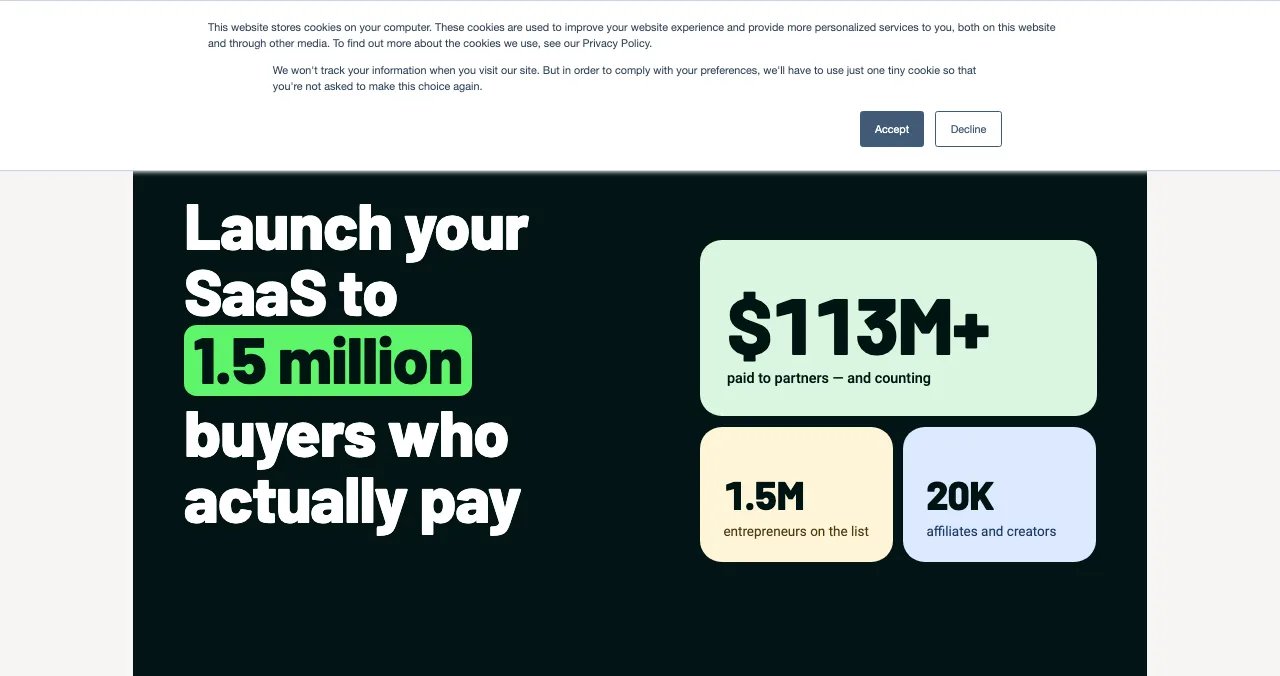
- Reach: 1.5M+ buyers on AppSumo's list (its figure).
- Split: 95% of sales from your buyers, 70% from AppSumo's.
- Entry: about 10% of applicants accepted; no upfront fees.
- Payout: 60 days after each month ends.
- Cost: lifetime customers to support for years.
Key takeaways
- AppSumo is a sales channel with a marketing team attached.
- Lifetime deals trade future revenue for cash and users now.
- Support and server costs continue after the money stops.
- Cap the deal's limits so heavy users don't sink you.
- Launch when the product is stable and onboarding is self-serve.
An AppSumo launch is the closest thing in SaaS to a guaranteed sales spike. A big email list, paid ads and thousands of affiliates point at your product for a few weeks, and buyers pay up front. The price is the deal itself: AppSumo deals are often lifetime deals, so those buyers never pay again, and you support them for as long as the product exists. Whether that trade is good depends on your margins, your support load and what you need right now. This analysis uses AppSumo's own seller terms as read on 17 November 2026. Jump to how it works, the economics or who it suits.
- Buyers on AppSumo's list (its figure)
- 1.5M+
- Applicants accepted
- ~10%
- Your share: buyers you bring / buyers AppSumo brings
- 95% / 70%
- Payout after each month ends
- 60 days
How an AppSumo launch works

- Apply — AppSumo reviews product quality, fit and whether you'll be around in a year; about 10% get in.
- Prepare — you agree the price, deal terms and listing with AppSumo.
- Launch — the deal goes live to its 1.5M+ list with email, ads and affiliates.
- Get paid — 95% of sales from buyers you bring, 70% from buyers AppSumo brings, paid 60 days after each month ends.
AppSumo says it accepts SaaS with real users and a roadmap, AI tools, apps built with tools like Lovable, Bolt, Cursor or Replit "if it works and you'll support it", and templates and courses. It reports $113M+ paid to partners, says about 40% of partner revenue comes from email, runs Google and Meta ads for top performers up to $25K in spend, and works with 20K affiliates and creators. Buyers leave public reviews; it warns sellers to expect blunt feedback.
The economics of a lifetime deal
A lifetime deal turns future subscription revenue into one payment now. That's useful when cash matters more than recurring revenue, and dangerous when serving each user costs real money every month.
| Line | Example (illustrative) |
|---|---|
| Deal price | $59 one-time |
| Your share, AppSumo-brought buyer (70%) | $41.30 |
| Your share, your own buyer (95%) | $56.05 |
| Monthly cost to serve one user (hosting, AI, support) | $1.50 |
| Months until a 70% sale is "used up" | About 27–28 |

Table: Lifetime deal economics, an illustrative example (split from AppSumo's seller page, checked 17 Nov 2026; price and costs are hypothetical)
Run your own numbers before you apply. AI-heavy products with real per-request costs need tight usage limits in the deal, or the deal becomes a loss.
Pros and cons

What you gain
- Cash up front, without raising
- Hundreds or thousands of real users fast
- AppSumo's email, ads and affiliates
- Public reviews and feature requests
What it costs
- Buyers never pay again
- Support load from a big, demanding cohort
- 30% of sales from AppSumo-brought buyers
- Feature requests that pull you off your roadmap
Who AppSumo suits
Before you apply

- Stable product — no major bugs you'll fix "after launch"
- Self-serve onboarding — thousands of users can't each get a call (SaaS onboarding audit)
- Usage limits — caps on seats, credits or volume in the deal
- Support plan — docs, a help centre, response times you can keep
- Your numbers — cost to serve a user for three years
- Upgrade path — a paid plan lifetime users can move to
Mistakes

- Unlimited usage in the deal — heavy users cost you forever
- Launching to fix cash flow with no support plan
- Promising roadmap features to close sales
- Ignoring reviews — they're public and stay up
Ready to test demand first?
How we know
Acceptance rate, revenue split, payout timing, marketing and partner figures come from AppSumo's seller page, read on 17 November 2026; they are AppSumo's own claims. The economics table is an illustrative example with hypothetical price and costs, not AppSumo data.
Key terms, defined
- Lifetime deal (LTD): a one-time payment for ongoing software access.
- Revenue share: the split of each sale between you and AppSumo.
- Affiliate: a creator or publisher paid for sales they refer.
- Cost to serve: what each user costs you per month to support and host.
- Plan limits: caps on usage included in a deal.
Frequently asked questions
Should I launch on AppSumo?
Launch if you need cash and users quickly, your product is stable and self-serve, and your costs per user are low enough to support lifetime customers. Don't if your main goal is recurring revenue from the same buyers, or if support would overwhelm a small team.
How much does AppSumo take?
AppSumo's seller page says you keep 95% of sales from buyers you bring and 70% from buyers AppSumo brings, with no upfront fees, paid 60 days after each month ends, as checked on 17 November 2026.
How do I get accepted on AppSumo?
Apply at sell.appsumo.com. AppSumo says it reviews product quality, fit and whether you'll be around in a year, and accepts about 10% of applicants. It accepts SaaS, AI tools, apps built with AI coding tools if they work and you'll support them, and templates and courses.
What is a lifetime deal?
A one-time payment for ongoing access to software, usually with plan limits. It's popular with buyers and brings cash up front, but the seller carries the cost of serving those users indefinitely.
What marketing does AppSumo do?
It says it emails its 1.5M+ list (about 40% of partner revenue comes from email), runs Google and Meta ads for top performers up to $25K in spend, and works with 20K affiliates and creators.
Are AppSumo reviews public?
Yes. AppSumo says buyers leave public reviews and feature requests, and warns sellers to expect blunt feedback.
Sources
- AppSumo — Sell on AppSumo (checked 17 Nov 2026)
- Science of Apps — Launchpad: launch your product free
- Product Hunt
- Checked November 17, 2026. Figures that change — fees, salaries, prices — are reviewed every six months; if something is out of date, tell us.
Where to go from here
- Product Hunt alternatives — other launch channels
- Places to launch a startup — free options first
- How to launch a SaaS — the full plan
- Science of Apps - LaunchpadHow to market a SaaS in 2027: positioning, being found by buyers, content that gets cited, launches and a product that convertsHow to market a SaaS in 2027: sharp positioning, alternatives directories, search and AI visibility, launches, founder-led sales and a trial that converts.
- Science of Apps - LaunchpadHow to promote your startup for free in 2027: 30 tactics across launches, listings, content, communities and partners30 free ways to promote a startup in 2027: launch sites, listings, search and AI visibility, content, communities, partners and your own users.
- Science of Apps - LaunchpadHow to get backlinks for a new startup for free, and which link tactics Google treats as spamHow a new startup can earn backlinks for free in 2027: launch sites, reviewed directories, data, free tools, partners and press, plus the link tactics to avoid.
- Science of Apps - LaunchpadDevHunt review: how the weekly developer-tool launches work, what's free, what the $49 launch and super boosts buy, and who it suitsA 2027 DevHunt review: free nofollow listings, the $49 weekly launch with a dofollow link, super boosts, developer voting and who it suits.
- Science of Apps - LaunchpadThe top websites to launch your startup, picked by what you built: SaaS, AI, mobile, dev tool or open sourceThe top websites to launch your startup in 2027, by product type: the three best launch sites for SaaS, AI, mobile apps, dev tools and open source.
- Science of Apps - LaunchpadHow to get your first SaaS customers: from design partners to paid plans, without a sales teamHow to get your first paying SaaS customers in 2027: design partners, founder-led sales, communities, launch sites, directories and a trial that works.

Get the ideas, not the noise.
Sign up with Google and we’ll send you short UX psychology tips by email — why people tap, stall and leave, and what to do about it. Unsubscribe anytime. Prefer something to keep? Get the free Laws of UX guide as a PDF.
Launch day ends. Your listing shouldn't.
Before giving away lifetime access, a free, permanent Launchpad listing gets you found by the problem you solve and a free report on your landing page, discoverability and speed.