 By
Quick answer: How are startups rated?
- Data-platform scores: CB Insights Mosaic (0–1,000), Crunchbase Growth and Heat (0–100).
- Investor scorecards: team, market, product, traction, risk.
- Product ratings: score the product itself with evidence.
- You can't edit Crunchbase's AI-generated scores; you can improve the inputs.
- Free product rating: list on the Science of Apps Launchpad.
Key takeaways
- Most public startup ratings measure signals around a company, not the product.
- Mosaic and Crunchbase scores are proprietary models; treat them as indicators.
- Investor scorecards are judgement, structured; they reward evidence.
- A product rating answers the question users care about: does it work for me?
- Improve ratings by improving the underlying evidence, not by chasing the score.
Somewhere, your startup already has a rating. A data platform may have scored it from your funding news and web traffic; an investor may have run it through a scorecard after your pitch. Neither one has necessarily signed up for your product. This explainer covers the three ways startups are rated, what each score means and misses, and how to get the one that rates the product itself. Facts come from CB Insights' and Crunchbase's own pages, checked on 18 November 2026. Jump to the comparison, Mosaic, Crunchbase or a product rating.
Three ways startups get rated
 Get rated free
Science of Apps product rating Rates the product
Tests the live product with evidence; you choose to show a score band.
Free to listEvidence-backed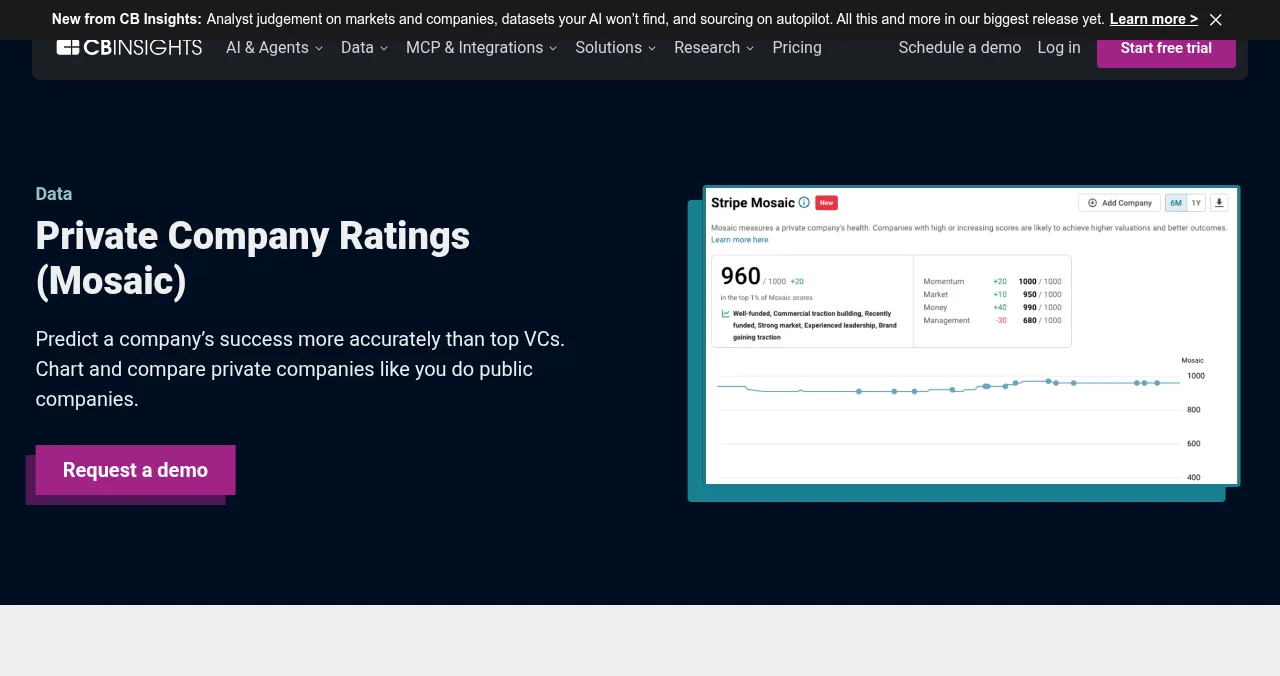
CB Insights Mosaic
0–1,000 health score from momentum, market, money and management.
Paid platformPrivate tech companies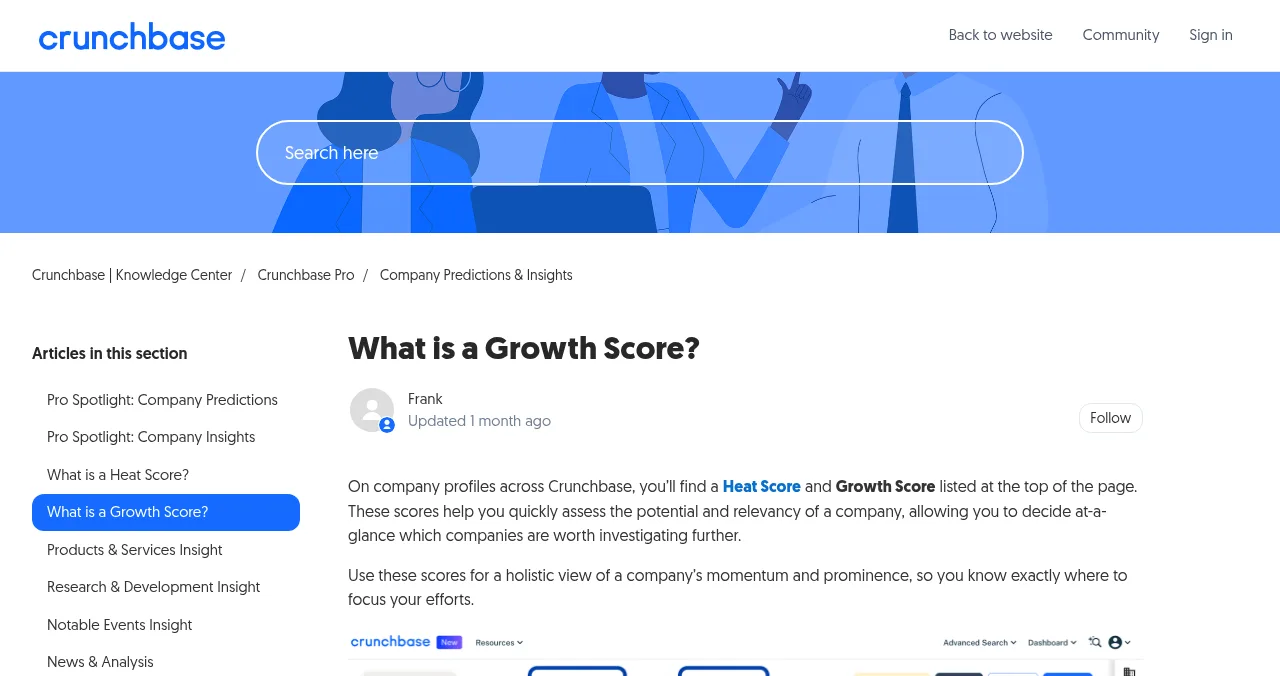
Crunchbase Growth and Heat
0–100 scores from funding, headcount, growth and attention.
On every profileAI-generated
Startup ratings compared
| Rating | Who makes it | Scale | What it measures | Can you influence it? |
|---|---|---|---|---|
| CB Insights Mosaic | CB Insights | 0–1,000 | Momentum, market, money, management | Indirectly: news, traffic, funding, team |
| Crunchbase Growth Score | Crunchbase | 0–100 | Growth from funding, operations, headcount, customers and more | Indirectly; scores can't be edited |
| Crunchbase Heat Score | Crunchbase | Shown on profiles | Momentum and prominence | Indirectly |
| Investor scorecard | Each investor | Varies | Team, market, product, traction, risk | Directly: better evidence |
| Product rating | Science of Apps Launchpad | Score bands, five verdicts | The product, area by area, with evidence | Directly: fix the findings |
Table: How startups get rated (CB Insights, Crunchbase and Science of Apps pages, checked 18 Nov 2026)
CB Insights Mosaic: a 0–1,000 health score
- Scale
- 0–1,000
- Factors
- Momentum, market, money, management
- "High potential"
- 510 or higher
- Covers
- Private tech companies with enough public data
CB Insights describes Mosaic as a measure of the health and growth potential of private companies using non-traditional signals:
- Momentum: performance relative to itself and peers, from social media, news sentiment, mobile and web traffic.
- Money: financial strength from financing history, burn rate and investor quality.
- Market: the health of the industry, from funding, deals, sentiment and exits.
- Management: the team's prior accomplishments and likelihood of a successful outcome.
Each factor is scored 0–1,000 and combined into a weighted overall score; CB Insights defines high-potential companies as 510 or higher. Only private tech companies with enough public information get a score.
Crunchbase Growth and Heat scores
- Growth Score
- 0–100
- Based on
- Funding, headcount, customers, more
- Generated by
- AI models and proprietary data
- Editable
- No
Crunchbase shows a Heat Score and a Growth Score at the top of company profiles. The Growth Score, from 0–100, quantifies a private company's growth using predictions and historical data, including funding, operations, headcount, market share, financials, customer growth, product usage, M&A and investment changes. Crunchbase says both scores come from AI models and proprietary data and can't be edited. You can influence them only by improving the underlying public record; see how to get listed on Crunchbase.
Investor scorecards
Investors rate startups with structured judgement. Most scorecards cover the same areas: team, problem, market, product, traction and risk, weighted by stage. The Berkus Method, for example, assigns up to $500,000 of pre-revenue value to each of five risk-reducing elements. Our 30-point evaluation framework shows how to run one on your own startup.
A product rating: scoring the product itself
None of the ratings above signs up for your product. A product rating does. When you list free on the Science of Apps Launchpad, a baseline check of your landing page, discoverability and speed runs as you go live. A full investigation rates 22 areas with 39 automatic measurements and 74 expert checks, and every finding gets one of five verdicts.
- Areas rated
- 22
- Automatic measurements
- 39
- Expert checks
- 74
- Verdicts: Good to Critical
- 5
Your report is private. The pricing page says you can choose to publish a Science of Apps card that shows your score band and verified strengths, never your weaknesses, a rating you can put on your site and in your data room.
A rating backed by evidence
List free. Then order the report that fits your stage.

 Economy
See what new customers see
- Store listing and homepage, screen by screen
- Scorecard against 60 Laws of UX
- The fixes worth most
PremiumThe full diagnosis and the plan
- Every screen, every finding, every flow
- All 60 laws with evidence and fixes
- 8 strategy chapters and a 90-day roadmap
Fact-checked against the evidence. Private by default.
How to improve your startup's rating

- Fix the public record — accurate Crunchbase profile, announced funding, team pages.
- Create real momentum — launches, press, hiring and traffic feed outside scores.
- Build evidence for investors — cohort retention, revenue and a written risk list.
- Get the product rated — list on the Launchpad and fix critical findings first.
- Show the rating — publish your score band and badges where buyers and investors look.
Mistakes

- Treating an outside score as a verdict — it's a model of public signals
- Trying to edit Crunchbase's scores — you can't; improve the inputs
- Chasing hype for momentum — it fades; retention doesn't
- Showing a rating without evidence — buyers trust what they can check
Ratings work as social proof and as an anchor: the first number someone sees shapes how they judge the rest.
Ready to get rated?
How we know
Mosaic's scale, factors and 510 threshold come from CB Insights' Mosaic page; the Growth Score's definition, range and the note that scores can't be edited come from Crunchbase's Knowledge Center; both read on 18 November 2026. The score card and report details come from the Science of Apps Launchpad pricing and investigation pages, read the same day. Science of Apps runs the Launchpad.
Key terms, defined
- Startup rating: a score or grade summarising a startup's health, growth or quality.
- Mosaic score: CB Insights' 0–1,000 health score for private tech companies.
- Growth Score: Crunchbase's 0–100 measure of a private company's growth.
- Scorecard: an investor's structured list of criteria and weights.
- Product rating: a score of the product itself, based on testing it with evidence.
Frequently asked questions
How are startups rated?
By data platforms using outside signals (CB Insights' Mosaic, Crunchbase's Growth and Heat scores), by investors using scorecards of team, market, product and traction, and by product evaluations that test the product itself. Each answers a different question, so a startup can score well on one and poorly on another.
What is the CB Insights Mosaic score?
An algorithmic health score for private tech companies on a 0–1,000 scale. CB Insights says it combines four factors (momentum, market, money and management), each scored 0–1,000 and weighted into an overall score, and that it treats 510 or higher as high-potential.
What are Crunchbase's Growth and Heat scores?
Scores shown at the top of Crunchbase company profiles. The Growth Score, from 0–100, quantifies a private company's growth using predictions and historical data such as funding, headcount and customer growth. Crunchbase says the scores are generated by AI models and can't be edited.
Can I get my startup rated for free?
Yes, in a few ways. Your Crunchbase profile is free to create, though its scores are Crunchbase's. For the product, list free on the Science of Apps Launchpad: a baseline check runs when you go live, and you can choose to publish a card showing your score band and verified strengths.
How do I improve my startup's rating?
Improve what the rating measures. For data platforms: accurate profiles, announced funding, hiring and news. For investors: retention, revenue and a strong team story. For product ratings: fix onboarding, the core flow, speed and accessibility findings.
Are startup ratings reliable?
As indicators, yes; as verdicts, no. Data-platform scores depend on public signals, so quiet, profitable startups can score low. Investor scorecards are structured judgement. Product ratings are most reliable when every finding is backed by evidence you can check.
Sources
- CB Insights — Private company ratings (Mosaic) (checked 18 Nov 2026)
- Crunchbase Knowledge Center — What is a Growth Score? (checked 18 Nov 2026)
- Crunchbase Knowledge Center — What is a Heat Score?
- Dave Berkus — The Berkus Method (checked 18 Nov 2026)
- Science of Apps — Pricing: reports and score card (checked 18 Nov 2026)
- Science of Apps — Product investigation (checked 18 Nov 2026)
- Checked November 18, 2026. Figures that change — fees, salaries, prices — are reviewed every six months; if something is out of date, tell us.
Where to go from here
- How to evaluate a startup — the 30-point framework
- CB Insights vs Crunchbase — the data platforms
- Get listed on Crunchbase — the profile behind the score
- Science of Apps - LaunchpadHow to evaluate a startup: a 30-point startup evaluation framework covering problem, product, market, traction, team, UX and risk, with how investors weigh each part and how to get your own product evaluated freeA 30-point startup evaluation framework: problem, product, market, traction, team, UX and risk, how investors weigh them, and how to evaluate your own startup.
- Science of Apps - LaunchpadScorecard method valuation step by step: Bill Payne's seven weighted factors, how to set the baseline, his worked example, a second illustrative example and how to raise your product scoreScorecard method valuation: start from the median pre-money of comparable funded startups, then weight seven factors. Bill Payne's steps and examples.
- Science of Apps - LaunchpadCB Insights vs Crunchbase compared for founders, investors and corporate teams: what each covers, how pricing works (self-serve vs request a quote) and which one a startup needsCB Insights vs Crunchbase: enterprise intelligence priced on request vs self-serve company data with a free account. Which fits founders, investors and teams.
- Science of Apps - LaunchpadWellfound alternatives for founders: where else to hire, and where else to be seen, with what Wellfound itself now costs and what happened to AngelList TalentWellfound alternatives for founders: Work at a Startup, Cutshort and Peerlist for hiring, Crunchbase and Tracxn for investors, plus Wellfound's own free plan.
- Science of Apps - LaunchpadWhat is indie hacking? What the term means, where it came from, how indie hackers pick ideas, build, launch and grow without investors, and where they launch their productsIndie hacking means building a profitable internet business on your own terms, funded by customers, not VCs. What it means, how indie hackers launch and grow.
- Science of Apps - LaunchpadHow to find angel investors for free: angel networks and platforms in India (IAN Group, LVX), free databases (Crunchbase, Gust, F6S), warm introductions and an outreach planHow to find angel investors free: angel networks like IAN Group and LVX, free databases like Crunchbase and Gust, and warm intros that get replies.




Get the ideas, not the noise.
Sign up with Google and we’ll send you short UX psychology tips by email — why people tap, stall and leave, and what to do about it. Unsubscribe anytime. Prefer something to keep? Get the free Laws of UX guide as a PDF.
Launch day ends. Your listing shouldn't.
Data platforms rate startups from the outside. The Science of Apps Launchpad rates the product itself: list free, get tested with evidence, and choose to show a verified score band.