CSSP Certifications Practice Test
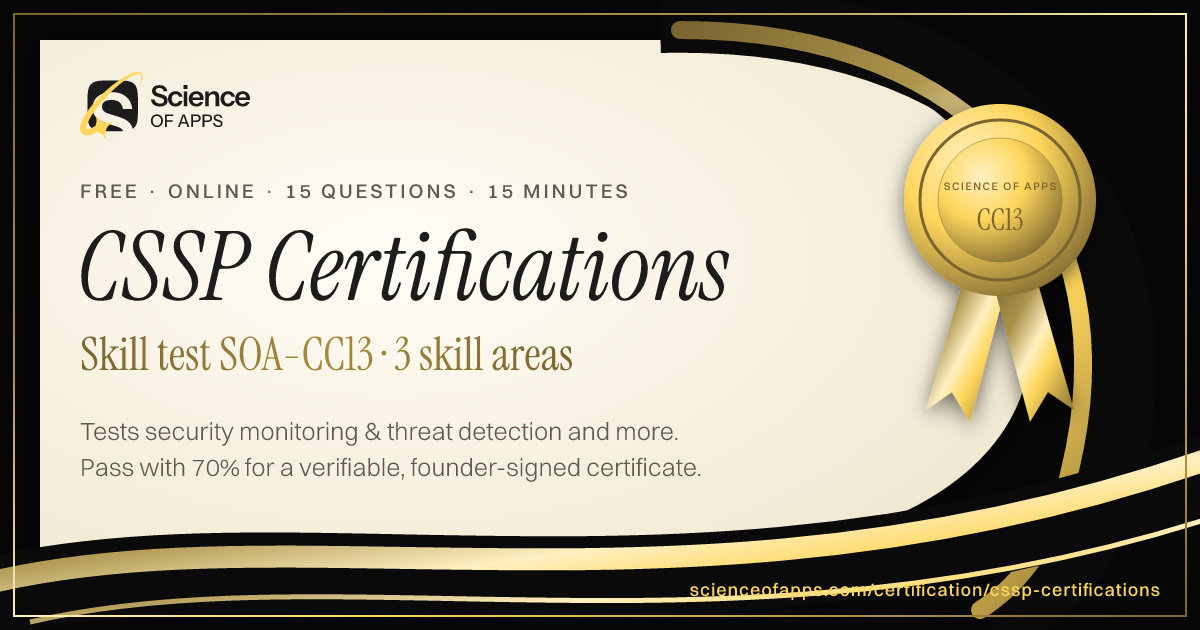
Practice test on cybersecurity service provider (CSSP-style) knowledge in three areas — security monitoring and threat detection (SIEM, IDS/IPS, ATT&CK), incident response and forensics (containment, chain of custody, ransomware) and vulnerability and risk management (CVSS, KEV, NIST controls). Not an official certification or exam. Pass to earn CSSP Certifications SOA-CC13.
- Intermediate difficulty.Assumes hands-on experience in the role.
- 15 scenario questions
- 15 minutes, timed
- 70% to pass · 90% for distinction
- Free no sign-up needed
- LinkedIn-ready · add it to your profile in one clickSee how ↓

 Founder, Science of Apps
What is the CSSP Certifications Practice Test?
- Career Booster
- Quality Assured
- Exclusive Certification
Updated for 2026 and 2027. Covers security monitoring & threat detection, incident response & forensics and vulnerability & risk management.
The CSSP Certifications Practice Test is a free 15-minute skill test from Science of Apps. Practice test on cybersecurity service provider (CSSP-style) knowledge in three areas — security monitoring and threat detection (SIEM, IDS/IPS, ATT&CK), incident response and forensics (containment, chain of custody, ransomware) and vulnerability and risk management (CVSS, KEV, NIST controls). Not an official certification or exam. Score 70% or more on its 15 questions to earn a verifiable CSSP Certifications certificate (SOA-CC13). Every question is based on published standards and research — including SP 800-137: Information Security Continuous Monitoring (NIST), SP 800-61 Rev. 3: Incident Response Recommendations and Considerations for Cybersecurity Risk Management (NIST), SP 800-86: Integrating forensic techniques into incident response (NIST) — and each answer is explained with its source.
Built for your job title
SOC analyst, Incident responder, Cybersecurity student, Vulnerability analyst and IT security administrator — and anyone who wants quick, verifiable proof of cybersecurity service provider knowledge for a CV or LinkedIn.
- SOC analyst
- Incident responder
- Cybersecurity student
- Vulnerability analyst
- IT security administrator
What the test covers
Three skill areas with 5 questions each, drawn from a bank of 10 per area, so a retake brings questions you haven't seen.
Security monitoring & threat detection
33%- SIEM, logs & alert triage
- IDS/IPS & network monitoring
- Threat frameworks & indicators
Incident response & forensics
33%- IR lifecycle & containment
- Evidence handling & chain of custody
- Ransomware & reporting
Vulnerability & risk management
33%- Scanning, CVSS & patching priority
- Security controls & frameworks
- DoD cyber workforce context
Independent skills test by Science of Apps. Credential and organisation names are trademarks of their owners and are used only to describe the knowledge tested. Passing earns a Science of Apps certificate, not an official or regulated credential.
Based on published standards
The questions are original scenarios, and each one names the public standard, official guide or research it draws on — shown under the question while you answer, and linked in your review. These are the sources behind this test:
- SP 800-137: Information Security Continuous MonitoringNIST4 questions
- SP 800-61 Rev. 3: Incident Response Recommendations and Considerations for Cybersecurity Risk ManagementNIST4 questions
- SP 800-86: Integrating forensic techniques into incident responseNIST4 questions
- MITRE ATT&CKMITRE3 questions
- SP 800-53 Rev. 5: Security and Privacy ControlsNIST3 questions
- #StopRansomware GuideCISA3 questions
- Known Exploited Vulnerabilities CatalogCISA2 questions
- Recognize and report phishingCISA1 question
- Common Vulnerability Scoring SystemFIRST1 question
- SP 800-115: Technical guide to information security testingNIST1 question
- SP 800-207: Zero Trust ArchitectureNIST1 question
- SP 800-37 Rev. 2: Risk Management FrameworkNIST1 question
- DoD Cyber Exchange: Cyber Workforce FrameworkUS Department of Defense CIO1 question
- NIST Cybersecurity Framework 2.0NIST1 question
Try a sample question
In a security operations center, what is the main purpose of a SIEM?
- Collect and correlate log data from many sources to surface security events
- Replace every firewall in the network
- Store backups of user files
- Provision virtual machines
Show the answer
A. Collect and correlate log data from many sources to surface security events — A SIEM aggregates and correlates logs so analysts can detect and investigate suspicious activity. The real test has 15 questions like this.
How the test works
15 minutes, 15 questions
One question per screen, with a progress bar and a countdown. Your progress is saved on this device if you need to pause.
Graded on our server
Answers reach the page only after you submit, so the certificate can only be earned by passing.
Every answer explained
Pass or not, you see every question with the right answer, why, and the source behind it. Pass mark 70%, distinction 90%.
Your certificate
Founder-signed, with a QR code and credential ID. Download PDF or PNG, add to LinkedIn, and it's emailed to you.
What you earn
Pass, then add it to LinkedIn in one click
No typing. The Add to LinkedIn Certifications button opens your profile’s Licenses & certifications form already filled in: the certificate name, Science of Apps as the issuer, the issue date, your credential ID and a link recruiters can use to verify it.
- 1Take the 15-minute test
- 2Score 70% or more
- 3Click Add to LinkedIn Certifications

CSSP Certifications
Science of Apps
Show credential ↗Try another skill test
- 10 minSOA-CYF
Cybersecurity Certification Test (Fundamentals)
Tests core cybersecurity — the CIA triad, common threats, NIST CSF 2.0, authentication and MFA, patching, backups, encryption basics and security culture.
Difficulty: BeginnerTake the 10-minute test → - 10 minSOA-SAPD
Security Awareness Certification Test (Phishing Detection)
Tests everyday security awareness — spotting phishing emails, texts and calls, suspicious links and attachments, safe reporting, passwords, MFA fatigue and deepfake scams.
Difficulty: BeginnerTake the 10-minute test → - 15 minSOA-NSF
Network Security Certification Test (Fundamentals)
Tests network security — firewalls and segmentation, VPNs and zero trust, TLS, DNS security, common ports, IDS/IPS, Wi-Fi security and DDoS basics.
Difficulty: IntermediateTake the 15-minute test →
Frequently asked questions
What is the CSSP Certifications Practice Test?
The CSSP Certifications Practice Test is a free 15-minute skill test from Science of Apps. Practice test on cybersecurity service provider (CSSP-style) knowledge in three areas — security monitoring and threat detection (SIEM, IDS/IPS, ATT&CK), incident response and forensics (containment, chain of custody, ransomware) and vulnerability and risk management (CVSS, KEV, NIST controls). Not an official certification or exam. Score 70% or more on its 15 questions to earn a verifiable CSSP Certifications certificate (SOA-CC13). Every question is based on published standards and research — including SP 800-137: Information Security Continuous Monitoring (NIST), SP 800-61 Rev. 3: Incident Response Recommendations and Considerations for Cybersecurity Risk Management (NIST), SP 800-86: Integrating forensic techniques into incident response (NIST) — and each answer is explained with its source.
Is there a free CSSP Certifications certification test for 2026?
Yes. Science of Apps has a free CSSP Certifications Practice Test built on published standards and official documentation for 2026 and 2027. It covers security monitoring & threat detection, incident response & forensics and vulnerability & risk management, scores you instantly and issues a verifiable certificate.
How do I take the CSSP Certifications Practice Test for free?
Read the three skill areas on this page, then take the 15-minute test online — no fee, course or sign-up. You see every answer explained when you finish. Score 70% or more and you get a CSSP Certifications certificate straight away, on screen, as a PDF and by email, with a credential ID anyone can verify.
Are the CSSP Certifications Practice Test questions based on real standards?
Yes. The questions are original scenarios written by Science of Apps, and each one is based on a public source you can read: SP 800-137: Information Security Continuous Monitoring (NIST); SP 800-61 Rev. 3: Incident Response Recommendations and Considerations for Cybersecurity Risk Management (NIST); SP 800-86: Integrating forensic techniques into incident response (NIST); MITRE ATT&CK (MITRE); SP 800-53 Rev. 5: Security and Privacy Controls (NIST); #StopRansomware Guide (CISA). The source is shown under each question and linked in the answer review. Science of Apps doesn't copy questions from other tests.
What does the CSSP Certifications Practice Test cover?
Three skill areas with five questions each, drawn from a bank of 10 per area so a retake brings new questions: Security monitoring & threat detection (SIEM, logs & alert triage, IDS/IPS & network monitoring, Threat frameworks & indicators); Incident response & forensics (IR lifecycle & containment, Evidence handling & chain of custody, Ransomware & reporting); Vulnerability & risk management (Scanning, CVSS & patching priority, Security controls & frameworks, DoD cyber workforce context). Every question is an original scenario based on a published standard, official documentation or research, named under the question.
Who should take the CSSP Certifications Practice Test?
SOC analyst, Incident responder, Cybersecurity student, Vulnerability analyst, IT security administrator. It suits anyone who wants a quick, verifiable way to show CSSP Certifications knowledge, from students and career switchers to experienced professionals.
Can I take the CSSP Certifications Practice Test from any country?
Yes. The test is online, in English and free everywhere — people take it from India, the US, the UK, Europe, Africa, Latin America and Asia-Pacific. Your certificate is dated with your own local date and can be verified from anywhere at scienceofapps.com/certification/verify/.
How long is the CSSP Certifications Practice Test?
15 questions — 5 from each of 3 skill areas — with a 15-minute limit. You need 70% (11 of 15) to pass and 90% for distinction.
How hard is the CSSP Certifications Practice Test?
We rate it Intermediate: assumes hands-on experience in the role. It has 15 scenario questions — 5 from each of 3 skill areas — and a 15-minute limit. You need 70% (11 of 15) to pass and 90% for distinction.
How much do Science of Apps certifications cost?
Nothing. There is no fee to take a test, to receive the certificate, to have it emailed or to verify it, and no sign-up.
How are the tests graded?
On our server, not in your browser. The answers never reach the page until you submit, so a certificate can only be earned by passing. Each certificate gets a unique credential ID stored by Science of Apps.
What happens if I don't pass?
You see your score for each area and every question with the correct answer and why, with the published source behind it. You can retake after 30 minutes, and the retake draws questions you haven't seen yet.
Do the certificates expire?
No. Every certificate is dated, so it always shows when you passed. Retake a test any time for a newer date or a higher score.
Can I add the certificate to LinkedIn?
Yes. After you pass, Add to LinkedIn opens the Licenses & certifications form with the certificate name, Science of Apps as the issuer, the issue date, your credential ID and the verification link filled in. You can also download it as a PDF or PNG, and it's emailed to you as a PDF.
How can an employer verify my certificate?
Every certificate has a credential ID and a QR code. Scanning it, or entering the ID at scienceofapps.com/certification/verify/, shows the holder's name, the certification, the score and the issue date from our records.
Are these accredited qualifications?
No. They are Science of Apps' own assessments of applied skill. They aren't issued by a university or standards body, and they work best alongside a portfolio that shows the skills in real work.
2734 more certifications to collect
Cybersecurity, IT, Cloud & DevOps
- Redhat Certification Practice Test15 min · Intermediate
- Testout Network Pro Certification Practice Test15 min · Intermediate
- CCE Exam Practice Test15 min · Intermediate
- Cloud Based Certifications Practice Test15 min · Intermediate
- AZ104 Certification Practice Test15 min · Intermediate
- Certificate in Investment Performance Measurement Cipm Certification Practice Test15 min · Intermediate
- SEC Plus Certification Practice Test15 min · Intermediate
- GIAC Global Information Assurance Certification Practice Test15 min · Intermediate
- Serving It Right Certificate Practice Test15 min · Intermediate
- A Plus IT Certification Practice Test10 min · Beginner
- AZ305 Certification Practice Test15 min · Intermediate
- Apple Certified Repair Certification Practice Test15 min · Intermediate
- CSSP Certifications Practice TestYou're here
- Cert 4 Business Admin Certification Practice Test10 min · Beginner
- Cybersecurity Certification Test (Fundamentals)10 min · Beginner
- Security Awareness Certification Test (Phishing Detection)10 min · Beginner
- Network Security Certification Test (Fundamentals)15 min · Intermediate
- Identity and Access Management Certification15 min · Intermediate
- Cloud Security Certification Test (Fundamentals)15 min · Intermediate
- Application Security Certification Test (Fundamentals)15 min · Intermediate
- Privacy Certification Test (Fundamentals)10 min · Beginner
- Security Incident Response Certification15 min · Intermediate
- SOC Certification Test (Security Operations Center)15 min · Intermediate
- Vulnerability Management Certification15 min · Intermediate
Foundation
AI & Generative AI
- AI UX Design Certification30 min · Advanced
- Prompt Engineering Certification30 min · Intermediate
- AI Product Manager Certification30 min · Advanced
Software Engineering & Web Development
- HTML & CSS Certification Test10 min · Beginner
- JavaScript Certification Test (Fundamentals)10 min · Beginner
- TypeScript Certification Test (Fundamentals)15 min · Intermediate
Data Analytics & Business Intelligence
- Product Analytics Certification30 min · Advanced
- Data Literacy Certification10 min · Beginner
- Microsoft Excel Certification Test (Fundamentals)10 min · Beginner
Digital Marketing, SEO, AEO & Growth
- Conversion Rate Optimization (CRO) Certification30 min · Advanced
- App Store Optimization (ASO) Certification30 min · Intermediate
- Growth Marketing Certification30 min · Intermediate
UX/UI, Design, Research & Creative
- UX Design Certification30 min · Intermediate
- UI Design Certification30 min · Intermediate
- Product Design Certification30 min · Intermediate
Product, Project Management & Business Analysis
- Product Manager Certification30 min · Intermediate
- Design Leadership Certification30 min · Advanced
- Agile Product Owner Certification30 min · Intermediate
Sales, Customer Success & Support
- Sales Fundamentals Certification10 min · Beginner
- Consultative Selling Certification15 min · Intermediate
- B2B Sales Development Representative Certification10 min · Beginner
Human Resources & People Management
- Human Resources Certification Test (Fundamentals)10 min · Beginner
- Talent Acquisition Certification Test10 min · Beginner
- Technical Recruitment Certification15 min · Intermediate
Finance, Accounting, Operations & Entrepreneurship
- Financial Literacy Test (for Professionals)10 min · Beginner
- Accounting Certification Test (Fundamentals)10 min · Beginner
- Bookkeeping Certification Test (Fundamentals)10 min · Beginner
Communication, Leadership & Transferable Skills
- Critical Thinking Test10 min · Beginner
- Attention to Detail Test10 min · Beginner
- Cognitive Bias Test10 min · Beginner
Languages
- English Level Test30 min · Beginner
- American Sign Language (ASL) Foundations Test25 min · Intermediate
- App & Software Localization Test25 min · Intermediate
Healthcare, Education, Legal Operations & Sustainability
- Healthcare Administration Certification Test (Fundamentals)10 min · Beginner
- Medical Office Administration Certification10 min · Beginner
- Healthcare Data Privacy Awareness Certification10 min · Beginner
Test Prep, Academics & Aptitude
- SAT Math Practice Test20 min · Advanced
- SAT Reading and Writing Practice Test20 min · Advanced
- ACT Practice Test (English, Math, Reading & Science)20 min · Advanced
Language Exam Prep
- IELTS Academic Practice Test with Band Score20 min · Advanced
- IELTS General Training Practice Test20 min · Advanced
- TOEFL iBT Practice Test20 min · Advanced
Office & Productivity Software
- Microsoft Word Skills Certification15 min · Intermediate
- Microsoft PowerPoint Skills Certification15 min · Intermediate
- Microsoft Outlook Skills Certification10 min · Beginner
Engineering, Architecture, Construction & Safety
- Mechanical Engineering Practice Test (FE-Style)20 min · Advanced
- Electrical Engineering Practice Test (FE-Style)20 min · Advanced
- Civil Engineering Practice Test (FE-Style)20 min · Advanced
Hospitality, Travel & Retail
- Hospitality Management Certification10 min · Beginner
- Food Safety Certification10 min · Beginner
- Hotel Revenue Management Certification15 min · Intermediate
Cognitive Ability & Pre-Employment Tests
- IQ Test20 min · Intermediate
- Numerical Reasoning Test20 min · Intermediate
- Verbal Reasoning Test20 min · Intermediate
Personality & Career Assessments
- Hogan Assessment Practice Test11 min · Beginner
- Big Five Personality Test10 min · Beginner
- Enneagram Test11 min · Beginner
Health, Fitness & Wellness
- Personal Trainer Practice Test (NASM, ACE & ISSA)20 min · Intermediate
- ACSM Practice Test (CPT & EP)20 min · Intermediate
- Yoga Teacher Certification Test (RYT 200)15 min · Beginner
Beauty & Cosmetology
- Nail Technician Practice Test15 min · Beginner
- Cosmetology Practice Test15 min · Beginner
- Esthetician Practice Test15 min · Beginner
Business Software, ERP & CRM
- Sage Accounting Software Certification Test20 min · Intermediate
- Salesforce Certified Associate Practice Test15 min · Beginner
- HubSpot Content Marketing Certification Practice Test20 min · Intermediate
Consulting, Strategy & Industry Leadership
- AI for Management Consultants Certification20 min · Intermediate
- Chief of Staff Certification Test20 min · Intermediate
- Market Sizing & Estimation Certification15 min · Beginner
Law, Policy & Global Affairs
- AI for Lawyers & Legal Practice Certification20 min · Intermediate
- Geopolitical Risk Analysis Certification20 min · Intermediate
- AI for Public Policy Professionals Certification20 min · Intermediate
Frontier Science & Deep Tech
- Quantum Computing Certification Test (Fundamentals)20 min · Intermediate
- Neurotechnology & Brain-Computer Interfaces Certification20 min · Intermediate
- Nuclear Fission & Fusion Energy Fundamentals Certification20 min · Intermediate
Creative Arts, Writing & Media
- Creative Writing Certification15 min · Beginner
- Game Design Certification20 min · Intermediate
- Screenwriting Certification20 min · Intermediate
Hobbies, Culture & Lifestyle
- Chess Strategy & Tactics Test15 min · Beginner
- Philosophy Fundamentals Test15 min · Beginner
- Stoic Philosophy for Modern Leaders Test15 min · Beginner
Global Business & Country Markets
- India Stack & Digital Public Infrastructure Certification20 min · Intermediate
- Indian Startup Ecosystem & Fundraising Certification20 min · Intermediate
- Indian Capital Markets Fundamentals Certification15 min · Beginner
Read before you test
- Career guidesHow to get a security incident response job in 2027: preparation, detection, triage, containment, eradication, recovery, evidence handling, communication and lessons learnedHow to get an incident response job in 2027: preparation, detection, triage, containment, recovery, evidence, CERT-In reporting, ransomware and pay in India.
- Career guidesVulnerability management skills employers want in 2027: asset inventory, scanning, CVSS and exploitability, CISA KEV, risk-based prioritisation, patching SLAs and reportingVulnerability management skills employers want in 2027: asset inventory, scanning, CVSS, exploitability, CISA KEV, risk-based prioritisation and patch SLAs.
- Career guidesHow to start a cybersecurity career in 2027: the CIA triad, threats and controls, networks, identity, vulnerabilities, incident basics and the entry-level roles that hireHow to start a cybersecurity career in 2027: CIA triad, threats and controls, networks, identity, vulnerabilities, incidents, entry roles and pay in India.
- Career guidesHow to become a SOC analyst in 2027: alert triage, SIEM and EDR, log analysis, MITRE ATT&CK, escalation, playbooks, shift work and moving up from tier 1How to become a SOC analyst in 2027: alert triage, SIEM and EDR, log analysis, MITRE ATT&CK, escalation, playbooks, shift work and SOC analyst pay in India.
- Career guidesHow to get a network security job in 2027: firewalls, segmentation, VPNs and zero trust, IDS/IPS, secure protocols, monitoring traffic and hardening networksHow to get a network security job in 2027: firewalls, segmentation, VPNs, zero trust, IDS/IPS, secure protocols, traffic monitoring and pay in India.
- Career guidesHow to get a responsible AI job in 2027: fairness, transparency, oversight, safety testing and the frameworks employers useHow to get a responsible AI job in 2027: NIST AI RMF, OECD principles, EU AI Act timing, red-teaming, incident response, pay and a 6-week plan.

Get the ideas, not the noise.
Sign up with Google and we’ll send you short UX psychology tips by email — why people tap, stall and leave, and what to do about it. Unsubscribe anytime. Prefer something to keep? Get the free Laws of UX guide as a PDF.
