Pega Certified Practice Test (Pega Platform Low-Code Knowledge)
Practice test on Pega Platform fundamentals in three areas — case design and automation, data and rule resolution, and user experience, security, testing and delivery. An independent practice test of public Pega concepts, not the official Pega certification and not endorsed by Pega Systems. Pass to earn Pega Certified SOA-PC6.
- Intermediate difficulty.Assumes hands-on experience in the role.
- 15 scenario questions
- 15 minutes, timed
- 70% to pass · 90% for distinction
- Free no sign-up needed
- LinkedIn-ready · add it to your profile in one clickSee how ↓

 Founder, Science of Apps
What is the Pega Certified Practice Test (Pega Platform Low-Code Knowledge)?
- Career Booster
- Quality Assured
- Exclusive Certification
Updated for 2026 and 2027. Covers case design & process automation, data, rules & rule resolution and user experience, security, testing & delivery.
The Pega Certified Practice Test (Pega Platform Low-Code Knowledge) is a free 15-minute skill test from Science of Apps. Practice test on Pega Platform fundamentals in three areas — case design and automation, data and rule resolution, and user experience, security, testing and delivery. An independent practice test of public Pega concepts, not the official Pega certification and not endorsed by Pega Systems. Score 70% or more on its 15 questions to earn a verifiable Pega Certified certificate (SOA-PC6). Every question is based on published standards and research — including Pega Platform documentation (Pegasystems), Pega Academy training and Pega Express concepts (Pegasystems) — and each answer is explained with its source.
Built for your job title
Aspiring Pega developer, Business analyst, Low-code developer, Solution architect and Workflow consultant — and anyone who wants quick, verifiable proof of Pega platform knowledge for a CV or LinkedIn.
- Aspiring Pega developer
- Business analyst
- Low-code developer
- Solution architect
- Workflow consultant
What the test covers
Three skill areas with 5 questions each, drawn from a bank of 10 per area, so a retake brings questions you haven't seen.
Case design & process automation
33%- Case types, stages, processes and steps
- Assignments, work queues and SLAs
- Child cases and automation
Data, rules & rule resolution
33%- Data pages and data modelling
- Decision rules and declarative logic
- Rulesets, inheritance and circumstancing
User experience, security, testing & delivery
33%- Constellation and the Cosmos design system
- Access roles, privileges and ABAC
- Testing and Deployment Manager
Independent skills test by Science of Apps. Credential and organisation names are trademarks of their owners and are used only to describe the knowledge tested. Passing earns a Science of Apps certificate, not an official or regulated credential.
Based on published standards
The questions are original scenarios, and each one names the public standard, official guide or research it draws on — shown under the question while you answer, and linked in your review. These are the sources behind this test:
Try a sample question
In Pega case design, what is the correct containment order of a case life cycle?
- A case contains only steps, with no stages or processes
- Steps contain stages, and stages contain processes
- Processes contain stages, and stages contain steps
- Stages contain processes, and processes contain steps
Show the answer
D. Stages contain processes, and processes contain steps — A case type is modelled as stages, each made up of processes that in turn contain steps. The real test has 15 questions like this.
How the test works
15 minutes, 15 questions
One question per screen, with a progress bar and a countdown. Your progress is saved on this device if you need to pause.
Graded on our server
Answers reach the page only after you submit, so the certificate can only be earned by passing.
Every answer explained
Pass or not, you see every question with the right answer, why, and the source behind it. Pass mark 70%, distinction 90%.
Your certificate
Founder-signed, with a QR code and credential ID. Download PDF or PNG, add to LinkedIn, and it's emailed to you.
What you earn
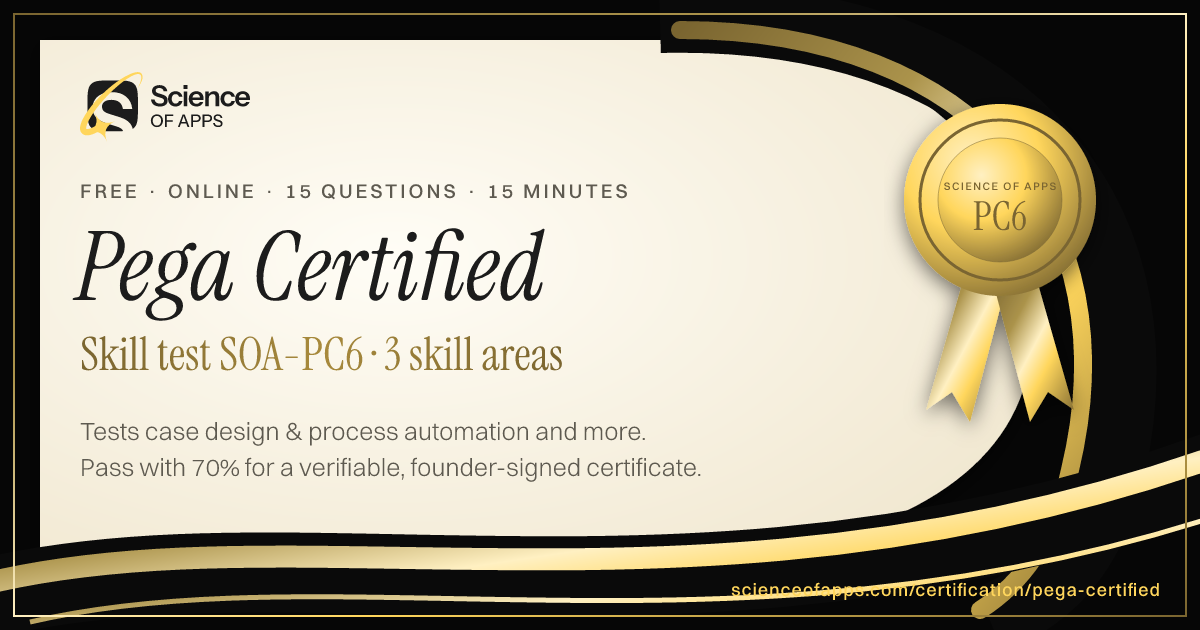
Pass, then add it to LinkedIn in one click
No typing. The Add to LinkedIn Certifications button opens your profile’s Licenses & certifications form already filled in: the certificate name, Science of Apps as the issuer, the issue date, your credential ID and a link recruiters can use to verify it.
- 1Take the 15-minute test
- 2Score 70% or more
- 3Click Add to LinkedIn Certifications

Pega Certified
Science of Apps
Show credential ↗Try another skill test
- 20 minSOA-SX
Sage Accounting Software Certification Test
Tests practical skill in Sage accounting software — setting up companies, the chart of accounts and control accounts, processing sales, purchases and bank transactions, handling VAT or sales tax, payroll journals and period end, and reporting, dimensions and controls in Sage Intacct — written to Sage Knowledgebase guidance, Sage Intacct documentation, HMRC Making Tax Digital rules and core bookkeeping standards for 2026. Covers Sage 50, Sage Accounting and Sage Intacct; menu names vary by version and country.
Difficulty: IntermediateTake the 20-minute test → - 15 minSOA-SAY
Salesforce Certified Associate Practice Test
Tests readiness for the Salesforce Certified Associate exam — the Salesforce ecosystem and navigation, the core data model of standard objects, fields and relationships, and reports and dashboards — written to the Salesforce Certified Associate exam guide, Salesforce Help and Trailhead for 2026. The entry point before Administrator, AI Associate and other Salesforce certifications.
Difficulty: BeginnerTake the 15-minute test → - 20 minSOA-HCM
HubSpot Content Marketing Certification Practice Test
Tests readiness for the HubSpot Academy Content Marketing Certification — content strategy, buyer personas and storytelling, pillar pages, topic clusters, SEO and blogging, creating and repurposing content across formats, and promoting, measuring and optimising content — written to HubSpot Academy's content marketing course, Google Search Central's SEO and helpful-content guidance and Content Marketing Institute research for 2026.
Difficulty: IntermediateTake the 20-minute test →
Frequently asked questions
What is the Pega Certified Practice Test (Pega Platform Low-Code Knowledge)?
The Pega Certified Practice Test (Pega Platform Low-Code Knowledge) is a free 15-minute skill test from Science of Apps. Practice test on Pega Platform fundamentals in three areas — case design and automation, data and rule resolution, and user experience, security, testing and delivery. An independent practice test of public Pega concepts, not the official Pega certification and not endorsed by Pega Systems. Score 70% or more on its 15 questions to earn a verifiable Pega Certified certificate (SOA-PC6). Every question is based on published standards and research — including Pega Platform documentation (Pegasystems), Pega Academy training and Pega Express concepts (Pegasystems) — and each answer is explained with its source.
Is there a free Pega Certified certification test for 2026?
Yes. Science of Apps has a free Pega Certified Practice Test (Pega Platform Low-Code Knowledge) built on published standards and official documentation for 2026 and 2027. It covers case design & process automation, data, rules & rule resolution and user experience, security, testing & delivery, scores you instantly and issues a verifiable certificate.
How do I take the Pega Certified Practice Test (Pega Platform Low-Code Knowledge) for free?
Read the three skill areas on this page, then take the 15-minute test online — no fee, course or sign-up. You see every answer explained when you finish. Score 70% or more and you get a Pega Certified certificate straight away, on screen, as a PDF and by email, with a credential ID anyone can verify.
Are the Pega Certified Practice Test (Pega Platform Low-Code Knowledge) questions based on real standards?
Yes. The questions are original scenarios written by Science of Apps, and each one is based on a public source you can read: Pega Platform documentation (Pegasystems); Pega Academy training and Pega Express concepts (Pegasystems). The source is shown under each question and linked in the answer review. Science of Apps doesn't copy questions from other tests.
What does the Pega Certified Practice Test (Pega Platform Low-Code Knowledge) cover?
Three skill areas with five questions each, drawn from a bank of 10 per area so a retake brings new questions: Case design & process automation (Case types, stages, processes and steps, Assignments, work queues and SLAs, Child cases and automation); Data, rules & rule resolution (Data pages and data modelling, Decision rules and declarative logic, Rulesets, inheritance and circumstancing); User experience, security, testing & delivery (Constellation and the Cosmos design system, Access roles, privileges and ABAC, Testing and Deployment Manager). Every question is an original scenario based on a published standard, official documentation or research, named under the question.
Who should take the Pega Certified Practice Test (Pega Platform Low-Code Knowledge)?
Aspiring Pega developer, Business analyst, Low-code developer, Solution architect, Workflow consultant. It suits anyone who wants a quick, verifiable way to show Pega Certified knowledge, from students and career switchers to experienced professionals.
Can I take the Pega Certified Practice Test (Pega Platform Low-Code Knowledge) from any country?
Yes. The test is online, in English and free everywhere — people take it from India, the US, the UK, Europe, Africa, Latin America and Asia-Pacific. Your certificate is dated with your own local date and can be verified from anywhere at scienceofapps.com/certification/verify/.
How long is the Pega Certified Practice Test (Pega Platform Low-Code Knowledge)?
15 questions — 5 from each of 3 skill areas — with a 15-minute limit. You need 70% (11 of 15) to pass and 90% for distinction.
How hard is the Pega Certified Practice Test (Pega Platform Low-Code Knowledge)?
We rate it Intermediate: assumes hands-on experience in the role. It has 15 scenario questions — 5 from each of 3 skill areas — and a 15-minute limit. You need 70% (11 of 15) to pass and 90% for distinction.
How much do Science of Apps certifications cost?
Nothing. There is no fee to take a test, to receive the certificate, to have it emailed or to verify it, and no sign-up.
How are the tests graded?
On our server, not in your browser. The answers never reach the page until you submit, so a certificate can only be earned by passing. Each certificate gets a unique credential ID stored by Science of Apps.
What happens if I don't pass?
You see your score for each area and every question with the correct answer and why, with the published source behind it. You can retake after 30 minutes, and the retake draws questions you haven't seen yet.
Do the certificates expire?
No. Every certificate is dated, so it always shows when you passed. Retake a test any time for a newer date or a higher score.
Can I add the certificate to LinkedIn?
Yes. After you pass, Add to LinkedIn opens the Licenses & certifications form with the certificate name, Science of Apps as the issuer, the issue date, your credential ID and the verification link filled in. You can also download it as a PDF or PNG, and it's emailed to you as a PDF.
How can an employer verify my certificate?
Every certificate has a credential ID and a QR code. Scanning it, or entering the ID at scienceofapps.com/certification/verify/, shows the holder's name, the certification, the score and the issue date from our records.
Are these accredited qualifications?
No. They are Science of Apps' own assessments of applied skill. They aren't issued by a university or standards body, and they work best alongside a portfolio that shows the skills in real work.
2934 more certifications to collect
Business Software, ERP & CRM
- Freshdesk Certification20 min · Intermediate
- Iterable Certification20 min · Intermediate
- Manhattan WMS Practice Test20 min · Intermediate
- Opera PMS Practice Test20 min · Intermediate
- Pipedrive Certification20 min · Intermediate
- SAP CRM Practice Test20 min · Intermediate
- SAP HCM Certification15 min · Intermediate
- Salesforce Admin Certification15 min · Intermediate
- Hub Spot Certifications Practice Test15 min · Intermediate
- Service NOW Certification Practice Test15 min · Intermediate
- Enterprise Resource Planning Certification Practice Test15 min · Intermediate
- LCQ Certificate Practice Test (Lean & Continuous Quality)10 min · Beginner
- Pega Certified Practice Test (Pega Platform Low-Code Knowledge)You're here
- Sage Accounting Software Certification Test20 min · Intermediate
- Salesforce Certified Associate Practice Test15 min · Beginner
- HubSpot Content Marketing Certification Practice Test20 min · Intermediate
- Odoo Certification Practice Test20 min · Intermediate
- SAP FICO Practice Test20 min · Intermediate
- SAP MM Practice Test20 min · Intermediate
- SAP S/4HANA Practice Test20 min · Intermediate
- Salesforce Business Analyst Practice Test20 min · Intermediate
- Salesforce Marketing Cloud Email Specialist Practice Test20 min · Intermediate
- HubSpot Email Marketing Certification Practice Test20 min · Intermediate
- MuleSoft Developer (Level 1, Mule 4) Practice Test20 min · Intermediate
Foundation
AI & Generative AI
- AI UX Design Certification30 min · Advanced
- Prompt Engineering Certification30 min · Intermediate
- AI Product Manager Certification30 min · Advanced
Software Engineering & Web Development
- HTML & CSS Certification Test10 min · Beginner
- JavaScript Certification Test (Fundamentals)10 min · Beginner
- TypeScript Certification Test (Fundamentals)15 min · Intermediate
Data Analytics & Business Intelligence
- Product Analytics Certification30 min · Advanced
- Data Literacy Certification10 min · Beginner
- Microsoft Excel Certification Test (Fundamentals)10 min · Beginner
Digital Marketing, SEO, AEO & Growth
- Conversion Rate Optimization (CRO) Certification30 min · Advanced
- App Store Optimization (ASO) Certification30 min · Intermediate
- Growth Marketing Certification30 min · Intermediate
UX/UI, Design, Research & Creative
- UX Design Certification30 min · Intermediate
- UI Design Certification30 min · Intermediate
- Product Design Certification30 min · Intermediate
Product, Project Management & Business Analysis
- Product Manager Certification30 min · Intermediate
- Design Leadership Certification30 min · Advanced
- Agile Product Owner Certification30 min · Intermediate
Cybersecurity, IT, Cloud & DevOps
- Cybersecurity Certification Test (Fundamentals)10 min · Beginner
- Security Awareness Certification Test (Phishing Detection)10 min · Beginner
- Network Security Certification Test (Fundamentals)15 min · Intermediate
Sales, Customer Success & Support
- Sales Fundamentals Certification10 min · Beginner
- Consultative Selling Certification15 min · Intermediate
- B2B Sales Development Representative Certification10 min · Beginner
Human Resources & People Management
- Human Resources Certification Test (Fundamentals)10 min · Beginner
- Talent Acquisition Certification Test10 min · Beginner
- Technical Recruitment Certification15 min · Intermediate
Finance, Accounting, Operations & Entrepreneurship
- Financial Literacy Test (for Professionals)10 min · Beginner
- Accounting Certification Test (Fundamentals)10 min · Beginner
- Bookkeeping Certification Test (Fundamentals)10 min · Beginner
Communication, Leadership & Transferable Skills
- Critical Thinking Test10 min · Beginner
- Attention to Detail Test10 min · Beginner
- Cognitive Bias Test10 min · Beginner
Languages
- English Level Test30 min · Beginner
- American Sign Language (ASL) Foundations Test25 min · Intermediate
- App & Software Localization Test25 min · Intermediate
Healthcare, Education, Legal Operations & Sustainability
- Healthcare Administration Certification Test (Fundamentals)10 min · Beginner
- Medical Office Administration Certification10 min · Beginner
- Healthcare Data Privacy Awareness Certification10 min · Beginner
Test Prep, Academics & Aptitude
- SAT Math Practice Test20 min · Advanced
- SAT Reading and Writing Practice Test20 min · Advanced
- ACT Practice Test (English, Math, Reading & Science)20 min · Advanced
Language Exam Prep
- IELTS Academic Practice Test with Band Score20 min · Advanced
- IELTS General Training Practice Test20 min · Advanced
- TOEFL iBT Practice Test20 min · Advanced
Office & Productivity Software
- Microsoft Word Skills Certification15 min · Intermediate
- Microsoft PowerPoint Skills Certification15 min · Intermediate
- Microsoft Outlook Skills Certification10 min · Beginner
Engineering, Architecture, Construction & Safety
- Mechanical Engineering Practice Test (FE-Style)20 min · Advanced
- Electrical Engineering Practice Test (FE-Style)20 min · Advanced
- Civil Engineering Practice Test (FE-Style)20 min · Advanced
Hospitality, Travel & Retail
- Hospitality Management Certification10 min · Beginner
- Food Safety Certification10 min · Beginner
- Hotel Revenue Management Certification15 min · Intermediate
Cognitive Ability & Pre-Employment Tests
- IQ Test20 min · Intermediate
- Numerical Reasoning Test20 min · Intermediate
- Verbal Reasoning Test20 min · Intermediate
Personality & Career Assessments
- Hogan Assessment Practice Test11 min · Beginner
- Big Five Personality Test10 min · Beginner
- Enneagram Test11 min · Beginner
Health, Fitness & Wellness
- Personal Trainer Practice Test (NASM, ACE & ISSA)20 min · Intermediate
- ACSM Practice Test (CPT & EP)20 min · Intermediate
- Yoga Teacher Certification Test (RYT 200)15 min · Beginner
Beauty & Cosmetology
- Nail Technician Practice Test15 min · Beginner
- Cosmetology Practice Test15 min · Beginner
- Esthetician Practice Test15 min · Beginner
Consulting, Strategy & Industry Leadership
- AI for Management Consultants Certification20 min · Intermediate
- Chief of Staff Certification Test20 min · Intermediate
- Market Sizing & Estimation Certification15 min · Beginner
Law, Policy & Global Affairs
- AI for Lawyers & Legal Practice Certification20 min · Intermediate
- Geopolitical Risk Analysis Certification20 min · Intermediate
- AI for Public Policy Professionals Certification20 min · Intermediate
Frontier Science & Deep Tech
- Quantum Computing Certification Test (Fundamentals)20 min · Intermediate
- Neurotechnology & Brain-Computer Interfaces Certification20 min · Intermediate
- Nuclear Fission & Fusion Energy Fundamentals Certification20 min · Intermediate
Creative Arts, Writing & Media
- Creative Writing Certification15 min · Beginner
- Game Design Certification20 min · Intermediate
- Screenwriting Certification20 min · Intermediate
Hobbies, Culture & Lifestyle
- Chess Strategy & Tactics Test15 min · Beginner
- Philosophy Fundamentals Test15 min · Beginner
- Stoic Philosophy for Modern Leaders Test15 min · Beginner
Global Business & Country Markets
- India Stack & Digital Public Infrastructure Certification20 min · Intermediate
- Indian Startup Ecosystem & Fundraising Certification20 min · Intermediate
- Indian Capital Markets Fundamentals Certification15 min · Beginner
Read before you test
- Career guidesOOP interview questions for developers in 2027: the principles, SOLID, patterns and design tasks interviews useOOP interview questions for developers in 2027: the four pillars, SOLID, composition, design patterns and low-level design, with answers.
- Career guides by Science of Apps for 2027The best DevOps certifications of 2027: eight for cloud, containers, automation and deliveryThe 8 best DevOps certifications of 2027: CKA, Terraform, AWS Solutions Architect, Azure AZ-104, Google Cloud ACE, ITIL 4, PSM I and AWS Cloud Practitioner.
- UI/UX designUX research methods: which one to use when — a practical guide by question and stageUX research methods explained by the question each answers — interviews, usability tests, surveys, diary studies, card sorting, A/B tests.
- Career guidesStatistics for data analyst interviews in 2027: the concepts employers test and how to explain them without jargonStatistics for data analyst interviews in 2027: the descriptive, inference and testing concepts employers check, real questions with plain answers.
- Career guidesHow to become a technical product manager in 2027: APIs and platforms, system design trade-offs, technical debt, non-functional requirements and developer experienceHow to become a technical product manager in 2027: APIs, platforms, system design trade-offs, technical debt, reliability, developer experience and pay.
- Career guides by Science of Apps for 2027The top 10 certifications for software engineers in 2027: cloud, platform, security and AIThe top 10 certifications for software engineers in 2027: AWS Solutions Architect, CKA, Terraform, AZ-104, Google Cloud ACE, AI-102, AWS ML Engineer and more.



Get the ideas, not the noise.
Sign up with Google and we’ll send you short UX psychology tips by email — why people tap, stall and leave, and what to do about it. Unsubscribe anytime. Prefer something to keep? Get the free Laws of UX guide as a PDF.
