SBE Certification Practice Test
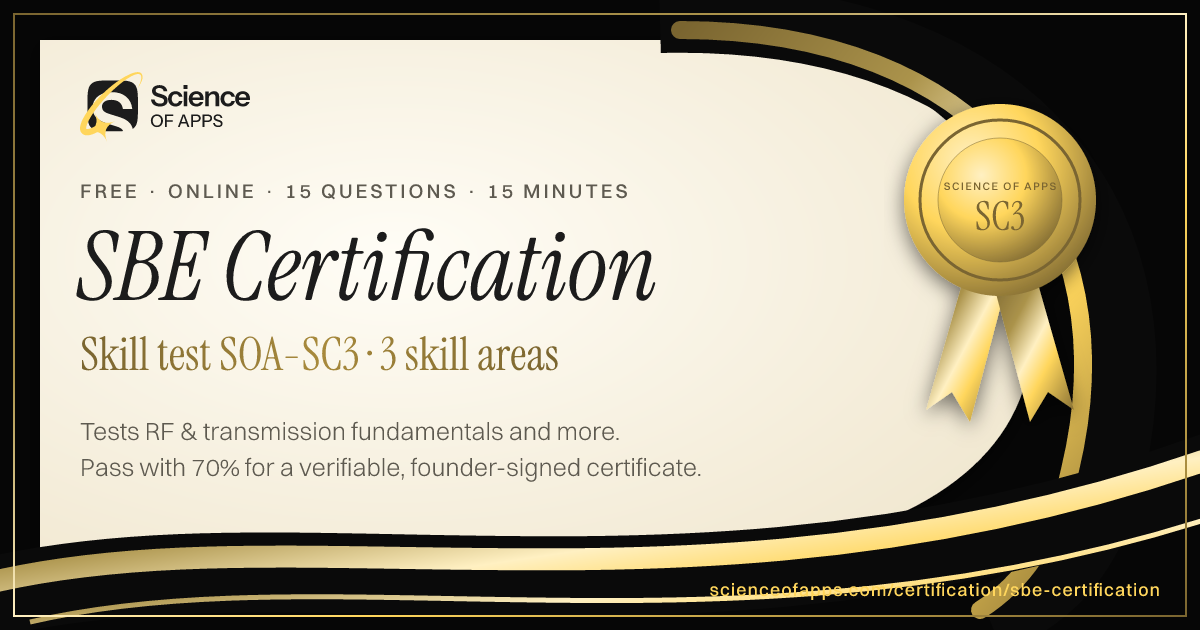
Practice test interpreting SBE as the Society of Broadcast Engineers topic area, in three areas — RF and transmission fundamentals, audio, video and digital broadcast systems, and FCC rules, the Emergency Alert System and safety — based on FCC regulations and published broadcast standards. A knowledge test, not an official SBE certification. Pass to earn SBE Certification SOA-SC3.
- Intermediate difficulty.Assumes hands-on experience in the role.
- 15 scenario questions
- 15 minutes, timed
- 70% to pass · 90% for distinction
- Free no sign-up needed
- LinkedIn-ready · add it to your profile in one clickSee how ↓

 Founder, Science of Apps
What is the SBE Certification Practice Test?
- Career Booster
- Quality Assured
- Exclusive Certification
Updated for 2026 and 2027. Covers RF & transmission fundamentals, audio, video & digital broadcast systems and FCC rules, EAS & safety.
The SBE Certification Practice Test is a free 15-minute skill test from Science of Apps. Practice test interpreting SBE as the Society of Broadcast Engineers topic area, in three areas — RF and transmission fundamentals, audio, video and digital broadcast systems, and FCC rules, the Emergency Alert System and safety — based on FCC regulations and published broadcast standards. A knowledge test, not an official SBE certification. Score 70% or more on its 15 questions to earn a verifiable SBE Certification certificate (SOA-SC3). Every question is based on published standards and research — including Society of Broadcast Engineers (SBE), 47 CFR Part 73: Radio broadcast services (eCFR), ATSC broadcast standards (ATSC 1.0 and ATSC 3.0) (Advanced Television Systems Committee) — and each answer is explained with its source.
Built for your job title
Broadcast technician, Radio or TV engineer, Studio maintenance engineer, Master control operator and Engineering student interested in broadcasting — and anyone who wants quick, verifiable proof of broadcast engineering knowledge for a CV or LinkedIn.
- Broadcast technician
- Radio or TV engineer
- Studio maintenance engineer
- Master control operator
- Engineering student interested in broadcasting
What the test covers
Three skill areas with 5 questions each, drawn from a bank of 10 per area, so a retake brings questions you haven't seen.
RF & transmission fundamentals
33%- Decibels and wavelength
- Transmission lines and VSWR
- FM and AM basics
Audio, video & digital broadcast systems
33%- Digital audio and loudness
- Video and IP workflows
- ATSC standards
FCC rules, EAS & safety
33%- Station operation
- Emergency Alert System
- Antenna structures and RF safety
Independent skills test by Science of Apps. Credential and organisation names are trademarks of their owners and are used only to describe the knowledge tested. Passing earns a Science of Apps certificate, not an official or regulated credential.
Based on published standards
The questions are original scenarios, and each one names the public standard, official guide or research it draws on — shown under the question while you answer, and linked in your review. These are the sources behind this test:
- Society of Broadcast EngineersSBE8 questions
- 47 CFR Part 73: Radio broadcast serviceseCFR5 questions
- ATSC broadcast standards (ATSC 1.0 and ATSC 3.0)Advanced Television Systems Committee4 questions
- AES standards (AES3, AES67)Audio Engineering Society3 questions
- SMPTE standards (SDI, ST 2110)Society of Motion Picture and Television Engineers3 questions
- 47 CFR Part 11: Emergency Alert System (EAS)eCFR3 questions
- 47 CFR Part 17: Construction, marking and lighting of antenna structureseCFR2 questions
- 47 CFR Part 1: Practice and procedure (including RF exposure limits)eCFR2 questions
Try a sample question
An RF signal is increased by 3 dB. What happens to its power?
- It roughly doubles
- It is halved
- It increases by tenfold
- It increases by 3 watts
Show the answer
A. It roughly doubles — A 3 dB gain is a factor of about two in power, and 10 dB is a factor of ten. The real test has 15 questions like this.
How the test works
15 minutes, 15 questions
One question per screen, with a progress bar and a countdown. Your progress is saved on this device if you need to pause.
Graded on our server
Answers reach the page only after you submit, so the certificate can only be earned by passing.
Every answer explained
Pass or not, you see every question with the right answer, why, and the source behind it. Pass mark 70%, distinction 90%.
Your certificate
Founder-signed, with a QR code and credential ID. Download PDF or PNG, add to LinkedIn, and it's emailed to you.
What you earn
Pass, then add it to LinkedIn in one click
No typing. The Add to LinkedIn Certifications button opens your profile’s Licenses & certifications form already filled in: the certificate name, Science of Apps as the issuer, the issue date, your credential ID and a link recruiters can use to verify it.
- 1Take the 15-minute test
- 2Score 70% or more
- 3Click Add to LinkedIn Certifications

SBE Certification
Science of Apps
Show credential ↗Try another skill test
- 20 minSOA-MECH
Mechanical Engineering Practice Test (FE-Style)
Tests mechanical engineering fundamentals in the style of the FE Mechanical exam — statics and mechanics of materials, thermodynamics and heat transfer, fluid mechanics, and dynamics, machine design and materials — with worked calculations.
Difficulty: AdvancedTake the 20-minute test → - 20 minSOA-ELEC
Electrical Engineering Practice Test (FE-Style)
Tests electrical and computer engineering fundamentals in the style of the FE Electrical and Computer exam — circuit analysis, electronics and digital logic, power systems and machines, and signals, control and communications.
Difficulty: AdvancedTake the 20-minute test → - 20 minSOA-CIVL
Civil Engineering Practice Test (FE-Style)
Tests civil engineering fundamentals in the style of the FE Civil exam — structural analysis and materials, geotechnical engineering, water resources and environmental engineering, and transportation and construction — with worked calculations.
Difficulty: AdvancedTake the 20-minute test →
Frequently asked questions
What is the SBE Certification Practice Test?
The SBE Certification Practice Test is a free 15-minute skill test from Science of Apps. Practice test interpreting SBE as the Society of Broadcast Engineers topic area, in three areas — RF and transmission fundamentals, audio, video and digital broadcast systems, and FCC rules, the Emergency Alert System and safety — based on FCC regulations and published broadcast standards. A knowledge test, not an official SBE certification. Score 70% or more on its 15 questions to earn a verifiable SBE Certification certificate (SOA-SC3). Every question is based on published standards and research — including Society of Broadcast Engineers (SBE), 47 CFR Part 73: Radio broadcast services (eCFR), ATSC broadcast standards (ATSC 1.0 and ATSC 3.0) (Advanced Television Systems Committee) — and each answer is explained with its source.
Is there a free SBE Certification certification test for 2026?
Yes. Science of Apps has a free SBE Certification Practice Test built on published standards and official documentation for 2026 and 2027. It covers RF & transmission fundamentals, audio, video & digital broadcast systems and FCC rules, EAS & safety, scores you instantly and issues a verifiable certificate.
How do I take the SBE Certification Practice Test for free?
Read the three skill areas on this page, then take the 15-minute test online — no fee, course or sign-up. You see every answer explained when you finish. Score 70% or more and you get a SBE Certification certificate straight away, on screen, as a PDF and by email, with a credential ID anyone can verify.
Are the SBE Certification Practice Test questions based on real standards?
Yes. The questions are original scenarios written by Science of Apps, and each one is based on a public source you can read: Society of Broadcast Engineers (SBE); 47 CFR Part 73: Radio broadcast services (eCFR); ATSC broadcast standards (ATSC 1.0 and ATSC 3.0) (Advanced Television Systems Committee); AES standards (AES3, AES67) (Audio Engineering Society); SMPTE standards (SDI, ST 2110) (Society of Motion Picture and Television Engineers); 47 CFR Part 11: Emergency Alert System (EAS) (eCFR). The source is shown under each question and linked in the answer review. Science of Apps doesn't copy questions from other tests.
What does the SBE Certification Practice Test cover?
Three skill areas with five questions each, drawn from a bank of 10 per area so a retake brings new questions: RF & transmission fundamentals (Decibels and wavelength, Transmission lines and VSWR, FM and AM basics); Audio, video & digital broadcast systems (Digital audio and loudness, Video and IP workflows, ATSC standards); FCC rules, EAS & safety (Station operation, Emergency Alert System, Antenna structures and RF safety). Every question is an original scenario based on a published standard, official documentation or research, named under the question.
Who should take the SBE Certification Practice Test?
Broadcast technician, Radio or TV engineer, Studio maintenance engineer, Master control operator, Engineering student interested in broadcasting. It suits anyone who wants a quick, verifiable way to show SBE Certification knowledge, from students and career switchers to experienced professionals.
Can I take the SBE Certification Practice Test from any country?
Yes. The test is online, in English and free everywhere — people take it from India, the US, the UK, Europe, Africa, Latin America and Asia-Pacific. Your certificate is dated with your own local date and can be verified from anywhere at scienceofapps.com/certification/verify/.
How long is the SBE Certification Practice Test?
15 questions — 5 from each of 3 skill areas — with a 15-minute limit. You need 70% (11 of 15) to pass and 90% for distinction.
How hard is the SBE Certification Practice Test?
We rate it Intermediate: assumes hands-on experience in the role. It has 15 scenario questions — 5 from each of 3 skill areas — and a 15-minute limit. You need 70% (11 of 15) to pass and 90% for distinction.
How much do Science of Apps certifications cost?
Nothing. There is no fee to take a test, to receive the certificate, to have it emailed or to verify it, and no sign-up.
How are the tests graded?
On our server, not in your browser. The answers never reach the page until you submit, so a certificate can only be earned by passing. Each certificate gets a unique credential ID stored by Science of Apps.
What happens if I don't pass?
You see your score for each area and every question with the correct answer and why, with the published source behind it. You can retake after 30 minutes, and the retake draws questions you haven't seen yet.
Do the certificates expire?
No. Every certificate is dated, so it always shows when you passed. Retake a test any time for a newer date or a higher score.
Can I add the certificate to LinkedIn?
Yes. After you pass, Add to LinkedIn opens the Licenses & certifications form with the certificate name, Science of Apps as the issuer, the issue date, your credential ID and the verification link filled in. You can also download it as a PDF or PNG, and it's emailed to you as a PDF.
How can an employer verify my certificate?
Every certificate has a credential ID and a QR code. Scanning it, or entering the ID at scienceofapps.com/certification/verify/, shows the holder's name, the certification, the score and the issue date from our records.
Are these accredited qualifications?
No. They are Science of Apps' own assessments of applied skill. They aren't issued by a university or standards body, and they work best alongside a portfolio that shows the skills in real work.
3034 more certifications to collect
Engineering, Architecture, Construction & Safety
- LEEA Certification Practice Test (Lifting Equipment Knowledge)15 min · Intermediate
- MCS Certification Practice Test15 min · Intermediate
- MCS Installer Certificate Practice Test15 min · Intermediate
- Macs 609 Certification Practice Test15 min · Intermediate
- Manufacturer Certified Collision Center Practice Test15 min · Intermediate
- Mold Remediation Specialist Certification Practice Test10 min · Beginner
- NIC EIC Certificate Practice Test15 min · Intermediate
- NCCO Certification Practice Test15 min · Intermediate
- NERC Certification Practice Test15 min · Intermediate
- NPPE Practice Exam Practice Test10 min · Beginner
- Pool Operator Certification Practice Test15 min · Intermediate
- RCDD Certification Practice Test15 min · Intermediate
- SBE Certification Practice TestYou're here
- Tesla Certified Practice Test10 min · Beginner
- Tesla Certified Auto Body Shop Practice Test10 min · Beginner
- Tesla Certified Body Shop Practice Test10 min · Beginner
- United Kingdom Accreditation Service Ukas Practice Test15 min · Intermediate
- WHS Certificate 4 Practice Test15 min · Intermediate
- Asbestos Inspection Certification Practice Test10 min · Beginner
- Boat Safety Cert Certification Practice Test15 min · Intermediate
- MPI Examination Certification Practice Test15 min · Intermediate
- Mechanical Engineering Practice Test (FE-Style)20 min · Advanced
- Electrical Engineering Practice Test (FE-Style)20 min · Advanced
- Civil Engineering Practice Test (FE-Style)20 min · Advanced
Foundation
AI & Generative AI
- AI UX Design Certification30 min · Advanced
- Prompt Engineering Certification30 min · Intermediate
- AI Product Manager Certification30 min · Advanced
Software Engineering & Web Development
- HTML & CSS Certification Test10 min · Beginner
- JavaScript Certification Test (Fundamentals)10 min · Beginner
- TypeScript Certification Test (Fundamentals)15 min · Intermediate
Data Analytics & Business Intelligence
- Product Analytics Certification30 min · Advanced
- Data Literacy Certification10 min · Beginner
- Microsoft Excel Certification Test (Fundamentals)10 min · Beginner
Digital Marketing, SEO, AEO & Growth
- Conversion Rate Optimization (CRO) Certification30 min · Advanced
- App Store Optimization (ASO) Certification30 min · Intermediate
- Growth Marketing Certification30 min · Intermediate
UX/UI, Design, Research & Creative
- UX Design Certification30 min · Intermediate
- UI Design Certification30 min · Intermediate
- Product Design Certification30 min · Intermediate
Product, Project Management & Business Analysis
- Product Manager Certification30 min · Intermediate
- Design Leadership Certification30 min · Advanced
- Agile Product Owner Certification30 min · Intermediate
Cybersecurity, IT, Cloud & DevOps
- Cybersecurity Certification Test (Fundamentals)10 min · Beginner
- Security Awareness Certification Test (Phishing Detection)10 min · Beginner
- Network Security Certification Test (Fundamentals)15 min · Intermediate
Sales, Customer Success & Support
- Sales Fundamentals Certification10 min · Beginner
- Consultative Selling Certification15 min · Intermediate
- B2B Sales Development Representative Certification10 min · Beginner
Human Resources & People Management
- Human Resources Certification Test (Fundamentals)10 min · Beginner
- Talent Acquisition Certification Test10 min · Beginner
- Technical Recruitment Certification15 min · Intermediate
Finance, Accounting, Operations & Entrepreneurship
- Financial Literacy Test (for Professionals)10 min · Beginner
- Accounting Certification Test (Fundamentals)10 min · Beginner
- Bookkeeping Certification Test (Fundamentals)10 min · Beginner
Communication, Leadership & Transferable Skills
- Critical Thinking Test10 min · Beginner
- Attention to Detail Test10 min · Beginner
- Cognitive Bias Test10 min · Beginner
Languages
- Esol Certificate Practice Test10 min · Beginner
- English Level Test30 min · Beginner
- American Sign Language (ASL) Foundations Test25 min · Intermediate
Healthcare, Education, Legal Operations & Sustainability
- Healthcare Administration Certification Test (Fundamentals)10 min · Beginner
- Medical Office Administration Certification10 min · Beginner
- Healthcare Data Privacy Awareness Certification10 min · Beginner
Test Prep, Academics & Aptitude
- SAT Math Practice Test20 min · Advanced
- SAT Reading and Writing Practice Test20 min · Advanced
- ACT Practice Test (English, Math, Reading & Science)20 min · Advanced
Language Exam Prep
- IELTS Academic Practice Test with Band Score20 min · Advanced
- IELTS General Training Practice Test20 min · Advanced
- TOEFL iBT Practice Test20 min · Advanced
Office & Productivity Software
- Microsoft Word Skills Certification15 min · Intermediate
- Microsoft PowerPoint Skills Certification15 min · Intermediate
- Microsoft Outlook Skills Certification10 min · Beginner
Hospitality, Travel & Retail
- Hospitality Management Certification10 min · Beginner
- Food Safety Certification10 min · Beginner
- Hotel Revenue Management Certification15 min · Intermediate
Cognitive Ability & Pre-Employment Tests
- IQ Test20 min · Intermediate
- Numerical Reasoning Test20 min · Intermediate
- Verbal Reasoning Test20 min · Intermediate
Personality & Career Assessments
- Hogan Assessment Practice Test11 min · Beginner
- Big Five Personality Test10 min · Beginner
- Enneagram Test11 min · Beginner
Health, Fitness & Wellness
- Personal Trainer Practice Test (NASM, ACE & ISSA)20 min · Intermediate
- ACSM Practice Test (CPT & EP)20 min · Intermediate
- Yoga Teacher Certification Test (RYT 200)15 min · Beginner
Beauty & Cosmetology
- Nail Technician Practice Test15 min · Beginner
- Cosmetology Practice Test15 min · Beginner
- Esthetician Practice Test15 min · Beginner
Business Software, ERP & CRM
- Sage Accounting Software Certification Test20 min · Intermediate
- Salesforce Certified Associate Practice Test15 min · Beginner
- HubSpot Content Marketing Certification Practice Test20 min · Intermediate
Consulting, Strategy & Industry Leadership
- AI for Management Consultants Certification20 min · Intermediate
- Chief of Staff Certification Test20 min · Intermediate
- Market Sizing & Estimation Certification15 min · Beginner
Law, Policy & Global Affairs
- AI for Lawyers & Legal Practice Certification20 min · Intermediate
- Geopolitical Risk Analysis Certification20 min · Intermediate
- AI for Public Policy Professionals Certification20 min · Intermediate
Frontier Science & Deep Tech
- Quantum Computing Certification Test (Fundamentals)20 min · Intermediate
- Neurotechnology & Brain-Computer Interfaces Certification20 min · Intermediate
- Nuclear Fission & Fusion Energy Fundamentals Certification20 min · Intermediate
Creative Arts, Writing & Media
- Creative Writing Certification15 min · Beginner
- Game Design Certification20 min · Intermediate
- Screenwriting Certification20 min · Intermediate
Hobbies, Culture & Lifestyle
- Chess Strategy & Tactics Test15 min · Beginner
- Philosophy Fundamentals Test15 min · Beginner
- Stoic Philosophy for Modern Leaders Test15 min · Beginner
Global Business & Country Markets
- India Stack & Digital Public Infrastructure Certification20 min · Intermediate
- Indian Startup Ecosystem & Fundraising Certification20 min · Intermediate
- Indian Capital Markets Fundamentals Certification15 min · Beginner
Read before you test
- CertificationsBest certifications by countryThe most valuable certifications in the USA, UK, India, UAE, Canada and Australia, based on local job demand, licensing rules and employer requirements.
- Career guidesHow to get a design systems job in 2027: tokens, components, documentation, governance, adoption and working between design and engineeringHow to get a design systems job in 2027: tokens, components, documentation, governance, adoption metrics, design-code parity, pay and a plan.
- CertificationsHow SOA designs certificationsHow Science of Apps designs each certification: a published standard, realistic scenarios, expert review, a 70% pass mark and verifiable certificates.
- Career guideseLearning design and development for 2027: authoring tools, interactive scenarios, microlearning, video and audio, accessibility, mobile-first design, SCORM and xAPI tracking, and AI-assisted course buildingeLearning design for 2027: authoring tools, interactive scenarios, microlearning, video, accessibility, mobile-first design, SCORM and xAPI, and AI tools.
- Career guides by Science of Apps for 2027How to pass AWS Certified Machine Learning Engineer – Associate in 2027: a 10-week study plan and tips that workHow to pass AWS Certified Machine Learning Engineer – Associate in 2027: a 10-week study plan, exam format, cost and free practice tests.
- Career guides by Science of Apps for 2027How to pass Databricks Certified Generative AI Engineer Associate in 2027: a 6-week study plan and tips that workHow to pass Databricks Certified Generative AI Engineer Associate in 2027: a 6-week study plan, exam format, cost and free practice tests.
Get the ideas, not the noise.
Sign up with Google and we’ll send you short UX psychology tips by email — why people tap, stall and leave, and what to do about it. Unsubscribe anytime. Prefer something to keep? Get the free Laws of UX guide as a PDF.
