Dry Needling Certification
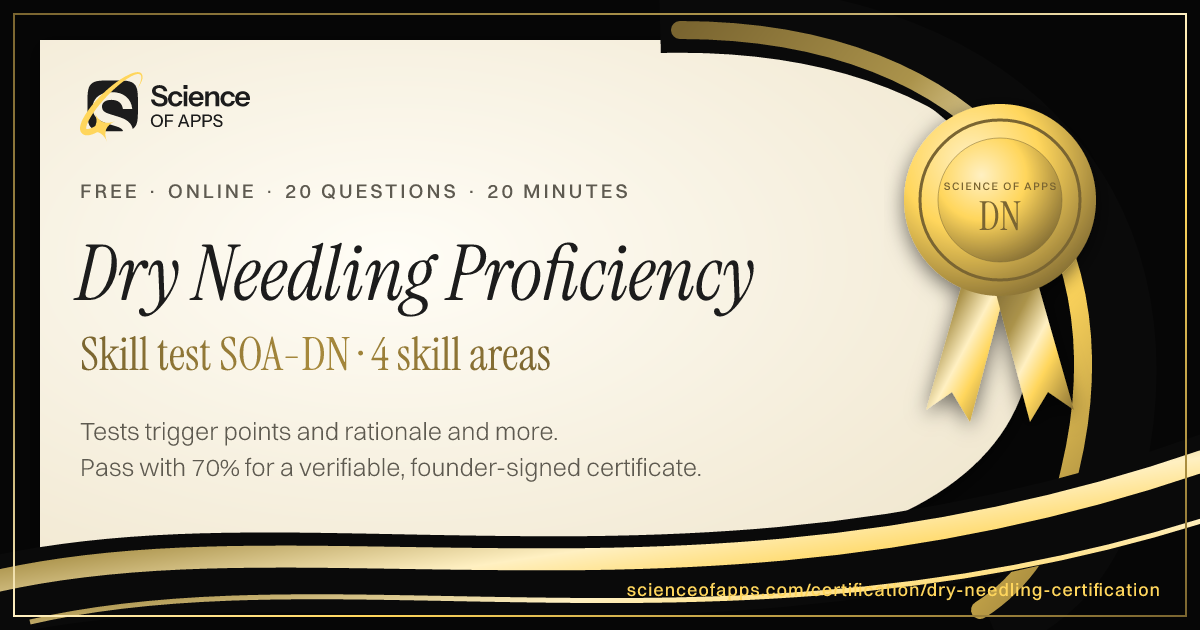
Tests dry needling knowledge for licensed clinicians — myofascial trigger points and the rationale for needling, anatomy, safety and contraindications, clean needle technique and adverse event management, and clinical reasoning, consent and the evidence base — written to APTA dry needling resources, peer-reviewed systematic reviews and clinical safety guidance for 2026. Who may dry needle, and what training is required, is set by each country's or state's regulator; this test does not grant permission to practise. Pass to earn Dry Needling Proficiency SOA-DN.
- Intermediate difficulty.Assumes hands-on experience in the role.
- 20 scenario questions
- 20 minutes, timed
- 70% to pass · 90% for distinction
- Free no sign-up needed
- LinkedIn-ready · add it to your profile in one clickSee how ↓

 Founder, Science of Apps
What is the Dry Needling Certification?
- Quality Assured
- Exclusive Certification
Updated for 2026 and 2027. Covers trigger points and rationale, anatomy, safety and contraindications, clean needle technique and adverse events and clinical reasoning, consent and evidence.
The Dry Needling Certification is a free intermediate-level, 20-minute skill test from Science of Apps. It tests dry needling knowledge for licensed clinicians — myofascial trigger points and the rationale for needling, anatomy, safety and contraindications, clean needle technique and adverse event management, and clinical reasoning, consent and the evidence base — written to APTA dry needling resources, peer-reviewed systematic reviews and clinical safety guidance for 2026. Who may dry needle, and what training is required, is set by each country's or state's regulator; this test does not grant permission to practise. Score 70% or more on its 20 questions to earn a verifiable Dry Needling Proficiency certificate (SOA-DN). Every question is based on published standards and research — including Dry needling: practice resources for physical therapists (American Physical Therapy Association), Boyce D et al. Adverse events associated with therapeutic dry needling. Int J Sports Phys Ther 2020 (IJSPT (PubMed 32089962)), Gattie E et al. The effectiveness of trigger point dry needling for musculoskeletal conditions by physical therapists: a systematic review and meta-analysis. J Orthop Sports Phys Ther 2017 (JOSPT (PubMed 28158962)) — and each answer is explained with its source.
Built for your job title
Physical therapist or physiotherapist, Chiropractor, Athletic trainer (where permitted), Sports medicine clinician and Rehabilitation student preparing for a dry needling course — and anyone who wants quick, verifiable proof of Dry Needling knowledge for a CV or LinkedIn in 2026 and 2027.
- Physical therapist or physiotherapist
- Chiropractor
- Athletic trainer (where permitted)
- Sports medicine clinician
- Rehabilitation student preparing for a dry needling course
What the test covers
Four skill areas with 5 questions each, drawn from a bank of 10 per area, so a retake brings questions you haven't seen.
Trigger Points and Rationale
25%- Myofascial pain
- Trigger point features
- Mechanisms
Anatomy, Safety and Contraindications
25%- Risk regions
- Precautions
- Contraindications
Clean Needle Technique and Adverse Events
25%- Hygiene
- Sharps
- Managing adverse events
Clinical Reasoning, Consent and Evidence
25%- Informed consent
- Documentation
- Research evidence
It is a knowledge and exam-readiness test: it does not replace official certification, licensure, supervised clinical or practical training, or local regulations.
Based on published standards
The questions are original scenarios, and each one names the public standard, official guide or research it draws on — shown under the question while you answer, and linked in your review. These are the sources behind this test:
- Dry needling: practice resources for physical therapistsAmerican Physical Therapy Association28 questions
- Boyce D et al. Adverse events associated with therapeutic dry needling. Int J Sports Phys Ther 2020IJSPT (PubMed 32089962)6 questions
- Gattie E et al. The effectiveness of trigger point dry needling for musculoskeletal conditions by physical therapists: a systematic review and meta-analysis. J Orthop Sports Phys Ther 2017JOSPT (PubMed 28158962)3 questions
- Bloodborne Pathogens Standard (29 CFR 1910.1030)OSHA2 questions
- Clinical safety: hand hygiene for healthcare workersCDC1 question
Try a sample question
The most serious adverse event clinicians must guard against when needling over the chest wall is
- temporary fatigue
- pneumothorax
- mild bruising
- short-term soreness
Show the answer
B. pneumothorax — Pneumothorax. The real test has 20 questions like this.
How the test works
20 minutes, 20 questions
One question per screen, with a progress bar and a countdown. Your progress is saved on this device if you need to pause.
Graded on our server
Answers reach the page only after you submit, so the certificate can only be earned by passing.
Every answer explained
Pass or not, you see every question with the right answer, why, and the source behind it. Pass mark 70%, distinction 90%.
Your certificate
Founder-signed, with a QR code and credential ID. Download PDF or PNG, add to LinkedIn, and it's emailed to you.
What you earn
Pass, then add it to LinkedIn in one click
No typing. The Add to LinkedIn button opens your profile’s Licenses & certifications form already filled in: the certificate name, Science of Apps as the issuer, the issue date, your credential ID and a link recruiters can use to verify it.
- 1Take the 20-minute test
- 2Score 70% or more
- 3Click Add to LinkedIn

Dry Needling Proficiency
Science of Apps
Show credential ↗Try another skill test
- 20 minSOA-PERS
Personal Trainer Practice Test (NASM, ACE & ISSA)
Tests readiness for the NASM, ACE and ISSA personal trainer exams — exercise science and anatomy, client assessment, program design and the OPT model, and nutrition, coaching and safety — written to the 2026 certification content outlines.
Difficulty: IntermediateTake the 20-minute test → - 20 minSOA-ACSM
ACSM Practice Test (CPT & EP)
Tests readiness for the ACSM Certified Personal Trainer (ACSM-CPT) and ACSM Certified Exercise Physiologist (ACSM-EP) exams — pre-participation screening and fitness assessment, exercise prescription and FITT-VP, special populations and chronic conditions, and exercise leadership, safety and behaviour change — written to ACSM's Guidelines for 2026 and 2027.
Difficulty: IntermediateTake the 20-minute test → - 15 minSOA-YC
Yoga Teacher Certification Test (RYT 200)
Tests foundational yoga teaching knowledge — anatomy and safe alignment, asana, pranayama and sequencing, and yoga philosophy, teaching methodology and ethics — aligned to the Yoga Alliance RYS 200 educational categories and NIH guidance on yoga safety for 2026.
Difficulty: BeginnerTake the 15-minute test →
Frequently asked questions
What is the Dry Needling Certification?
The Dry Needling Certification is a free intermediate-level, 20-minute skill test from Science of Apps. It tests dry needling knowledge for licensed clinicians — myofascial trigger points and the rationale for needling, anatomy, safety and contraindications, clean needle technique and adverse event management, and clinical reasoning, consent and the evidence base — written to APTA dry needling resources, peer-reviewed systematic reviews and clinical safety guidance for 2026. Who may dry needle, and what training is required, is set by each country's or state's regulator; this test does not grant permission to practise. Score 70% or more on its 20 questions to earn a verifiable Dry Needling Proficiency certificate (SOA-DN). Every question is based on published standards and research — including Dry needling: practice resources for physical therapists (American Physical Therapy Association), Boyce D et al. Adverse events associated with therapeutic dry needling. Int J Sports Phys Ther 2020 (IJSPT (PubMed 32089962)), Gattie E et al. The effectiveness of trigger point dry needling for musculoskeletal conditions by physical therapists: a systematic review and meta-analysis. J Orthop Sports Phys Ther 2017 (JOSPT (PubMed 28158962)) — and each answer is explained with its source.
Where can I take a free Dry Needling test online?
Science of Apps offers a free Dry Needling Certification, updated for 2026 and 2027. It measures trigger points and rationale, anatomy, safety and contraindications, clean needle technique and adverse events and clinical reasoning, consent and evidence and gives instant results with a shareable certificate.
How do I take the Dry Needling Certification for free?
Read the four skill areas on this page, then take the 20-minute test online — no fee, course or sign-up. You see every answer explained when you finish. Score 70% or more and you get a Dry Needling Proficiency certificate straight away, on screen, as a PDF and by email, with a credential ID anyone can verify.
Are the Dry Needling Certification questions based on real standards?
Yes. The questions are original scenarios written by Science of Apps, and each one is based on a public source you can read: Dry needling: practice resources for physical therapists (American Physical Therapy Association); Boyce D et al. Adverse events associated with therapeutic dry needling. Int J Sports Phys Ther 2020 (IJSPT (PubMed 32089962)); Gattie E et al. The effectiveness of trigger point dry needling for musculoskeletal conditions by physical therapists: a systematic review and meta-analysis. J Orthop Sports Phys Ther 2017 (JOSPT (PubMed 28158962)); Bloodborne Pathogens Standard (29 CFR 1910.1030) (OSHA); Clinical safety: hand hygiene for healthcare workers (CDC). The source is shown under each question and linked in the answer review. Science of Apps doesn't copy questions from other tests.
What does the Dry Needling Certification cover?
Four skill areas with five questions each, drawn from a bank of 10 per area so a retake brings new questions: Trigger Points and Rationale (Myofascial pain, Trigger point features and Mechanisms); Anatomy, Safety and Contraindications (Risk regions, Precautions and Contraindications); Clean Needle Technique and Adverse Events (Hygiene, Sharps and Managing adverse events); Clinical Reasoning, Consent and Evidence (Informed consent, Documentation and Research evidence). Every question is an original scenario written to the 2026–2027 standard, with the published source named under it.
Who should take the Dry Needling Certification?
Physical therapist or physiotherapist, Chiropractor, Athletic trainer (where permitted), Sports medicine clinician and Rehabilitation student preparing for a dry needling course. It suits anyone who wants a quick, verifiable way to show Dry Needling knowledge in 2026 and 2027, from students and career switchers to experienced professionals.
What is dry needling?
Dry needling is a skilled intervention in which a clinician inserts a thin, solid filiform needle (with no injected substance) into muscle or connective tissue to treat pain and movement problems, most often at myofascial trigger points. It is used alongside exercise and other rehabilitation, not instead of them.
Who is allowed to do dry needling?
It depends on where you practise. Regulators in each country, state or province decide whether physiotherapists, chiropractors, athletic trainers or other clinicians may dry needle and what post-qualification training they need. Check your own regulator's rules before practising.
Can I take the Dry Needling Certification from any country?
Yes. The test is online, in English and free everywhere — people take it from India, the US, the UK, Europe, Africa, Latin America and Asia-Pacific. Your certificate is dated with your own local date and can be verified from anywhere at scienceofapps.com/certification/verify/.
How long is the Dry Needling Certification?
20 questions — 5 from each of 4 skill areas — with a 20-minute limit. You need 70% (14 of 20) to pass and 90% for distinction.
How hard is the Dry Needling Certification?
We rate it Intermediate: assumes hands-on experience in the role. It has 20 scenario questions — 5 from each of 4 skill areas — and a 20-minute limit. You need 70% (14 of 20) to pass and 90% for distinction.
How much do Science of Apps certifications cost?
Nothing. There is no fee to take a test, to receive the certificate, to have it emailed or to verify it, and no sign-up.
How are the tests graded?
On our server, not in your browser. The answers never reach the page until you submit, so a certificate can only be earned by passing. Each certificate gets a unique credential ID stored by Science of Apps.
What happens if I don't pass?
You see your score for each area and every question with the correct answer and why, with the published source behind it. You can retake after 30 minutes, and the retake draws questions you haven't seen yet.
Do the certificates expire?
No. Every certificate is dated, so it always shows when you passed. Retake a test any time for a newer date or a higher score.
Can I add the certificate to LinkedIn?
Yes. After you pass, Add to LinkedIn opens the Licenses & certifications form with the certificate name, Science of Apps as the issuer, the issue date, your credential ID and the verification link filled in. You can also download it as a PDF or PNG, and it's emailed to you as a PDF.
How can an employer verify my certificate?
Every certificate has a credential ID and a QR code. Scanning it, or entering the ID at scienceofapps.com/certification/verify/, shows the holder's name, the certification, the score and the issue date from our records.
Are these accredited qualifications?
No. They are Science of Apps' own assessments of applied skill. They aren't issued by a university or standards body, and they work best alongside a portfolio that shows the skills in real work.
2402 more certifications to collect
Health, Fitness & Wellness
- Personal Trainer Practice Test (NASM, ACE & ISSA)20 min · Intermediate
- ACSM Practice Test (CPT & EP)20 min · Intermediate
- Yoga Teacher Certification Test (RYT 200)15 min · Beginner
- CSCS Practice Test (Strength & Conditioning)25 min · Advanced
- Group Fitness Instructor Practice Test (ACE & AFAA)15 min · Beginner
- Longevity Science & Healthy Aging Certification15 min · Beginner
- Happiness & Well-Being Science Test15 min · Beginner
- Marathon & Endurance Training Test15 min · Beginner
- Meditation Teacher Certification Test20 min · Intermediate
- Positive Psychology Practitioner Certification15 min · Beginner
- Digital Wellbeing & Focus Test15 min · Beginner
- Sleep Science Certification15 min · Beginner
- Sports Science Certification Test20 min · Intermediate
- Pilates Instructor Certification Test20 min · Intermediate
- Youth Sports Coaching Fundamentals Test15 min · Beginner
- Life Coaching Certification20 min · Intermediate
- Lifeguard Practice Test15 min · Beginner
- Massage Therapy Certification20 min · Intermediate
- Senior Fitness Specialist Certification20 min · Intermediate
- Wilderness First Responder Certification20 min · Intermediate
- Swim Instructor Certification20 min · Intermediate
- ADHD Coaching Practice Test20 min · Intermediate
- Career Coaching Certification20 min · Intermediate
- CrossFit Level 1 Practice Test20 min · Intermediate
- Precision Nutrition Level 1 Practice Test20 min · Intermediate
- Corrective Exercise Specialist Certification25 min · Advanced
- Dry Needling CertificationYou're here
- Sports Nutrition Certification20 min · Intermediate
- Spin Instructor Certification20 min · Intermediate
- Aqua Fitness Certification20 min · Intermediate
- Basketball Coaching Certification20 min · Intermediate
- Zumba Instructor Certification20 min · Intermediate
- Golf Instructor Certification20 min · Intermediate
- Sports Massage Certification20 min · Intermediate
- Pre- and Postnatal Fitness Practice Test20 min · Intermediate
- Kinesiology Taping Certification20 min · Intermediate
- Google Certified Trainer Certification20 min · Intermediate
- Youth Fitness Certification20 min · Intermediate
Foundation
AI & Generative AI
- AI UX Design Certification30 min · Advanced
- Prompt Engineering Certification30 min · Intermediate
- AI Product Manager Certification30 min · Advanced
Software Engineering & Web Development
- HTML & CSS Certification Test10 min · Beginner
- JavaScript Certification Test (Fundamentals)10 min · Beginner
- TypeScript Certification Test (Fundamentals)15 min · Intermediate
Data Analytics & Business Intelligence
- Product Analytics Certification30 min · Advanced
- Data Literacy Certification10 min · Beginner
- Microsoft Excel Certification Test (Fundamentals)10 min · Beginner
Digital Marketing, SEO, AEO & Growth
- Conversion Rate Optimization (CRO) Certification30 min · Advanced
- App Store Optimization (ASO) Certification30 min · Intermediate
- Growth Marketing Certification30 min · Intermediate
UX/UI, Design, Research & Creative
- UX Design Certification30 min · Intermediate
- UI Design Certification30 min · Intermediate
- Product Design Certification30 min · Intermediate
Product, Project Management & Business Analysis
- Product Manager Certification30 min · Intermediate
- Design Leadership Certification30 min · Advanced
- Agile Product Owner Certification30 min · Intermediate
Cybersecurity, IT, Cloud & DevOps
- Cybersecurity Certification Test (Fundamentals)10 min · Beginner
- Security Awareness Certification Test (Phishing Detection)10 min · Beginner
- Network Security Certification Test (Fundamentals)15 min · Intermediate
Sales, Customer Success & Support
- Sales Fundamentals Certification10 min · Beginner
- Consultative Selling Certification15 min · Intermediate
- B2B Sales Development Representative Certification10 min · Beginner
Human Resources & People Management
- Human Resources Certification Test (Fundamentals)10 min · Beginner
- Talent Acquisition Certification Test10 min · Beginner
- Technical Recruitment Certification15 min · Intermediate
Finance, Accounting, Operations & Entrepreneurship
- Financial Literacy Test (for Professionals)10 min · Beginner
- Accounting Certification Test (Fundamentals)10 min · Beginner
- Bookkeeping Certification Test (Fundamentals)10 min · Beginner
Communication, Leadership & Transferable Skills
- Critical Thinking Test10 min · Beginner
- Attention to Detail Test10 min · Beginner
- Cognitive Bias Test10 min · Beginner
Languages
- English Level Test30 min · Beginner
- American Sign Language (ASL) Foundations Test25 min · Intermediate
- App & Software Localization Test25 min · Intermediate
Healthcare, Education, Legal Operations & Sustainability
- Healthcare Administration Certification Test (Fundamentals)10 min · Beginner
- Medical Office Administration Certification10 min · Beginner
- Healthcare Data Privacy Awareness Certification10 min · Beginner
Test Prep, Academics & Aptitude
- SAT Math Practice Test20 min · Advanced
- SAT Reading and Writing Practice Test20 min · Advanced
- ACT Practice Test (English, Math, Reading & Science)20 min · Advanced
Language Exam Prep
- IELTS Academic Practice Test with Band Score20 min · Advanced
- IELTS General Training Practice Test20 min · Advanced
- TOEFL iBT Practice Test20 min · Advanced
Office & Productivity Software
- Microsoft Word Skills Certification15 min · Intermediate
- Microsoft PowerPoint Skills Certification15 min · Intermediate
- Microsoft Outlook Skills Certification10 min · Beginner
Engineering, Architecture, Construction & Safety
- Mechanical Engineering Practice Test (FE-Style)20 min · Advanced
- Electrical Engineering Practice Test (FE-Style)20 min · Advanced
- Civil Engineering Practice Test (FE-Style)20 min · Advanced
Hospitality, Travel & Retail
- Hospitality Management Certification10 min · Beginner
- Food Safety Certification10 min · Beginner
- Hotel Revenue Management Certification15 min · Intermediate
Cognitive Ability & Pre-Employment Tests
- IQ Test20 min · Intermediate
- Numerical Reasoning Test20 min · Intermediate
- Verbal Reasoning Test20 min · Intermediate
Personality & Career Assessments
- Hogan Assessment Practice Test11 min · Beginner
- Big Five Personality Test10 min · Beginner
- Enneagram Test11 min · Beginner
Beauty & Cosmetology
- Nail Technician Practice Test15 min · Beginner
- Cosmetology Practice Test15 min · Beginner
- Esthetician Practice Test15 min · Beginner
Business Software, ERP & CRM
- Sage Accounting Software Certification Test20 min · Intermediate
- Salesforce Certified Associate Practice Test15 min · Beginner
- HubSpot Content Marketing Certification Practice Test20 min · Intermediate
Consulting, Strategy & Industry Leadership
- AI for Management Consultants Certification20 min · Intermediate
- Chief of Staff Certification Test20 min · Intermediate
- Market Sizing & Estimation Certification15 min · Beginner
Law, Policy & Global Affairs
- AI for Lawyers & Legal Practice Certification20 min · Intermediate
- Geopolitical Risk Analysis Certification20 min · Intermediate
- AI for Public Policy Professionals Certification20 min · Intermediate
Frontier Science & Deep Tech
- Quantum Computing Certification Test (Fundamentals)20 min · Intermediate
- Neurotechnology & Brain-Computer Interfaces Certification20 min · Intermediate
- Nuclear Fission & Fusion Energy Fundamentals Certification20 min · Intermediate
Creative Arts, Writing & Media
- Creative Writing Certification15 min · Beginner
- Game Design Certification20 min · Intermediate
- Screenwriting Certification20 min · Intermediate
Hobbies, Culture & Lifestyle
- Chess Strategy & Tactics Test15 min · Beginner
- Philosophy Fundamentals Test15 min · Beginner
- Stoic Philosophy for Modern Leaders Test15 min · Beginner
Global Business & Country Markets
- India Stack & Digital Public Infrastructure Certification20 min · Intermediate
- Indian Startup Ecosystem & Fundraising Certification20 min · Intermediate
- Indian Capital Markets Fundamentals Certification15 min · Beginner
Read before you test
- Career guides by Science of Apps for 2027The best AI certifications for healthcare professionals in 2027The 6 best AI certifications for healthcare professionals in 2027: AI for Everyone, AI Essentials, Elements of AI, Data Analytics, ML and AI for Business.
- Career guides by Science of Apps for 2027The best AI certifications for doctors in 2027: six for understanding clinical AIThe 6 best AI certifications for doctors in 2027: AI for Everyone, Google AI Essentials, Elements of AI, ML Specialization, CS50 AI and Google Data Analytics.
- Tech explainedApp permissions explained: what each one lets an app see, and which to allowApp permissions explained for Android and iPhone: what camera, location, contacts, SMS and accessibility access allow, which to refuse and how to check them.
- UI/UX designOnboarding screen examples: 40 patterns that get users to value faster40 app onboarding examples and patterns — welcome, sign-up, personalisation, permissions, empty states and first success — and why each works.
- Startups in IndiaESOP meaning: how employee stock options work in India — vesting, exercise, tax and buybacksESOP meaning in plain English: how employee stock options work in Indian startups — grants, vesting, exercise, the two tax points, deferral and liquidity.
- Career guides by Science of Apps for 2027Certified ScrumMaster (CSM) review for 2027: is it worth it, who it's for and the best alternativesCertified ScrumMaster review for 2027: two-day course plus test, cost by trainer, renewal, job value and how it compares with PSM I.


Get the ideas, not the noise.
Sign up with Google and we’ll send you short UX psychology tips by email — why people tap, stall and leave, and what to do about it. Unsubscribe anytime. Prefer something to keep? Get the free Laws of UX guide as a PDF.