 By
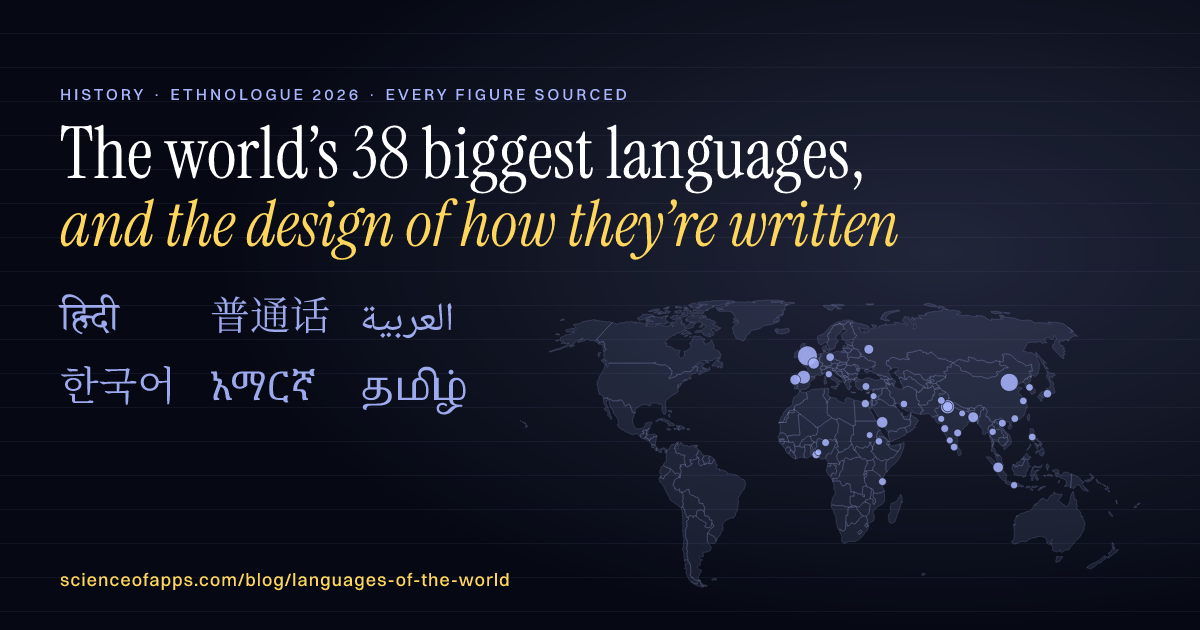
Quick answer: which languages have 50 million or more speakers?
- English — 1.49 billion (372 million native)
- Mandarin Chinese — 1.18 billion (988 million native)
- Hindi — 611 million (347 million native)
- Spanish — 561 million (487 million native)
- Modern Standard Arabic — 335 million
- French — 334 million (75 million native)
- Bengali — 274 million (234 million native)
- Portuguese — 269 million (252 million native)
- Indonesian — 255 million (78 million native)
- Urdu — 246 million (78 million native)
…and 28 more, from Russian to Bhojpuri. Source: Ethnologue 2026 [1,2].
Explore all 38
Ethnologue ranks individual languages, not "macrolanguages", so Arabic and Chinese appear as several separate varieties — Modern Standard, Egyptian, Levantine and Sudanese Arabic; Mandarin, Cantonese and Wu Chinese[1,2]. Counts include second-language speakers, which is why English, spoken natively by 372 million, leads with 1.49 billion[2].
- Languages
- 3850M+ speakers each
- Scripts
- 187 basic kinds
- Language families
- 12Indo-European is the largest
- Speaker counts, added
- 8.1Bpeople counted once per language
Showing 38 of 38 languages
- 01EnglishEnglish1.49B speakers372M first · 1.12B second
- 02普通话Mandarin Chinese1.18B speakers988M first · 194M second
- 03हिन्दीHindi611M speakers347M first · 264M second
- 04españolSpanish561M speakers487M first · 75M second
- 05العربية الفصحىModern Standard Arabic335M speakers0 first · 335M second
- 06françaisFrench334M speakers75M first · 258M second
- 07বাংলাBengali274M speakers234M first · 43M second
- 08portuguêsPortuguese269M speakers252M first · 18M second
- 09Bahasa IndonesiaIndonesian255M speakers78M first · 177M second
- 10اُردُوUrdu246M speakers78M first · 168M second
- 11русскийRussian210M speakers133M first · 77M second
- 12DeutschGerman133M speakers76M first · 57M second
- 13日本語Japanese126M speakers124M first · 2M second
- 14NaijáNigerian Pidgin121M speakers5M first · 116M second
- 15مصريEgyptian Arabic118M speakers83M first · 35M second
- 16मराठीMarathi99M speakers83M first · 16M second
- 17Tiếng ViệtVietnamese97M speakers86M first · 11M second
- 18తెలుగుTelugu96M speakers83M first · 13M second
- 19KiswahiliSwahili95M speakers4M first · 91M second
- 20HausaHausa95M speakers58M first · 36M second
- 21TürkçeTurkish94M speakers86M first · 7M second
- 22پنجابیWestern Punjabi90M speakers
- 23TagalogTagalog (Filipino)87M speakers33M first · 54M second
- 24தமிழ்Tamil86M speakers79M first · 8M second
- 25粵語Cantonese (Yue Chinese)86M speakers85M first · 1M second
- 26吴语Wu Chinese83M speakers83M first · — second
- 27فارسیPersian (Iranian)82M speakers65M first · 17M second
- 28한국어Korean82M speakers82M first · 1M second
- 29አማርኛAmharic78M speakers39M first · 39M second
- 30ภาษาไทยThai71M speakers27M first · 44M second
- 31ꦧꦱꦗꦮJavanese69M speakers
- 32italianoItalian66M speakers60M first · 6M second
- 33ગુજરાતીGujarati62M speakers58M first · 5M second
- 34ಕನ್ನಡKannada59M speakers44M first · 15M second
- 35شاميLevantine Arabic58M speakers55M first · 3M second
- 36عربي سودانيSudanese Arabic54M speakers43M first · 11M second
- 37YorùbáYoruba53M speakers48M first · 5M second
- 38भोजपुरीBhojpuri53M speakers53M first · — second
First language vs second language
For 9 of the 38, more people speak the language as a second language than as a first: English, Modern Standard Arabic, French, Indonesian, Urdu, Nigerian Pidgin, Swahili, Tagalog (Filipino), Thai. These are the bridge languages of trade, school and government[2].
English is the biggest of these bridge languages, and most of its speakers learned it as a second language. If you’re one of them, our free English level test places you on the CEFR scale from A1 to C2 and gives you a certificate for your CV and LinkedIn.
- English
- Mandarin Chinese
- Hindi
- Spanish
- Modern Standard Arabic
- French
- Bengali
- Portuguese
- Indonesian
- Urdu
- Russian
- German
- Japanese
- Nigerian Pidgin
- Egyptian Arabic
- Marathi
- Vietnamese
- Telugu
- Swahili
- Hausa
- Turkish
- Western Punjabi
- Tagalog (Filipino)
- Tamil
- Cantonese (Yue Chinese)
- Wu Chinese
- Persian (Iranian)
- Korean
- Amharic
- Thai
- Javanese
- Italian
- Gujarati
- Kannada
- Levantine Arabic
- Sudanese Arabic
- Yoruba
- Bhojpuri
Added together, their speaker counts reach 8.1 billion, because many people speak two or three of these languages and are counted once for each[2].
“How are you?” in 38 languages
The same question, written in each language's own script — and spoken. Press play to hear all of them one after another, or pick one to stop the stage; each language page compares it side by side with any other and cites its phrasebook source.
Synthetic voice (ElevenLabs Eleven v3, voice “Sia”). Pronunciation is approximate and may not match a native speaker; Cantonese and Wu Chinese are not voiced because the model reads Chinese characters with Mandarin sounds.
Where writing came from
Most of the world's alphabets descend from a single invention. In the second millennium BCE, Semitic speakers in Egypt and Sinai adapted Egyptian hieroglyphs into Proto-Sinaitic, considered the earliest alphabet; its Phoenician descendant spread around the Mediterranean[3,4,5].
Took shape in use from the 7th century CE and in its present form by about the 11th century.
→ → → → → →
Phoenician gave rise to Greek, and through it to Latin and Cyrillic, and to Aramaic, whose Nabataean branch became Arabic[5,6,7]. Ancient South Arabian, another offshoot of Proto-Sinaitic, became Ge'ez[8,9].
India's Brahmi, the ancestor of every Indian script and, through Pallava, of Thai and Javanese, may have been inspired by Aramaic, but its origin is still debated, so that link is drawn dashed[10,5,11]. Chinese writing arose on its own from the oracle bones of the Shang dynasty[12], and Hangul was invented outright in 1443[13].
Seven kinds of script
Writing systems differ in what one symbol stands for. The 18 scripts on this page use seven basic designs; see chunking for why units like Hangul's syllable blocks are easier to read.
- HxpgLatin alphabet · Hxpg
Alphabet
One letter for each consonant and vowel.
Latin alphabet · Cyrillic alphabet
- سلامArabic script · salām
Abjad (consonants)
Letters write consonants; short vowels are optional marks.
Arabic script · Persian alphabet (Perso-Arabic) · Nastaliq (Urdu and Shahmukhi)
- नमस्तेDevanagari · namaste
Abugida (syllabic)
Each consonant carries a vowel, changed by marks attached to it.
Devanagari · Bengali–Assamese script · Gujarati script · Telugu script · Kannada script · Tamil script · Thai script · Ge'ez (Ethiopic) script · Javanese script (Aksara Jawa)
- 你好Chinese characters · nǐ hǎo
Logographic
Each character writes a word or meaningful part of one.
Chinese characters (simplified) · Chinese characters (traditional)
- 日本語Japanese · nihongo
Mixed system
Several writing systems are used together in one sentence.
Japanese (kanji, hiragana, katakana)
- 한글Hangul · hangeul
Featural alphabet
Letter shapes encode how the sound is made.
Hangul
Ten ways to write 0–9
The digits 0–9 used worldwide began in India, where they developed out of Brahmi numerals; they reached the Islamic world through writers such as al-Khwarizmi and Europe through Fibonacci's Liber abaci of 1202[14,15]. Many scripts still keep their own forms of the same ten digits.
- Western (Hindu-Arabic)14 Latin-script languages, plus Korean and most of the world1947
- 00
- 11
- 22
- 33
- 44
- 55
- 66
- 77
- 88
- 99
- Arabic scriptModern Standard Arabic, Egyptian Arabic, Levantine Arabic, Sudanese Arabic١٩٤٧
- ٠0
- ١1
- ٢2
- ٣3
- ٤4
- ٥5
- ٦6
- ٧7
- ٨8
- ٩9
- Persian and UrduUrdu, Western Punjabi, Persian (Iranian)۱۹۴۷
- ۰0
- ۱1
- ۲2
- ۳3
- ۴4
- ۵5
- ۶6
- ۷7
- ۸8
- ۹9
- DevanagariHindi, Marathi, Bhojpuri१९४७
- ०0
- १1
- २2
- ३3
- ४4
- ५5
- ६6
- ७7
- ८8
- ९9
- Bengali–Assamese scriptBengali১৯৪৭
- ০0
- ১1
- ২2
- ৩3
- ৪4
- ৫5
- ৬6
- ৭7
- ৮8
- ৯9
- Gujarati scriptGujarati૧૯૪૭
- ૦0
- ૧1
- ૨2
- ૩3
- ૪4
- ૫5
- ૬6
- ૭7
- ૮8
- ૯9
- Telugu scriptTelugu౧౯౪౭
- ౦0
- ౧1
- ౨2
- ౩3
- ౪4
- ౫5
- ౬6
- ౭7
- ౮8
- ౯9
- Kannada scriptKannada೧೯೪೭
- ೦0
- ೧1
- ೨2
- ೩3
- ೪4
- ೫5
- ೬6
- ೭7
- ೮8
- ೯9
- Tamil scriptTamil௧௯௪௭
- ௦0
- ௧1
- ௨2
- ௩3
- ௪4
- ௫5
- ௬6
- ௭7
- ௮8
- ௯9
- Chinese and JapaneseMandarin Chinese, Japanese, Cantonese (Yue Chinese), Wu Chinese一九四七
- 〇0
- 一1
- 二2
- 三3
- 四4
- 五5
- 六6
- 七7
- 八8
- 九9
- JapaneseMandarin Chinese, Japanese, Cantonese (Yue Chinese), Wu Chinese一九四七
- 〇0
- 一1
- 二2
- 三3
- 四4
- 五5
- 六6
- 七7
- 八8
- 九9
- Thai scriptThai๑๙๔๗
- ๐0
- ๑1
- ๒2
- ๓3
- ๔4
- ๕5
- ๖6
- ๗7
- ๘8
- ๙9
- Ge'ez (Ethiopic) scriptAmharicnot positional
- —0
- ፩1
- ፪2
- ፫3
- ፬4
- ፭5
- ፮6
- ፯7
- ፰8
- ፱9
- Javanese scriptJavanese꧑꧙꧔꧗
- ꧐0
- ꧑1
- ꧒2
- ꧓3
- ꧔4
- ꧕5
- ꧖6
- ꧗7
- ꧘8
- ꧙9
What scripts teach product owners
Writing systems are the oldest interfaces humans have designed, refined over centuries by millions of readers. Six lessons carry straight into apps — and into the conventions users bring with them.
Store meaning, draw appearance
In Devanagari the vowel sign ि is drawn before its consonant but spoken after it. Unicode stores text in spoken order and leaves drawing to the font — a clean split between data and presentation that every design system should copy[16].
See it in Hindi →Direction is not one-way
Arabic, Persian and Urdu run right to left, but numbers inside them run left to right, so one line can change direction twice. Interfaces built for these languages must handle both[17].
See it in Arabic →Case is a local rule
Uppercasing 'i' gives 'İ' in Turkish, not 'I'. Most of the world's scripts have no case at all. Never assume a transformation works the same way in every language[18].
See it in Turkish →Spaces are optional
Thai and traditional Javanese do not separate words with spaces, so line-breaking needs a dictionary. Truncating text at the nearest space breaks in these languages[19,20].
See it in Thai →Tools shape forms
The reed pen's square dot became the unit of Arabic calligraphy, and round South Indian letters are often linked to writing on palm leaves. Every interface is shaped by the medium it is made for, too[21,22].
See it in Tamil →A system beats a set of one-offs
Hangul builds every syllable from 24 letters by rule, and Ge'ez makes seven vowel forms of each consonant by regular marks. Readers learn the pattern once — the same reason consistent components make apps easier to learn[13,23].
See it in Korean →
The full table
| Own name | ||||||||
|---|---|---|---|---|---|---|---|---|
| 1 | English | English | 1.5B | 372M | 1.1B | Latin alphabet | Indo-European | |
| 2 | Mandarin Chinese | 普通话 | 1.2B | 988M | 194M | Chinese characters | Sino-Tibetan | |
| 3 | Hindi | हिन्दी | 611M | 347M | 264M | Devanagari | Indo-European | |
| 4 | Spanish | español | 561M | 487M | 75M | Latin alphabet | Indo-European | |
| 5 | Modern Standard Arabic | العربية الفصحى | 335M | 0 | 335M | Arabic script | Afro-Asiatic | |
| 6 | French | français | 334M | 75M | 258M | Latin alphabet | Indo-European | |
| 7 | Bengali | বাংলা | 274M | 234M | 43M | Bengali–Assamese script | Indo-European | |
| 8 | Portuguese | português | 269M | 252M | 18M | Latin alphabet | Indo-European | |
| 9 | Indonesian | Bahasa Indonesia | 255M | 78M | 177M | Latin alphabet | Austronesian | |
| 10 | Urdu | اُردُو | 246M | 78M | 168M | Nastaliq | Indo-European | |
| 11 | Russian | русский | 210M | 133M | 77M | Cyrillic alphabet | Indo-European | |
| 12 | German | Deutsch | 133M | 76M | 57M | Latin alphabet | Indo-European | |
| 13 | Japanese | 日本語 | 126M | 124M | 2M | Japanese | Japonic | |
| 14 | Nigerian Pidgin | Naijá | 121M | 5M | 116M | Latin alphabet | English-based creole | |
| 15 | Egyptian Arabic | مصري | 118M | 83M | 35M | Arabic script | Afro-Asiatic | |
| 16 | Marathi | मराठी | 99M | 83M | 16M | Devanagari | Indo-European | |
| 17 | Vietnamese | Tiếng Việt | 97M | 86M | 11M | Latin alphabet | Austroasiatic | |
| 18 | Telugu | తెలుగు | 96M | 83M | 13M | Telugu script | Dravidian | |
| 19 | Swahili | Kiswahili | 95M | 4M | 91M | Latin alphabet | Niger–Congo | |
| 20 | Hausa | Hausa | 95M | 58M | 36M | Latin alphabet | Afro-Asiatic | |
| 21 | Turkish | Türkçe | 94M | 86M | 7M | Latin alphabet | Turkic | |
| 22 | Western Punjabi | پنجابی | 90M | — | — | Nastaliq | Indo-European | |
| 23 | Tagalog (Filipino) | Tagalog | 87M | 33M | 54M | Latin alphabet | Austronesian | |
| 24 | Tamil | தமிழ் | 86M | 79M | 8M | Tamil script | Dravidian | |
| 25 | Cantonese (Yue Chinese) | 粵語 | 86M | 85M | 1M | Chinese characters | Sino-Tibetan | |
| 26 | Wu Chinese | 吴语 | 83M | 83M | — | Chinese characters | Sino-Tibetan | |
| 27 | Persian (Iranian) | فارسی | 82M | 65M | 17M | Persian alphabet | Indo-European | |
| 28 | Korean | 한국어 | 82M | 82M | 1M | Hangul | Koreanic | |
| 29 | Amharic | አማርኛ | 78M | 39M | 39M | Ge'ez (Ethiopic) script | Afro-Asiatic | |
| 30 | Thai | ภาษาไทย | 71M | 27M | 44M | Thai script | Kra–Dai | |
| 31 | Javanese | ꦧꦱꦗꦮ | 69M | — | — | Javanese script | Austronesian | |
| 32 | Italian | italiano | 66M | 60M | 6M | Latin alphabet | Indo-European | |
| 33 | Gujarati | ગુજરાતી | 62M | 58M | 5M | Gujarati script | Indo-European | |
| 34 | Kannada | ಕನ್ನಡ | 59M | 44M | 15M | Kannada script | Dravidian | |
| 35 | Levantine Arabic | شامي | 58M | 55M | 3M | Arabic script | Afro-Asiatic | |
| 36 | Sudanese Arabic | عربي سوداني | 54M | 43M | 11M | Arabic script | Afro-Asiatic | |
| 37 | Yoruba | Yorùbá | 53M | 48M | 5M | Latin alphabet | Niger–Congo | |
| 38 | Bhojpuri | भोजपुरी | 53M | 53M | — | Devanagari | Indo-European |
How we built this
- Which languages: every individual language with 50 million or more total speakers in Ethnologue's 2026 ranking [1,2]. Ethnologue's own page publishes the top 20 to one decimal; ranks 21–38 use its 2026 figures rounded to the million. A dash means Ethnologue gives no first/second-language split.
- Phrases: each “How are you?”, “Hello” and “Thank you” comes from a published phrasebook — Omniglot for most languages, the British Council for Nigerian Pidgin, and learner guides for Sudanese Arabic — and is cited on its page. Spoken varieties without a fixed spelling (Levantine and Sudanese Arabic, Nigerian Pidgin) vary from writer to writer.
- History and design: dates and claims are cited to Encyclopaedia Britannica, the Unicode Standard 17.0, UNESCO, government records, museums and primary sources. Where scholars disagree — the age of the Ram Khamhaeng inscription, the date of Halmidi, Brahmi's origin — the page says so.
- Maps: Natural Earth's public-domain 1:110m country outlines; shading marks whole countries where a language is official or widely spoken, and pins mark where it began. Small places appear as dots.
- Type: every script is set in a Noto typeface, subset to the characters each page shows, so the letters you see are drawn by a font made for that script.
Frequently asked questions
What are the most spoken languages in the world?
By total speakers (first and second language), Ethnologue's 2026 ranking puts English first with about 1.49 billion, followed by Mandarin Chinese (1.18 billion), Hindi (611 million), Spanish (561 million) and Modern Standard Arabic (335 million).
How many languages have more than 50 million speakers?
38 languages have 50 million or more total speakers in Ethnologue's 2026 figures. Ethnologue counts individual languages, so varieties of Arabic and Chinese such as Egyptian Arabic, Cantonese and Wu are listed separately.
Which language has the most native speakers?
Mandarin Chinese, with about 988 million first-language speakers. English has more speakers in total, but most of them (1.12 billion) learned it as a second language.
Which writing system do the most languages use?
The Latin alphabet: 14 of the 38 languages are written mainly in it, including English, Spanish, French, Portuguese, Indonesian, Vietnamese, Turkish and Swahili. Brahmic scripts descended from ancient Brahmi come next, used across South and Southeast Asia.
Why are Hindi and Urdu listed as separate languages?
Spoken Hindi and Urdu are largely mutually intelligible — linguists call the shared base Hindustani — but they have separate standards: Hindi is written in Devanagari and draws learned words from Sanskrit; Urdu is written in Perso-Arabic Nastaliq and draws them from Persian and Arabic. Ethnologue counts them separately.
What was the first alphabet?
Proto-Sinaitic, created in the second millennium BCE by Semitic speakers in Egypt and Sinai who adapted Egyptian hieroglyphs, is considered the earliest alphabet. Through its descendant Phoenician it is the ancestor of Greek, Latin, Cyrillic, Arabic and, possibly, India's Brahmi.
Which major languages are written right to left?
Among the 38 languages with 50 million or more speakers, Modern Standard Arabic, Urdu, Egyptian Arabic, Western Punjabi, Persian (Iranian), Levantine Arabic, Sudanese Arabic are written right to left, in the Arabic script or its Persian and Nastaliq styles. Numbers inside right-to-left text still run left to right.
Where do the numbers 0–9 come from?
They began in India, developing from Brahmi numerals, and reached Europe through the Arabic world — Fibonacci's Liber abaci of 1202 popularised them — which is why they are called Hindu-Arabic numerals. Scripts such as Devanagari, Bengali, Thai and Arabic still use their own forms of the same ten digits.
Sources
- Ethnologue — What are the top 200 most spoken languages? (2026)
- Wikipedia — List of languages by total number of speakers (Ethnologue 2026 figures, retrieved October 2026)
- Omniglot — Proto-Sinaitic script
- Omniglot — Phoenician alphabet
- Encyclopaedia Britannica — Alphabet (writing)
- Omniglot — Aramaic alphabet
- Omniglot — Nabataean alphabet
- Omniglot — Ancient South Arabian script
- Omniglot — Ge'ez (Ethiopic) script
- Encyclopaedia Britannica — Brahmi
- Omniglot — Pallava script
- Encyclopaedia Britannica — Chinese languages
- Encyclopaedia Britannica — Hangul
- Encyclopaedia Britannica — Hindu-Arabic numerals
- Encyclopaedia Britannica — Liber abaci (1202)
- The Unicode Standard 17.0, chapter 12: South and Central Asia-I (Devanagari, Bengali, Gujarati, Tamil, Telugu, Kannada)
- The Unicode Standard 17.0, chapter 9: Middle East-I (Arabic)
- The Unicode Standard 17.0, chapter 7: Europe-I (Latin, Greek, Cyrillic)
- The Unicode Standard 17.0, chapter 16: Southeast Asia-I (Thai)
- The Unicode Standard 17.0, chapter 17: Southeast Asia-II (Javanese, Philippine scripts, Kawi)
- Asian Art Museum, San Francisco — The history of Islamic calligraphy
- Wikipedia — Ola leaf (palm-leaf writing and rounded scripts)
- The Unicode Standard 17.0, chapter 19: Africa (Ethiopic)
Checked October 25, 2026. Each language page lists the sources for its own history, phrases and script. Found an error? Tell us.
Where to go from here
- Chunking — why grouped units, like syllable blocks, are easier to read
- The aesthetic-usability effect — why beautiful letterforms feel easier to use
- Design historyWindows evolution: how every version from Windows 1.0 to Windows 11 was designed, and what testing changedWindows evolution from tiled Windows 1.0 (1985) to Windows 11: the Start button, XP's Bliss, Windows 8's missing Start and the tests behind each change.
- Architecture & engineeringUNESCO World Heritage Sites in India: all 45, with a map, dates and what makes each one specialIndia has 45 UNESCO World Heritage Sites as of 2026, after Sarnath: 37 cultural, 7 natural, 1 mixed. All of them on one map, with dates and design notes.
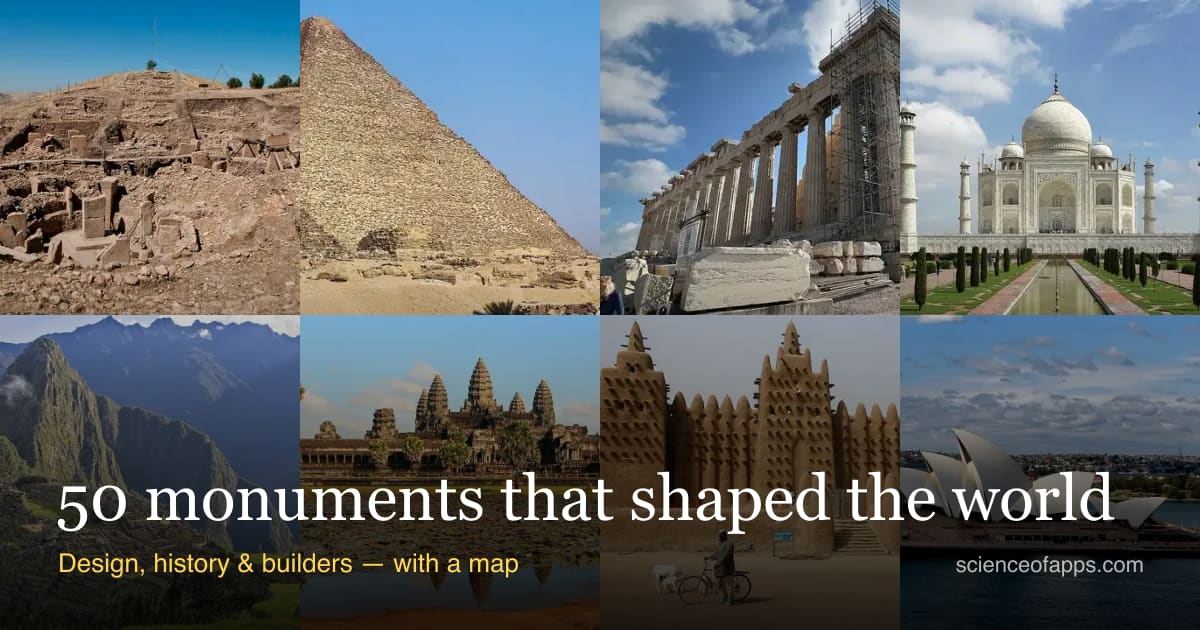
- History50 of the world's greatest monuments: how they were designed, built and changedA design history of 50 famous monuments, from 11,600-year-old Göbekli Tepe to the Burj Khalifa: who built them, when and how they changed, with a map.
- Architecture & engineeringDelhi Metro history: how India's biggest metro was designed and built, phase by phaseDelhi Metro history from its first 8 km in 2002 to a network of more than 370 km: who built it, how each phase grew and the design choices behind it.
- Design historyiPhone evolution: every iPhone from 2007 to 2026, and the design decisions that shaped itiPhone evolution from the 3.5-inch original (2007) to the foldable iPhone Duo (2026): every model, the design change it made and why Apple made it.
- Design historyLogo evolution: how 20 famous logos changed, and why almost all of them got simplerLogo evolution of 20 brands from Coca-Cola (1886) to Air India (2023): who designed each, what changed, and the memory science behind simpler logos.

Get the ideas, not the noise.
Sign up with Google and we’ll send you short UX psychology tips by email — why people tap, stall and leave, and what to do about it. Unsubscribe anytime. Prefer something to keep? Get the free Laws of UX guide as a PDF.