GitHub Copilot Certification
Tests practical, professional use of GitHub Copilot — choosing between code completions, Copilot Chat, agent mode and the Copilot coding agent; giving Copilot the right context through prompts, custom instructions and prompt files; reviewing, testing and securing AI-generated code; and the privacy, policy and administration settings organisations rely on — written to GitHub Docs, VS Code documentation and GitHub's responsible-use guidance for 2026. For the official exam, see the GH-300 practice test. Pass to earn GitHub Copilot Proficiency SOA-GC.
- Intermediate difficulty.Assumes hands-on experience in the role.
- 20 scenario questions
- 20 minutes, timed
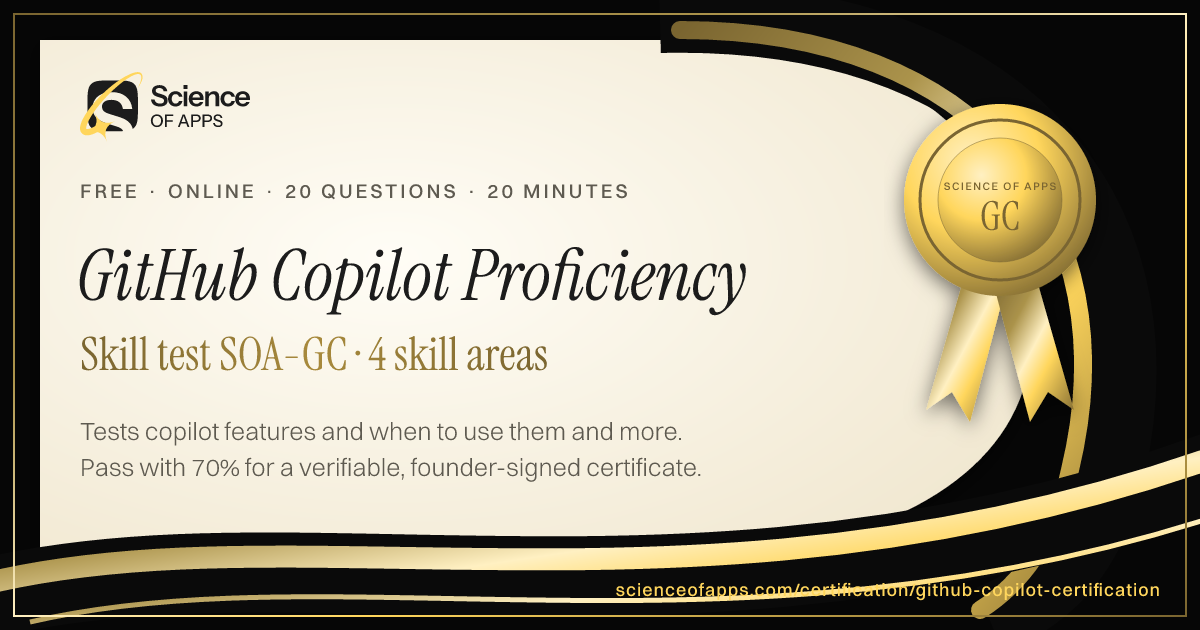
- 70% to pass · 90% for distinction
- Free no sign-up needed
- LinkedIn-ready · add it to your profile in one clickSee how ↓

 Founder, Science of Apps
What is the GitHub Copilot Certification?
- Career Booster
- Quality Assured
- Exclusive Certification
Updated for 2026 and 2027. Covers copilot features and when to use them, prompting and context, reviewing, testing and securing AI-Generated code and privacy, policies and administration.
The GitHub Copilot Certification is a free intermediate-level, 20-minute skill test from Science of Apps. It tests practical, professional use of GitHub Copilot — choosing between code completions, Copilot Chat, agent mode and the Copilot coding agent; giving Copilot the right context through prompts, custom instructions and prompt files; reviewing, testing and securing AI-generated code; and the privacy, policy and administration settings organisations rely on — written to GitHub Docs, VS Code documentation and GitHub's responsible-use guidance for 2026. For the official exam, see the GH-300 practice test. Score 70% or more on its 20 questions to earn a verifiable GitHub Copilot Proficiency certificate (SOA-GC). Every question is based on published standards and research — including GitHub Copilot documentation (GitHub Docs), Responsible use of GitHub Copilot Chat in your IDE (GitHub Docs), Best practices for using GitHub Copilot (GitHub Docs) — and each answer is explained with its source.
Built for your job title
Software developer, Engineering lead, DevOps or platform engineer, Student developer and Developer productivity or enablement lead — and anyone who wants quick, verifiable proof of GitHub Copilot knowledge for a CV or LinkedIn in 2026 and 2027.
- Software developer
- Engineering lead
- DevOps or platform engineer
- Student developer
- Developer productivity or enablement lead
What the test covers
Four skill areas with 5 questions each, drawn from a bank of 10 per area, so a retake brings questions you haven't seen.
Copilot Features and When to Use Them
25%- Completions and next edit suggestions
- Chat, agent mode and coding agent
- Plans and models
Prompting and Context
25%- Writing good prompts
- Context
- Custom instructions and prompt files
Reviewing, Testing and Securing AI-Generated Code
25%- Verification
- Security
- Responsible use
Privacy, Policies and Administration
25%- Content exclusion
- Organisation policies
- Data handling
Based on published standards
The questions are original scenarios, and each one names the public standard, official guide or research it draws on — shown under the question while you answer, and linked in your review. These are the sources behind this test:
- GitHub Copilot documentationGitHub Docs11 questions
- Responsible use of GitHub Copilot Chat in your IDEGitHub Docs9 questions
- Best practices for using GitHub CopilotGitHub Docs8 questions
- Use agent mode in VS CodeMicrosoft (Visual Studio Code docs)4 questions
- About GitHub Copilot coding agentGitHub Docs2 questions
- GitHub Copilot Chat cheat sheetGitHub Docs2 questions
- Adding repository custom instructions for GitHub CopilotGitHub Docs2 questions
- Excluding content from GitHub CopilotGitHub Docs2 questions
Try a sample question
Where do you put repository-wide instructions that Copilot should follow in every chat?
- .vscode/settings.json
- README.md at the root
- .gitignore in the root
- .github/copilot-instructions.md
Show the answer
D. .github/copilot-instructions.md — Repository custom instructions file. The real test has 20 questions like this.
How the test works
20 minutes, 20 questions
One question per screen, with a progress bar and a countdown. Your progress is saved on this device if you need to pause.
Graded on our server
Answers reach the page only after you submit, so the certificate can only be earned by passing.
Every answer explained
Pass or not, you see every question with the right answer, why, and the source behind it. Pass mark 70%, distinction 90%.
Your certificate
Founder-signed, with a QR code and credential ID. Download PDF or PNG, add to LinkedIn, and it's emailed to you.
What you earn
Pass, then add it to LinkedIn in one click
No typing. The Add to LinkedIn button opens your profile’s Licenses & certifications form already filled in: the certificate name, Science of Apps as the issuer, the issue date, your credential ID and a link recruiters can use to verify it.
- 1Take the 20-minute test
- 2Score 70% or more
- 3Click Add to LinkedIn

GitHub Copilot Proficiency
Science of Apps
Show credential ↗Try another skill test
- SpecialistSOA-AIUX
AI UX Design Certification
Certifies that you can design AI-powered products people trust — setting expectations, conversational and agent UX, handling errors and uncertainty, and responsible AI.
Difficulty: AdvancedEarn Certified AI Product Designer → - SpecialistSOA-PE
Prompt Engineering Certification
Certifies that you can get reliable results from large language models — prompt fundamentals, structure and reasoning, prompting for real product work, and evaluation, safety and reliability.
Difficulty: IntermediateEarn Certified Prompt Engineer → - ProfessionalSOA-AIPM
AI Product Manager Certification
Certifies that you can manage AI products — finding the right AI opportunities, data, models and evaluation, AI UX, trust and safety, and shipping, cost and operations.
Difficulty: AdvancedEarn Certified AI Product Manager →
Frequently asked questions
What is the GitHub Copilot Certification?
The GitHub Copilot Certification is a free intermediate-level, 20-minute skill test from Science of Apps. It tests practical, professional use of GitHub Copilot — choosing between code completions, Copilot Chat, agent mode and the Copilot coding agent; giving Copilot the right context through prompts, custom instructions and prompt files; reviewing, testing and securing AI-generated code; and the privacy, policy and administration settings organisations rely on — written to GitHub Docs, VS Code documentation and GitHub's responsible-use guidance for 2026. For the official exam, see the GH-300 practice test. Score 70% or more on its 20 questions to earn a verifiable GitHub Copilot Proficiency certificate (SOA-GC). Every question is based on published standards and research — including GitHub Copilot documentation (GitHub Docs), Responsible use of GitHub Copilot Chat in your IDE (GitHub Docs), Best practices for using GitHub Copilot (GitHub Docs) — and each answer is explained with its source.
Where can I take a free GitHub Copilot test online?
Science of Apps offers a free GitHub Copilot Certification, updated for 2026 and 2027. It measures copilot features and when to use them, prompting and context, reviewing, testing and securing AI-Generated code and privacy, policies and administration and gives instant results with a shareable certificate.
How do I take the GitHub Copilot Certification for free?
Read the four skill areas on this page, then take the 20-minute test online — no fee, course or sign-up. You see every answer explained when you finish. Score 70% or more and you get a GitHub Copilot Proficiency certificate straight away, on screen, as a PDF and by email, with a credential ID anyone can verify.
Are the GitHub Copilot Certification questions based on real standards?
Yes. The questions are original scenarios written by Science of Apps, and each one is based on a public source you can read: GitHub Copilot documentation (GitHub Docs); Responsible use of GitHub Copilot Chat in your IDE (GitHub Docs); Best practices for using GitHub Copilot (GitHub Docs); Use agent mode in VS Code (Microsoft (Visual Studio Code docs)); About GitHub Copilot coding agent (GitHub Docs); GitHub Copilot Chat cheat sheet (GitHub Docs). The source is shown under each question and linked in the answer review. Science of Apps doesn't copy questions from other tests.
What does the GitHub Copilot Certification cover?
Four skill areas with five questions each, drawn from a bank of 10 per area so a retake brings new questions: Copilot Features and When to Use Them (Completions and next edit suggestions, Chat, agent mode and coding agent and Plans and models); Prompting and Context (Writing good prompts, Context and Custom instructions and prompt files); Reviewing, Testing and Securing AI-Generated Code (Verification, Security and Responsible use); Privacy, Policies and Administration (Content exclusion, Organisation policies and Data handling). Every question is an original scenario written to the 2026–2027 standard, with the published source named under it.
Who should take the GitHub Copilot Certification?
Software developer, Engineering lead, DevOps or platform engineer, Student developer and Developer productivity or enablement lead. It suits anyone who wants a quick, verifiable way to show GitHub Copilot knowledge in 2026 and 2027, from students and career switchers to experienced professionals.
Is there an official GitHub Copilot certification?
Yes. GitHub's GitHub Copilot certification is earned by passing the GH-300 exam, which covers responsible AI, Copilot plans and features, how Copilot works with data, prompt engineering, developer use cases, testing, and privacy and content exclusions. This skill test checks the same practical judgement in day-to-day use.
What is the difference between Copilot agent mode and the coding agent?
Agent mode runs in your editor: it plans multi-file changes, runs commands with your approval and iterates while you watch. The Copilot coding agent works in the background on GitHub: you assign it an issue, it works in its own environment and opens a pull request for you to review.
Can I take the GitHub Copilot Certification from any country?
Yes. The test is online, in English and free everywhere — people take it from India, the US, the UK, Europe, Africa, Latin America and Asia-Pacific. Your certificate is dated with your own local date and can be verified from anywhere at scienceofapps.com/certification/verify/.
How long is the GitHub Copilot Certification?
20 questions — 5 from each of 4 skill areas — with a 20-minute limit. You need 70% (14 of 20) to pass and 90% for distinction.
How hard is the GitHub Copilot Certification?
We rate it Intermediate: assumes hands-on experience in the role. It has 20 scenario questions — 5 from each of 4 skill areas — and a 20-minute limit. You need 70% (14 of 20) to pass and 90% for distinction.
How much do Science of Apps certifications cost?
Nothing. There is no fee to take a test, to receive the certificate, to have it emailed or to verify it, and no sign-up.
How are the tests graded?
On our server, not in your browser. The answers never reach the page until you submit, so a certificate can only be earned by passing. Each certificate gets a unique credential ID stored by Science of Apps.
What happens if I don't pass?
You see your score for each area and every question with the correct answer and why, with the published source behind it. You can retake after 30 minutes, and the retake draws questions you haven't seen yet.
Do the certificates expire?
No. Every certificate is dated, so it always shows when you passed. Retake a test any time for a newer date or a higher score.
Can I add the certificate to LinkedIn?
Yes. After you pass, Add to LinkedIn opens the Licenses & certifications form with the certificate name, Science of Apps as the issuer, the issue date, your credential ID and the verification link filled in. You can also download it as a PDF or PNG, and it's emailed to you as a PDF.
How can an employer verify my certificate?
Every certificate has a credential ID and a QR code. Scanning it, or entering the ID at scienceofapps.com/certification/verify/, shows the holder's name, the certification, the score and the issue date from our records.
Are these accredited qualifications?
No. They are Science of Apps' own assessments of applied skill. They aren't issued by a university or standards body, and they work best alongside a portfolio that shows the skills in real work.
2402 more certifications to collect
AI & Generative AI
- AI UX Design Certification30 min · Advanced
- Prompt Engineering Certification30 min · Intermediate
- AI Product Manager Certification30 min · Advanced
- AI Literacy Certification10 min · Beginner
- Generative AI Certification Test (Fundamentals)10 min · Beginner
- AI Tools for Workplace Productivity Certification10 min · Beginner
- Advanced Prompt Engineering Assessment20 min · Advanced
- AI Workflow Automation Certification15 min · Intermediate
- AI Agent Design and Orchestration Certification20 min · Advanced
- AI Agent Evaluation and Reliability Certification20 min · Advanced
- AI Research and Fact-Checking Certification15 min · Intermediate
- AI Output Quality Assurance Certification15 min · Intermediate
- AI Hallucination Detection Test15 min · Intermediate
- AI Safety Certification Test15 min · Intermediate
- AI Ethics Certification Test15 min · Intermediate
- AI Governance Certification Test (Fundamentals)20 min · Advanced
- AI for Business Certification Test10 min · Beginner
- AI for Entrepreneurs and Founders Certification10 min · Beginner
- AI for Managers and Team Leaders Certification15 min · Intermediate
- AI for HR Certification Test10 min · Beginner
- AI for Sales Professionals Certification10 min · Beginner
- AI for Digital Marketers Certification10 min · Beginner
- AI for UX/UI Designers Certification15 min · Intermediate
- AI for Product Managers Certification15 min · Intermediate
- AI for Software Developers Certification15 min · Intermediate
- AI for Data Analysts Certification15 min · Intermediate
- AI for Teachers and Educators Certification10 min · Beginner
- AI for Customer Support Certification10 min · Beginner
- AI Content Creation and Editing Certification10 min · Beginner
- AI Image Generation and Art Direction Certification15 min · Intermediate
- AI Video Generation and Editing Certification15 min · Intermediate
- AI Coding Assistant Proficiency Certification15 min · Intermediate
- Retrieval-Augmented Generation (RAG) Fundamentals Certification20 min · Advanced
- LLM Evaluation and Benchmarking Certification20 min · Advanced
- AI Data Privacy and Security Certification15 min · Intermediate
- AI Adoption and Change Management Certification15 min · Intermediate
- Deep Learning Certification25 min · Advanced
- MLOps Certification25 min · Advanced
- LLM Application Development Certification25 min · Advanced
- LLM Fine-Tuning Certification25 min · Advanced
- Multimodal AI Certification20 min · Intermediate
- AI Data Annotation Test15 min · Beginner
- LLM Inference Optimization Test25 min · Advanced
- Vector Database & Semantic Search Certification20 min · Intermediate
- LLM Observability Certification20 min · Intermediate
- LLM Cost Optimization Test20 min · Intermediate
- AI Red Teaming Certification25 min · Advanced
- EU AI Act Compliance Certification20 min · Intermediate
- ChatGPT Certification Test20 min · Intermediate
- Claude Certification Test20 min · Intermediate
- Gemini Certification Test20 min · Intermediate
- Claude Code Certification Test25 min · Advanced
- MCP Certification Test25 min · Advanced
- Context Engineering Certification Test25 min · Advanced
- n8n Certification Test20 min · Intermediate
- ISO 42001 Certification Test25 min · Advanced
- AI Literacy Test (EU AI Act)15 min · Beginner
- AI-900 Practice Test15 min · Beginner
- AI-102 Practice Test25 min · Advanced
- AWS AI Practitioner Practice Exam15 min · Beginner
- Google Generative AI Leader Practice Exam15 min · Beginner
- PyTorch Quiz25 min · Advanced
- TensorFlow Quiz25 min · Advanced
- NLP Quiz20 min · Intermediate
- Computer Vision Quiz20 min · Intermediate
- Vibe Coding Certification Test20 min · Intermediate
- LangChain Certification Test25 min · Advanced
- Copilot Studio Certification Test20 min · Intermediate
- NIST AI RMF Certification Test20 min · Intermediate
- Prompt Injection Security Test20 min · Intermediate
- Deepfake Quiz15 min · Beginner
- AWS ML Engineer Associate Practice Exam25 min · Advanced
- Google Professional ML Engineer Practice Exam25 min · Advanced
- Salesforce AI Associate Practice Exam15 min · Beginner
- Salesforce Agentforce Specialist Practice Exam20 min · Intermediate
- NVIDIA Generative AI LLM Associate Practice Exam20 min · Intermediate
- Databricks Generative AI Engineer Practice Exam25 min · Advanced
- AWS Machine Learning Certification Test25 min · Advanced
- Azure Machine Learning Certification Test20 min · Intermediate
- Google Cloud Machine Learning Engineer Certification Test25 min · Advanced
- Neural Network Quiz20 min · Intermediate
- Reinforcement Learning Quiz25 min · Advanced
- Multi-task Learning Quiz25 min · Advanced
- AIGP Practice Test (IAPP AI Governance)25 min · Advanced
- Hugging Face Certification Test20 min · Intermediate
- Perplexity AI Certification Test15 min · Beginner
- AI Security Certification Test (OWASP LLM Top 10)25 min · Advanced
- Claude Certified Architect Practice Exam (CCA-F)25 min · Advanced
- Claude Certified Associate Practice Test (CCAO-F)15 min · Beginner
- AI for Investment Professionals Certification20 min · Intermediate
- AI for Researchers & Scientists Certification20 min · Intermediate
- AI for Students & Academic Success Certification15 min · Beginner
- Transformer Architecture Internals Certification25 min · Advanced
- AI for Accountants & Auditors Certification20 min · Intermediate
- AI for Pharma & Biotech Certification20 min · Intermediate
- Embodied AI & Robot Learning Certification25 min · Advanced
- RLHF & Preference Optimization Certification25 min · Advanced
- Distributed Training & Large-Scale ML Systems Certification25 min · Advanced
- AI World Models & Simulation Certification25 min · Advanced
- Mechanistic Interpretability Fundamentals Certification25 min · Advanced
- AI for Engineers Certification20 min · Intermediate
- AI for Financial Advisors & Wealth Managers Certification20 min · Intermediate
- Search & Ranking Systems Certification25 min · Advanced
- Diffusion Models Engineering Certification25 min · Advanced
- AI Accelerators & ML Hardware Certification25 min · Advanced
- AI for Retail & E-commerce Certification15 min · Beginner
- AI for Manufacturing & Industry 4.0 Certification20 min · Intermediate
- AI for Supply Chain Professionals Certification20 min · Intermediate
- Recommender Systems Engineering Certification25 min · Advanced
- AI for Journalists & Newsrooms Certification15 min · Beginner
- AI for Nonprofits & Social Impact Certification15 min · Beginner
- Autonomous Vehicles: Perception & Planning Certification25 min · Advanced
- Speech Recognition & Voice AI Engineering Certification20 min · Intermediate
- AI Research Paper Reading & Reproduction Certification25 min · Advanced
- AI for Real Estate Professionals Certification15 min · Beginner
- AI for Architects & Built Environment Certification20 min · Intermediate
- AI for Energy & Utilities Certification20 min · Intermediate
- Edge AI & TinyML Certification20 min · Intermediate
- Graph Neural Networks Certification25 min · Advanced
- Synthetic Data Generation Certification20 min · Intermediate
- Mathematical Optimization for Machine Learning Certification25 min · Advanced
- AI for Hospitality & Travel Certification15 min · Beginner
- GitHub Copilot CertificationYou're here
- Google AI Essentials Practice Test15 min · Beginner
- Agentic AI Practice Test (NVIDIA NCP-AAI)25 min · Advanced
- UiPath Certification20 min · Intermediate
- PMI-CPMAI Practice Test20 min · Intermediate
- NVIDIA AI Infrastructure and Operations (NCA-AIIO) Practice Test20 min · Intermediate
- Automation Anywhere Certification20 min · Intermediate
- Chatbot Development Certification20 min · Intermediate
- Microsoft AI Transformation Leader (AB-731) Practice Test20 min · Intermediate
- Blue Prism Certification20 min · Intermediate
- Microsoft AI Business Professional (AB-730) Practice Test20 min · Intermediate
- OpenAI API Practice Test20 min · Intermediate
- AI for Finance Practice Test20 min · Intermediate
- IBM AI Engineering Practice Test20 min · Intermediate
- Google AI-Powered Performance Ads Practice Test20 min · Intermediate
- LLMOps Practice Test20 min · Intermediate
Foundation
Software Engineering & Web Development
- HTML & CSS Certification Test10 min · Beginner
- JavaScript Certification Test (Fundamentals)10 min · Beginner
- TypeScript Certification Test (Fundamentals)15 min · Intermediate
Data Analytics & Business Intelligence
- Product Analytics Certification30 min · Advanced
- Data Literacy Certification10 min · Beginner
- Microsoft Excel Certification Test (Fundamentals)10 min · Beginner
Digital Marketing, SEO, AEO & Growth
- Conversion Rate Optimization (CRO) Certification30 min · Advanced
- App Store Optimization (ASO) Certification30 min · Intermediate
- Growth Marketing Certification30 min · Intermediate
UX/UI, Design, Research & Creative
- UX Design Certification30 min · Intermediate
- UI Design Certification30 min · Intermediate
- Product Design Certification30 min · Intermediate
Product, Project Management & Business Analysis
- Product Manager Certification30 min · Intermediate
- Design Leadership Certification30 min · Advanced
- Agile Product Owner Certification30 min · Intermediate
Cybersecurity, IT, Cloud & DevOps
- Cybersecurity Certification Test (Fundamentals)10 min · Beginner
- Security Awareness Certification Test (Phishing Detection)10 min · Beginner
- Network Security Certification Test (Fundamentals)15 min · Intermediate
Sales, Customer Success & Support
- Sales Fundamentals Certification10 min · Beginner
- Consultative Selling Certification15 min · Intermediate
- B2B Sales Development Representative Certification10 min · Beginner
Human Resources & People Management
- Human Resources Certification Test (Fundamentals)10 min · Beginner
- Talent Acquisition Certification Test10 min · Beginner
- Technical Recruitment Certification15 min · Intermediate
Finance, Accounting, Operations & Entrepreneurship
- Financial Literacy Test (for Professionals)10 min · Beginner
- Accounting Certification Test (Fundamentals)10 min · Beginner
- Bookkeeping Certification Test (Fundamentals)10 min · Beginner
Communication, Leadership & Transferable Skills
- Critical Thinking Test10 min · Beginner
- Attention to Detail Test10 min · Beginner
- Cognitive Bias Test10 min · Beginner
Languages
- English Level Test30 min · Beginner
- American Sign Language (ASL) Foundations Test25 min · Intermediate
- App & Software Localization Test25 min · Intermediate
Healthcare, Education, Legal Operations & Sustainability
- Healthcare Administration Certification Test (Fundamentals)10 min · Beginner
- Medical Office Administration Certification10 min · Beginner
- Healthcare Data Privacy Awareness Certification10 min · Beginner
Test Prep, Academics & Aptitude
- SAT Math Practice Test20 min · Advanced
- SAT Reading and Writing Practice Test20 min · Advanced
- ACT Practice Test (English, Math, Reading & Science)20 min · Advanced
Language Exam Prep
- IELTS Academic Practice Test with Band Score20 min · Advanced
- IELTS General Training Practice Test20 min · Advanced
- TOEFL iBT Practice Test20 min · Advanced
Office & Productivity Software
- Microsoft Word Skills Certification15 min · Intermediate
- Microsoft PowerPoint Skills Certification15 min · Intermediate
- Microsoft Outlook Skills Certification10 min · Beginner
Engineering, Architecture, Construction & Safety
- Mechanical Engineering Practice Test (FE-Style)20 min · Advanced
- Electrical Engineering Practice Test (FE-Style)20 min · Advanced
- Civil Engineering Practice Test (FE-Style)20 min · Advanced
Hospitality, Travel & Retail
- Hospitality Management Certification10 min · Beginner
- Food Safety Certification10 min · Beginner
- Hotel Revenue Management Certification15 min · Intermediate
Cognitive Ability & Pre-Employment Tests
- IQ Test20 min · Intermediate
- Numerical Reasoning Test20 min · Intermediate
- Verbal Reasoning Test20 min · Intermediate
Personality & Career Assessments
- Hogan Assessment Practice Test11 min · Beginner
- Big Five Personality Test10 min · Beginner
- Enneagram Test11 min · Beginner
Health, Fitness & Wellness
- Personal Trainer Practice Test (NASM, ACE & ISSA)20 min · Intermediate
- ACSM Practice Test (CPT & EP)20 min · Intermediate
- Yoga Teacher Certification Test (RYT 200)15 min · Beginner
Beauty & Cosmetology
- Nail Technician Practice Test15 min · Beginner
- Cosmetology Practice Test15 min · Beginner
- Esthetician Practice Test15 min · Beginner
Business Software, ERP & CRM
- Sage Accounting Software Certification Test20 min · Intermediate
- Salesforce Certified Associate Practice Test15 min · Beginner
- HubSpot Content Marketing Certification Practice Test20 min · Intermediate
Consulting, Strategy & Industry Leadership
- AI for Management Consultants Certification20 min · Intermediate
- Chief of Staff Certification Test20 min · Intermediate
- Market Sizing & Estimation Certification15 min · Beginner
Law, Policy & Global Affairs
- AI for Lawyers & Legal Practice Certification20 min · Intermediate
- Geopolitical Risk Analysis Certification20 min · Intermediate
- AI for Public Policy Professionals Certification20 min · Intermediate
Frontier Science & Deep Tech
- Quantum Computing Certification Test (Fundamentals)20 min · Intermediate
- Neurotechnology & Brain-Computer Interfaces Certification20 min · Intermediate
- Nuclear Fission & Fusion Energy Fundamentals Certification20 min · Intermediate
Creative Arts, Writing & Media
- Creative Writing Certification15 min · Beginner
- Game Design Certification20 min · Intermediate
- Screenwriting Certification20 min · Intermediate
Hobbies, Culture & Lifestyle
- Chess Strategy & Tactics Test15 min · Beginner
- Philosophy Fundamentals Test15 min · Beginner
- Stoic Philosophy for Modern Leaders Test15 min · Beginner
Global Business & Country Markets
- India Stack & Digital Public Infrastructure Certification20 min · Intermediate
- Indian Startup Ecosystem & Fundraising Certification20 min · Intermediate
- Indian Capital Markets Fundamentals Certification15 min · Beginner
Read before you test
- Career guidesAI-assisted software development skills employers want in 2027: verification, specs and working with coding agentsAI-assisted development skills employers want in 2027: coding assistants and agents, verification, specs, security and measuring impact.
- Career guidesAI coding assistant skills employers want in 2027: Copilot, Cursor and Claude Code — context, task sizing, agent mode, review, tests and securityAI coding assistant skills employers want in 2027: context and instructions, task sizing, agent mode, multi-file changes, review, tests and security.
- AI & vibe codingCursor vs Copilot vs Claude Code: which AI coding tool fits how you work?Cursor vs Claude Code vs GitHub Copilot compared on workflow, agent capabilities, codebase context, team controls and best use cases — with a decision guide.
- Career guidesAI skills for software developers in 2027: coding with assistants, building with LLM APIs, agents and MCP — while keeping code secure and correctAI skills developers need in 2027: coding with AI, reviewing AI code, building with LLM APIs and structured outputs, agents, MCP, security and evals.
- AI & vibe codingPrompt engineering guide: the principles that work, with 50 copy-ready examplesA practical prompt engineering guide: seven principles from the AI labs' own docs, a reusable template and 50 copy-ready examples.
- Career guidesCode review skills in 2027: what senior engineers and tech leads are judged on, and how to get betterCode review and code quality skills for senior engineers and tech leads in 2027: what to look for, giving feedback, review speed, tests and debt, with examples.
Get the ideas, not the noise.
Sign up with Google and we’ll send you short UX psychology tips by email — why people tap, stall and leave, and what to do about it. Unsubscribe anytime. Prefer something to keep? Get the free Laws of UX guide as a PDF.