CPI Nonviolent Crisis Intervention Practice Test
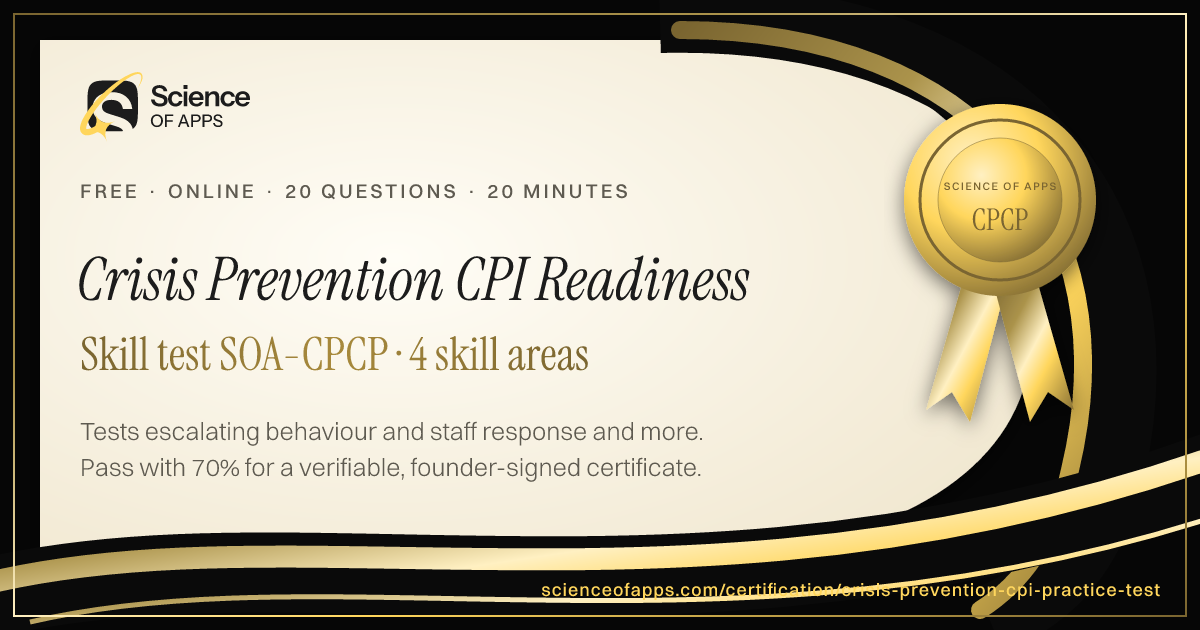
Practice for Crisis Prevention Institute (CPI) Nonviolent Crisis Intervention training — recognising stages of escalating behaviour and matching staff responses, verbal and non-verbal de-escalation, decision making and the least-restrictive use of safety interventions, and post-crisis debriefing and trauma-informed practice — written to CPI's published programme descriptions, SAMHSA trauma-informed care guidance and restraint-reduction principles for 2026. Independent practice questions; physical skills must be learned and assessed in person with a certified instructor. Pass to earn Crisis Prevention CPI Readiness SOA-CPCP.
- Intermediate difficulty.Assumes hands-on experience in the role.
- 20 scenario questions
- 20 minutes, timed
- 70% to pass · 90% for distinction
- Free no sign-up needed
- LinkedIn-ready · add it to your profile in one clickSee how ↓

 Founder, Science of Apps
What is the CPI Nonviolent Crisis Intervention Practice Test?
- Recruiter Friendly
- Quality Assured
- Exclusive Certification
Updated for 2026 and 2027 exams. Covers escalating behaviour and staff response, verbal and non-verbal de-escalation, decision making and safety interventions and debriefing and trauma-informed practice.
The CPI Nonviolent Crisis Intervention Practice Test is a free intermediate-level, 20-minute skill test from Science of Apps. Practice for Crisis Prevention Institute (CPI) Nonviolent Crisis Intervention training — recognising stages of escalating behaviour and matching staff responses, verbal and non-verbal de-escalation, decision making and the least-restrictive use of safety interventions, and post-crisis debriefing and trauma-informed practice — written to CPI's published programme descriptions, SAMHSA trauma-informed care guidance and restraint-reduction principles for 2026. Independent practice questions; physical skills must be learned and assessed in person with a certified instructor. Score 70% or more on its 20 questions to earn a verifiable Crisis Prevention CPI Readiness certificate (SOA-CPCP). Every question is based on published standards and research — including Nonviolent Crisis Intervention training programme (Crisis Development Model, de-escalation, decision making and debriefing) (Crisis Prevention Institute), SAMHSA's concept of trauma and guidance for a trauma-informed approach (SAMHSA) — and each answer is explained with its source.
Built for your job title
Nurse or healthcare support worker, Teacher, teaching assistant or special educator, Residential care or group home staff, Security or front-desk staff and Social worker or behaviour support specialist — and anyone who wants quick, verifiable proof of CPI Nonviolent Crisis Intervention knowledge for a CV or LinkedIn in 2026 and 2027.
- Nurse or healthcare support worker
- Teacher, teaching assistant or special educator
- Residential care or group home staff
- Security or front-desk staff
- Social worker or behaviour support specialist
What the test covers
Four skill areas with 5 questions each, drawn from a bank of 10 per area, so a retake brings questions you haven't seen.
Escalating Behaviour and Staff Response
25%- Behaviour levels
- Matching responses
- Precipitating factors
Verbal and Non-Verbal De-escalation
25%- Personal space and body language
- Paraverbal communication
- Setting limits
Decision Making and Safety Interventions
25%- Assessing risk
- Least restrictive practice
- Restraint risks
Debriefing and Trauma-Informed Practice
25%- Post-crisis debriefing
- Documentation
- Trauma-informed care
Independent practice test. Science of Apps is not affiliated with, endorsed by or sponsored by Crisis Prevention Institute. Exam, product and organisation names are trademarks of their owners. Passing earns a Science of Apps certificate, not the official credential.
Based on published standards
The questions are original scenarios, and each one names the public standard, official guide or research it draws on — shown under the question while you answer, and linked in your review. These are the sources behind this test:
Try a sample question
When a person first shows anxiety, such as pacing or fidgeting, the best staff response is
- supportive, with empathy and listening
- directive, with firm limits and rules
- a physical hold to prevent escalation
- ignoring it until it gets worse
Show the answer
A. supportive, with empathy and listening — Matching behaviour and response. The real test has 20 questions like this.
How the test works
20 minutes, 20 questions
One question per screen, with a progress bar and a countdown. Your progress is saved on this device if you need to pause.
Graded on our server
Answers reach the page only after you submit, so the certificate can only be earned by passing.
Every answer explained
Pass or not, you see every question with the right answer, why, and the source behind it. Pass mark 70%, distinction 90%.
Your certificate
Founder-signed, with a QR code and credential ID. Download PDF or PNG, add to LinkedIn, and it's emailed to you.
What you earn
Pass, then add it to LinkedIn in one click
No typing. The Add to LinkedIn button opens your profile’s Licenses & certifications form already filled in: the certificate name, Science of Apps as the issuer, the issue date, your credential ID and a link recruiters can use to verify it.
- 1Take the 20-minute test
- 2Score 70% or more
- 3Click Add to LinkedIn

Crisis Prevention CPI Readiness
Science of Apps
Show credential ↗Try another skill test
- 10 minSOA-HRF
Human Resources Certification Test (Fundamentals)
Tests HR basics — the employee lifecycle, recruitment and onboarding, employment law principles, policies, employee relations, records and data privacy, and HR's strategic role.
Difficulty: BeginnerTake the 10-minute test → - 10 minSOA-TAR
Talent Acquisition Certification Test
Tests recruitment — workforce planning, job descriptions, sourcing channels, inclusive hiring, candidate experience, structured selection, offers and recruitment metrics.
Difficulty: BeginnerTake the 10-minute test → - 15 minSOA-TECR
Technical Recruitment Certification
Tests tech recruiting — understanding engineering roles and stacks, sourcing developers, assessing technical skills fairly, partnering with engineers and selling the role.
Difficulty: IntermediateTake the 15-minute test →
Frequently asked questions
What is the CPI Nonviolent Crisis Intervention Practice Test?
The CPI Nonviolent Crisis Intervention Practice Test is a free intermediate-level, 20-minute skill test from Science of Apps. Practice for Crisis Prevention Institute (CPI) Nonviolent Crisis Intervention training — recognising stages of escalating behaviour and matching staff responses, verbal and non-verbal de-escalation, decision making and the least-restrictive use of safety interventions, and post-crisis debriefing and trauma-informed practice — written to CPI's published programme descriptions, SAMHSA trauma-informed care guidance and restraint-reduction principles for 2026. Independent practice questions; physical skills must be learned and assessed in person with a certified instructor. Score 70% or more on its 20 questions to earn a verifiable Crisis Prevention CPI Readiness certificate (SOA-CPCP). Every question is based on published standards and research — including Nonviolent Crisis Intervention training programme (Crisis Development Model, de-escalation, decision making and debriefing) (Crisis Prevention Institute), SAMHSA's concept of trauma and guidance for a trauma-informed approach (SAMHSA) — and each answer is explained with its source.
Is there a free CPI Nonviolent Crisis Intervention practice test for 2026?
Yes. Science of Apps has a free CPI Nonviolent Crisis Intervention Practice Test built on the current Crisis Prevention Institute exam outline for 2026 and 2027. It covers escalating behaviour and staff response, verbal and non-verbal de-escalation, decision making and safety interventions and debriefing and trauma-informed practice, scores you instantly and issues a verifiable certificate.
How do I take the CPI Nonviolent Crisis Intervention Practice Test for free?
Read the four skill areas on this page, then take the 20-minute test online — no fee, course or sign-up. You see every answer explained when you finish. Score 70% or more and you get a Crisis Prevention CPI Readiness certificate straight away, on screen, as a PDF and by email, with a credential ID anyone can verify.
Are the CPI Nonviolent Crisis Intervention Practice Test questions based on real standards?
Yes. The questions are original scenarios written by Science of Apps, and each one is based on a public source you can read: Nonviolent Crisis Intervention training programme (Crisis Development Model, de-escalation, decision making and debriefing) (Crisis Prevention Institute); SAMHSA's concept of trauma and guidance for a trauma-informed approach (SAMHSA). The source is shown under each question and linked in the answer review. Science of Apps doesn't copy questions from other tests.
What does the CPI Nonviolent Crisis Intervention Practice Test cover?
Four skill areas with five questions each, drawn from a bank of 10 per area so a retake brings new questions: Escalating Behaviour and Staff Response (Behaviour levels, Matching responses and Precipitating factors); Verbal and Non-Verbal De-escalation (Personal space and body language, Paraverbal communication and Setting limits); Decision Making and Safety Interventions (Assessing risk, Least restrictive practice and Restraint risks); Debriefing and Trauma-Informed Practice (Post-crisis debriefing, Documentation and Trauma-informed care). Every question is an original scenario written to the 2026–2027 standard, with the published source named under it.
Who should take the CPI Nonviolent Crisis Intervention Practice Test?
Nurse or healthcare support worker, Teacher, teaching assistant or special educator, Residential care or group home staff, Security or front-desk staff and Social worker or behaviour support specialist. It suits anyone who wants a quick, verifiable way to show CPI Nonviolent Crisis Intervention knowledge in 2026 and 2027, from students and career switchers to experienced professionals.
What is CPI Nonviolent Crisis Intervention training?
It is a widely used de-escalation programme from the Crisis Prevention Institute for schools, hospitals and care settings. It teaches staff to recognise escalating behaviour, respond with the least restrictive approach, use physical safety interventions only as a last resort, and debrief afterwards to prevent repeat incidents.
How long does CPI certification last?
CPI course completion is usually valid for a set period, often one to two years depending on the employer and programme, after which staff take a refresher. Physical skills must be practised and assessed in person, so this test covers the knowledge side only.
Is this the official CPI Nonviolent Crisis Intervention exam?
No. It is an independent practice test written to the publicly available CPI Nonviolent Crisis Intervention content outline for 2026 and 2027, for checking your readiness before you book the real exam. Passing earns a Science of Apps certificate rather than the official credential.
Can I take the CPI Nonviolent Crisis Intervention Practice Test from any country?
Yes. The test is online, in English and free everywhere — people take it from India, the US, the UK, Europe, Africa, Latin America and Asia-Pacific. Your certificate is dated with your own local date and can be verified from anywhere at scienceofapps.com/certification/verify/.
How long is the CPI Nonviolent Crisis Intervention Practice Test?
20 questions — 5 from each of 4 skill areas — with a 20-minute limit. You need 70% (14 of 20) to pass and 90% for distinction.
How hard is the CPI Nonviolent Crisis Intervention Practice Test?
We rate it Intermediate: assumes hands-on experience in the role. It has 20 scenario questions — 5 from each of 4 skill areas — and a 20-minute limit. You need 70% (14 of 20) to pass and 90% for distinction.
How much do Science of Apps certifications cost?
Nothing. There is no fee to take a test, to receive the certificate, to have it emailed or to verify it, and no sign-up.
How are the tests graded?
On our server, not in your browser. The answers never reach the page until you submit, so a certificate can only be earned by passing. Each certificate gets a unique credential ID stored by Science of Apps.
What happens if I don't pass?
You see your score for each area and every question with the correct answer and why, with the published source behind it. You can retake after 30 minutes, and the retake draws questions you haven't seen yet.
Do the certificates expire?
No. Every certificate is dated, so it always shows when you passed. Retake a test any time for a newer date or a higher score.
Can I add the certificate to LinkedIn?
Yes. After you pass, Add to LinkedIn opens the Licenses & certifications form with the certificate name, Science of Apps as the issuer, the issue date, your credential ID and the verification link filled in. You can also download it as a PDF or PNG, and it's emailed to you as a PDF.
How can an employer verify my certificate?
Every certificate has a credential ID and a QR code. Scanning it, or entering the ID at scienceofapps.com/certification/verify/, shows the holder's name, the certification, the score and the issue date from our records.
Are these accredited qualifications?
No. They are Science of Apps' own assessments of applied skill. They aren't issued by a university or standards body, and they work best alongside a portfolio that shows the skills in real work.
2402 more certifications to collect
Human Resources & People Management
- Human Resources Certification Test (Fundamentals)10 min · Beginner
- Talent Acquisition Certification Test10 min · Beginner
- Technical Recruitment Certification15 min · Intermediate
- Interviewing and Candidate Evaluation Certification15 min · Intermediate
- Resume Screening and Skills-Based Hiring Certification15 min · Intermediate
- Employer Branding Certification10 min · Beginner
- HR Analytics Certification Test (Fundamentals)15 min · Intermediate
- Performance Management Certification15 min · Intermediate
- Learning and Development Certification15 min · Intermediate
- Compensation Certification Test (Fundamentals)15 min · Intermediate
- Employee Engagement Certification10 min · Beginner
- People Management for New Managers Certification10 min · Beginner
- Workplace Ethics and Professional Conduct Certification10 min · Beginner
- Organizational Development (OD) Certification15 min · Intermediate
- Job Interview Test15 min · Beginner
- Resume Writing Certification15 min · Beginner
- Diversity, Equity & Inclusion (DEI) Certification15 min · Beginner
- Workforce Planning Certification20 min · Intermediate
- Employee Relations Certification20 min · Intermediate
- SHRM-CP Practice Test20 min · Intermediate
- SHRM-SCP Practice Test25 min · Advanced
- aPHR Practice Test15 min · Beginner
- PHR Practice Test20 min · Intermediate
- Employment Law Quiz20 min · Intermediate
- Diversity and Inclusion Quiz15 min · Beginner
- Workday HCM Certification Test20 min · Intermediate
- CIPD Level 5 Practice Test20 min · Intermediate
- HRCI Practice Test (PHR & SPHR)25 min · Advanced
- SAP SuccessFactors Certification Test20 min · Intermediate
- Global Mobility & Expat Assignment Management Certification20 min · Intermediate
- ICF Credentialing Exam Practice Test20 min · Intermediate
- CPP Practice Test (Certified Payroll Professional)20 min · Intermediate
- Training and Development Certification20 min · Intermediate
- HRIS Practice Test20 min · Intermediate
- CPI Nonviolent Crisis Intervention Practice TestYou're here
- FPC Practice Test (Fundamental Payroll Certification)20 min · Intermediate
- GPHR Practice Test (Global Professional in Human Resources)20 min · Intermediate
- Workplace Investigation Certification20 min · Intermediate
- Mentoring Certification20 min · Intermediate
- Articulate Storyline Certification20 min · Intermediate
- Moodle Certification20 min · Intermediate
- Sourcing Certification20 min · Intermediate
- Total Rewards CCP Practice Test20 min · Intermediate
- CITI Training Practice Test20 min · Intermediate
- SAP SuccessFactors Employee Central Practice Test20 min · Intermediate
Foundation
AI & Generative AI
- AI UX Design Certification30 min · Advanced
- Prompt Engineering Certification30 min · Intermediate
- AI Product Manager Certification30 min · Advanced
Software Engineering & Web Development
- HTML & CSS Certification Test10 min · Beginner
- JavaScript Certification Test (Fundamentals)10 min · Beginner
- TypeScript Certification Test (Fundamentals)15 min · Intermediate
Data Analytics & Business Intelligence
- Product Analytics Certification30 min · Advanced
- Data Literacy Certification10 min · Beginner
- Microsoft Excel Certification Test (Fundamentals)10 min · Beginner
Digital Marketing, SEO, AEO & Growth
- Conversion Rate Optimization (CRO) Certification30 min · Advanced
- App Store Optimization (ASO) Certification30 min · Intermediate
- Growth Marketing Certification30 min · Intermediate
UX/UI, Design, Research & Creative
- UX Design Certification30 min · Intermediate
- UI Design Certification30 min · Intermediate
- Product Design Certification30 min · Intermediate
Product, Project Management & Business Analysis
- Product Manager Certification30 min · Intermediate
- Design Leadership Certification30 min · Advanced
- Agile Product Owner Certification30 min · Intermediate
Cybersecurity, IT, Cloud & DevOps
- Cybersecurity Certification Test (Fundamentals)10 min · Beginner
- Security Awareness Certification Test (Phishing Detection)10 min · Beginner
- Network Security Certification Test (Fundamentals)15 min · Intermediate
Sales, Customer Success & Support
- Sales Fundamentals Certification10 min · Beginner
- Consultative Selling Certification15 min · Intermediate
- B2B Sales Development Representative Certification10 min · Beginner
Finance, Accounting, Operations & Entrepreneurship
- Financial Literacy Test (for Professionals)10 min · Beginner
- Accounting Certification Test (Fundamentals)10 min · Beginner
- Bookkeeping Certification Test (Fundamentals)10 min · Beginner
Communication, Leadership & Transferable Skills
- Critical Thinking Test10 min · Beginner
- Attention to Detail Test10 min · Beginner
- Cognitive Bias Test10 min · Beginner
Languages
- English Level Test30 min · Beginner
- American Sign Language (ASL) Foundations Test25 min · Intermediate
- App & Software Localization Test25 min · Intermediate
Healthcare, Education, Legal Operations & Sustainability
- Healthcare Administration Certification Test (Fundamentals)10 min · Beginner
- Medical Office Administration Certification10 min · Beginner
- Healthcare Data Privacy Awareness Certification10 min · Beginner
Test Prep, Academics & Aptitude
- SAT Math Practice Test20 min · Advanced
- SAT Reading and Writing Practice Test20 min · Advanced
- ACT Practice Test (English, Math, Reading & Science)20 min · Advanced
Language Exam Prep
- IELTS Academic Practice Test with Band Score20 min · Advanced
- IELTS General Training Practice Test20 min · Advanced
- TOEFL iBT Practice Test20 min · Advanced
Office & Productivity Software
- Microsoft Word Skills Certification15 min · Intermediate
- Microsoft PowerPoint Skills Certification15 min · Intermediate
- Microsoft Outlook Skills Certification10 min · Beginner
Engineering, Architecture, Construction & Safety
- Mechanical Engineering Practice Test (FE-Style)20 min · Advanced
- Electrical Engineering Practice Test (FE-Style)20 min · Advanced
- Civil Engineering Practice Test (FE-Style)20 min · Advanced
Hospitality, Travel & Retail
- Hospitality Management Certification10 min · Beginner
- Food Safety Certification10 min · Beginner
- Hotel Revenue Management Certification15 min · Intermediate
Cognitive Ability & Pre-Employment Tests
- IQ Test20 min · Intermediate
- Numerical Reasoning Test20 min · Intermediate
- Verbal Reasoning Test20 min · Intermediate
Personality & Career Assessments
- Hogan Assessment Practice Test11 min · Beginner
- Big Five Personality Test10 min · Beginner
- Enneagram Test11 min · Beginner
Health, Fitness & Wellness
- Personal Trainer Practice Test (NASM, ACE & ISSA)20 min · Intermediate
- ACSM Practice Test (CPT & EP)20 min · Intermediate
- Yoga Teacher Certification Test (RYT 200)15 min · Beginner
Beauty & Cosmetology
- Nail Technician Practice Test15 min · Beginner
- Cosmetology Practice Test15 min · Beginner
- Esthetician Practice Test15 min · Beginner
Business Software, ERP & CRM
- Sage Accounting Software Certification Test20 min · Intermediate
- Salesforce Certified Associate Practice Test15 min · Beginner
- HubSpot Content Marketing Certification Practice Test20 min · Intermediate
Consulting, Strategy & Industry Leadership
- AI for Management Consultants Certification20 min · Intermediate
- Chief of Staff Certification Test20 min · Intermediate
- Market Sizing & Estimation Certification15 min · Beginner
Law, Policy & Global Affairs
- AI for Lawyers & Legal Practice Certification20 min · Intermediate
- Geopolitical Risk Analysis Certification20 min · Intermediate
- AI for Public Policy Professionals Certification20 min · Intermediate
Frontier Science & Deep Tech
- Quantum Computing Certification Test (Fundamentals)20 min · Intermediate
- Neurotechnology & Brain-Computer Interfaces Certification20 min · Intermediate
- Nuclear Fission & Fusion Energy Fundamentals Certification20 min · Intermediate
Creative Arts, Writing & Media
- Creative Writing Certification15 min · Beginner
- Game Design Certification20 min · Intermediate
- Screenwriting Certification20 min · Intermediate
Hobbies, Culture & Lifestyle
- Chess Strategy & Tactics Test15 min · Beginner
- Philosophy Fundamentals Test15 min · Beginner
- Stoic Philosophy for Modern Leaders Test15 min · Beginner
Global Business & Country Markets
- India Stack & Digital Public Infrastructure Certification20 min · Intermediate
- Indian Startup Ecosystem & Fundraising Certification20 min · Intermediate
- Indian Capital Markets Fundamentals Certification15 min · Beginner
Read before you test
- Career guides by Science of Apps for 2027The top 10 online certifications for remote workers and digital nomads in 2027The top 10 online certifications for remote workers and digital nomads in 2027: AWS, Salesforce, PL-300, Google UX, Meta Front-End, CPC, HubSpot and more.
- Career guidesData-driven decision-making for managers and team leads in 2027: how employers test it and how to get better at itData-driven decision-making for managers, team leads and founders in 2027: framing questions, choosing metrics, weighing evidence, how it's tested and a plan.
- Career guides by Science of Apps for 2027The best healthcare certifications of 2027: six for coders, care staff and health operationsThe 6 best healthcare certifications of 2027: AAPC CPC for medical coding, Red Cross CPR, Six Sigma Green Belt, Google Data Analytics, Google IT Support and AI.
- Career guides by Science of Apps for 2027The top certifications for teachers in 2027: eight for classroom tech, AI and safetyThe 8 best certifications for teachers in 2027: Google Certified Educator, AI Essentials, Canva, AI for Everyone, Elements of AI, CPR, CS50 and OpenAI.
- Law of UX · Decision-makingSocial ProofWhen people are uncertain, they look to what others like them are doing to decide what's right.
- Career guidesComplaint resolution and de-escalation skills for 2027 jobs: calming angry customers, apology and ownership, fair remedies, root causes, grievance rules and escalation pathsComplaint resolution skills for 2027: de-escalating angry customers, owning the problem, fair remedies, root causes, grievance rules and complaint handler pay.


Get the ideas, not the noise.
Sign up with Google and we’ll send you short UX psychology tips by email — why people tap, stall and leave, and what to do about it. Unsubscribe anytime. Prefer something to keep? Get the free Laws of UX guide as a PDF.