CAMS Practice Test
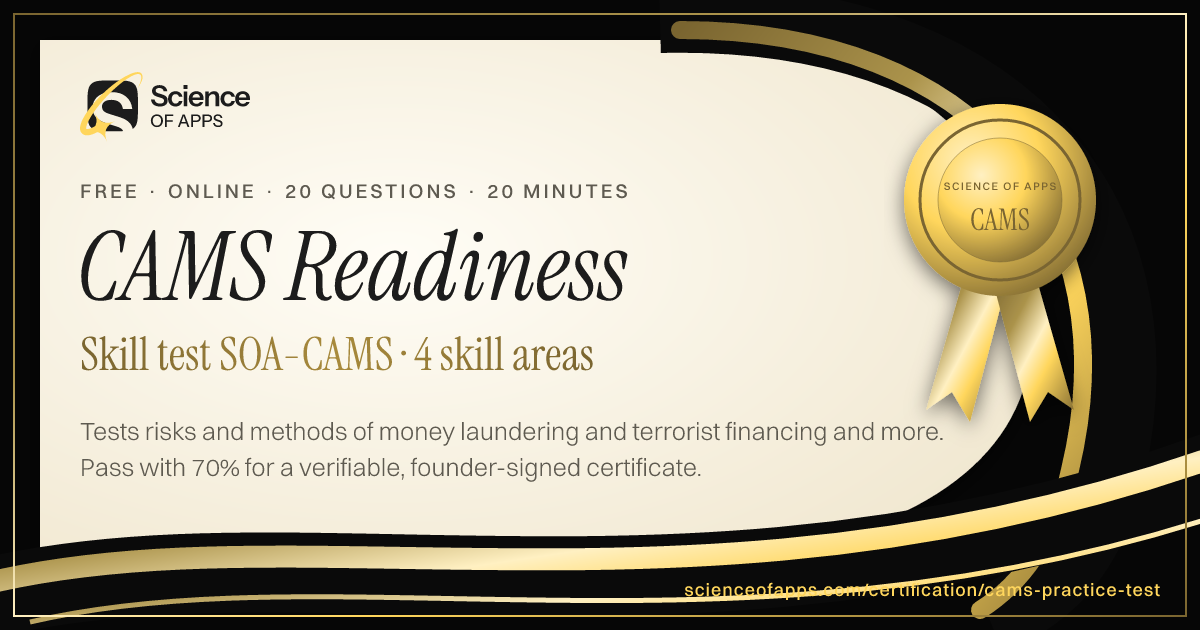
Tests readiness for the ACAMS Certified Anti-Money Laundering Specialist (CAMS) exam across its four domains — risks and methods of money laundering, terrorist financing and sanctions evasion; international compliance standards; building AML, CFT and sanctions compliance programmes; and conducting and supporting investigations — written to the CAMS examination blueprint, the FATF Recommendations, EU and US AML rules and Wolfsberg and Egmont guidance for 2026. Pass to earn CAMS Readiness SOA-CAMS.
- Intermediate difficulty.Assumes hands-on experience in the role.
- 20 scenario questions
- 20 minutes, timed
- 70% to pass · 90% for distinction
- Free no sign-up needed
- LinkedIn-ready · add it to your profile in one clickSee how ↓

 Founder, Science of Apps
What is the CAMS Practice Test?
- Recruiter Friendly
- Quality Assured
- Exclusive Certification
Updated for 2026 and 2027 exams. Covers risks and methods of money laundering and terrorist financing, international AML and CFT standards, AML, CFT and sanctions compliance programmes and investigations and reporting.
The CAMS Practice Test is a free intermediate-level, 20-minute skill test from Science of Apps. It tests readiness for the ACAMS Certified Anti-Money Laundering Specialist (CAMS) exam across its four domains — risks and methods of money laundering, terrorist financing and sanctions evasion; international compliance standards; building AML, CFT and sanctions compliance programmes; and conducting and supporting investigations — written to the CAMS examination blueprint, the FATF Recommendations, EU and US AML rules and Wolfsberg and Egmont guidance for 2026. Score 70% or more on its 20 questions to earn a verifiable CAMS Readiness certificate (SOA-CAMS). Every question is based on published standards and research — including The FATF Recommendations (Financial Action Task Force), FinCEN guidance and Suspicious Activity Report requirements (Financial Crimes Enforcement Network), Wolfsberg Group standards and guidance (The Wolfsberg Group) — and each answer is explained with its source.
Built for your job title
AML or KYC analyst, Financial crime compliance officer, MLRO or BSA officer, Fraud and sanctions investigator and Bank, fintech or crypto compliance specialist — and anyone who wants quick, verifiable proof of CAMS knowledge for a CV or LinkedIn in 2026 and 2027.
- AML or KYC analyst
- Financial crime compliance officer
- MLRO or BSA officer
- Fraud and sanctions investigator
- Bank, fintech or crypto compliance specialist
What the test covers
Four skill areas with 5 questions each, drawn from a bank of 10 per area, so a retake brings questions you haven't seen.
Risks and Methods of Money Laundering and Terrorist Financing
25%- Laundering stages
- Typologies
- Sanctions evasion
International AML and CFT Standards
25%- FATF
- Regional and national rules
- International bodies
AML, CFT and Sanctions Compliance Programmes
25%- Risk assessment
- CDD and EDD
- Controls, training and testing
Investigations and Reporting
25%- Alerts and investigations
- Suspicious activity reports
- Tipping off and cooperation
Independent practice test. Science of Apps is not affiliated with, endorsed by or sponsored by ACAMS. Exam, product and organisation names are trademarks of their owners. Passing earns a Science of Apps certificate, not the official credential.
Based on published standards
The questions are original scenarios, and each one names the public standard, official guide or research it draws on — shown under the question while you answer, and linked in your review. These are the sources behind this test:
- The FATF RecommendationsFinancial Action Task Force15 questions
- FinCEN guidance and Suspicious Activity Report requirementsFinancial Crimes Enforcement Network7 questions
- Wolfsberg Group standards and guidanceThe Wolfsberg Group5 questions
- Customer Due Diligence RequirementsFinCEN4 questions
- Office of Foreign Assets ControlUS Department of the Treasury3 questions
- Currency Transaction Report (CTR) and Bank Secrecy Act requirementsFinCEN2 questions
- Egmont Group of Financial Intelligence UnitsEgmont Group2 questions
- Regulation (EU) 2024/1624 on preventing the use of the financial system for money laundering or terrorist financingEuropean Union1 question
- Updated Guidance for a Risk-Based Approach to Virtual Assets and VASPsFATF1 question
Try a sample question
Moving illicit funds through many accounts and jurisdictions to hide their origin is the money laundering stage called
- placement
- integration
- structuring
- layering
Show the answer
D. layering — Layering distances funds from their source. The real test has 20 questions like this.
How the test works
20 minutes, 20 questions
One question per screen, with a progress bar and a countdown. Your progress is saved on this device if you need to pause.
Graded on our server
Answers reach the page only after you submit, so the certificate can only be earned by passing.
Every answer explained
Pass or not, you see every question with the right answer, why, and the source behind it. Pass mark 70%, distinction 90%.
Your certificate
Founder-signed, with a QR code and credential ID. Download PDF or PNG, add to LinkedIn, and it's emailed to you.
What you earn
Pass, then add it to LinkedIn in one click
No typing. The Add to LinkedIn button opens your profile’s Licenses & certifications form already filled in: the certificate name, Science of Apps as the issuer, the issue date, your credential ID and a link recruiters can use to verify it.
- 1Take the 20-minute test
- 2Score 70% or more
- 3Click Add to LinkedIn

CAMS Readiness
Science of Apps
Show credential ↗Try another skill test
- 10 minSOA-FLIT
Financial Literacy Test (for Professionals)
Tests practical financial literacy at work — revenue, costs and profit, margins, cash flow, budgets, reading basic financial statements, interest and making money-aware decisions.
Difficulty: BeginnerTake the 10-minute test → - 10 minSOA-ACCF
Accounting Certification Test (Fundamentals)
Tests core accounting — the accounting equation, double-entry, debits and credits, accrual vs cash basis, the three financial statements, depreciation and revenue recognition.
Difficulty: BeginnerTake the 10-minute test → - 10 minSOA-BOOK
Bookkeeping Certification Test (Fundamentals)
Tests bookkeeping — recording transactions, chart of accounts, invoices and bills, bank reconciliation, petty cash, sales tax/VAT basics, month-end closing and record keeping.
Difficulty: BeginnerTake the 10-minute test →
Frequently asked questions
What is the CAMS Practice Test?
The CAMS Practice Test is a free intermediate-level, 20-minute skill test from Science of Apps. It tests readiness for the ACAMS Certified Anti-Money Laundering Specialist (CAMS) exam across its four domains — risks and methods of money laundering, terrorist financing and sanctions evasion; international compliance standards; building AML, CFT and sanctions compliance programmes; and conducting and supporting investigations — written to the CAMS examination blueprint, the FATF Recommendations, EU and US AML rules and Wolfsberg and Egmont guidance for 2026. Score 70% or more on its 20 questions to earn a verifiable CAMS Readiness certificate (SOA-CAMS). Every question is based on published standards and research — including The FATF Recommendations (Financial Action Task Force), FinCEN guidance and Suspicious Activity Report requirements (Financial Crimes Enforcement Network), Wolfsberg Group standards and guidance (The Wolfsberg Group) — and each answer is explained with its source.
Is there a free CAMS practice test for 2026?
Yes. Science of Apps has a free CAMS Practice Test built on the current ACAMS exam outline for 2026 and 2027. It covers risks and methods of money laundering and terrorist financing, international AML and CFT standards, AML, CFT and sanctions compliance programmes and investigations and reporting, scores you instantly and issues a verifiable certificate.
How do I take the CAMS Practice Test for free?
Read the four skill areas on this page, then take the 20-minute test online — no fee, course or sign-up. You see every answer explained when you finish. Score 70% or more and you get a CAMS Readiness certificate straight away, on screen, as a PDF and by email, with a credential ID anyone can verify.
Are the CAMS Practice Test questions based on real standards?
Yes. The questions are original scenarios written by Science of Apps, and each one is based on a public source you can read: The FATF Recommendations (Financial Action Task Force); FinCEN guidance and Suspicious Activity Report requirements (Financial Crimes Enforcement Network); Wolfsberg Group standards and guidance (The Wolfsberg Group); Customer Due Diligence Requirements (FinCEN); Office of Foreign Assets Control (US Department of the Treasury); Currency Transaction Report (CTR) and Bank Secrecy Act requirements (FinCEN). The source is shown under each question and linked in the answer review. Science of Apps doesn't copy questions from other tests.
What does the CAMS Practice Test cover?
Four skill areas with five questions each, drawn from a bank of 10 per area so a retake brings new questions: Risks and Methods of Money Laundering and Terrorist Financing (Laundering stages, Typologies and Sanctions evasion); International AML and CFT Standards (FATF, Regional and national rules and International bodies); AML, CFT and Sanctions Compliance Programmes (Risk assessment, CDD and EDD and Controls, training and testing); Investigations and Reporting (Alerts and investigations, Suspicious activity reports and Tipping off and cooperation). Every question is an original scenario written to the 2026–2027 standard, with the published source named under it.
Who should take the CAMS Practice Test?
AML or KYC analyst, Financial crime compliance officer, MLRO or BSA officer, Fraud and sanctions investigator and Bank, fintech or crypto compliance specialist. It suits anyone who wants a quick, verifiable way to show CAMS knowledge in 2026 and 2027, from students and career switchers to experienced professionals.
How many questions are on the CAMS exam?
The CAMS exam has 120 multiple-choice and multiple-selection questions to answer in 3.5 hours, and the passing score is 75. There is no penalty for guessing, so answer every question.
What are the CAMS exam domains?
Four domains: risks and methods of money laundering, terrorist financing and sanctions evasion; compliance standards for AML and CFT; AML, CFT and sanctions compliance programmes; and techniques for conducting and supporting investigations.
Is this the official CAMS exam?
No. It is an independent practice test written to the publicly available CAMS content outline for 2026 and 2027, for checking your readiness before you book the real exam. Passing earns a Science of Apps certificate rather than the official credential.
Can I take the CAMS Practice Test from any country?
Yes. The test is online, in English and free everywhere — people take it from India, the US, the UK, Europe, Africa, Latin America and Asia-Pacific. Your certificate is dated with your own local date and can be verified from anywhere at scienceofapps.com/certification/verify/.
How long is the CAMS Practice Test?
20 questions — 5 from each of 4 skill areas — with a 20-minute limit. You need 70% (14 of 20) to pass and 90% for distinction.
How hard is the CAMS Practice Test?
We rate it Intermediate: assumes hands-on experience in the role. It has 20 scenario questions — 5 from each of 4 skill areas — and a 20-minute limit. You need 70% (14 of 20) to pass and 90% for distinction.
How much do Science of Apps certifications cost?
Nothing. There is no fee to take a test, to receive the certificate, to have it emailed or to verify it, and no sign-up.
How are the tests graded?
On our server, not in your browser. The answers never reach the page until you submit, so a certificate can only be earned by passing. Each certificate gets a unique credential ID stored by Science of Apps.
What happens if I don't pass?
You see your score for each area and every question with the correct answer and why, with the published source behind it. You can retake after 30 minutes, and the retake draws questions you haven't seen yet.
Do the certificates expire?
No. Every certificate is dated, so it always shows when you passed. Retake a test any time for a newer date or a higher score.
Can I add the certificate to LinkedIn?
Yes. After you pass, Add to LinkedIn opens the Licenses & certifications form with the certificate name, Science of Apps as the issuer, the issue date, your credential ID and the verification link filled in. You can also download it as a PDF or PNG, and it's emailed to you as a PDF.
How can an employer verify my certificate?
Every certificate has a credential ID and a QR code. Scanning it, or entering the ID at scienceofapps.com/certification/verify/, shows the holder's name, the certification, the score and the issue date from our records.
Are these accredited qualifications?
No. They are Science of Apps' own assessments of applied skill. They aren't issued by a university or standards body, and they work best alongside a portfolio that shows the skills in real work.
2402 more certifications to collect
Finance, Accounting, Operations & Entrepreneurship
- Financial Literacy Test (for Professionals)10 min · Beginner
- Accounting Certification Test (Fundamentals)10 min · Beginner
- Bookkeeping Certification Test (Fundamentals)10 min · Beginner
- Financial Statement Analysis Certification15 min · Intermediate
- Budgeting Certification Test15 min · Intermediate
- Financial Modeling Certification Test (Fundamentals)15 min · Intermediate
- Business Finance and Unit Economics Certification15 min · Intermediate
- Business Valuation Certification Test (Fundamentals)20 min · Advanced
- Risk Management Certification Test (Fundamentals)15 min · Intermediate
- Procurement Certification Test15 min · Intermediate
- Supply Chain Management Certification Test (Fundamentals)10 min · Beginner
- Inventory Management Certification Test15 min · Intermediate
- Operations Management Certification15 min · Intermediate
- Process Improvement Certification Test (Fundamentals)10 min · Beginner
- Business Operations Analytics Certification15 min · Intermediate
- Entrepreneurship Fundamentals Certification10 min · Beginner
- Startup Idea Validation Certification10 min · Beginner
- Business Model and Revenue Design Certification15 min · Intermediate
- Pricing Strategy Certification15 min · Intermediate
- Business Planning and Pitch Decks Certification10 min · Beginner
- E-commerce Operations Certification10 min · Beginner
- Marketplace Management Certification15 min · Intermediate
- Freelancing and Client Management Certification10 min · Beginner
- Small Business AI Adoption Certification10 min · Beginner
- Business Decision-Making Under Uncertainty Certification20 min · Advanced
- QuickBooks Online Certification Practice15 min · Intermediate
- Xero Certification Practice15 min · Intermediate
- CPA Exam Practice Questions (AUD, FAR, REG)20 min · Advanced
- ACCA Practice Questions: Knowledge & Skills20 min · Advanced
- CMA Exam Practice Questions20 min · Advanced
- CFA Level 1 Practice Questions20 min · Advanced
- CFA Level 1 Quantitative Methods Practice15 min · Intermediate
- CFA Level 1 Financial Statement Analysis Practice15 min · Intermediate
- FRM Part 1 Practice Exam20 min · Advanced
- CIMA Management Accounting Practice Questions20 min · Advanced
- Enrolled Agent (EA) Exam Practice Test15 min · Intermediate
- Payroll Certification15 min · Intermediate
- IFRS Certification20 min · Advanced
- US GAAP Certification20 min · Advanced
- International Tax Certification15 min · Intermediate
- Transfer Pricing Certification20 min · Advanced
- Anti-Money Laundering (AML) Certification15 min · Intermediate
- KYC & Customer Due Diligence Certification15 min · Intermediate
- Financial Risk Management Certification15 min · Intermediate
- Investment Banking Technical Interview Test20 min · Advanced
- Equity Research & Valuation Certification20 min · Advanced
- Treasury & Cash Management Certification15 min · Intermediate
- Bloomberg Market Concepts (BMC) Practice Test15 min · Intermediate
- Six Sigma Yellow Belt Certification10 min · Beginner
- Six Sigma Green Belt Certification20 min · Advanced
- Warehouse & Inventory Management Certification10 min · Beginner
- Enterprise Risk Management (ERM) Certification15 min · Intermediate
- Third-Party Risk Management (TPRM) Certification15 min · Intermediate
- Anti-Bribery & Corruption (ABC) Compliance Certification15 min · Intermediate
- Sanctions Compliance Certification15 min · Intermediate
- Financial Crime Compliance Certification15 min · Intermediate
- Lean Six Sigma Certification15 min · Intermediate
- Supply Chain Planning Certification15 min · Intermediate
- Demand Forecasting Certification15 min · Intermediate
- Venture Capital Test15 min · Intermediate
- Small Business Management Certification10 min · Beginner
- Insurance Fundamentals Certification10 min · Beginner
- Insurance Claims Adjuster Certification Practice15 min · Intermediate
- Insurance Underwriting Certification15 min · Intermediate
- Actuarial Exam Practice (Exam P & FM)20 min · Advanced
- Real Estate Finance Certification15 min · Intermediate
- Property Valuation Certification15 min · Intermediate
- Real Estate Investment Analysis Certification15 min · Intermediate
- Property Management Certification10 min · Beginner
- Tax Preparer Test20 min · Intermediate
- Personal Finance Test15 min · Beginner
- SIE Exam Practice Test20 min · Intermediate
- Corporate Finance Certification20 min · Intermediate
- CIA Exam Practice Questions (Internal Audit)25 min · Advanced
- CFE Exam Practice Test (Fraud Examination)25 min · Advanced
- Banking Test (Banking Fundamentals)15 min · Beginner
- Fintech Certification20 min · Intermediate
- Blockchain Certification Test15 min · Beginner
- Sustainable Finance Certification Test20 min · Intermediate
- Cost & Managerial Accounting Test20 min · Intermediate
- Accounts Payable Certification Test (AP & AR)15 min · Beginner
- Credit Analysis Certification20 min · Intermediate
- Stock Market Quiz15 min · Beginner
- Portfolio Management Certification20 min · Intermediate
- NMLS SAFE MLO Practice Test20 min · Intermediate
- Real Estate Exam Practice Test20 min · Intermediate
- Life and Health Insurance Practice Exam20 min · Intermediate
- Series 7 Practice Test25 min · Advanced
- Six Sigma Black Belt Practice Exam25 min · Advanced
- CFP Practice Exam25 min · Advanced
- Due Diligence Quiz20 min · Intermediate
- Wealth Management Certification Test25 min · Advanced
- Financial Math Test20 min · Intermediate
- Internal Audit Test20 min · Intermediate
- Auditing Quiz20 min · Intermediate
- Series 63 Practice Test20 min · Intermediate
- Series 65 Practice Test25 min · Advanced
- Warehouse Assessment Test15 min · Beginner
- Logistics Coordinator Test20 min · Intermediate
- Purchase Executive Test15 min · Beginner
- DeFi Quiz25 min · Advanced
- Cost Accounting Quiz15 min · Beginner
- Warehouse Supervisor Test20 min · Intermediate
- Purchasing Test15 min · Beginner
- Purchasing Manager Test25 min · Advanced
- Tally Prime Practice Test (with GST)15 min · Beginner
- Financial Analyst Certification Test20 min · Intermediate
- Forex Trading Certification Test15 min · Beginner
- CIPS Level 4 Practice Test20 min · Intermediate
- CPSM Practice Test25 min · Advanced
- CPIM Practice Test (APICS)25 min · Advanced
- CAIA Level I Practice Test25 min · Advanced
- FP&A Certification Practice Test (FPAC)25 min · Advanced
- Private Equity Interview Test25 min · Advanced
- SOX Internal Controls Certification Test20 min · Intermediate
- Credit Analyst Certification Test20 min · Intermediate
- CLTD Practice Test (APICS)25 min · Advanced
- AAT Level 3 Practice Test20 min · Intermediate
- CSCP Practice Test (APICS)25 min · Advanced
- Islamic Finance Certification Test20 min · Intermediate
- Python for Finance & Quantitative Analysis Certification20 min · Intermediate
- Stablecoins & Digital Payments Infrastructure Certification20 min · Intermediate
- Private Credit & Direct Lending Certification25 min · Advanced
- Accelerator Application Readiness Certification15 min · Beginner
- Quant Trading Interview Readiness Certification25 min · Advanced
- SaaS Metrics & Tech Company Valuation Certification20 min · Intermediate
- Startup Cap Tables, SAFEs & Term Sheets Certification20 min · Intermediate
- Options, Futures & Derivatives Pricing Certification25 min · Advanced
- Sales & Trading Analyst Certification20 min · Intermediate
- Wall Street Recruiting Readiness Certification15 min · Beginner
- Search Fund & Entrepreneurship Through Acquisition Certification20 min · Intermediate
- Behavioral Finance Certification20 min · Intermediate
- Fixed Income Certification Test20 min · Intermediate
- Hedge Fund Long/Short Equity Pitch Certification25 min · Advanced
- Growth Equity Investing Certification25 min · Advanced
- Restructuring & Distressed Debt Investing Certification25 min · Advanced
- Private Equity Secondaries & Continuation Funds Certification25 min · Advanced
- Commodities Certification Test20 min · Intermediate
- Corporate Development & M&A Integration Certification20 min · Intermediate
- Equity Capital Markets & IPO Readiness Certification20 min · Intermediate
- Payments Certification Test20 min · Intermediate
- Startup Equity & Option Plans Certification15 min · Beginner
- Tokenomics & Crypto Market Structure Certification20 min · Intermediate
- Family Office Investment Management Certification25 min · Advanced
- Founder Mental Fitness & Resilience Certification15 min · Beginner
- Global Macro Investing Certification25 min · Advanced
- Leveraged Finance & High-Yield Credit Certification25 min · Advanced
- Sports Finance & Club Valuation Certification20 min · Intermediate
- Deep-Tech Commercialization & Tech Transfer Certification20 min · Intermediate
- Bootstrapping & Profitable Growth Certification15 min · Beginner
- Investor Relations Professional Certification20 min · Intermediate
- Pre-MBA Finance Bootcamp Certification15 min · Beginner
- Embedded Finance & Banking-as-a-Service Certification20 min · Intermediate
- Emerging & Frontier Markets Investing Certification20 min · Intermediate
- Founding Team Building & Early Hiring Certification20 min · Intermediate
- Fundraising Data Room & Investor Due Diligence Certification20 min · Intermediate
- Global Expansion for Startups Certification20 min · Intermediate
- Quality of Earnings Analysis Certification20 min · Intermediate
- Climate Tech Venture Building Certification20 min · Intermediate
- Infrastructure Investing Certification25 min · Advanced
- LP Fund Selection & Manager Due Diligence Certification25 min · Advanced
- Market Microstructure & Trade Execution Certification25 min · Advanced
- Debt Capital Markets Professional Certification20 min · Intermediate
- ETF & Index Construction Certification20 min · Intermediate
- Factor Investing & Smart Beta Certification25 min · Advanced
- Activist Investing & Shareholder Engagement Certification25 min · Advanced
- Endowment Model Investing Certification25 min · Advanced
- Hardware Startup & Manufacturing Scale-Up Certification20 min · Intermediate
- Merger Arbitrage & Event-Driven Investing Certification25 min · Advanced
- Sovereign Wealth & Pension Fund Investing Certification25 min · Advanced
- Venture Debt & Revenue-Based Financing Certification20 min · Intermediate
- University Spinout Founder Certification20 min · Intermediate
- Art Finance & Collectibles Investing Certification20 min · Intermediate
- Liquidity Events & Founder Wealth Planning Certification20 min · Intermediate
- Reinsurance & Catastrophe Risk Certification25 min · Advanced
- Startup Board Management Certification20 min · Intermediate
- Venture Studio Operator Certification20 min · Intermediate
- CAMS Practice TestYou're here
- FMVA Practice Test20 min · Intermediate
- IMC Practice Test20 min · Intermediate
- CFCS Practice Test20 min · Intermediate
- Certified Bookkeeper (CPB) Practice Test20 min · Intermediate
- CPCU Practice Test20 min · Intermediate
- CCEP Practice Test (Compliance and Ethics)20 min · Intermediate
- CRCM Regulatory Compliance Practice Test20 min · Intermediate
- CRMA Risk Management Assurance Practice Test20 min · Intermediate
- CPPS Patient Safety Practice Test20 min · Intermediate
- CDCS Trade Finance Practice Test20 min · Intermediate
- CIA Certified Internal Auditor Practice Test25 min · Advanced
- CISI International Introduction to Investment Practice Test15 min · Beginner
- AFC Financial Counselor Practice Test20 min · Intermediate
- CGMA Practice Test20 min · Intermediate
- Dispatcher Certification20 min · Intermediate
- AAMS Practice Test20 min · Intermediate
- IAAP CPACC Practice Test20 min · Intermediate
- CPWA Practice Test20 min · Intermediate
- Forensic Accounting Certification20 min · Intermediate
- ISO 9001 Lead Auditor Practice Test25 min · Advanced
- AINS Practice Test20 min · Intermediate
- ChFC Practice Test20 min · Intermediate
- CCIM Practice Test25 min · Advanced
- CRPC Practice Test20 min · Intermediate
- RICP Practice Test20 min · Intermediate
- VAT Practice Test20 min · Intermediate
- Credit Risk Certification20 min · Intermediate
- CITF Practice Test (Certificate in International Trade and Finance)20 min · Intermediate
- CTFA Practice Test (Certified Trust and Fiduciary Advisor)20 min · Intermediate
- Fleet Management Certification20 min · Intermediate
- Supply Chain Analyst Certification20 min · Intermediate
- Financial Accounting Certification20 min · Intermediate
- ISO 9001 Internal Auditor Practice Test20 min · Intermediate
- ACFCS CFCS Practice Test20 min · Intermediate
- CRPS Retirement Plans Specialist Practice Test20 min · Intermediate
- FLMI Practice Test20 min · Intermediate
- CIC Insurance Counselor Practice Test20 min · Intermediate
- Certified Risk Manager (CRM) Practice Test20 min · Intermediate
- ISO 13485 Lead Auditor Practice Test25 min · Advanced
- Demand Planning Certification20 min · Intermediate
- Trade Compliance Certification20 min · Intermediate
- Credit Card Fraud Analyst Certification20 min · Intermediate
- Transportation Management (CTP / CTL) Practice Test20 min · Intermediate
- Freight Forwarding Practice Test20 min · Intermediate
- Internal Controls and Control Testing Practice Test20 min · Intermediate
- Truck Dispatcher Practice Test20 min · Intermediate
- Operational Risk and RCSA Practice Test15 min · Beginner
- Customs Practice Test20 min · Intermediate
- Order Picker Certification15 min · Beginner
- Production Planning Certification20 min · Intermediate
- Import Export Certification20 min · Intermediate
- Retail Banking Certification20 min · Intermediate
- S&OP Practice Test20 min · Intermediate
Foundation
AI & Generative AI
- AI UX Design Certification30 min · Advanced
- Prompt Engineering Certification30 min · Intermediate
- AI Product Manager Certification30 min · Advanced
Software Engineering & Web Development
- HTML & CSS Certification Test10 min · Beginner
- JavaScript Certification Test (Fundamentals)10 min · Beginner
- TypeScript Certification Test (Fundamentals)15 min · Intermediate
Data Analytics & Business Intelligence
- Product Analytics Certification30 min · Advanced
- Data Literacy Certification10 min · Beginner
- Microsoft Excel Certification Test (Fundamentals)10 min · Beginner
Digital Marketing, SEO, AEO & Growth
- Conversion Rate Optimization (CRO) Certification30 min · Advanced
- App Store Optimization (ASO) Certification30 min · Intermediate
- Growth Marketing Certification30 min · Intermediate
UX/UI, Design, Research & Creative
- UX Design Certification30 min · Intermediate
- UI Design Certification30 min · Intermediate
- Product Design Certification30 min · Intermediate
Product, Project Management & Business Analysis
- Product Manager Certification30 min · Intermediate
- Design Leadership Certification30 min · Advanced
- Agile Product Owner Certification30 min · Intermediate
Cybersecurity, IT, Cloud & DevOps
- Cybersecurity Certification Test (Fundamentals)10 min · Beginner
- Security Awareness Certification Test (Phishing Detection)10 min · Beginner
- Network Security Certification Test (Fundamentals)15 min · Intermediate
Sales, Customer Success & Support
- Sales Fundamentals Certification10 min · Beginner
- Consultative Selling Certification15 min · Intermediate
- B2B Sales Development Representative Certification10 min · Beginner
Human Resources & People Management
- Human Resources Certification Test (Fundamentals)10 min · Beginner
- Talent Acquisition Certification Test10 min · Beginner
- Technical Recruitment Certification15 min · Intermediate
Communication, Leadership & Transferable Skills
- Critical Thinking Test10 min · Beginner
- Attention to Detail Test10 min · Beginner
- Cognitive Bias Test10 min · Beginner
Languages
- English Level Test30 min · Beginner
- American Sign Language (ASL) Foundations Test25 min · Intermediate
- App & Software Localization Test25 min · Intermediate
Healthcare, Education, Legal Operations & Sustainability
- Healthcare Administration Certification Test (Fundamentals)10 min · Beginner
- Medical Office Administration Certification10 min · Beginner
- Healthcare Data Privacy Awareness Certification10 min · Beginner
Test Prep, Academics & Aptitude
- SAT Math Practice Test20 min · Advanced
- SAT Reading and Writing Practice Test20 min · Advanced
- ACT Practice Test (English, Math, Reading & Science)20 min · Advanced
Language Exam Prep
- IELTS Academic Practice Test with Band Score20 min · Advanced
- IELTS General Training Practice Test20 min · Advanced
- TOEFL iBT Practice Test20 min · Advanced
Office & Productivity Software
- Microsoft Word Skills Certification15 min · Intermediate
- Microsoft PowerPoint Skills Certification15 min · Intermediate
- Microsoft Outlook Skills Certification10 min · Beginner
Engineering, Architecture, Construction & Safety
- Mechanical Engineering Practice Test (FE-Style)20 min · Advanced
- Electrical Engineering Practice Test (FE-Style)20 min · Advanced
- Civil Engineering Practice Test (FE-Style)20 min · Advanced
Hospitality, Travel & Retail
- Hospitality Management Certification10 min · Beginner
- Food Safety Certification10 min · Beginner
- Hotel Revenue Management Certification15 min · Intermediate
Cognitive Ability & Pre-Employment Tests
- IQ Test20 min · Intermediate
- Numerical Reasoning Test20 min · Intermediate
- Verbal Reasoning Test20 min · Intermediate
Personality & Career Assessments
- Hogan Assessment Practice Test11 min · Beginner
- Big Five Personality Test10 min · Beginner
- Enneagram Test11 min · Beginner
Health, Fitness & Wellness
- Personal Trainer Practice Test (NASM, ACE & ISSA)20 min · Intermediate
- ACSM Practice Test (CPT & EP)20 min · Intermediate
- Yoga Teacher Certification Test (RYT 200)15 min · Beginner
Beauty & Cosmetology
- Nail Technician Practice Test15 min · Beginner
- Cosmetology Practice Test15 min · Beginner
- Esthetician Practice Test15 min · Beginner
Business Software, ERP & CRM
- Sage Accounting Software Certification Test20 min · Intermediate
- Salesforce Certified Associate Practice Test15 min · Beginner
- HubSpot Content Marketing Certification Practice Test20 min · Intermediate
Consulting, Strategy & Industry Leadership
- AI for Management Consultants Certification20 min · Intermediate
- Chief of Staff Certification Test20 min · Intermediate
- Market Sizing & Estimation Certification15 min · Beginner
Law, Policy & Global Affairs
- AI for Lawyers & Legal Practice Certification20 min · Intermediate
- Geopolitical Risk Analysis Certification20 min · Intermediate
- AI for Public Policy Professionals Certification20 min · Intermediate
Frontier Science & Deep Tech
- Quantum Computing Certification Test (Fundamentals)20 min · Intermediate
- Neurotechnology & Brain-Computer Interfaces Certification20 min · Intermediate
- Nuclear Fission & Fusion Energy Fundamentals Certification20 min · Intermediate
Creative Arts, Writing & Media
- Creative Writing Certification15 min · Beginner
- Game Design Certification20 min · Intermediate
- Screenwriting Certification20 min · Intermediate
Hobbies, Culture & Lifestyle
- Chess Strategy & Tactics Test15 min · Beginner
- Philosophy Fundamentals Test15 min · Beginner
- Stoic Philosophy for Modern Leaders Test15 min · Beginner
Global Business & Country Markets
- India Stack & Digital Public Infrastructure Certification20 min · Intermediate
- Indian Startup Ecosystem & Fundraising Certification20 min · Intermediate
- Indian Capital Markets Fundamentals Certification15 min · Beginner
Read before you test
- Career guidesBusiness case and ROI skills employers want in 2027: costs and benefits, ROI, payback, NPV and the time value of money, sensitivity analysis, risks and recommendationsBusiness case and ROI skills employers want in 2027: costs, benefits, ROI, payback, NPV, time value of money, sensitivity analysis and clear recommendations.
- Ideas50 app ideas worth building in 2027 — with the user, the problem and who pays50 app ideas for 2027 across health, money, learning, local commerce, family, climate and AI — each with the user problem, who pays and a one-week test.
- Startups in IndiaStartup valuation: how to value your startup at pre-seed and seed, with methods and worked examplesHow to value a startup at pre-seed and seed: the methods investors use, a worked VC-method example, dilution maths and India's valuation report rules.
- Career guidesHow to get a data governance job in 2027: data quality, stewardship and the DPDP deadline driving demandHow to get a data governance or data quality job in 2027: skills employers test, DAMA and CDMP, India's DPDP Rules, pay by experience and a 12-week plan.
- Career guides by Science of Apps for 2027How to pass FRM in 2027: a 20-week study plan and tips that workHow to pass FRM in 2027: a 20-week study plan, exam format and cost, the best free resources and practice-test tips.
- Career guides by Science of Apps for 2027The best finance certifications of 2027: seven for analysts, risk managers and FP&AThe 7 best finance certifications of 2027: CFA, FRM, FMVA, Microsoft PL-300, CISA, Google Data Analytics and AI for Business, with study times and fees.






Get the ideas, not the noise.
Sign up with Google and we’ll send you short UX psychology tips by email — why people tap, stall and leave, and what to do about it. Unsubscribe anytime. Prefer something to keep? Get the free Laws of UX guide as a PDF.