The Laws of UX, in one field guide
The Laws of UX field guide is a free 74-page PDF that explains 60 research-backed UX psychology principles in six categories. Each law gets one page: a one-line definition, an illustration, how it shows up in apps, four steps to apply it, a do and a don't, and how to measure it. It ends with a cheat sheet of all 60.
- Printable · LightWhite pages, for printing a hard copy
- Soft copy · DarkFor reading on screen
Who it’s for
- Product designers who want the reason behind a design choice, not just the pattern
- Product managers bringing psychology into specs, reviews and experiments
- Founders fixing onboarding, pricing pages and drop-off without a research team
- Students and job seekers preparing for UX interviews and portfolio reviews
What’s inside
- 60 laws, one page each: definition, illustration, who described it and when
- How each law shows up in real apps, with a worked example
- Four steps to apply it, plus a do, a don't and the most common mistake
- How to measure whether applying it worked
- A two-page cheat sheet with all 60 one-line definitions
Sample pages
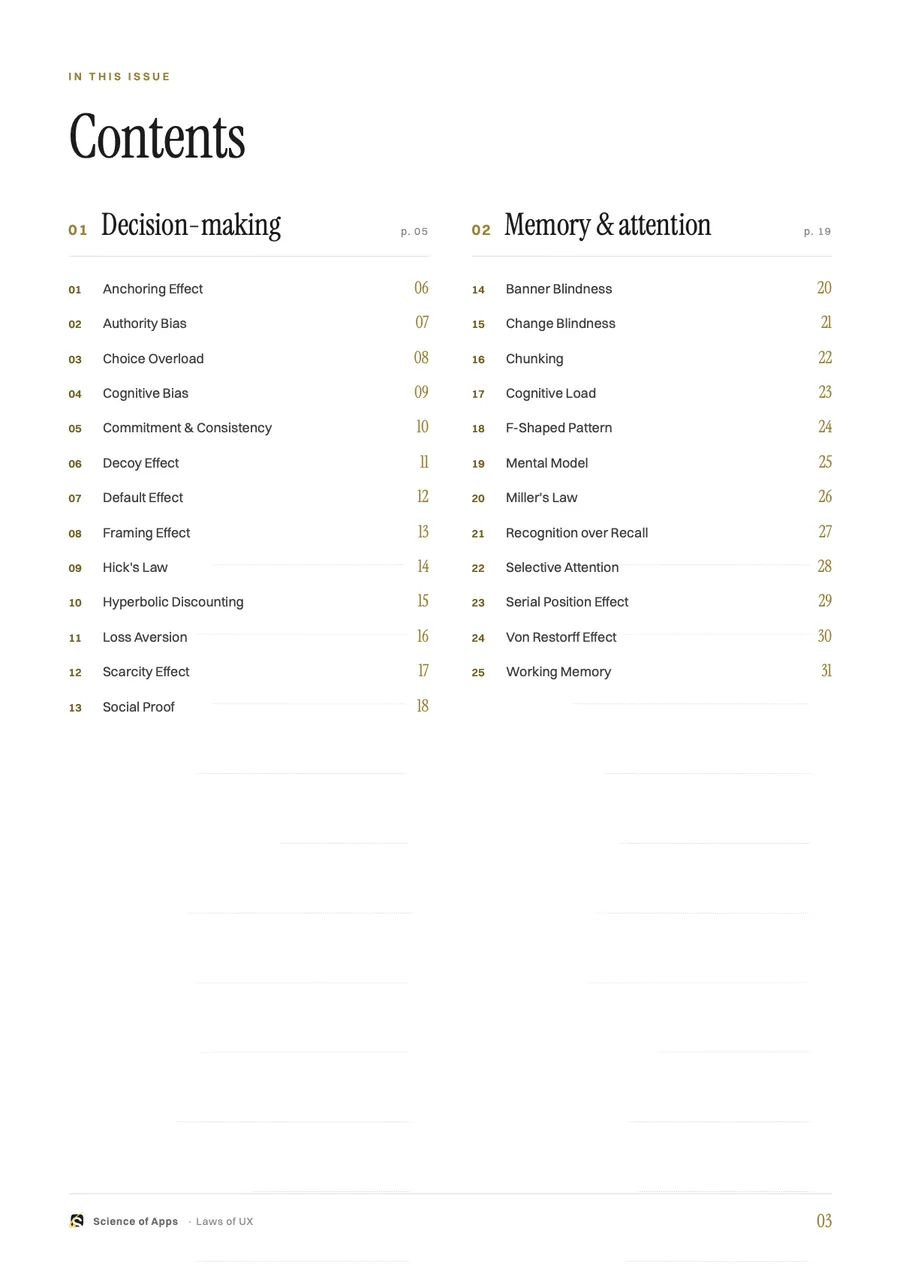
Contents: six parts, 60 laws 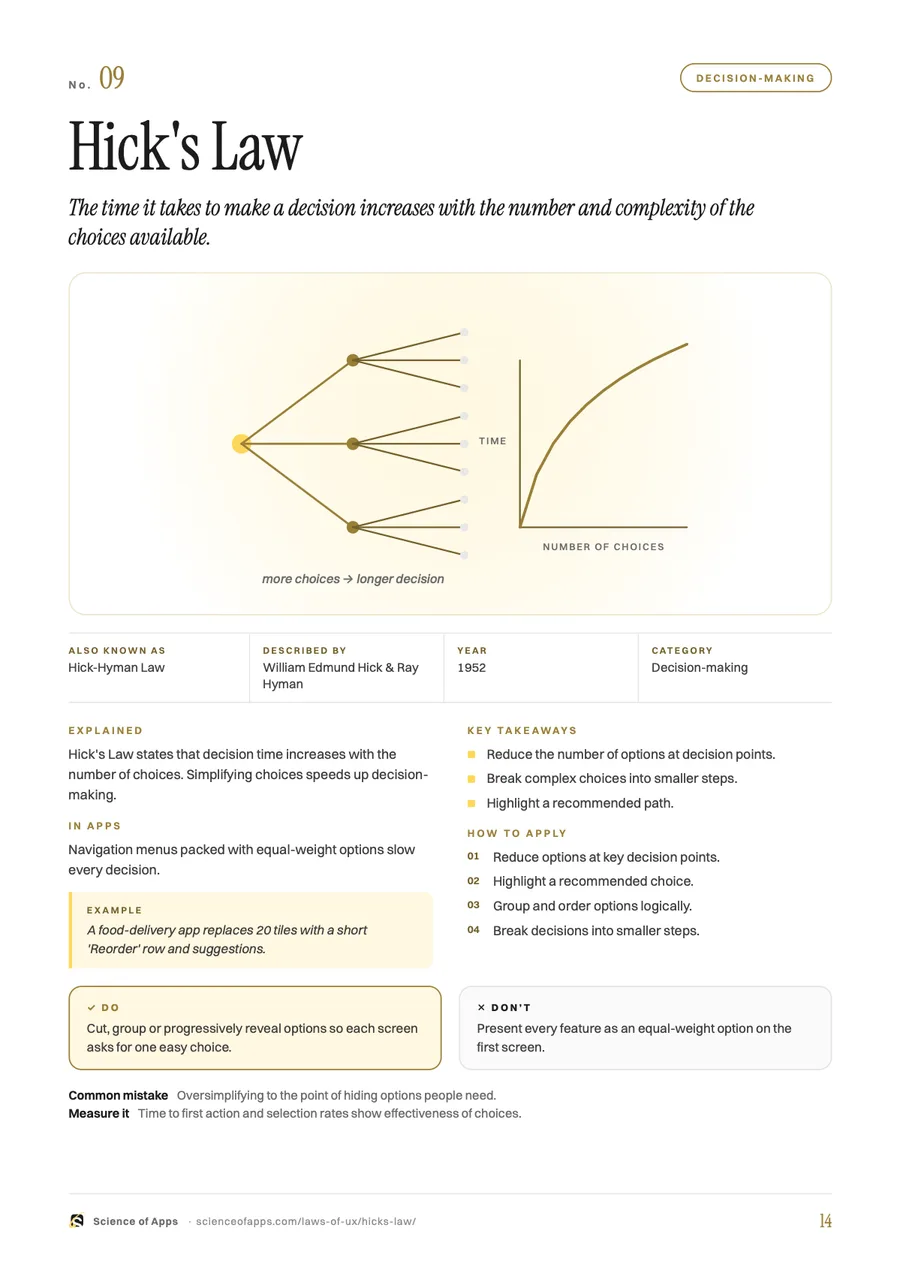
One law per page: Hick's Law 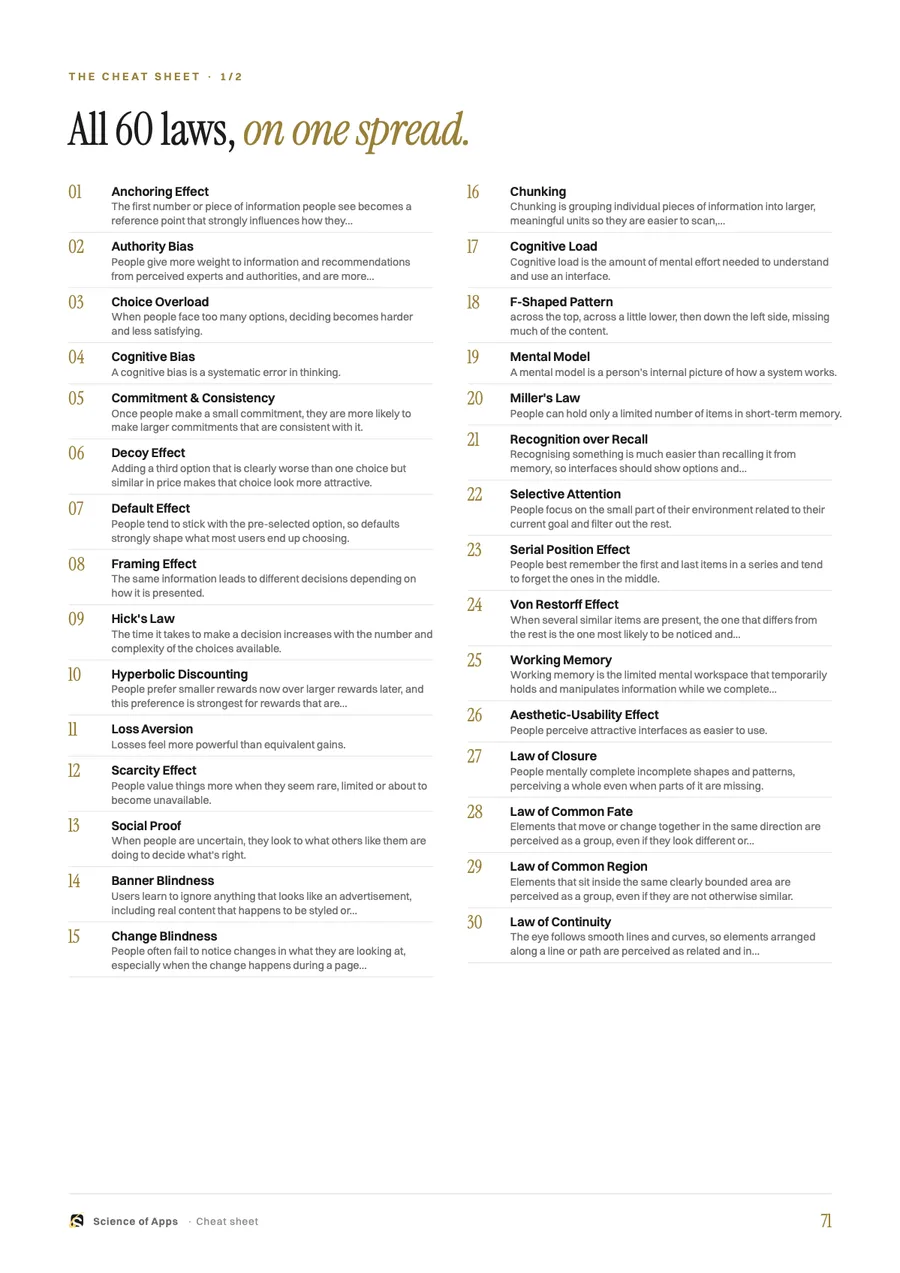
The cheat sheet: all 60 at a glance
Contents: 60 laws in 6 parts
Each law also has its own free page online. Click any name to read it now.
01 Decision-makingp. 5
Anchoring Effect, Authority Bias, Choice Overload, Cognitive Bias, Commitment & Consistency, Decoy Effect, Default Effect, Framing Effect, Hick's Law, Hyperbolic Discounting, Loss Aversion, Scarcity Effect, Social Proof
02 Memory & attentionp. 19
Banner Blindness, Change Blindness, Chunking, Cognitive Load, F-Shaped Pattern, Mental Model, Miller's Law, Recognition over Recall, Selective Attention, Serial Position Effect, Von Restorff Effect, Working Memory
03 Perceptionp. 32
Aesthetic-Usability Effect, Law of Closure, Law of Common Fate, Law of Common Region, Law of Continuity, Figure-Ground, Law of Proximity, Law of Prägnanz, Law of Similarity, Law of Uniform Connectedness
04 Interaction & speedp. 43
Affordances & Signifiers, Doherty Threshold, Fitts's Law, Jakob's Law, Labor Illusion, Paradox of the Active User, Postel's Law, Steering Law
05 Motivation & emotionp. 52
Curiosity Gap, Endowment Effect, Flow, Fogg Behavior Model, Goal-Gradient Effect, IKEA Effect, Peak-End Rule, Reciprocity, Variable Reward, Zeigarnik Effect
06 Product strategyp. 63
Gall's Law, Kano Model, Occam's Razor, Pareto Principle, Parkinson's Law, Progressive Disclosure, Tesler's Law
Frequently asked questions
Is the Laws of UX PDF really free?
Yes. You enter your name and email and the PDF is emailed to you straight away, as an attachment and a download link. There is no card and no paywall. You also get occasional UX psychology tips by email and can unsubscribe at any time.
What is the difference between the Light and Dark editions?
The content is the same. The Light edition has white pages and is made for printing a hard copy. The Dark edition is made for reading on a screen. You can ask for either one or both.
Which laws of UX does the guide cover?
All 60 laws on Science of Apps, in six categories: decision-making (13), memory and attention (12), perception (10), interaction and speed (8), motivation and emotion (10) and product strategy (7). They include Hick's Law, Fitts's Law, Jakob's Law, Miller's Law, cognitive load, the peak-end rule and progressive disclosure.
Can I read the laws online instead?
Yes. Every law in the guide also has its own free page on the Laws of UX hub, with an interactive demo. The PDF puts them in one printable place with a cheat sheet, for design reviews and offline reading.
Who wrote the Laws of UX field guide?
Sushant Singh, founder of Science of Apps, a behavioral UX consultancy for app and SaaS teams.
Keep all 60 laws on your desk
Free. No card, no paywall. Enter your email and the PDF arrives straight away, as an attachment and a download link.